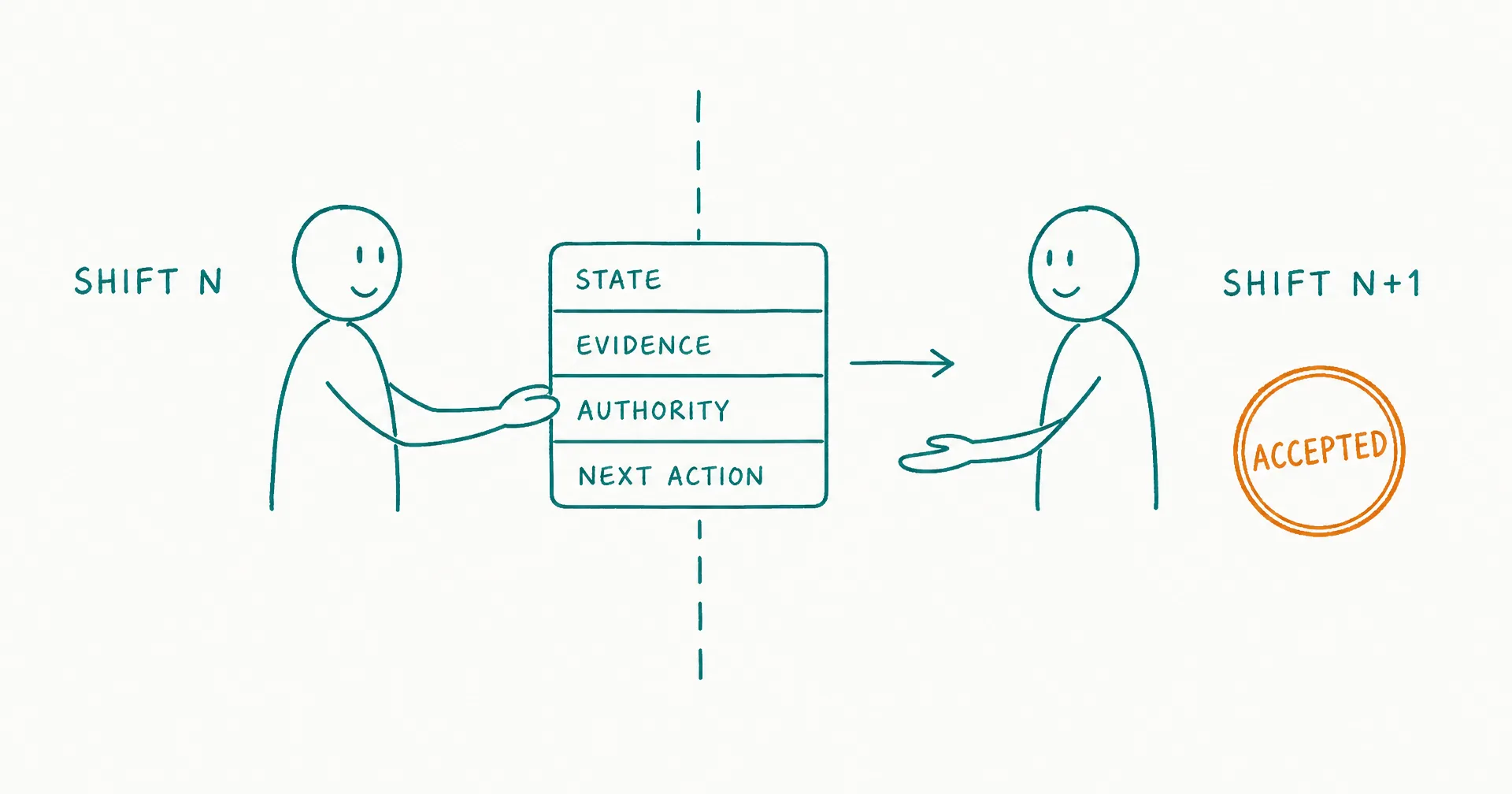
An AI employee handover is a structured transfer of current work state from one shift or owner to the next.
The receiver needs the task identity, goal, current state, completed work, current artifacts, evidence, decisions, unknowns, blockers, active approvals, authority boundary, next action, due time, and acceptance rule.
Do not hand over a transcript and ask the receiver to reconstruct the task. Do not copy an entire memory store into the packet. Do not change ownership until the receiver accepts or the managed transfer policy explicitly assigns it.
A good handover lets the next shift continue from the last verified checkpoint without repeating work, losing evidence, inheriting excess authority, or leaving closure unowned.
On this page · 14 sectionsOpen
- Handover Packet at a Glance
- What Is an AI Employee Handover?
- Start From the Authoritative Task State
- Build the Handover Packet
- Transfer Minimum Necessary Context
- Keep Authority and Ownership Explicit
- Require Receiver Acceptance and Reconciliation
- Handle Exceptions, Rejection, and Incidents
- Close the Transfer Without Leaving Open Loops
- Copyable AI Employee Handover Template
- Test and Measure Handover Quality
- How CellCog Maps to the Handover Model
- Common handover mistakes
- Final Checklist
- Treat a handover as a state transition, not a summary note - and read current task state from the system of record before writing the packet.
- Transfer the minimum high-signal context required for the next action: goal, state, evidence, decisions, unknowns, authority, approvals, blockers, timing, and acceptance.
- Distinguish a same-role shift handover from a cross-role ownership transfer or delegated subtask.
- Require the receiver to accept, reject, or request clarification - silence is not acceptance.
- Revalidate sources, approvals, permissions, and target state when work resumes; the sender’s access never travels with the task.
- Close only after authoritative ownership and receiver state agree, and measure reconciliation defects, duplicate work, and lost open loops.
§ 01Handover Packet at a Glance
| Packet component | Required content | Failure it prevents |
|---|---|---|
| Identity | Handover, task, shift, sender, receiver IDs | Ambiguous transfer |
| Goal | Outcome, purpose, priority, non-goals | Helpful scope drift |
| State | Current status and last verified checkpoint | Repeated or skipped work |
| Completed work | Actions, tool results, validation | Duplicate effort |
| Artifacts | Current IDs, versions, locations, hashes where needed | Wrong-draft use |
| Evidence | Sources, fields, timestamps, tests, provenance | Unsupported continuation |
| Decisions | Decision, owner, rationale, conditions, version | Reopening settled choices |
| Unknowns | Missing, ambiguous, conflicting, stale facts | Confident invention |
| Blockers | Reason, owner, due time, wake condition | Ownerless waiting |
| Authority | Allowed data, tools, actions, limits | Permission inheritance |
| Approvals | Exact action, approver, expiry, use state | Stale authorization |
| Next action | One bounded step and entry conditions | Narrative without route |
| Timing | Deadline, next wake, budget remaining | Late or runaway work |
| Acceptance | Receiver response and ownership rule | Silent transfer |
| Closure | Reconciliation and remaining open loops | Coordination debt |
§ 02What Is an AI Employee Handover?
An AI employee handover is the controlled transfer of operational continuity.
It can occur between shifts of the same standing role; from an AI employee to a human supervisor; from a human back to the AI employee; from one role to another; at a review or approval boundary; during escalation; when a worker pauses or retires; or when an incident moves work to a response owner.
A shift handover is not always an ownership transfer
The same role may retain ownership across shifts. The outgoing run records the current state so the next run can resume.
Example:
- Role owner: research employee
- Outgoing shift: shift/2026-08-06/am
- Incoming shift: shift/2026-08-07/am
- Task owner: remains the research employee
- Handover purpose: checkpoint and continuity
A cross-role handoff changes defined ownership
When ownership moves between agents or roles, use the AI agent handoff protocol. It defines a typed cross-agent envelope, relationship type, sender and receiver identities, scope, authority, acceptance, and closure.
This article focuses on the broader operating discipline for AI Employee shifts and supervisory continuity. The cross-agent protocol is the stricter specialization when task ownership moves to another agent.
Handover is not delegation
In delegation, the parent owner retains the main outcome; the receiving worker owns a bounded child task; the child result returns; the parent validates and integrates it; and the parent remains accountable for closure.
Use the AI agent task-delegation guide when the expected path is a bounded return rather than ownership transfer.
Handover is not memory
The AI employee memory guide defines persisted working, episodic, semantic, and procedural information. Memory can make relevant information retrievable. It does not establish the current task owner, current state, active approval, next action, due time, blocker owner, receiver acceptance, or closure.
Those belong in the task and handover records.
Handover is not a transcript
A transcript contains every exchange in sequence. A handover selects the facts and state required to continue safely.
Anthropic’s context-engineering guidance describes context as finite and emphasizes high-signal information, just-in-time retrieval, and compaction. A handover should preserve recoverability without forcing the receiver to process every prior token.
Define when a handover is required
Require a handover when a shift ends with open work; the next-action owner changes; a task crosses a role or team boundary; review, approval, or specialist judgment becomes necessary; a worker pauses before completion; a lease expires and another worker may take over; a blocker will outlive the current work session; a task moves into or out of incident handling; the role is paused, changed, or retired; or a delegated result returns to the parent owner.
Do not create a handover for every internal step. A handover is useful when continuity, ownership, authority, or acceptance crosses a meaningful boundary.
The trigger should identify the affected task and current owner; the relationship between sender and receiver; the latest safe checkpoint; the deadline for receiver response; who owns work during the transfer; and what happens if the receiver is unavailable.
For routine same-role shifts, the packet can be concise because the role, source hierarchy, and procedures remain stable. For cross-role, high-impact, exceptional, or incident work, require stronger identity, context, authority, approval, and acceptance checks.
Do not wait until the final minute of a shift to discover that required evidence or current artifact versions are missing. Begin reconciliation early enough to repair the packet or place the task in a safe, owned waiting state.
§ 03Start From the Authoritative Task State
The sender should not write the handover from recollection alone.
Read the current task record; active goal and procedure versions; current owner; state and state-entered time; current artifact version; source and evidence registry; decision records; approval objects; tool execution records; dependencies; open exceptions; due and wake times; and incident or pause flags.
The AI employee task-board guide defines the authoritative work states, ownership, waiting reasons, review, acceptance, and closure.
Reconcile before transfer
| Reconciliation check | Required result |
|---|---|
| Task state | Matches last verified business state |
| Owner | Exactly one next-action owner |
| Artifact | Current version identified |
| Evidence | Material claims and decisions have provenance |
| Actions | Proposed, attempted, executed, and verified states differ |
| Approval | Exact action, expiry, and use state are known |
| Blocker | Reason, owner, and wake condition exist |
| Dependency | Required upstream state and artifact are clear |
| Time | Due time and next wake remain valid |
| Budget | Remaining allowance is current |
| Incident | Pause or response state is reflected |
If the sender cannot reconcile the state, the handover should say so explicitly and route the uncertainty. It should not choose the most convenient version.
Separate verified, reported, and inferred
Label:
- Verified: read from the authoritative source.
- Reported: supplied by a person or other worker but not independently checked.
- Inferred: derived from evidence under a named rule.
- Unknown: required fact is absent.
- Conflicting: sources disagree.
- Stale: source is outside its freshness rule.
The receiver should know which facts may support action.
Use stable identifiers
Include the handover ID; task ID; parent or child task IDs; outgoing and incoming shift IDs; sender and receiver IDs; goal and procedure versions; artifact IDs and versions; source IDs; approval IDs; decision IDs; incident ID; and correlation or trace ID.
The W3C Trace Context Recommendation standardizes identifiers that let distributed operations correlate a transaction across system boundaries. A handover does not need to implement that exact standard, but it needs the same property: a reviewer can follow one work object through its transitions.
§ 04Build the Handover Packet
Use one typed packet rather than a free-form note.
Identity and relationship
Record the handover ID; task ID; sender; intended receiver; accountable human; relationship (shift continuation, ownership transfer, review, approval, escalation, incident, or return); ownership before; ownership after acceptance; sender obligations after transfer; and closure owner.
Goal and scope
Include the approved outcome, business purpose, priority, included object and population, non-goals, acceptance criteria, constraints, and stop conditions.
Do not ask the receiver to infer why the work exists from the artifact.
Current state
| State field | Required content |
|---|---|
| Status | Exact board state and reason |
| Last checkpoint | Last verified transition |
| Work complete | Bounded completed actions |
| Work attempted | Attempts and results |
| Work withheld | Actions intentionally not taken |
| Current blocker | Reason and affected step |
| Waiting owner | Actor that owns the next decision or input |
| Next action | One specific bounded step |
| Wake condition | Event or time that permits resumption |
| Terminal condition | What ends this task |
Artifacts and evidence
For every active artifact: stable ID, type, version, location, owner, schema, validation status, replacement chain, sensitivity, retention, and whether it is draft, proposed, approved, executed, or superseded.
For evidence: source ID, field or passage, observed time, authority, applicable version, transformation, supported claim or decision, and unresolved conflict.
Decisions and approvals
| Record | Required fields |
|---|---|
| Decision | Question, result, owner, rationale, evidence, conditions, effective time |
| Approval | Approver, exact action, object, channel, target, limit, expiry, use state |
| Rejection | Decision, reason, prohibited action, correction or route |
| Exception | Type, impact, current owner, safe state, next decision |
Do not collapse approval into “manager said yes.”
Time, cost, and service state
Include the original due time; next review time; next wake time or event; time zone; active schedule window; time spent; budget spent; remaining allowance; attempt count; retry eligibility; and expiry.
Receiver request
End with one of:
- Continue the same role from this checkpoint.
- Accept ownership of the defined scope.
- Review the attached artifact against the named rubric.
- Decide the named approval question.
- Resolve the named exception.
- Acknowledge the handover and keep the task waiting.
“Please take a look” does not define the relationship.
§ 05Transfer Minimum Necessary Context
More context is not automatically safer.
| Context item | Include directly | Reference | Keep behind |
|---|---|---|---|
| Current goal and constraints | Short summary | Full version | Unrelated goals |
| Current task state | Yes | Task record | Superseded states |
| Current artifact | When compact | Stable artifact | Obsolete drafts |
| Governing policy | Key rule | Current source | Unapproved drafts |
| Material evidence | Key facts | Source registry | Unrelated corpus |
| Prior decision | Decision and conditions | Full record | Unrelated discussion |
| Open unknown/conflict | Yes | Supporting records | Resolved noise |
| Complete transcript | Rarely | Event references | Default |
| Role memory | Only task-relevant items | Memory IDs | Unrelated role history |
| Secrets/credentials | No | Authorized system identity | Never paste |
Preserve source authority
The AI employee context-pack guide defines source hierarchy, purpose, freshness, conflicts, unknowns, and retrieval. A handover should reference those controls rather than copy policy into a second unowned version.
Do not transfer unrelated data
Limit customer fields, personal data, internal messages, private notes, browsing history, credentials, tool output, files, and memory.
The receiver should receive only what its role, task, and purpose permit.
Summarize loss visibly
If context was compacted, state what was summarized; what was omitted; where originals live; what decisions depend on the summary; whether the summary was validated; and what the receiver must retrieve before acting.
Treat the handover payload as untrusted input
The OWASP AI Agent Security Cheat Sheet recommends authenticating identities, validating inputs, applying least privilege, and treating external content as untrusted.
The receiver should not let the packet redefine its role; expand access; create approval; bypass policy; suppress validation; change a stop condition; expose unrelated data; or force execution.
§ 06Keep Authority and Ownership Explicit
Task ownership and action authority are separate. A receiver can own the next step but still lack permission to execute a consequential action.
State ownership before and after
| Transfer phase | Task owner | Sender behavior | Receiver behavior |
|---|---|---|---|
| Prepared | Sender | Reconciles and proposes transfer | May inspect |
| Offered | Sender unless policy says otherwise | Holds or continues safe work | Validates packet and capacity |
| Clarification | Sender | Supplies missing information | Does not assume ownership |
| Accepted | Receiver | Stops acting on transferred scope | Becomes accountable |
| Rejected | Sender or routing owner | Reassigns or resolves | Takes no transferred action |
| Closed | Closure owner | Retains required evidence | Confirms remaining loops resolved |
Re-evaluate permission
The AI employee permissions and approvals guide applies again at the boundary.
The receiver acts under its own identity; its own role permission; the task purpose and scope; current policy; the exact approval where required; and the lower of all applicable limits.
The sender’s access does not travel with the task.
Bind approval to immutable intent
Approval should reference the proposed artifact or action hash; target or recipient; object; channel; amount, count, or consequence limit; issue time; expiry; conditions; use state; and revocation.
If the receiver materially changes the action, obtain new approval.
Avoid dual ownership
After acceptance: update the authoritative task owner atomically; record the acceptance; end or narrow the sender lease; notify required parties; prevent both actors from executing; preserve sender support obligations; and revalidate before the receiver acts.
§ 07Require Receiver Acceptance and Reconciliation
Silence is not acceptance.
The receiver should respond: accepted; accepted with conditions; clarification required; rejected for capacity; rejected for scope; rejected for authority; rejected for context; rejected for policy; or misrouted.
Receiver validation
| Check | Receiver question |
|---|---|
| Identity | Are sender, receiver, task, and principal authentic? |
| Relationship | Is this continuation, transfer, review, approval, escalation, or delegation? |
| Scope | Does the task fit this role? |
| Capacity | Can it be owned within WIP, time, and budget limits? |
| State | Does the packet match the system of record? |
| Context | Are required sources current and accessible? |
| Artifact | Is the named version current and valid? |
| Authority | Does the receiver have minimum required permission? |
| Approval | Does authorization cover the exact next action? |
| Risk | Do consequence and data fit the role boundary? |
| Timing | Are deadline and expiry still valid? |
| Completion | Can the receiver prove the required result? |
Accept atomically
Acceptance should:
- Record receiver identity and time.
- Record conditions.
- Update the authoritative owner and state.
- End the outgoing lease where applicable.
- Create the receiver’s next action.
- Preserve the handover version.
- Notify the sender and accountable human as required.
Reconcile at resume
Before continuing:
- Read the current task and target object.
- Compare them with the packet.
- Refresh required sources.
- Recheck approvals and permissions.
- Confirm no newer action or handover superseded it.
- Resume from the last verified checkpoint.
Define acceptance timeout
If no response arrives: keep ownership with the sender; keep the task waiting; route to a managed queue; escalate to the supervisor; expire the transfer; or invoke an approved fallback.
Do not infer acceptance.
§ 08Handle Exceptions, Rejection, and Incidents
A handover can fail safely.
| Defect | Required route |
|---|---|
| Missing task or object ID | Sender corrects packet |
| State conflict | Preserve both records; process owner reconciles |
| Artifact mismatch | Stop and identify current version |
| Missing evidence | Return for evidence or mark unknown |
| Stale policy | Policy owner |
| Permission gap | Supervisor/security owner; no access inheritance |
| Approval mismatch | Approver; no execution |
| Capacity unavailable | Sender or routing owner |
| Out-of-scope task | Correct role or human owner |
| Unsafe content | Security route |
| Incident concern | Incident owner and affected-work pause |
Preserve a safe state
The rejected packet should record the defect, evidence, action withheld, current task owner, next decision owner, correction requested, deadline, expiry, and whether unrelated work may continue.
Limit clarification loops
Define the maximum clarification rounds; required fields per round; deadline; who owns the task while clarifying; fallback; and terminal state.
After the limit, route to a supervisor or fail bounded.
Handle possible side effects
If the sender may have executed an action: preserve the proposed action; preserve the tool response; preserve the idempotency key; read the resulting system state; mark uncertainty if read-back fails; prevent receiver retry; and route to the system owner.
Escalate incidents separately
Microsoft’s responsible AI guidance for agentic systems emphasizes human oversight, accountability, access control, testing, and monitoring.
If a handover reveals possible unauthorized, unsafe, or harmful action:
- Pause affected actions.
- Preserve evidence.
- Move the task into the incident state.
- Notify the incident owner.
- Prevent duplicate execution.
- Await authorized recovery.
§ 09Close the Transfer Without Leaving Open Loops
A handover is not complete when the packet is sent.
| Closure condition | Required proof |
|---|---|
| Delivery | Intended receiver received the packet |
| Validation | Schema and required fields passed |
| Acceptance | Receiver response is recorded |
| Ownership | Authoritative task owner matches acceptance |
| State | Task state and next action are current |
| Lease | Outgoing lease ended or narrowed |
| Authority | Receiver permission and approval were re-evaluated |
| Exceptions | Unresolved issues remain owned |
| Notification | Required parties know the change |
| Retention | Evidence and temporary data follow policy |
Reconcile sender and receiver views
The sender records what it believes transferred, what it retained, what it stopped doing, and any support commitment.
The receiver records what it accepted, conditions, current next action, exceptions, and completion owner.
Differences must become a visible defect.
Close the outgoing shift
The AI employee shifts and schedules guide defines the shift window, end conditions, catch-up, and next wake.
At shift end: checkpoint active work; update the board; write required handovers; end leases; record resource use; route open approvals; preserve incidents; schedule the next valid wake; and stop actions outside the window.
Keep closure distinct from task completion
The handover may close while the task remains open under the receiver. The task closes only when its acceptance and downstream postconditions pass.
§ 10Copyable AI Employee Handover Template
| Field | Entry |
|---|---|
| Handover ID and version | Stable identifier |
| Relationship | Shift continuation, transfer, review, approval, escalation, incident, return |
| Task ID | Authoritative work object |
| Parent/child IDs | Related work |
| Sender | Identity and role |
| Receiver | Intended identity and role |
| Accountable human | Supervisor or owner |
| Goal | Outcome, purpose, priority |
| Scope | Included work, population, non-goals |
| State | Current status and last checkpoint |
| Completed | Verified actions and results |
| Attempted | Attempts, failures, and retries |
| Withheld | Actions intentionally not taken |
| Artifact | Current ID, version, validation |
| Evidence | Sources, timestamps, provenance |
| Decisions | Results, owner, rationale, conditions |
| Unknowns | Missing, ambiguous, conflicting, stale |
| Blocker | Reason, owner, wake condition |
| Dependencies | Task, required state, artifact |
| Authority | Data, tools, actions, limits |
| Approval | Exact action, expiry, use state |
| Next action | One bounded step |
| Timing | Due, wake, time zone, expiry |
| Resources | Time, spend, attempt allowance |
| Stop conditions | Conditions that block continuation |
| Acceptance | Response states and deadline |
| Closure | Owner update, lease, notification, retention |
Receiver response template
| Response field | Entry |
|---|---|
| Handover ID | Matching packet |
| Receiver | Authenticated identity |
| Decision | Accept, accept with conditions, clarify, reject, misroute |
| Scope accepted | Exact work object |
| Conditions | Limits or required changes |
| State confirmed | Task and artifact versions |
| Authority confirmed | Permission and approval result |
| Exceptions | Defects and owners |
| Next action | First bounded step |
| Acceptance time | Timestamp |
| Ownership effective | Timestamp or pending condition |
Shift-continuation example
| Field | Example |
|---|---|
| Relationship | Same-role shift continuation |
| Task | Weekly competitor-change brief |
| State | Waiting for one source; draft v3 otherwise complete |
| Completed | 11 of 12 sources checked; material changes cited |
| Unknown | Source 12 unavailable since 16:20 |
| Authority | Public-source read and internal draft only |
| Next action | Retry source once after 08:00, then apply missing-source rule |
| Wake | Next scheduled shift at 08:00 |
| Completion | All sources checked or missing-source exception accepted |
| Owner | Research employee remains owner |
§ 11Test and Measure Handover Quality
Test normal, missing, conflicting, unsafe, and failure cases.
| Test case | Expected behavior |
|---|---|
| Complete same-role shift packet | Receiver resumes from checkpoint |
| Missing task ID | Rejected for correction |
| Artifact version conflict | No continuation until reconciled |
| Stale approval | Action remains unexecuted |
| Sender has broader access | Receiver does not inherit it |
| Unknown hidden in summary | Evaluation fails |
| Receiver at capacity | Transfer rejected or queued; ownership explicit |
| No receiver response | No silent ownership change |
| Possible prior side effect | Read-back before any retry |
| Malicious instruction in artifact | Isolated from role and authority |
| Incident concern | Pause and incident route |
| Handover replay | No duplicate ownership or action |
OpenAI’s agent-building guide recommends clear actions, guardrails, evaluation, and human intervention. Handover tests should prove those controls survive a boundary between shifts or owners.
Useful measures
Track packet completeness; schema pass rate; acceptance latency; clarification rate; rejection by reason; state-reconciliation defects; artifact-version defects; authority defects; approval defects; duplicate-work rate; duplicate-action rate; lost-open-loop rate; handover-related correction; reopen rate; time to safe resume; and accepted end-to-end outcome.
Do not reward packet volume
More handovers can mean excessive fragmentation, poor task boundaries, insufficient shift length, misrouting, unstable ownership, or unnecessary agent-to-agent chatter.
Measure useful continuation and accepted results.
Review defects at the source
If handovers repeatedly miss:
- current state, fix the board;
- source authority, fix the context pack;
- steps and completion, fix the SOP;
- permission, fix the role matrix;
- approval, fix the authorization flow;
- capacity, fix WIP and routing; or
- artifact versions, fix document control.
NIST’s AI RMF Core calls for documented responsibility, monitoring, measurement, communication, and ongoing risk treatment. A handover defect ledger connects those duties to actual work transitions.
§ 12How CellCog Maps to the Handover Model
CellCog’s public material describes shifts and handovers as part of an AI Employee’s standing operating machinery. It also describes task boards, memory, goals, KPIs, schedules, wake conditions, permissions, approvals, inboxes, and employee-to-employee delegation.
| Handover need | CellCog capability to configure | Organization-owned decision |
|---|---|---|
| Outgoing state | Task board and shift work | Required checkpoint and fields |
| Context | Memory, task context, Context Trees | Minimum sources and provenance |
| Timing | Shifts, schedules, wake conditions | End condition and next wake |
| Authority | Permissions and approvals | Exact data, action, limit, approver |
| Transfer | Handovers and team coordination | Relationship and ownership rule |
| Receiver | AI Employee or accountable human | Capacity and acceptance |
| Measurement | KPIs and dashboards | Defect and accepted-outcome formulas |
| Delegation | Other AI Employees | Parent, child, return, and closure |
The CellCog AI Employees page is the product entry point. Verify the current interface and APIs against required handover fields, sender and receiver identities, task versions, acceptance states, permission checks, audit records, retention, and exports.
Users set the employee’s goals, schedule, permissions, and connected accounts, and remain responsible for monitoring its work and the actions it takes on their behalf.
Use the platform handover as a checkpoint, not policy
The organization still defines what must be included; which source governs state; who may receive it; whether ownership moves; what authority remains valid; how acceptance works; how defects route; when the handover closes; and what is retained or deleted.
§ 13Common handover mistakes
Sending a narrative without structured state
A readable summary cannot drive ownership, approval expiry, or recovery by itself.
Copying all memory
Transfer minimum relevant context and preserve references to owned sources.
Treating delivery as acceptance
The receiver must accept, reject, or request clarification.
Letting permission travel with the task
The receiver uses its own identity and the lower applicable authority boundary.
Hiding uncertainty
Missing, conflicting, ambiguous, and stale facts should be explicit.
Closing the sender before ownership reconciles
Keep a safe owner until acceptance and authoritative task state agree.
Rewriting settled decisions without a change record
Preserve the decision, owner, rationale, evidence, conditions, and supersession.
§ 14Final Checklist
Before closing an AI employee handover, confirm:
- The packet identifies the task, shifts, sender, receiver, and relationship.
- The goal, scope, non-goals, and acceptance are current.
- Task state matches the last verified business state.
- Completed, attempted, executed, verified, and withheld actions are distinct.
- Current artifacts and evidence have stable IDs and versions.
- Decisions preserve owner, rationale, evidence, conditions, and effective time.
- Unknown, ambiguous, conflicting, and stale facts are visible.
- Every blocker has an owner and wake condition.
- The receiver does not inherit the sender’s permission.
- Approval covers the exact next action and remains valid.
- Time, budget, retries, and expiry are current.
- The receiver accepted, rejected, or requested clarification explicitly.
- Authoritative ownership changes atomically after acceptance.
- The receiver revalidates state before continuing.
- Unresolved exceptions and incidents remain owned.
- Sender and receiver views reconcile before closure.
If these conditions are true, the handover carries enough context to continue without carrying the coordination debt of the entire history.
Start with one typed packet and one receiver-response contract. Test missing state, version conflict, stale approval, capacity rejection, replay, possible side effects, and incident routing before relying on handovers between shifts or roles in a CellCog AI Organization.
Q1What should be included in an AI employee handover?
Include task identity, relationship, goal, scope, current state, completed and attempted work, artifacts, evidence, decisions, unknowns, blockers, dependencies, authority, approvals, next action, timing, resources, stop conditions, acceptance, and closure.
Q2Is an AI employee handover the same as memory?
No. Memory makes approved information persistent and retrievable. A handover states current work ownership, state, active evidence, next action, approval, exception, timing, and receiver acceptance.
Q3Does a handover transfer task ownership automatically?
Not necessarily. A same-role shift handover can preserve ownership. A cross-role transfer should change ownership only after receiver acceptance or under an explicit managed assignment policy. The packet must state the relationship.
Q4How much context should an AI employee hand over?
Transfer the minimum high-signal context required for the receiver’s responsibility. Include current state and material evidence directly, reference larger authoritative sources, and keep unrelated transcripts, memory, personal data, and credentials behind.
Q5What happens if the receiving AI employee rejects the handover?
The task remains with the sender or named routing owner. Record the defect, safe state, correction requested, next decision owner, deadline, and expiry. Do not let both workers act.
Q6When is an AI employee handover complete?
It is complete when the receiver has validated and accepted the defined scope, authoritative ownership and task state match the decision, outgoing leases are ended or narrowed, exceptions remain owned, required parties are notified, and retention rules are applied.