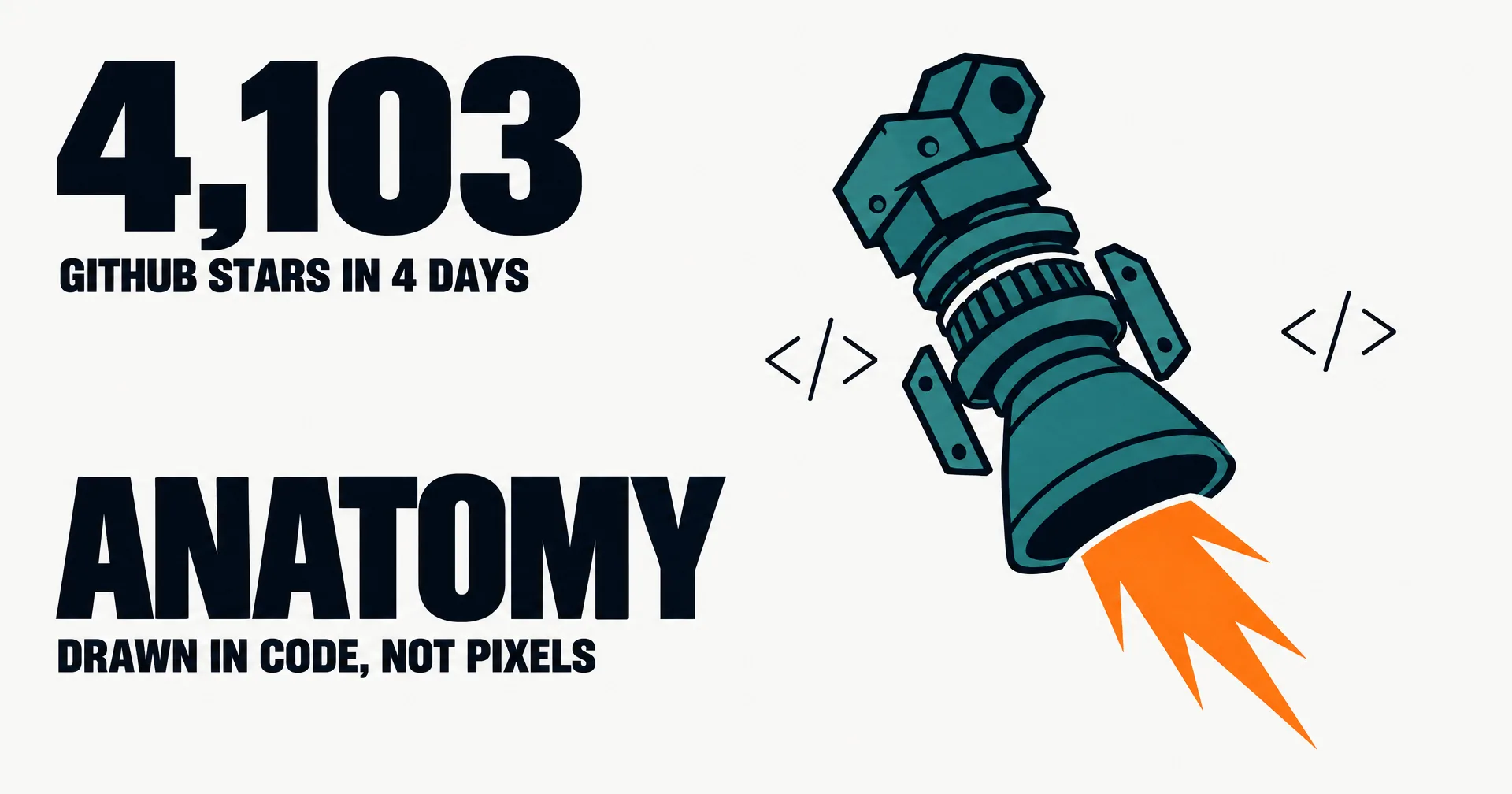
Anatomy is an open-source Claude skill that turns a one-line prompt into an interactive drawing of a machine: an isometric figure you can rotate, take apart and watch run, built entirely in code. Its author, Ryan (@wheresryan22), introduced it on October 10, 2026 with “Describe a machine in one line. Claude brings it to life.” That post had 1,396,709 views and 19,286 bookmarks when we read it at 07:03 UTC on October 12, and the GitHub repository held 4,103 stars and 323 forks four days after it was created.
The same weekend, posts claiming “CLAUDE CAN FINALLY GENERATE IMAGES” passed 900,000 views. That claim is wrong in the way that matters, and Anatomy shows why. Here is what the skill does, what it needs, and what Claude is and is not doing.
On this page · 7 sectionsOpen
 Anatomy is an open-source Claude skill that turns a one-line prompt into an interactive isometric drawing of a machine you can rotate, take apart and watch run.
 Ryan introduced it on October 10, 2026; the post had 1.4 million views and the GitHub repository 4,103 stars and 323 forks by October 12.
 It draws three kinds of figure: SVG, SVG with a WebGL shader layer for fire and water, and a beta 3D mode where parts turn in true 3D.
 The figures are code (SVG, HTML and WebGL) rendered by a browser. Anthropic’s release notes list no image-generation feature for Claude.
 It installs with one npx command, runs in Claude Code, OpenCode and Codex, needs Node.js 20.10+ and Chrome, and is MIT licensed.
 Its README says it is slow on purpose and not a chart library, and it draws machines, not people or exact maps.
§ 01What Anatomy makes
Its README calls it “A Claude skill that explains an idea by building it as a real, working object.” It draws three kinds of figure from one shared kit:
| Kind | What it is | Examples in the repo |
|---|---|---|
| SVG | Solid isometric parts with four-tone shading, painted back to front, in a card with a live readout and eased motion; ships as an HTML page, a single SVG file or React components | dial-indicator, desk-computer, arcade-cabinet, test-rig |
| SVG + WebGL | A shader layer for fire, exhaust, water, light and steam, drawn inside the figure’s own isometric camera; the SVG still reads without WebGL | raptor-engine, ripple-tank |
| 3D (beta) | Parts that turn in true 3D, re-projected and re-shaded every frame while the rest of the figure stays static | turning-dial |
The workflow inside the skill is closer to engineering drawing than to image generation. Claude collects the true numbers first, writes a parts list, builds the geometry with the kit, paints it back to front, then checks it. An audit script proves that nothing passes through anything and every part sits on a mount.
It installs as a standard agent skill: npx skills add wheresryan22/anatomy -g -a claude-code, then /anatomy explain how a token bucket rate limiter works, interactive. It also runs in OpenCode and Codex. It needs Node.js 20.10 or later and Chrome for the checks, and nothing else to install. The license is MIT.
§ 02Can Claude generate images now?
Not in the sense the viral posts mean. Claude writes text, and code is text. What Anatomy produces is SVG, HTML and WebGL code that a browser renders into a picture. No pixels come out of the model.
| Claim | Status |
|---|---|
| Claude can now generate images | Not in Anthropic’s sense: the Claude Platform release notes, read October 12, list no image-generation feature |
| Claude can draw detailed, interactive figures | Yes, as code: Anatomy and similar skills write SVG and WebGL that a browser renders |
| The figures come from a new Claude model | Not established: a “Claude Next Model” post showed outputs but named no model, and Anthropic has announced none |
| Anatomy is open source and free | Confirmed: MIT license, no API keys, no dependencies to install |
The distinction is not pedantic. A drawing made of code is editable, inspectable and exact: every part has a size, and the README says the geometry is audited. It is also bounded. The skill draws machines, instruments, tools and furniture, “Not people or exact maps.”
§ 03The limits, in the author’s words
The README is unusually honest about cost and scope:
- “It is not a chart library.” There are no axes or data plots; numbers appear only as live readouts and as the true sizes of parts.
- “It is slow on purpose.” A figure takes a long session, a Raptor engine build takes a few minutes, and a full 3D orbit audit takes 15 to 20 minutes for 30 parts.
- The 3D mode is beta, proved on its example and one test figure. A small 3D figure runs at 60 fps; a 380-part stress test measured about 20 fps.
§ 04Where CellCog sits
Our conflict, declared: we build CellCog, where businesses hire AI employees, and every CellCog tier runs on Claude Opus 5.5. That is the overlap; we did not build or test Anatomy. Agent skills like this one are part of what makes a capable model useful in real work, the subject of our Claude Code skills explainer.
§ 05What we are watching
- Whether Anthropic ships native image generation in Claude, which would change the grading above.
- Anatomy’s 3D mode leaving beta, and figures beyond machines.
- Similar code-drawing skills for charts and maps.
§ 06Update log
- October 12, 2026: page opened.
§ 07Sources
- Ryan, Anatomy repository and README, created October 8, 2026, read via the GitHub API October 12, 2026, 07:03 UTC; project site.
- Ryan on X, October 10, 2026; Mr Tactical on X and Chetaslua on X, October 11, 2026; views read October 12.
- Anthropic, Claude Platform release notes, read October 12, 2026.
- Anthropic, Claude Code skills.
Q1Who made Anatomy?
Ryan (@wheresryan22), who published it on GitHub on October 8, 2026 and introduced it on X on October 10.
Q2Is Anatomy free?
Yes. It is MIT licensed, needs no API keys, and its kit uses only Node’s built-in modules.
Q3Does Anatomy work outside Claude Code?
Yes. It follows the open Agent Skills format, so OpenCode and Codex load it too; in Codex you type $anatomy.
Q4What can't Anatomy draw?
Its README says it is not a chart library and draws machines, instruments, tools and furniture, not people or exact maps.
Q5Does CellCog use Anatomy?
No. Every CellCog tier runs on Claude Opus 5.5, the overlap we claim; we did not build or test Anatomy.