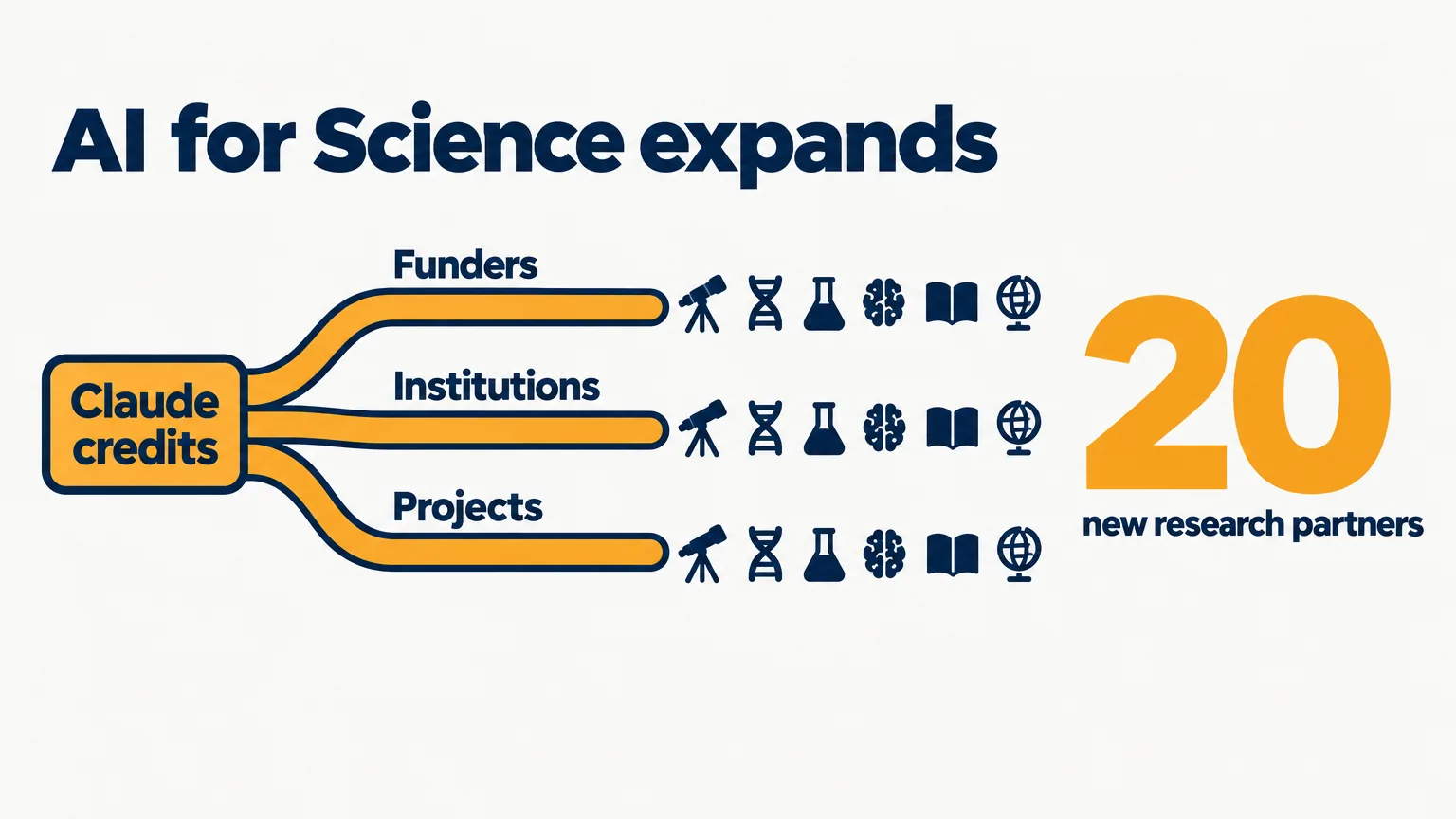
Anthropic is giving free Claude credits to 20 science foundations, institutes and research projects, an expansion of the AI for Science program it started in May 2025. Its announcement on October 28, 2026 describes a program “which gives free Claude credits to researchers working on high-impact scientific projects,” and names the new partners in three groups: funders that pass credits on, institutions that use them in-house, and projects that receive them directly.
The change is one of reach. “AI for Science began by supporting individual scientists,” the post says; partners now let it “reach more researchers across many fields.” It does not say how many credits any partner receives.
On this page · 8 sectionsOpen
 On October 28, 2026, Anthropic expanded its AI for Science program to 20 foundations, institutions and research projects, all receiving free Claude credits.
 Six funders, including the Sloan and Simons foundations and the US National Science Foundation, will pass credits on to researchers they fund.
 Six institutions, including the Space Telescope Science Institute, the Wellcome Sanger Institute and EMBL, will use the credits in-house.
 Six projects get credits directly, among them gnomAD, FlyWire and the Lean mathematics library Tau Ceti.
 Anthropic does not disclose how many credits any partner receives.
 The program sits beside the Team plan for scientists: Standard seats free and Premium seats $15 a month for 12 months.
§ 01Three ways the credits reach researchers

| Group | How the credits are used | Partners named |
|---|---|---|
| Science funders and societies | Passed on to researchers they fund | Alfred P. Sloan Foundation, Simons Foundation, Schmidt Sciences, Open Source for Science Fund (Renaissance Philanthropy), US National Science Foundation, CAS (American Chemical Society) |
| Institutions | Used inside the organization | Space Telescope Science Institute, Wellcome Sanger Institute, Francis Crick Institute, Imperial College London Department of Life Sciences, EMBL, Gladstone Institutes |
| Research projects | Given to the project directly | FlyWire (Princeton), LEAP (Columbia), AstroPath (Johns Hopkins), gnomAD (Broad Institute), Tau Ceti (Lean mathematics), Centre for Population Genomics (Garvan Institute and Murdoch Children’s) |
The three lists hold 18 organizations; the post also names two earlier collaborators, HHMI Janelia Research Campus and the Allen Institute, which brings the count to the 20 in its opening line.
The funders carry the widest reach. The National Science Foundation alone accounts “for about 25% of federal support for basic research at US colleges and universities,” per the post, so credits routed through it can land in labs Anthropic never deals with. The institutions span astronomy (STScI runs science operations for Hubble, Webb and Roman) and genomics (Sanger, EMBL). The projects lean toward open data: gnomAD “pools DNA data from over 800,000 people into an open reference of human genetic variation,” and Tau Ceti is building a library of mathematics in Lean, “a language that lets computers check every proof.”
§ 02From single grants to institutions

The expansion is the latest step in a science program that has grown on a steady cadence:
| Date | Program | What it offers |
|---|---|---|
| May 5, 2025 | AI for Science launch | Free API credits for researchers on high-impact projects, first focused on biology and life sciences |
| July 20, 2026 | Rare disease call | Grants of up to $50,000 in Claude usage credits |
| August 27, 2026 | Claude Team plan for scientists | Standard seats free and Premium seats $15 a month for 12 months, for up to 10,000 scientists |
| August 27, 2026 | Model Hardware Standard preview | A shared specification for AI agents to operate lab instruments, begun with HHMI Janelia |
| October 28, 2026 | Institutional expansion | Credits for 20 funders, institutions and research projects |
The Team plan is the one with published prices. On its program page, verified principal investigators at universities and nonprofit institutes get Standard seats free and Premium seats at $15 a month, against regular prices of $20 and $100, for groups of 1 to 25 seats:
The Model Hardware Standard, opened as a research preview on August 27, is the piece that moves Claude from analysis to instruments: it lets agents run “microscopes, liquid handlers, and robotic arms, in parallel,” and Anthropic says it cuts integration work “to hours or minutes.”
§ 03What the partners are expected to produce
Anthropic frames the credits as seed money for shared tools: the projects “will also produce public goods that benefit the wider scientific community: open datasets, open-source software, open standards, and shared libraries.” It also cites one result from the earlier partners: the Allen Institute is building teams of AI agents to analyze its data, “turning months of manual analysis into hours.” That figure is Anthropic’s, with no published study behind it in the post.
The post is plain that this is early: “Many of these collaborations are still in their early stages.” Our record of Claude in drug development covers the first results Anthropic has published from the science side.
§ 04Two labs, two credit programs, one day
Hours earlier on the same day, OpenAI began giving ChatGPT Pro and Business subscribers up to $500 a month in API credits. The two programs point in different directions. OpenAI’s goes to every paying subscriber on a published schedule; Anthropic’s goes through selected funders and institutions, with no amounts disclosed. Both buy future API usage from the people most likely to build on it.
§ 05What we are watching for
- Credit amounts per partner, which the post does not give.
- The first open datasets or tools the projects publish with Claude.
- The Model Hardware Standard leaving research preview; Anthropic has said it plans to open-source it.
- More partners: “We hope to expand these efforts to even more partners around the world.”
§ 06The record
As of October 28, 2026: Anthropic’s AI for Science program gives Claude credits to six funders, six institutions and six research projects, plus earlier work with HHMI Janelia and the Allen Institute. Amounts are not disclosed. The Team plan for scientists remains the program’s published-price entry point.
§ 07Update log
- October 29, 2026, 01:12 UTC: added two animated scenes, the three credit routes and the program timeline.
- October 29, 2026, 01:04 UTC: published from Anthropic’s announcement and program pages.
§ 08Sources
- Anthropic, AI for Science expands to foundations and research institutions, October 28, 2026.
- Anthropic, Introducing Anthropic’s AI for Science Program, May 5, 2025.
- Claude, Team plan for scientists, read October 29, 2026.
- Anthropic, Previewing the Model Hardware Standard, August 27, 2026.
- Anthropic on X, rare disease grants, July 20, 2026.
- Claude on X, Team plan for scientists launch, August 27, 2026.
Q1What is Anthropic's AI for Science program?
A program started in May 2025 that gives free Claude API credits to researchers on high-impact scientific projects. It now also reaches researchers through partner funders and institutions.
Q2Which organizations joined on October 28, 2026?
Six funders (Sloan, Simons, Schmidt Sciences, Open Source for Science Fund, the NSF and CAS), six institutions (STScI, Sanger, Crick, Imperial life sciences, EMBL, Gladstone) and six projects (FlyWire, LEAP, AstroPath, gnomAD, Tau Ceti, Centre for Population Genomics).
Q3Can an individual researcher still apply?
Yes. Researchers at research institutions can apply through Anthropic’s AI for Science application form, and principal investigators can sign up for the Claude Team plan for scientists.
Q4What is the Model Hardware Standard?
A shared specification, in research preview since August 27, 2026, that lets AI agents operate lab instruments such as microscopes and robotic arms. Anthropic began it with HHMI Janelia.
Q5How does this compare with OpenAI's API credits?
On the same day OpenAI began giving ChatGPT Pro and Business subscribers up to $500 a month in API credits on a published schedule. Anthropic routes its credits through selected partners and has not published amounts.