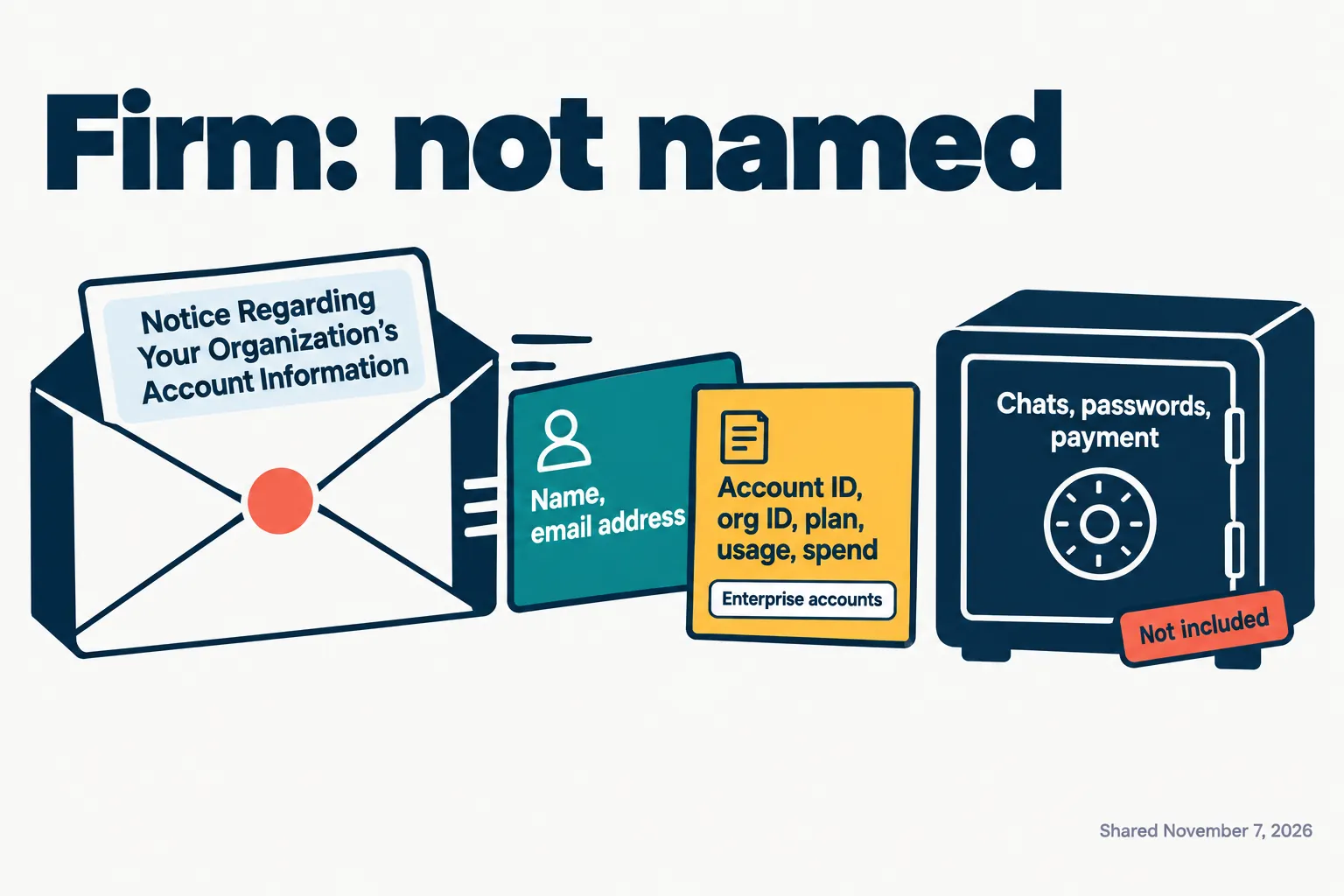
Anthropic is emailing organizations that use Claude to say an outside security firm reached some of their data without permission. The email, titled “Notice Regarding Your Organization’s Account Information” and sent from no-reply@email.claude.com, began circulating on November 7, 2026, when security researcher Jamieson O’Reilly posted three screenshots of it on X.
It says “limited information may have been subject to unauthorized access by a third-party cybersecurity research company.” It names no firm and no system. Below: exactly what the notice says, what it leaves out, how it lines up with the Cathedral access Anthropic described in October, and what to do if you received it.
On this page · 8 sectionsOpen
 Anthropic began emailing organizations that use Claude about unauthorized access by an unnamed third-party cybersecurity research company; the notice spread on November 7, 2026.
 Everyone notified had contact details involved; enterprise Claude accounts also had account ID, organization ID, plan tier, usage and spend metrics.
 Conversations with Claude, passwords and payment card or bank details were not included, the notice says.
 The notice names no firm, no system, no date and no count. What it describes matches the Cathedral access Anthropic described to the Washington Post in October.
 Recipients should expect phishing that knows their plan or spend, and send questions to privacy@anthropic.com.
§ 01What the notice says

| What the notice lists | |
|---|---|
| Everyone who received it | Contact information, such as name and email address |
| Organizations with enterprise Claude accounts | Account ID, organization ID, plan tier, usage and spend metrics |
| Not included | Content of conversations with Claude, passwords, payment card or bank account details |
| Who viewed what | “We cannot confirm whether any particular person’s information was viewed” |
| The accessed data now | “The cybersecurity firm has certified in writing that it has deleted the accessed data and will not use it” |
| Regulators | Anthropic “reported this incident to the relevant Korean authorities” |
| Contact | privacy@anthropic.com |
On its response, the notice says Anthropic “timely disabled access by the third party”, fixed the vulnerabilities it found and opened an investigation, and that it has found no evidence the data was altered, deleted or misused. It frames the email as sent “out of an abundance of caution should you wish to notify individuals in your organization.”
§ 02What it leaves out
- The firm. The notice says a “third-party cybersecurity research company” and nothing more.
- The systems. It does not say which software held the data or how the firm got in.
- When. No date for the access, the discovery or the shutdown.
- How many. No count of organizations or people notified. O’Reilly wrote that he had “seen at-least two others on X.”
- Why Korea. It names no Korean authority and does not say whether any other regulator was told.
We found no public post, status-page entry or spokesperson comment from Anthropic about the notice as of 01:50 UTC November 8, 2026.
§ 03Is this the Cathedral access?
Almost certainly the same event, though the notice does not say so. On October 26, the Washington Post reported that Cathedral, a security startup founded by former DOGE staffers, had reached Anthropic’s internal sales, HR and IT systems through outside business software. Anthropic told the Post the access covered business contact details for some customers and partners and basic user account records, and said: “Our monitoring flagged some of Cathedral’s activity before they reported it to us, and we shut off their access the same day.” The data the notice lists matches that description, and Anthropic has not disclosed any other access of this kind. Our record of the Cathedral access carries the full October account.
| Anthropic to the Washington Post, October 26 | Customer notice, November 7 | |
|---|---|---|
| Who | Cathedral, testing under Anthropic’s bug bounty | A third-party cybersecurity research company, not named |
| Authorization | Did not disclose all of its activity | Acted “on its own initiative and without our authorisation”, as quoted by a recipient |
| Data | Business contacts for some customers and partners, basic account records | Contact details; account ID, organization ID, plan, usage and spend for enterprise accounts |
| Not reached | Claude conversations, code, model weights | Conversations, passwords, payment details |
| Response | Access shut off the same day | Access disabled, vulnerabilities fixed, investigation opened, Korean authorities told |
The framing moved. In October the dispute was about a researcher who overstepped a bug bounty. The notice, as O’Reilly quotes it, calls it a “security testing exercise on its own initiative and without our authorisation.”
§ 04Why recipients are unhappy
O’Reilly, who runs a security firm and says he has spent over $50,000 on Anthropic API credits in six months, objected to the two lines that pull against each other: the company “cannot confirm whether any particular person’s information was viewed,” yet says “we have no reason to believe you are at heightened risk.” On the deletion promise he wrote: “Translation - they pinky promised they deleted everything they gained unauthorised access to.” He closed: “I’m getting deeply unserious security vibes and considering moving all my (and my clients) token spend to @OpenAI if I don’t see material change here.”
The criticism is about the email, not the size of the exposure. Names, emails and account metadata are not chats or keys. But an enterprise customer’s plan tier and spend, paired with a contact’s name, are useful to anyone writing a convincing fake invoice.
§ 05What to do if you received it
- Expect phishing that knows your plan. Treat any email about your Anthropic plan, billing or account with care for a while, and check payment requests in the Claude console, not through a link.
- Tell the people listed. The notice is written so you can pass it on to the contacts whose names and emails sat in Anthropic’s records.
- Ask what you need. Questions go to privacy@anthropic.com, the address the notice gives, including which of your contacts were in the data and when the access happened.
- Nothing to rotate for this one. The notice says passwords and payment details were not involved, so no credential change is called for by this notice alone.
§ 06Where CellCog sits
Our conflict, declared: every CellCog tier runs on Claude Opus 5.5, so Anthropic is our model provider. We also connect AI employees to outside apps for a living, so a vendor’s business software being the way in is the case we design for.
§ 07What we are watching
- An Anthropic statement naming the firm, the systems and the dates.
- Korea. Which authority received the report, and whether it publishes anything.
- A second wave of notices to individual users rather than organizations.
§ 08Sources
- Jamieson O’Reilly on X, November 7, 2026, 10:50 UTC, with three screenshots of the notice.
- Ryan Merket, RuntimeWire, Anthropic notifies customers after unnamed security firm accessed internal systems, November 7, 2026.
- r/ClaudeAI, Did Anthropic get hacked?, November 7, 2026.
- Elizabeth Dwoskin and Gerrit De Vynck, The Washington Post, It took just 12 hours for an AI start-up founded by ex-DOGE staffers to break into Anthropic, October 26, 2026.
Q1Was this Cathedral?
The notice does not say. What it describes matches the Cathedral access Anthropic told the Washington Post about on October 26, and Anthropic has disclosed no other access of this kind.
Q2Were Claude conversations exposed?
No, according to the notice. It says the content of conversations with Claude, passwords, and payment card or bank account information were not included.
Q3Why Korean authorities?
The notice says Anthropic reported the incident to the relevant Korean authorities but does not name the authority or explain why, and does not mention other regulators.
Q4Do I need to change my password?
The notice says passwords were not involved, so it calls for no credential change on its own. The real risk is targeted phishing.
Q5Has Anthropic said anything publicly?
Not that we found as of 01:50 UTC November 8, 2026: no post, status-page entry or spokesperson comment about the notice.