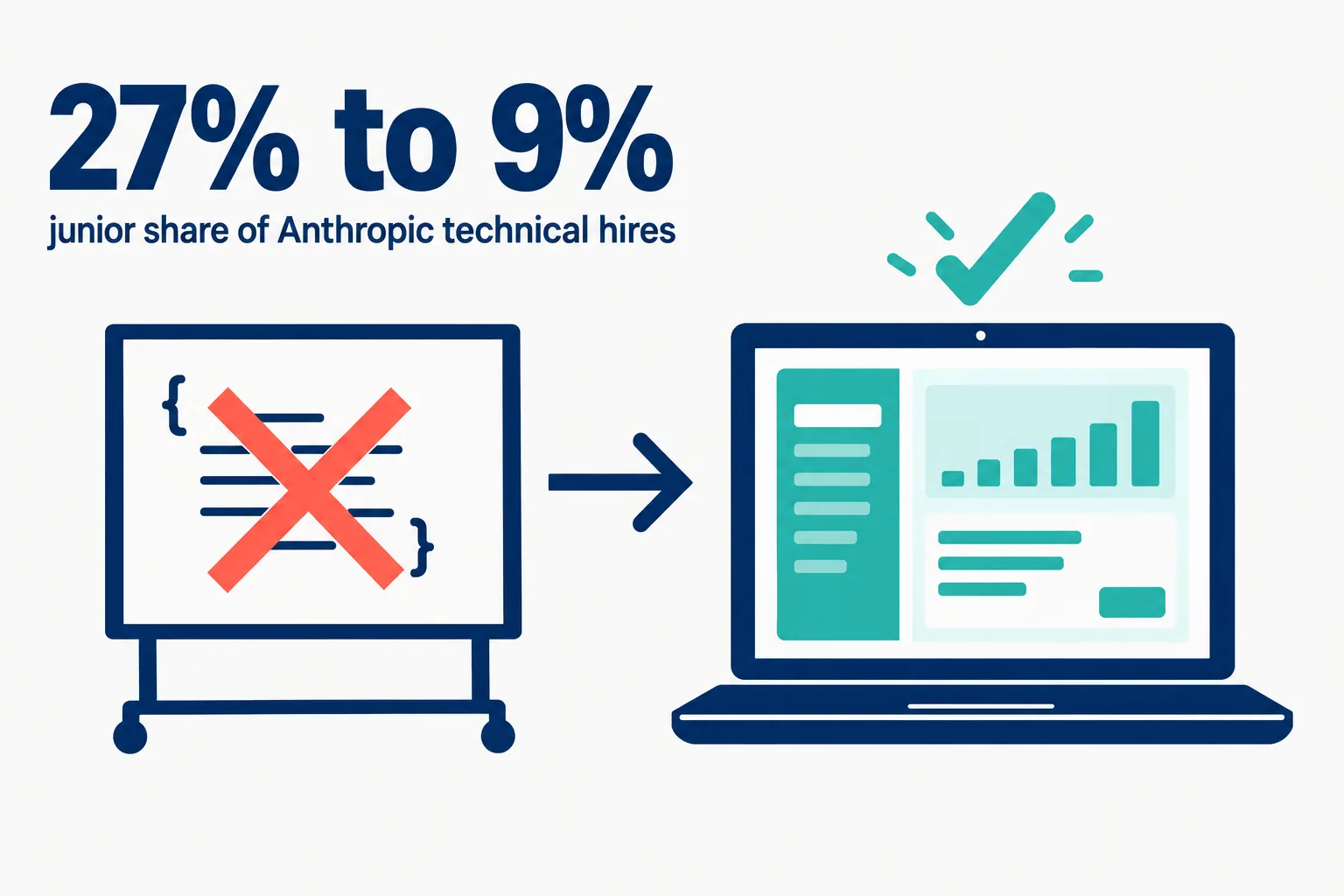
Felix Rieseberg, an engineering manager at Anthropic, said on October 27, 2026 that he has dropped the coding interview for his team. “The coding interview is dead, at least for my team at Anthropic,” he posted on X, adding that “it no longer provides signal.” His reason is Claude: a small coding challenge now measures what the model can do, not what the candidate will do on the job.
The post links his essay, Hunger beats tenure: Advice for junior engineers, which opens: “This month, I laid the traditional coding interview to rest.” It is one team’s hiring loop, not a company policy, and it lands eleven days after Anthropic published data showing how few junior engineers it now hires.
 Felix Rieseberg, an engineering manager at Anthropic, posted on October 27, 2026 that he removed the coding interview from his team’s hiring loops this month.
 His reason: the test no longer gives signal, because Claude is now better than candidates at small coding challenges.
 He now looks for small prototypes in resumes and portfolios that show taste, empathy and principled thinking.
 Anthropic’s own October 16 report found the junior share of its technical hires fell from 27% to 9% since early 2025.
 It is one team, not company policy: Anthropic’s careers page still says technical roles use live coding tools.
§ 01What he changed, and why

Rieseberg has led engineering for Claude.ai, Cowork and Claude Code Desktop. He writes that small coding challenges in real code used to be “a weak but useful predictor” of success on his teams. Now: “There’s no more point in giving you a little React challenge than there is in quizzing people about assembly; Claude is now better at both.”
What replaces it is still open. “I’m scanning resumes and portfolios for little prototypes that exhibit taste, empathy, and principled thinking,” he writes, and asks other managers who have found something better to tell him. His own example is Claude Code’s desktop app: two relatively new engineers, Anthony Morris and Alice Zhao, built a working prototype over one weekend, and “The first public version shipped roughly eight days later.”
| Item | Status | Source |
|---|---|---|
| Coding interview on Rieseberg’s team | Removed this month | His essay and X post, Oct 27 |
| What he screens for | Prototypes showing taste, empathy, principled thinking | His essay |
| Anthropic’s company careers page | Still lists live coding tools for technical roles | anthropic.com/careers |
| Junior share of Anthropic technical hires | Down from 27% to 9% since early 2025 | Anthropic report, Oct 16 |
§ 02The numbers behind the shift
Anthropic’s own report on employment at Anthropic, published October 16, 2026, found that “relative hiring in junior technical positions has slowed” even as the company grows. “The proportion of junior technical hires fell even faster, from 27% to 9%.”
Rieseberg reads the same trend the other way. “Plenty of ink has been spilled to describe how AI is a challenge for junior developers,” he writes, but “I’m seeing engineers who are comparatively new fly past people who are probably better coders and have been around much longer.” His summary: “Hunger beats tenure.”
§ 03His advice to junior engineers
The argument rests on one line: “Well, good news: Execution isn’t expensive anymore.” If a working prototype costs a weekend, a newcomer no longer has to earn status before the organization takes a bet on an idea. His five steps:
- Pick business impact over backlog: learn what your manager’s manager is trying to achieve.
- Pick a radical idea that would change the odds of reaching those goals.
- Build it over a weekend instead of writing a requirements document.
- Focus on one good idea per prototype, not three good ones hidden among twenty.
- Lean into a fresh perspective: newcomers see friction that old-timers stopped noticing.
§ 04What it means for hiring
The live interview is not gone at Anthropic as a whole. Its careers page still says: “For technical roles, we use live coding tools like Colab and CodeSignal.” What has moved is the signal one manager trusts, from solving a puzzle to building something worth using. That matches what we see running AI employees: the code is the cheap part, and the judgment about what to build is the part people still own. We covered a related Anthropic finding in this record.
§ 05What to watch
- Whether other Anthropic teams, or the company’s careers page, drop the coding round.
- What Rieseberg lands on as a replacement; he says he has not “quite gotten there yet.”
- Anthropic’s next employment report and whether junior hiring keeps falling.
- Other large AI labs publishing a similar change to their loops.
Q1Who is Felix Rieseberg?
An engineering manager at Anthropic who has led engineering for Claude.ai, Cowork and Claude Code Desktop. He co-maintains Electron and previously worked at Notion, Stripe, Slack and Microsoft.
Q2Where did he say it?
In an X post on October 27, 2026 at 21:56 UTC, linking his essay Hunger beats tenure: Advice for junior engineers, published the same day.
Q3Why does he think juniors benefit?
He argues impact is less bounded by years of framework knowledge now that execution is cheap, and that newcomers spot friction old-timers stopped noticing.
Q4What is his advice?
Pick business impact over backlog, pick a radical idea, build it over a weekend, focus on one good idea per prototype, and lean into a fresh perspective.
Q5What do Anthropic's numbers say?
Its October 16, 2026 employment report found junior technical hires fell from 27% to 9% of the total and the junior share of technical staff from 21% to 14% since early 2025.