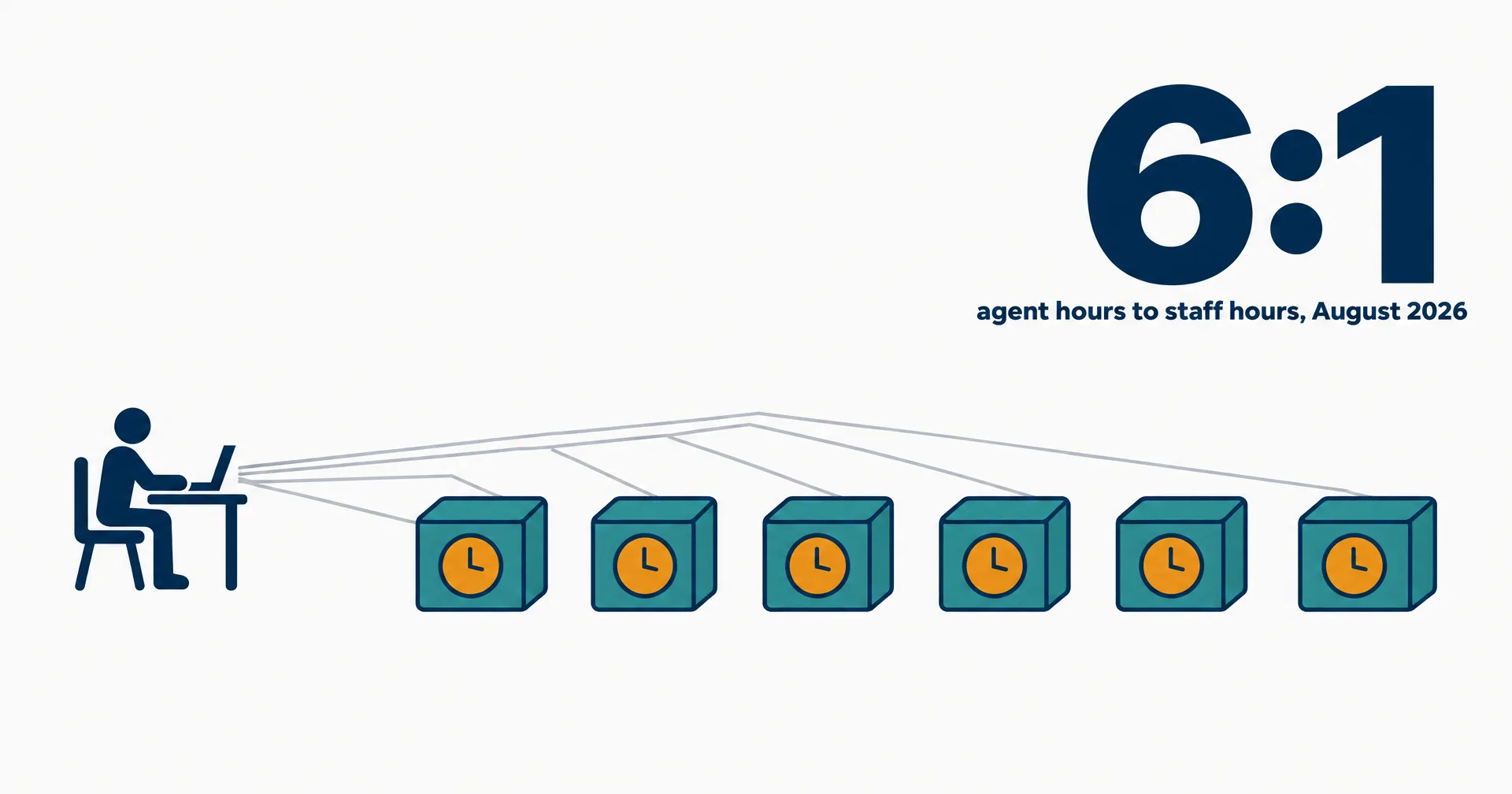
Anthropic published two reports on October 16, 2026 that measure what happened to its own workforce as Claude agents spread through the company. By August, the agents its employees direct logged six times as many working hours as the employees themselves. The share of junior technical hires fell from 27% to 9%, output per person rose in engineering, sales and legal, and the scarce resource became human attention.
The first report, How employment is changing at Anthropic, by Nathan Wilmers, Regina Catipon, Maxim Massenkoff and Peter McCrory, draws on internal employment, agent telemetry, calendar, survey and hiring records, plus 17 employee interviews. The second, The AI expectations gap, compares what Anthropic staff and a nationally representative sample of US adults, both surveyed in August 2026, expect AI to do by 2030. Anthropic introduced both in a short companion post. The figures are Anthropic’s own internal numbers and have not been independently audited.
@figure anth-agent-hours.svg | Agent hours passed staff hours in March 2026 and reached 6 times by August | Animation: a staff hours bar and an agent hours bar; the agent bar grows past the staff bar in March 2026 and reaches exactly 6 times its length by August 2026
On this page · 7 sectionsOpen
 Anthropic published two reports on October 16, 2026 measuring its own workforce: by August, the agents employees direct logged 6 times their human hours.
 The junior share of technical hires fell from 27% to 9%, and the junior share of technical staff from 21% to 14%, while the company tripled in size.
 Code commits per engineer are 5 times their pace of six months earlier, and agent-written code was reverted no more often than hand-written code.
 Agents spend about 80% of interactive session time waiting for a person; reading their output would fill over half a work week.
 Meta-work, building tools to steer and check agents, rose from 10% to 22% of interactive Claude sessions; standing instructions reached 8,500.
 91% of Anthropic staff but 39% of US adults expect AI to make a Nobel-level discovery by 2030.
§ 01Agents now log more hours than people
Based on agent session telemetry, the sum of autonomous and interactive agent work hours passed human work hours for the first time in March 2026. Counting only the interactive agents individual employees direct, with subagents pooled, agents worked six times as many hours as their human handlers by August. Agent time is runtime including inference and tool use, excluding any wait longer than 30 minutes; human hours are headcount times 40 a week.
Output moved with it. Code commits per engineer are 5x their pace of six months earlier, and lawyers processed more contracts, accounts payable cleared more invoices and salespeople closed more deals. To separate AI from the company’s own boom, the researchers followed 192 engineers who adopted coding agents against 74 who had not yet, and the adopters’ added code rose sharply after adoption. Agent-written code was removed or reverted no more often than code the same person wrote by hand, in the same month and directory. Anthropic adds two cautions: adoption was not random, and more code does not necessarily mean better code.
§ 02Fewer junior technical roles
Talk of lower demand for junior technical staff started inside Anthropic’s core technical teams in January 2026. By April, engineering and research had de-emphasized hiring for lower-band technical roles, and about a third of ML managers and a fifth of software engineering managers said they were hiring less because of AI.
| Measure | Earlier | Latest |
|---|---|---|
| Junior share of technical employees | 21% (early 2025) | 14% |
| Junior share of technical hires | 27% | 9% |
| Technical departments’ share of staff | 61% | 56% |
| Coding-agent sessions a month, non-technical staff | 2 (Aug 2025) | 90 (May 2026) |
| Meta-work share of interactive Claude sessions | 10% (fall 2025) | 22% (spring 2026) |
| Written standing instructions for agents | A few hundred (Jul 2025) | 8,500 (a year later) |
This is a mix change, not a hiring freeze. Anthropic tripled in size in the last year, technical hiring still grows in absolute terms, and sales, finance and recruiting hiring has grown faster. At five years old it takes in 2 to 4 times as much revenue per employee as Meta and Google did at the same age. Clerical roles stayed thin as the company grew, and employees with a year’s tenure were 50% more likely to move across departments each month in 2026 than in 2025. A product writing team that once wrote the greetings on Claude.ai now writes model evals and prompts: “Writers who used language to drive human behavior are now using it to drive Claude behavior.”
§ 03Human attention is the bottleneck
In interactive sessions, about 80% of an agent’s time is spent waiting for human input; as one engineer put it, people are “bottlenecking the agents.” Converting output tokens to words at 250 words a minute, reading everything their interactive sessions produce would take non-technical groups more than half the work week. Another engineer described the job as facing “an army of Claudes, with every one asking for my attention.”

The response is meta-work: building the tools to steer and check agents, which rose from 10% to 22% of interactive Claude sessions. Written standing instructions for agents grew from a few hundred to 8,500 in a year. One engineer set up an agent chief of staff to triage agent requests; another wrote a performance review for a team of Claudes. For non-technical staff, the strategic part of the job grows: “that 20% that was strategic becomes 90% of the job.”

People did not disappear from the loop. The median employee spends 20% more time in meetings than a year ago, and 16% more among technical individual contributors. Agents appeared in nearly half of active public Slack channels but added replies rather than replacing human ones. They also forced a habit: decisions made in unlogged meetings leave agents working from stale context, so work at Anthropic moved into the open. One employee whose name sat on an old swag document kept getting agent requests for t-shirts long after the job had moved on.
§ 04What hiring managers look for now
Across thousands of interview scorecards since 2024, mentions of a candidate’s track record with AI tools tripled for technical roles (from around 5%) and quadrupled for non-technical roles (from around 7%). For technical candidates, the biggest gains were comments on autonomy and judgment, while domain expertise shrank as a share of assessment. For non-technical candidates, customer and mission orientation rose and execution skills fell.
§ 05The expectations gap
The second report asks whether Anthropic staff and the public disagree about how AI affects jobs, or about what AI can do. Its answer is the second.
| Question | US adults | Anthropic staff |
|---|---|---|
| AI makes a Nobel-level discovery by 2030 | 39% | 91% |
| A work task takes a quarter of the time or less with AI | 26% (US adults who use AI at work) | 59% |
| Expected share of own work AI can do by 2030 | 28% | 75% |
| Expect AI can do at least 80% of their work by 2030 | 5% (US workers) | Over half |
Among both US workers and Anthropic staff, people who expect AI to do more of their own job anticipate higher unemployment, and the link is very similar in both groups. The authors read the gap as different experiences of what AI can do, not different theories of how it changes work.
§ 06What Anthropic says employers can do
The report names three practices. First, widespread stock ownership, so employees share in the gains from rollout; it calls a way to share the benefits essential while noting that shared ownership may not suit every firm. Second, an early warning system that reads role-level demand and productivity against AI capability and use. Third, internal redeployment of employees whose work is changing. Anthropic is direct that none of this prevents disruption or helps people who were never hired, and calls for government policy on retraining and income support alongside it. In one executive’s words, “a workforce that is anxiously worried is not a workforce doing its best work.”
§ 07What it means for teams running agents
The most practical findings are organizational. Agents work best from fresh, written context. Individual contributors end up managing a team of agents, and they spend real time building the tools to supervise them. That is the design we built CellCog around: AI employees post in shared channels, keep their work on a task board, write a handover so the next session starts from the record, and bring a person only the decisions that need one. When one needs help, it can hand work to helper agents and review every result before calling it done.
Q1Is Anthropic hiring fewer people?
No. It tripled in size in the last year and technical hiring still grows in absolute terms; what fell is the share of junior technical roles.
Q2What does 6 to 1 measure?
Runtime of the interactive agents employees direct, subagents pooled and waits over 30 minutes excluded, against headcount times 40 hours a week.
Q3Did agent-written code hurt quality?
Comparing the same person, month and directory, Anthropic found no difference in lines later removed or reverted, though AI errors may be harder to spot.
Q4What does Anthropic suggest employers do?
Share gains through stock ownership, run an early warning system for roles at risk, redeploy people internally, and pair this with public retraining and income support.
Q5What model does CellCog run?
Every CellCog tier runs Claude Opus 5.5.