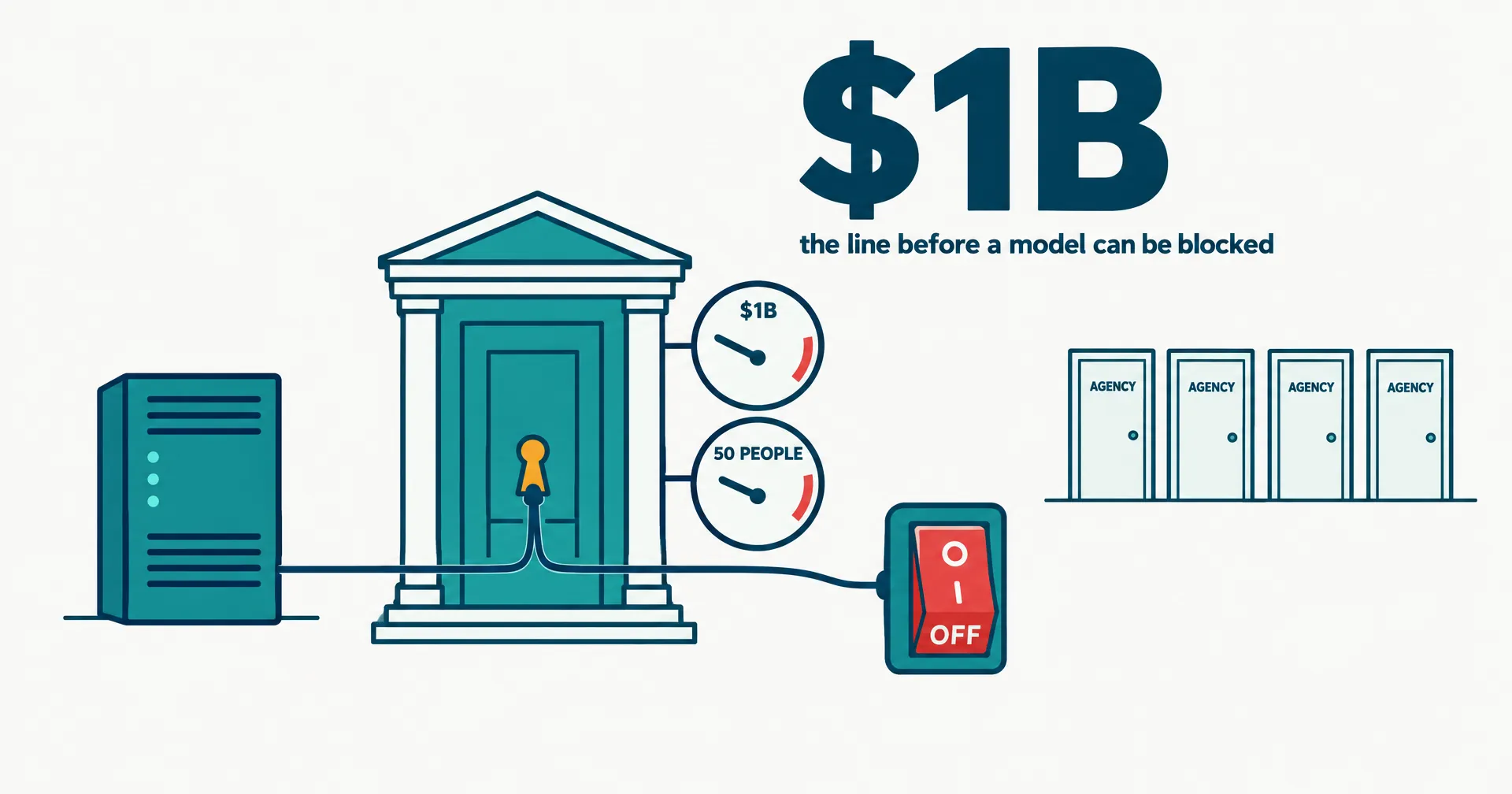
Anthropic has privately pitched members of Congress a draft federal bill on frontier AI safety, POLITICO reported on October 16, 2026 at 21:45 UTC. Under the draft, the government could block a model’s release or use only when it poses a foreseeable, imminent risk of more than $1 billion in damages, or of killing or seriously injuring more than 50 people, from a biological weapon, a model escaping its developer’s control, or a cyberattack.
The draft is confidential and Anthropic has not published bill text. POLITICO obtained a copy and cites three people familiar with the effort. Anthropic confirmed the substance: “This bill represents the proposals outlined in Anthropic’s Advanced AI Framework, which we have been advocating for with federal and state lawmakers since June,” a spokesperson said. “These are sensible policies we believe Congress should act on.”
On this page · 8 sectionsOpen
 POLITICO reported on October 16, 2026 that Anthropic privately pitched lawmakers a draft federal AI safety bill; Anthropic says it reflects its Advanced AI Framework.
 A model could be blocked only for a foreseeable, imminent risk of over $1 billion in damages or over 50 deaths or serious injuries.
 Only Commerce, through a federal judge in DC, could suspend a model; every other US agency would be barred from doing so.
 Independent evaluators would register with Commerce and report an imminent enumerated risk within 72 hours.
 The draft would preempt some state laws on risk disclosure, third-party evaluation and incident reporting, not all state AI rules.
 Anthropic’s public framework covers models over 10^25 FLOPs from firms with $500M AI revenue or $1B in AI R&D.
§ 01What the draft would do
Everything in this table comes from POLITICO’s account of the draft; no sponsor has been named.
| Area | What the draft reportedly says |
|---|---|
| When a model can be blocked | Only a foreseeable, imminent risk of over $1 billion in damages or over 50 deaths or serious injuries |
| Which risks count | Creating or releasing a biological weapon, a model evading its developer’s controls, or a cyberattack |
| Who can block it | The Commerce Department asks a federal judge in the District of Columbia, who can order a suspension |
| Who cannot | Any other US department, agency or officer |
| Independent evaluators | Register with Commerce, review the lab and its frontier models, may be paid by the lab if pay does not depend on results |
| Reporting | Evaluators report an imminent enumerated risk to Commerce within 72 hours; labs report critical safety incidents |
| Lab duties | Safety frameworks, transparency reports for new frontier models, whistleblower protections |
| States | Preempts some state laws on public risk disclosure, third-party evaluation and critical-incident reporting |
POLITICO says the risk language mirrors California’s AI laws, including SB 53, signed last year.
§ 02One gate, one court
The center of the draft is who holds the off switch. Commerce would have to go to a single federal court to suspend a model, and the language bars every other US “department, agency, or officer” from suspending a model’s development, deployment or internal use.

That reads as a response to recent events. POLITICO reports that over the summer Anthropic was hit by export controls that shut down two of its most advanced models, decided in a series of calls between officials and company executives. A court gate with written thresholds is the opposite of that process.
The evaluator half of the draft builds on what Anthropic already does in private. It gave METR staff employee-like access on October 15 and works with SecureBio and Accenture. The draft would turn that practice into a registered role, with a 72-hour clock when an evaluator sees an imminent enumerated risk.

§ 03The public framework behind it
Anthropic’s public version is its Advanced AI Framework, on the page it calls Policy on the AI Exponential. It argues that “transparency alone is no longer sufficient” and that government should be able to block or deter dangerous deployments, with civil penalties tied to global annual revenue.
The framework also sets who would be covered: models trained with more than 10^25 FLOPs, built by companies with more than $500M in AI revenue or more than $1 billion in AI R&D spending. POLITICO’s account of the draft does not give a coverage threshold, so whether the bill keeps those numbers is not public.
On states, the framework draws a line the draft will be judged against: “We do not believe Congress should preempt state law unless it enacts a federal law that is at least as strong as the framework we are proposing today.” The draft, as reported, preempts state rules only in three areas, risk disclosure, third-party evaluation and incident reporting.
§ 04How the thresholds compare
| Rule | Training compute line | What it does |
|---|---|---|
| Anthropic Advanced AI Framework | More than 10^25 FLOPs, plus a revenue or R&D test | Testing, transparency, evaluation, power to block deployment |
| EU AI Act, Article 51 | More than 10^25 FLOPs | Presumes systemic risk; duties for the provider |
| China draft export list | 10^26 FLOPs, 2T parameters or a top-10 rank | Restricts export of model weights and code |
The EU AI Act uses the same 10^25 line for its systemic-risk presumption. China’s draft export controls, published the same day as POLITICO’s report, set their line at 10^26 for a different purpose: keeping model weights inside the country.
§ 05Where Congress stands
Anthropic is not the only one writing. In the House, Reps. Lori Trahan and Jay Obernolte lead the FRONTIER Act, which would also let the government stop risky deployments and preempt some state laws. In the Senate, Majority Leader John Thune and Sens. Amy Klobuchar and Ted Cruz have been negotiating a catastrophic-risk bill, with pushback from Sen. Maria Cantwell and safety groups who want a larger government review role. Anthropic has not publicly backed any of them, POLITICO notes; it has backed two California safety laws.
Bloomberg and Reuters carried the story the same evening, both citing POLITICO. The FTC’s demands to OpenAI and Anthropic on safety incidents this week are the other federal track to watch.
§ 06What it means if you build on frontier models
For builders, the draft as reported changes little day to day: its duties fall on frontier labs, not on companies that use their models. What would change is predictability. A written threshold and a single court make a sudden shutdown of a model you depend on less likely than an executive call, which matters if your product runs on one lab’s model.
Our conflict, declared: we build CellCog, and every CellCog chat and AI employee tier runs on Anthropic’s Claude Opus 5.5. A rule that decides when a frontier model can be suspended decides something about our own stack too.
§ 07What we are watching
- A sponsor for the draft, or Anthropic publishing the bill text.
- Whether the draft keeps the framework’s 10^25 FLOPs and revenue tests.
- How the FRONTIER Act and the Senate negotiation treat preemption and the court gate.
§ 08Sources
- POLITICO, Owen Dahlkamp, Anthropic quietly pitches its own AI safety bill to lawmakers, October 16, 2026, 21:45 UTC.
- Anthropic, Policy on the AI Exponential and the Advanced AI Framework, read October 17, 2026.
- Bloomberg, Anthropic Pitches AI Safety Bill to Lawmakers, Politico Says, October 16, 2026.
- Reuters, Anthropic quietly pitches its own AI safety bill to lawmakers, Politico reports, October 16, 2026.
- Regulation (EU) 2024/1689, the EU AI Act, Article 51.
Q1Has Anthropic published the bill?
No. POLITICO obtained a confidential draft. Anthropic confirmed it reflects its public Advanced AI Framework and says Congress should act on these policies.
Q2Who is sponsoring the bill?
No sponsor has been named. POLITICO reports Anthropic representatives pitched it to lawmakers; Anthropic has not publicly backed any bill in Congress.
Q3Would it override state AI laws?
Partly. As reported, it preempts state rules on public risk disclosure, third-party evaluation and critical-incident reporting. Anthropic’s framework says states should keep regulating areas such as child safety and consumer protection.
Q4Which models would it cover?
POLITICO’s account gives no coverage threshold. Anthropic’s public framework proposes models trained with more than 10^25 FLOPs from companies with over $500M in AI revenue or over $1 billion in AI R&D spending.
Q5Does it affect companies that use AI models?
Not directly as reported. The duties fall on frontier labs: safety frameworks, transparency reports, evaluators, whistleblower protections and incident reports.