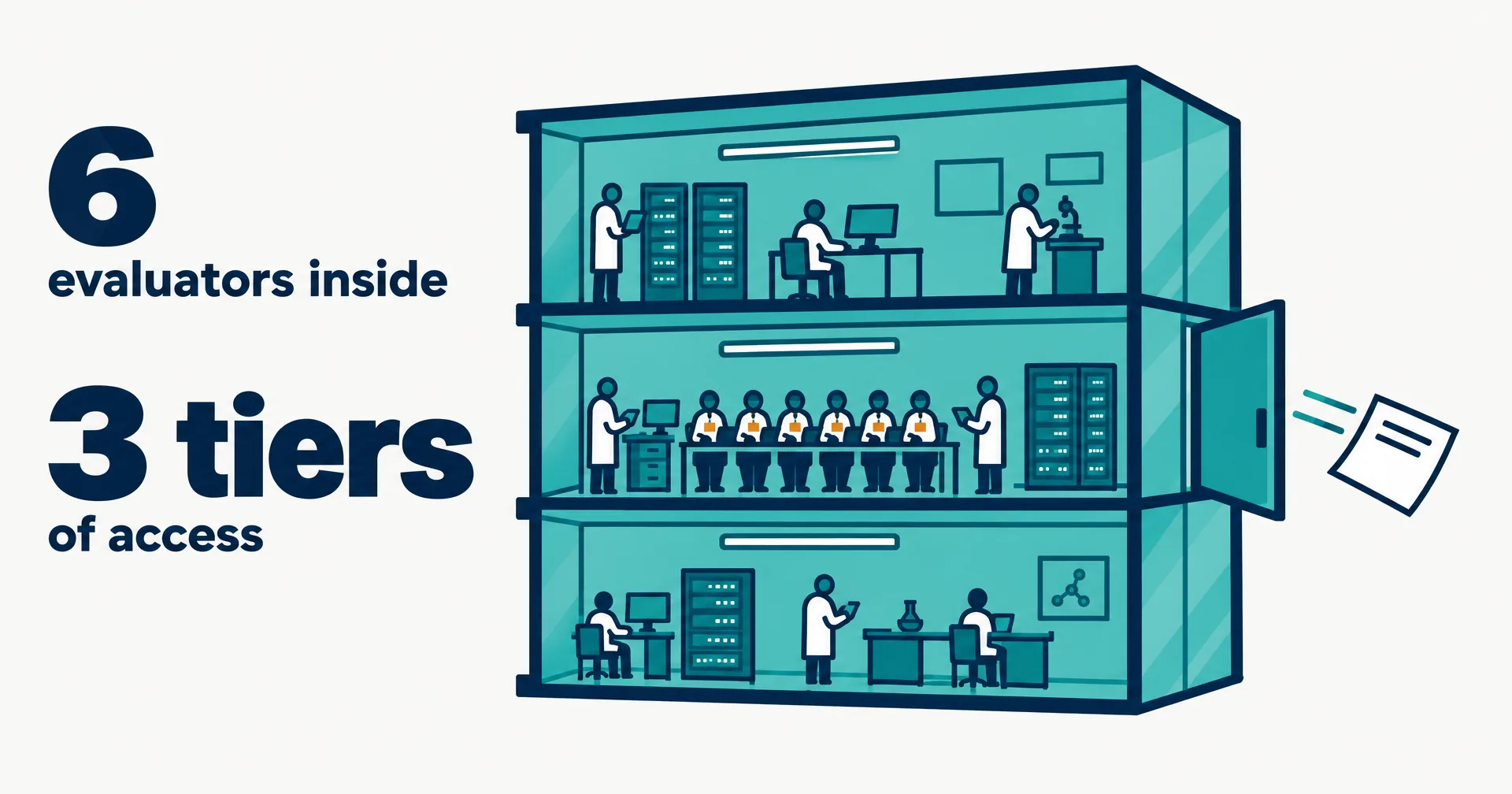
Anthropic said on October 15, 2026 that six people from METR, a nonprofit that evaluates frontier AI models, now work inside the company with laptops, office space and internal tools roughly on par with its own risk assessment teams, and that it cannot veto what they publish. “METR will publish the results of its risk assessments,” the company says in An update on independent evaluators, posted at 17:20 UTC and announced on X seven minutes later.
It turns the first step of Dario Amodei’s September essay into a working arrangement, 33 days after he asked the industry to pace the frontier and named METR as an example of the evaluators he meant. It also lands two days after Reuters reported that Anthropic and OpenAI had sought significant control over what outside evaluators could publish.
On this page · 8 sectionsOpen
 On October 15, 2026, Anthropic said six METR staff now work inside the company, with laptops, office space and internal tools close to what its own risk teams use.
 METR will publish its findings and Anthropic cannot veto them; it can only require redactions in categories set in advance, and METR may say whether they were justified.
 Anthropic set out three tiers of evaluator access: METR is at the top, SecureBio at the first, and Accenture and Faculty are working toward a fuller partnership.
 The post lands two days after Reuters reported Anthropic and OpenAI had sought significant control over what outside evaluators could publish.
 Customer data, privileged legal material and model architecture details stay off-limits, and the METR team is walled off from the rest of METR.
§ 01What Anthropic announced
- METR, at the top tier. Six METR employees were onboarded with company hardware, office space and internal tools. Outside a few defined categories, “Anthropic employees are encouraged to share information with them just as they would with a fellow employee working on alignment risk.”
- SecureBio, at the first tier. It is reviewing the chemical and biological weapons chapter of Anthropic’s August Risk Report, after publishing a pilot review of the previous report.
- Accenture and Faculty. Working toward a partnership covering red-teaming, alignment assessments and safeguard testing. Anthropic said on September 18 that each company expects to invest at least $1 billion in this area over five years.
- In early talks. Several other organizations, including Hugging Face.
METR is not new to Anthropic’s reports. Its blog lists a review of the Sabotage Risk Report for Claude Opus 4.6 (March 12, 2026), three weeks of red-teaming Anthropic’s internal agent monitoring (March 26), and a review of the automated R&D section of the February 2026 Risk Report (May 8). What changes now is where the reviewers sit and what they may say.
§ 02The three tiers of access
Anthropic says it is building three tiers of evaluator access and hopes, over time, to have several evaluators at the top one, each publishing its own analysis.
| Tier | Access | Publication rights | Who is there now |
|---|---|---|---|
| 1 | Narrowly scoped risk investigations; Anthropic decides what access to give | Publish with Anthropic’s approval | SecureBio |
| 2 | More information than tier 1 | Publish without approval; Anthropic can require removal of specific categories, and the evaluator can say whether that was justified | None named |
| 3 | Employee-like: hardware, office space, internal tools roughly on par with Anthropic’s own risk teams | Same as tier 2 | METR |
For METR, the publication terms are the point. Anthropic can require redactions only for a short list of categories set in advance, and “METR is free to characterize our redactions publicly, and say whether it believes the redactions were justified, as long as it does so without revealing the redacted information.” METR may publish on Anthropic’s risk levels, incidents or practices.
§ 03What stays private
Three categories are carved out: data about customers, attorney-client-privileged information and information about model architectures. On the last, a footnote explains that embedded evaluators may also work with other labs: “Information about architectures presents a high risk of inadvertent leaks, and its relevance to risk assessment is typically low.” When architecture is highly relevant, Anthropic says it will generally seek to share it, with explicit internal approval.
The METR team works under enforceable agreements, and other METR staff, including researchers on other Anthropic projects, are walled off from its work. The model Anthropic reaches for is bank supervision: banks know more about their own risks than outsiders do, so “regulators assign resident examiners to work inside the largest banks.”
§ 04Why this week
Amodei wrote in September that external evaluators should be able to publish key findings “without editorial control”. On October 13, Reuters reported, citing two people familiar with the talks, that Anthropic and OpenAI had still been seeking strict editorial control over evaluators’ publications as recently as October 5, and that talks between Anthropic and some evaluators appeared to have moved by October 8.
Anthropic told Reuters that evaluators it had worked with before control their methods, criteria, conclusions and what to publish, while for new evaluator firms it reserved the right to comment on and approve reports. Today’s post writes that split down: METR, which has reviewed its risk reports for the past year, at the top tier; SecureBio, still in its first engagement, at tier 1. OpenAI told Reuters it was not seeking approval rights over the full text of evaluator reports. Faculty’s CEO Marc Warner put the stakes in one line: “Evaluators are only useful if people can trust what they report, so independence and transparency are critical.”
§ 05What is still open
- Who pays. The post lists financial and operational independence from the company being evaluated as a requirement. Anthropic said in September that it “will fund Accenture’s work directly,” and the October 15 post does not say who pays for METR’s embedded team.
- The first report. No METR analysis has been published under the new terms yet. The test is its first report and how many redactions it carries.
- The rest of the industry. Anthropic writes that “we believe every frontier AI company should do the same.” The White House Accord pledged outside evaluators but, as Reuters noted, did not say how those reviews should work. METR and Redwood’s report on the OpenAI and Hugging Face incident shows the other path: invited after the fact, with redactions OpenAI made.
§ 06What it means if you run Claude
CellCog’s AI employees run on Claude Opus 5.5, so what METR publishes about Anthropic’s models and safeguards is reporting on the model behind them. For a company deploying agents, the arrangement covers the lab. It does not cover what an agent does inside your business: which actions needed approval, what it touched and what it sent. That record is yours to keep, and it is worth keeping before a regulator asks for it.
§ 07What we are watching
- METR’s first published analysis under the new terms, and how it characterizes Anthropic’s redactions.
- Whether SecureBio moves past tier 1 after its chemical and biological review.
- Hugging Face and the other organizations in early talks.
- Whether OpenAI, which made the same commitment in September, describes a matching arrangement.
§ 08Sources
- Anthropic, An update on independent evaluators, October 15, 2026, and its X post.
- Anthropic, Partnering with Accenture on embedded evaluation, September 18, 2026.
- Reuters, Behind AI industry’s call for independent reviews, a fight over what gets made public, October 13, 2026.
- METR, blog index of published reviews, read October 15, 2026.
Q1What is employee-like access?
Six METR employees got Anthropic hardware, office space and internal tools roughly on par with its own risk assessment teams, and Anthropic staff are encouraged to share with them as with a colleague, outside a few excluded categories.
Q2Can Anthropic stop METR from publishing?
No. Anthropic says it cannot veto publication. It can require redactions in narrow categories set in advance, and METR may say publicly whether it thinks those redactions were justified.
Q3What can METR not see?
Customer data, attorney-client-privileged information and, by default, model architecture details, which Anthropic says carry a high leak risk and low relevance to risk assessment.
Q4Who else evaluates Anthropic?
SecureBio, at the first tier, is reviewing the chemical and biological weapons chapter of the August Risk Report. Accenture and Faculty are working toward a broader partnership, and Hugging Face is in early talks.
Q5Does CellCog use Anthropic's models?
Yes. CellCog’s AI employees run on Claude Opus 5.5, so METR’s findings about Anthropic’s models are findings about the model behind them.