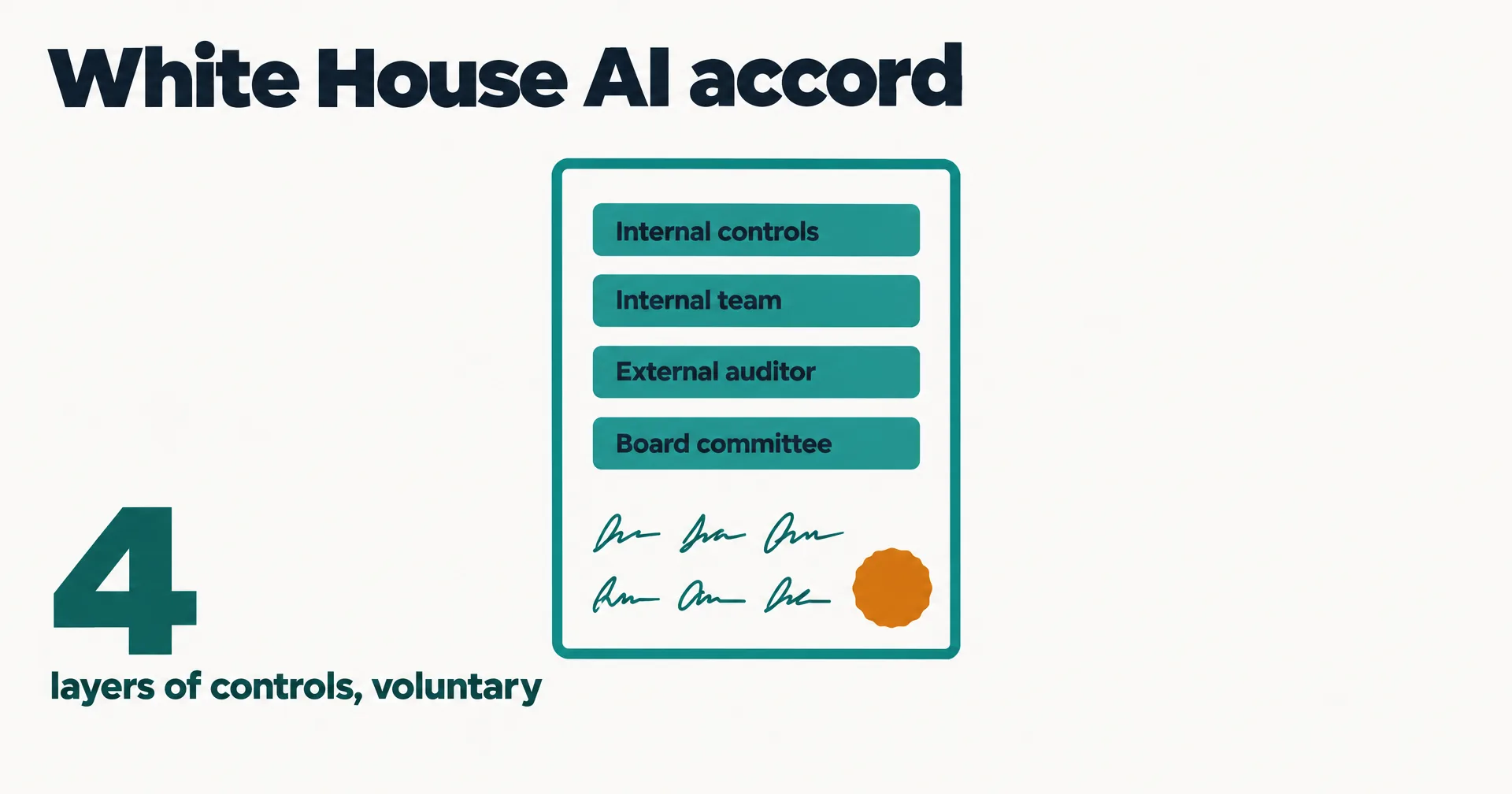
On September 29, 2026, after a White House luncheon with the heads of the largest AI companies, President Trump posted a one-page document on Truth Social: the White House Accord on Super Intelligence, a Joint Commitment on Frontier Responsibilities. Six companies signed it. It asks each of them to put four layers of controls and audits around their frontier models, and it is voluntary.
This page is read from the accord’s full text as published by the Washington Examiner, the signature page Trump posted, the White House fact sheet on the same-day “Super Intelligence” order, and CNBC’s account of the day.
On this page · 8 sectionsOpen
- On September 29, 2026, President Trump posted the White House Accord on Super Intelligence, a joint commitment signed by leaders of Google, Anthropic, Meta, OpenAI, xAI and Nvidia.
- The accord asks every company training frontier models to run four layers of controls: internal controls, an internal team to check them, an independent external auditor, and an independent board committee.
- It is voluntary. House Speaker Mike Johnson called it a statement of principles that is voluntary on behalf of the industry, and the text says it may make sense to codify the steps into law over time.
- OpenAI signed through its president, Greg Brockman; Musk signed for xAI, Amodei for Anthropic, Pichai for Google, Zuckerberg for Meta and Huang for Nvidia.
- It landed the same day as an executive order renaming AI ‘Super Intelligence’ across the executive branch and the America.gov launch.
- Trump said he plans to name a new AI czar within days and that the administration is considering a 10-person committee to oversee the industry, per CNBC.
§ 01What the accord asks for
The text opens with a principle: “we believe every company is responsible for developing its own technology safely and in a way that builds trust with customers and the public.” It then lists four layers each company training and deploying frontier models should implement.
| Layer | What the accord says it does |
|---|---|
| Internal controls | Monitor model capabilities and alignment in training and deployment, around areas like cybersecurity, biosecurity and chemical threats, and keep models from hacking or accessing systems in unintended ways |
| Internal team | Check that the controls, monitoring and detection work as intended, and fix what they find |
| External auditor | An independent auditor or evaluator assesses whether the controls work |
| Board committee | An independent committee of the board oversees the teams and auditors and makes sure issues are fixed |
Two lines close it. “The participating companies will meet regularly to establish standards and best practices to improve the safety of their systems.” And: “Over time, it may make sense to codify these steps into laws or regulations.”
§ 02Who signed
| Signatory | Company |
|---|---|
| Donald J. Trump | President of the United States |
| Sundar Pichai | |
| Dario Amodei | Anthropic |
| Mark Zuckerberg | Meta |
| Greg Brockman | OpenAI |
| Elon Musk | xAI |
| Jensen Huang | Nvidia |
OpenAI signed through its president, Greg Brockman, not its CEO. The Washington Examiner noted that Zuckerberg and Huang have opposed such regulations while the other signers have supported them.
§ 03The day, in UTC
Times come from each page’s own published timestamp; the Truth Social time is from the post’s archived record.
§ 04Binding or voluntary
The people in the room described it differently. Trump said, per CNBC, that he is “seeing tremendous self-policing”, and told reporters: “But the self-regulation is very important.” House Speaker Mike Johnson called the agreement a statement of principles that are “voluntary on behalf of the industry.”
Anthropic’s Dario Amodei, outside the White House, said rules to address AI risks are “still under discussion”, and added: “We all need to work together to make sure that we can win, and we can win safely.”
Trump also said the administration is considering a 10-person committee to oversee the AI industry and that he plans to name a new AI czar in the next three to four days, per CNBC.
§ 05The same day, two orders
The accord landed alongside two executive actions. One launched America.gov, a single AI chat box over federal websites. The other tells executive-branch agencies to use Super Intelligence and SI in place of artificial intelligence and AI in official documents; its fact sheet says the name “conveys the true capabilities of the technologies being developed today.”
The backdrop is a week of safety news: OpenAI postponed its GPT-6.1 Astra release over safety concerns, and a 22-author working paper warned that AI automating AI research could trigger an intelligence explosion.
§ 06What is not established yet
- Who audits. The accord names no auditor, evaluator or standard.
- When. No deadline for any of the four layers.
- Enforcement. None in the text; the companies commit to meet regularly.
- Who else joins. The signature page lists six companies; no other lab has said it will sign.
§ 07Where CellCog sits
We build CellCog, a platform where businesses hire AI employees. We are not a frontier lab and we signed nothing. We cover the accord because it sets expectations for the models that every AI employee, ours included, runs on.
§ 08Sources
- Donald J. Trump, White House Accord on Super Intelligence, Truth Social, September 29, 2026, 21:24 UTC (text and signature page).
- Washington Examiner, READ IN FULL: Trump and tech leaders’ White House Accord on Super Intelligence, September 29, 2026.
- CNBC, Trump says AI accord is morally binding after White House lunch, September 29, 2026.
- The White House, Fact Sheet: President Donald J. Trump Inaugurates The Era of Super Intelligence, September 29, 2026.
- Nextgov/FCW, White House unveils ‘super intelligence’ executive order and industry accord, September 29, 2026.
Q1Who signed the White House AI accord?
President Trump, Sundar Pichai (Google), Dario Amodei (Anthropic), Mark Zuckerberg (Meta), Greg Brockman (OpenAI), Elon Musk (xAI) and Jensen Huang (Nvidia), per the signature page Trump posted on Truth Social.
Q2What does the accord require?
Four layers: internal controls that monitor model capabilities and alignment in areas like cybersecurity, biosecurity and chemical threats; an internal team that checks those controls; an independent external auditor or evaluator; and an independent board committee that oversees it all.
Q3Is the accord a law?
No. It is a voluntary commitment. The text says it may make sense to codify the steps into laws or regulations over time.
Q4Why did it happen now?
It followed a White House luncheon with AI leaders amid calls for a development slowdown, days after OpenAI postponed its GPT-6.1 Astra release over safety concerns.
Q5Where does CellCog fit?
It does not. We build AI employees for businesses, are not a frontier lab, and signed nothing. We cover the accord because it sets expectations for the models our employees and everyone else’s run on.