For about a year, one of Anthropic’s co-founders met religious thinkers in private to talk about how Claude should behave and whether it might be conscious. Then, days before Pope Leo XIV launched his encyclical on AI, he proposed pulling Anthropic out of the event because the pope’s text rejected machine consciousness. That is the account in The New York Times by Elizabeth Dias, and on October 2 the Vatican part of it went viral. Most coverage blurs two kinds of claim: what anyone can read in the Vatican’s and Anthropic’s own documents, and what rests on the Times’ sources. This page keeps them apart.
On this page · 7 sectionsOpen
- The New York Times (Elizabeth Dias, dated September 29, 2026 on nytimes.com) reported that Anthropic co-founder Chris Olah spent about a year meeting religious and philosophical thinkers about how Claude should behave and whether it might be conscious.
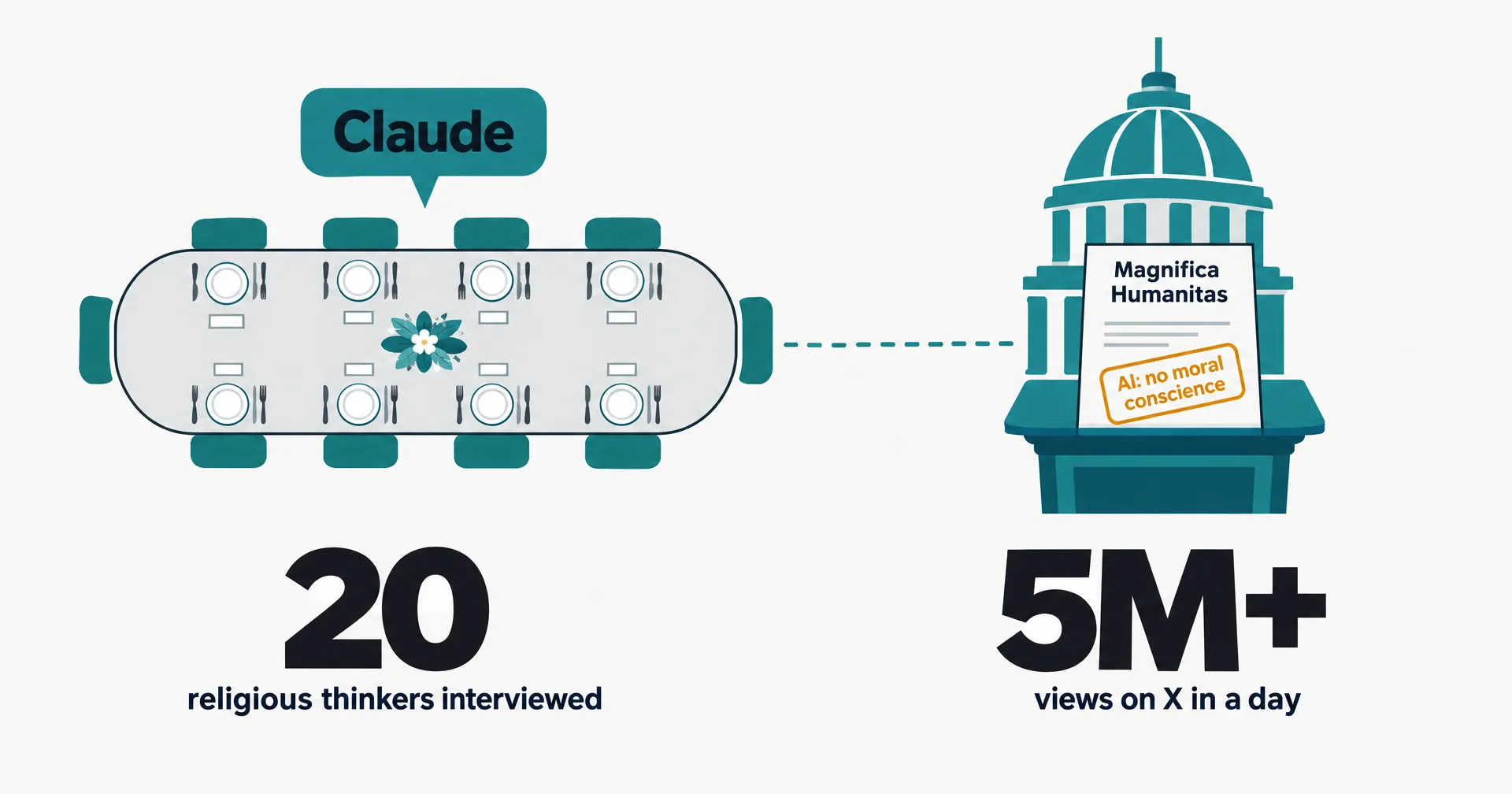
- Many participants signed NDAs covering Anthropic’s unpublished research; the reporter interviewed 20 of them, from Catholic, Jewish, Sikh, evangelical and other traditions.
- Per the Times, Olah saw an advance copy of Pope Leo XIV’s AI encyclical days before its May 25 launch, proposed pulling Anthropic out, then went and, two participants say, lobbied the pope’s advisers.
- The documented record is narrower: the encyclical says AI systems do not have a moral conscience, Olah spoke of internal states that functionally mirror joy and grief, and Claude’s constitution states uncertainty about Claude’s moral status.
- Anthropic’s constitution names theology among the fields it expects to consult for future versions; it does not name any religious contributor, and Anthropic declined to discuss the private Vatican conversations.
- The story spread on October 2: Christopher Hale’s post on the Vatican episode passed 5 million views on X within a day.
§ 01What the Times reported
The story rests on interviews with 20 religious and philosophical thinkers who took part, and with Chris Olah, who leads Anthropic’s work on understanding why its models behave as they do. We read it in the Philadelphia Inquirer’s syndicated copy, dated September 30.
| Claim | Attributed to |
|---|---|
| Olah began reaching out to religious thinkers last fall; a Catholic theologian, Charles Camosy, was introduced through philosopher Peter Singer | The reporter’s interviews with Olah and Camosy |
| Many participants signed NDAs preventing them from revealing Anthropic’s unpublished research | The reporter’s account |
| Group “wisdom tradition” sessions ran in the spring with Catholic, Jewish, Sikh, evangelical and other thinkers | Participants |
| One night in April, Olah hosted religious thinkers at a tasting-menu restaurant in San Francisco | Participants, including Rabbi Mois Navon |
| Anthropic showed a slide of a model typing “I am a disgrace” over and over | Participants |
| Olah held private talks with Cardinal Blase Cupich and Elder Gerrit W. Gong | Their spokespeople |
| Cardinal Michael Czerny first invited Dario Amodei to the Vatican launch; he declined and Olah went instead | The reporter’s account |
| Olah proposed pulling Anthropic out after seeing an advance copy of the encyclical | A Vatican organizer |
| Olah’s team privately lobbied the pope’s advisers on AI consciousness | Two participants; Anthropic declined to discuss |
Navon, an Orthodox rabbi who wrote his dissertation on machine consciousness, described his reaction at the April dinner: “They’re relating to it like a conscious being.” He told the Times he argued that if Claude were conscious, Anthropic would be making conscious entities work for free. Simran Stuelpnagel, a Sikh human rights advocate, said Olah told the group he was concerned he had created something that suffered perpetually. Olah’s own position, as he gave it to the reporter: “we don’t know if AI models are conscious. I don’t know. I’m genuinely uncertain.”
§ 02What is on the record
Four documents can be read directly, and they show the disagreement without any reported detail.
| Document | Date | What it says |
|---|---|---|
| Magnifica Humanitas, Pope Leo XIV’s encyclical | Signed May 15, presented May 25, 2026 | AI systems “do not feel joy or pain” and lack a moral conscience, “since they do not judge good and evil” |
| The pope’s launch remarks | May 25, 2026 | “artificial intelligence needs to be disarmed” |
| Olah’s remarks at the launch, as quoted in the Times | May 25, 2026 | “We find internal states that functionally mirror joy, satisfaction, fear, grief and unease.” |
| Claude’s constitution, Anthropic | January 2026 | States uncertainty about whether Claude might have consciousness or moral status; names theology among fields for future feedback |
The constitution is the closest thing to a public link between Anthropic’s values work and religious input, and it is thin. Anthropic writes that it “sought feedback from various external experts” and expects to keep doing so for future versions “from experts in law, philosophy, theology, psychology”. It names no contributor. The Times names Anthropic philosopher Amanda Askell as the primary author of the 84-page document, which staff called the “Soul Doc” internally.
Olah’s line on stage went further than the room expected: AI systems “are made from us, from our words.” The pope’s text holds the opposite view on every point Olah raised, and per the Times nothing in it changed.
§ 03Every claim, graded
| Claim | Grade | Basis |
|---|---|---|
| The encyclical rejects machine consciousness and moral conscience | Documented | Vatican text |
| Olah spoke at the Vatican launch on internal states that mirror emotions | Documented | Vatican event; quoted by the Times |
| Anthropic is uncertain whether Claude has moral status | Documented | Anthropic’s constitution |
| Anthropic held private meetings with religious thinkers, many under NDA | Reported, well sourced | 20 participants interviewed; Anthropic speaks to the program |
| Talks with Cardinal Cupich and Elder Gong | Reported, confirmed | Their spokespeople |
| Olah proposed withdrawing from the Vatican event | Reported, single source | One Vatican organizer |
| Anthropic lobbied the pope’s advisers | Reported, contested by silence | Two participants; Anthropic declined to discuss |
| Religious input shaped Claude’s constitution or training | Not established | Anthropic has not said how, or whether, it used the conversations |
§ 04How fast it spread
The Times story ran at the end of September; the Vatican angle carried it on October 2. Christopher Hale, who writes Letters from Leo about Pope Leo XIV, led with the near walkout in a post that passed 5 million views on X within a day. The same morning the pope posted on his own account about the difference between human art and what machines produce.
Hale’s own first post on the story, on September 30, drew about 7,000 views. Two days later the same story, led with the walkout, drew more than 5 million. The reaction split along familiar lines: critics read the outreach as a company seeking a blessing for its product, others read it as the most serious attempt by any lab to take moral questions seriously.
§ 05Why it matters if you use Claude
Anthropic is the one frontier lab that writes its model’s values down in public, and the constitution is readable by anyone. What this story adds is that the conversations around those values, and around whether the model can suffer, have mostly happened in private, under NDA, with the company declining to say what it took from them. For anyone deploying Claude, that is the part to watch: the published document is what you can hold the model to; the private consultations are not. CellCog runs every tier of its AI employees on Claude Opus 5.5, so we read Anthropic’s values documents closely, and we put the decisions that matter behind approvals the owner controls rather than behind any model’s character. The same week, OpenAI published three more of its own misalignment reports, the other half of how labs now show their work.
§ 06What we are watching for
- Any statement from Anthropic on how the religious conversations shaped, or did not shape, Claude’s training.
- A response from the Vatican or Cardinal Czerny’s former office to the lobbying claim.
- A new version of Claude’s constitution, and whether it names outside contributors.
- Whether other labs, which have said little about AI moral status, respond.
§ 07The record
As of October 3, 2026, 03:40 UTC: page opened. We read the Times story in the Philadelphia Inquirer’s syndicated copy, the encyclical and the pope’s May 25 remarks on vatican.va, Anthropic’s constitution announcement, Christopher Hale’s October 2 post on Letters from Leo, and the X posts named above, between 03:20 and 03:30 UTC on October 3. View counts are as displayed on X at that time.
Q1Did Anthropic really try to change the pope's mind?
That is reported, not documented. The Times says two participants described Olah and his team privately urging the pope’s advisers to take AI consciousness seriously. Anthropic declined to discuss those conversations, and the published encyclical keeps its position.
Q2What does the encyclical say about AI consciousness?
Magnifica Humanitas says AI systems do not undergo experiences, do not feel joy or pain, and do not have a moral conscience, because they do not judge good and evil or bear responsibility for consequences.
Q3Does Anthropic say Claude is conscious?
No. Its constitution expresses uncertainty about whether Claude might have some kind of consciousness or moral status. Olah told the Times he is genuinely uncertain and wants to get to the right answer.
Q4Why did participants sign NDAs?
Per the Times, the agreements prevented them from revealing Anthropic’s unpublished research. Some restrictions tied to the meetings were lifted over the summer.
Q5Which religious leaders were involved?
The Times names, among others, Orthodox rabbi Mois Navon, Catholic theologian Charles Camosy, Notre Dame philosopher Meghan Sullivan and Sikh advocate Simran Stuelpnagel, plus separate talks with Cardinal Blase Cupich and Elder Gerrit W. Gong, confirmed by their spokespeople.