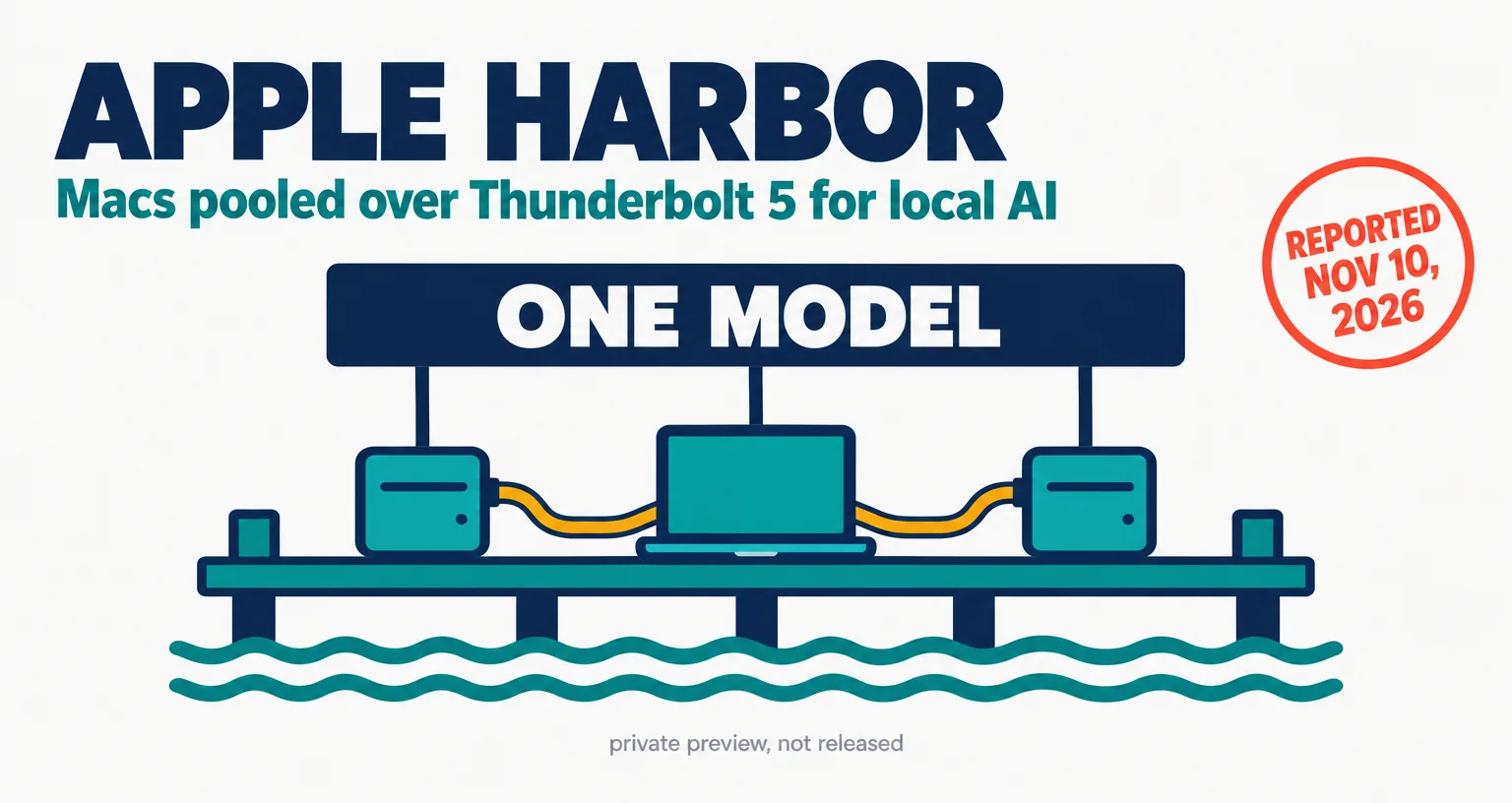
Claris, the software company Apple owns, is testing a Mac app called Claris Harbor that turns Apple silicon Macs into a private AI server. Leaker Aaron Perris posted the app’s App Store listing on November 10, 2026, and less than five hours later the listing was gone. Harbor is in private preview. No price and no release date have been published.
Most coverage treats this as a leak, and the listing was one. The product itself is more than a rumor, though: a preview page is live on Claris’s own site, under the line “Claris, an Apple company”. Below we separate what Claris has published from what only the pulled listing and press reports say.
On this page · 8 sectionsOpen
 Claris, the software company Apple owns, has a live private preview page for Claris Harbor, an app that turns Apple silicon Macs into a private AI server.
 Harbor connects several Macs over Thunderbolt 5 and pools their unified memory, so a model too large for one Mac can run across them.
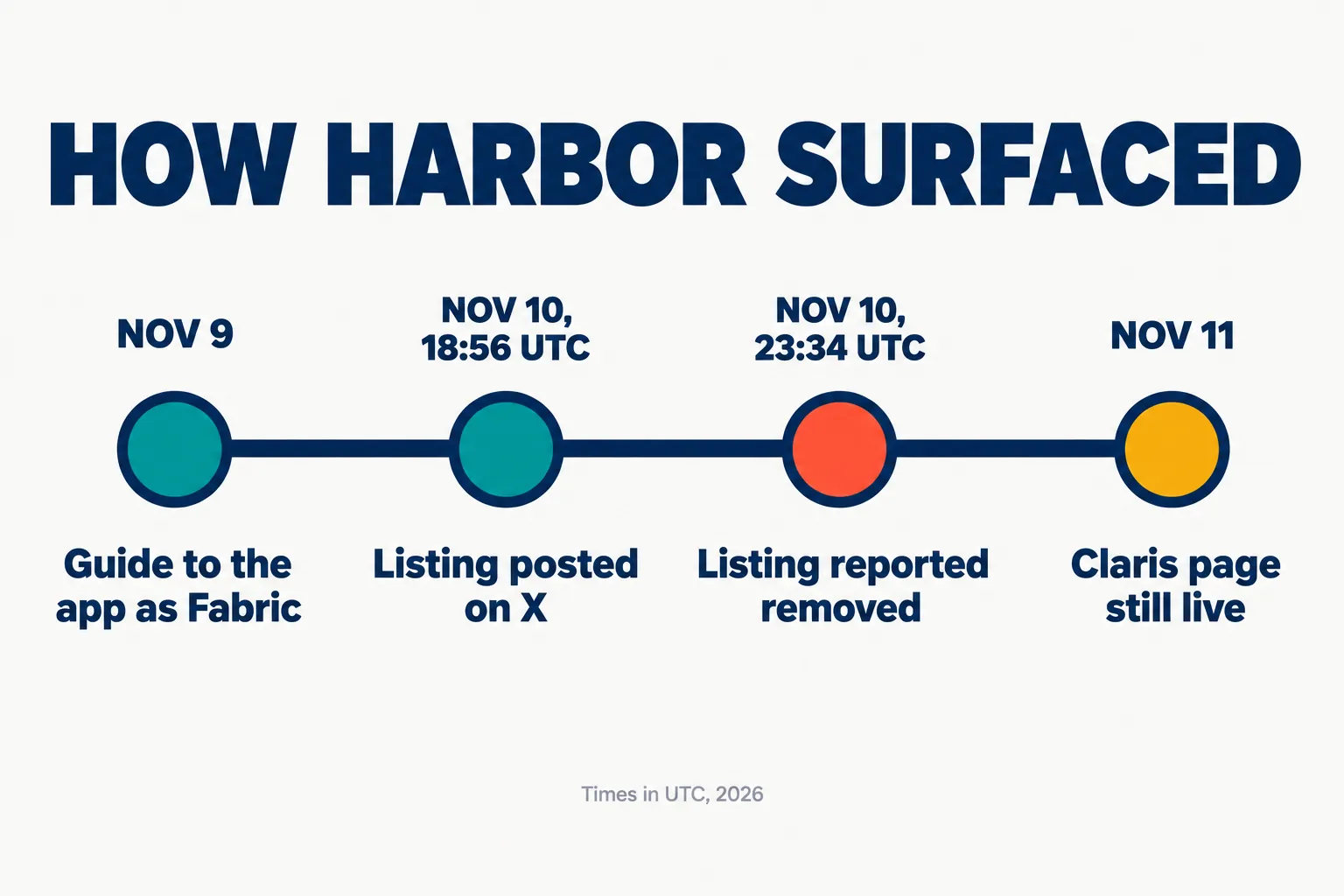
 Leaker Aaron Perris posted the App Store listing at 18:56 UTC on November 10, 2026. By 23:34 UTC MacRumors reported that the listing had been removed.
 Claris’s page is a sign-up form that asks for a company name. It says the details are used to send updates, and it offers no download.
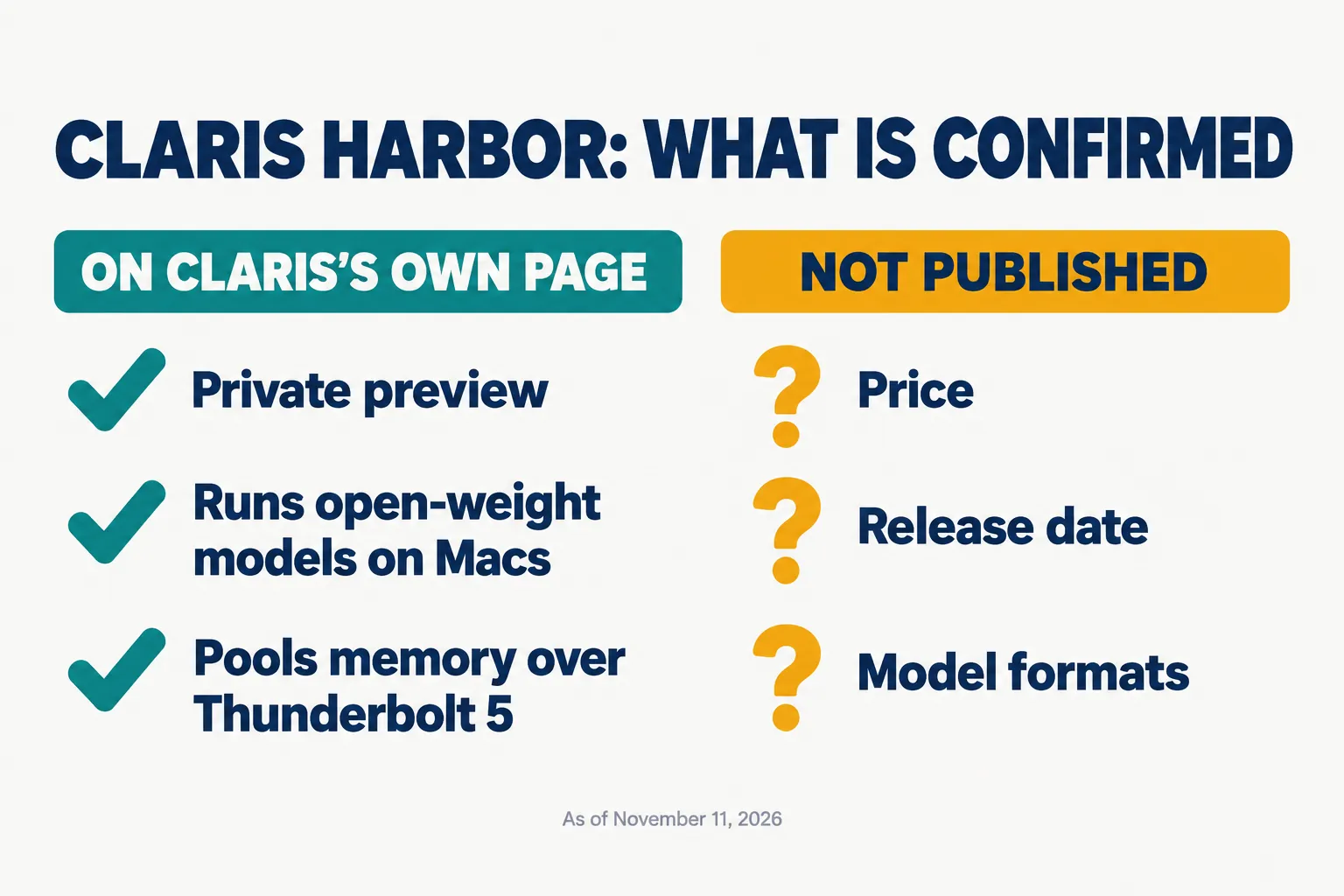
 No price, release date or list of supported model formats has been published. Apple has not said why the listing was removed.
§ 01What is confirmed, and by whom
| Claim | Source | Status |
|---|---|---|
| The app is called Claris Harbor and is in private preview | Claris’s own page | Confirmed by Claris |
| It runs open-weight models on Apple silicon Macs | Claris’s own page | Confirmed by Claris |
| Several Macs connect over Thunderbolt 5 to pool unified memory | Claris’s own page | Confirmed by Claris |
| It sets up an endpoint that other software can call | Claris’s own page | Confirmed by Claris, no details |
| It had an App Store listing that was removed on November 10 | Aaron Perris, MacRumors | Reported, no comment from Apple |
| It was called Fabric before | Aaron Perris, AppleInsider | Reported |
| Models download from Hugging Face inside the app | Listing screenshots, Settings Blog | Reported |
| It needs an M1 or later Mac, macOS 27 and 16 GB of memory | Settings Blog | Reported by one site |
| Price, release date, supported model formats | Nobody | Not published |
Claris’s page describes the product in one sentence: “Claris Harbor turns the Apple silicon computers you own into a private AI server.”
It sells the idea on cost and privacy. The page promises “zero cloud fees, no per-token billing” and says prompts and data stay on the Mac.
It also says how small the starting point is: “Set up an endpoint in minutes on a single Mac.”
The page is a sign-up form. It asks for a name, an email address, a company, a phone number and a country, and it says the details are used to send updates. It offers no download.
§ 02How Harbor works
A language model has to fit in memory to run. Apple silicon Macs share one pool of memory between the processor and the graphics chip, which Apple calls unified memory, and that is why a Mac with a lot of memory can run a large model. Harbor’s pitch is the step after that. When a model is too large for one Mac, you connect more Macs with Thunderbolt 5 cables and Harbor treats their memory as one pool.

The listing text that Perris posted names two uses for a cluster. One is running a model that is larger than any single computer can hold. The other is answering more requests at the same time. It says Harbor detects the connected Macs by itself, with no command line.
One of the listing’s screenshots shows a cluster of three Macs. We read the numbers off the image.
| Mac | Chip | Memory (GB) |
|---|---|---|
| MacBook Pro | Apple M5 Max | 48 |
| Mac mini 1 | Apple M4 Pro | 16 |
| Mac mini 2 | Apple M4 Pro | 24 |
Together the three hold 88 GB. That sum is ours. The side panel of that same screenshot reads Standalone for the server’s mode and 48 GB for cluster memory, which is the MacBook Pro’s own figure. So the image shows three Macs wired together, but it does not show their memory pooled. It also does not show how fast a model runs when it is spread across cables.
The same screenshots show a model picker, a window that downloads a model from Hugging Face, a chat box for testing the model, and a button that copies the server’s address so other software can call it. In the cluster screenshot, the faster link mode, RDMA over Thunderbolt, reads as not enabled.
§ 03How it surfaced
| Time (UTC) | What happened | Source |
|---|---|---|
| Nov 9, 06:55 | A hands-on guide to the app appears under its earlier name, Fabric | Settings Blog |
| Nov 10, 18:56 | Aaron Perris posts the App Store listing text and four images | X |
| Nov 10, 19:15 | First news report | 9to5Mac |
| Nov 10, 19:57 | Report adds the earlier name | AppleInsider |
| Nov 10, 23:34 | Report says the listing has been removed | MacRumors |
| Nov 10, 23:40 | Perris says Apple took the listing down and links Claris’s page | X |
| Nov 11, 07:07 | We read Claris’s page, which is still live | Claris |
Perris’s first post had about 404,000 views when we read it at 07:06 UTC on November 11. His later post put the removal plainly: “Apple has taken down Harbor from the App Store now”.
MacRumors reported the same thing a few minutes earlier: “There was an App Store listing, but it has now been removed.”
The listing itself said where the app stood: “Harbor is currently in a private preview under the Claris brand.”
A reader asked Perris whether this was the app once known as Fabric. He answered: “Yes it was called Fabric, renamed to Harbor”.
The old name is still visible. In the download screenshot, the folder that stores models is named for Fabric, and Settings Blog’s guide from the day before describes the same app as Fabric, version 0.41.0.
§ 04What Apple had already shipped
Harbor looks like a simpler front door to something Apple already published. At WWDC26 Apple presented its own stack for running models on a Mac. At the bottom is MLX, its open-source framework for Apple silicon. On top sits MLX-LM Server, which Apple described as a server that uses the same API format as OpenAI’s.
In that session Apple said a model can be split across several Macs, and it dated the faster link: “Starting with macOS 26.2, we have support for Thunderbolt RDMA”.
It gave one number for what that buys. Apple said distributed inference with MLX had sped up by “up to three times with four nodes”.
Apple’s route needs a terminal: one launch command and a file that lists every Mac. Harbor’s listing promises the same result with no command line. AppleInsider read it the same way, as an app that makes the setup easier and does not make models run faster.
We do not know that Harbor is built on MLX. Nothing Claris has published says which engine it uses or which model formats it loads.
§ 05Who it looks aimed at
Claris is best known for FileMaker, a database product sold to businesses. MacRumors read the sign-up form that way: “The sign-up page for Harbor asks for a company name, which suggests more of a business focus.”
We read the form, and it does ask for a company.
Free tools already cover parts of this. MacRumors names two: Exo, an open-source tool for clustering Macs, and LM Studio, which runs models on a single Mac. Its summary is that Harbor appears to combine LM Studio’s simple interface with clustering.
On timing, 9to5Mac expects a public launch “in the weeks and months ahead”. That is the writer’s expectation. Neither Apple nor Claris has given a date.
§ 06What is not known
- The price. MacRumors says it is not clear whether Harbor will be free.
- The release date. The page says private preview and nothing more.
- The engine and the model formats. Not published.
- The supported Macs. Claris says Apple silicon, and Thunderbolt 5 for a cluster. The M1, macOS 27 and 16 GB figures come from one site’s guide to an early version.
- How well a cluster performs. No speed or capacity figure has been published for Harbor.
- Why the listing was removed. Apple has not said.
We have not run Harbor. Everything on this page comes from the pages, posts and images listed below.
§ 07Our conflict, declared
CellCog sells AI employees that run on hosted models. CellCog runs on Anthropic’s Claude models (Claude Opus 5.5 on most tiers; Claude Fable 5.2 on Agent Max and Creative Max since November 11, 2026). Harbor’s pitch, no cloud fees and data that stays on the Mac, argues for the opposite setup, so read our framing with that in mind. We route no work to local models, and we have no relationship with Apple or Claris.
§ 08Sources
- Claris, Claris Harbor private preview page, read at 07:07 UTC on November 11, 2026
- Aaron Perris on X: the listing, the removal and the earlier name, November 10, 2026
- 9to5Mac, Apple has new Mac app coming to make running local AI models easy, November 10, 2026
- MacRumors, Apple’s Claris Testing ‘Harbor’ App for Local AI on Macs, November 10, 2026
- AppleInsider, Apple’s ‘Harbor’ app will make running local AI across multiple Macs trivial, November 10, 2026
- Settings Blog, Claris Fabric: Your Access Point to Local LLMs, November 9, 2026
- Apple, Run local agentic AI on the Mac using MLX, WWDC26
- Hacker News, discussion of the 9to5Mac report
Q1What is Apple Harbor?
Harbor, full name Claris Harbor, is a Mac app in private preview that turns Apple silicon Macs into a private AI server. It runs open-weight models on the Mac itself, so prompts and data do not go to a cloud service, and it can connect several Macs over Thunderbolt 5 to run larger models.
Q2Is Harbor made by Apple?
It is made by Claris, a software company that Apple owns and that is best known for FileMaker. Claris’s own page calls itself an Apple company. Apple has not announced Harbor under its own name.
Q3Can I download Harbor today?
No. An unlisted App Store entry existed until November 10, 2026, when it was removed after leaker Aaron Perris posted about it. Claris’s preview page has a form that collects contact details to send updates, and no download.
Q4Which Macs does Harbor need?
Claris says Apple silicon, and Thunderbolt 5 on each Mac for a cluster. One guide to an early version, from Settings Blog, lists an M1 or later chip, macOS 27 and at least 16 GB of memory. Claris has not published requirements.
Q5How is Harbor different from LM Studio or Exo?
LM Studio runs models on a single Mac, and Exo is an open-source tool that clusters Macs. MacRumors describes Harbor as LM Studio’s simple interface combined with clustering. Nobody outside the preview has published a side by side test.
Q6Does CellCog use Harbor or local models?
No. CellCog runs on Anthropic’s Claude models (Claude Opus 5.5 on most tiers; Claude Fable 5.2 on Agent Max and Creative Max since November 11, 2026), which are hosted. We have not run Harbor.