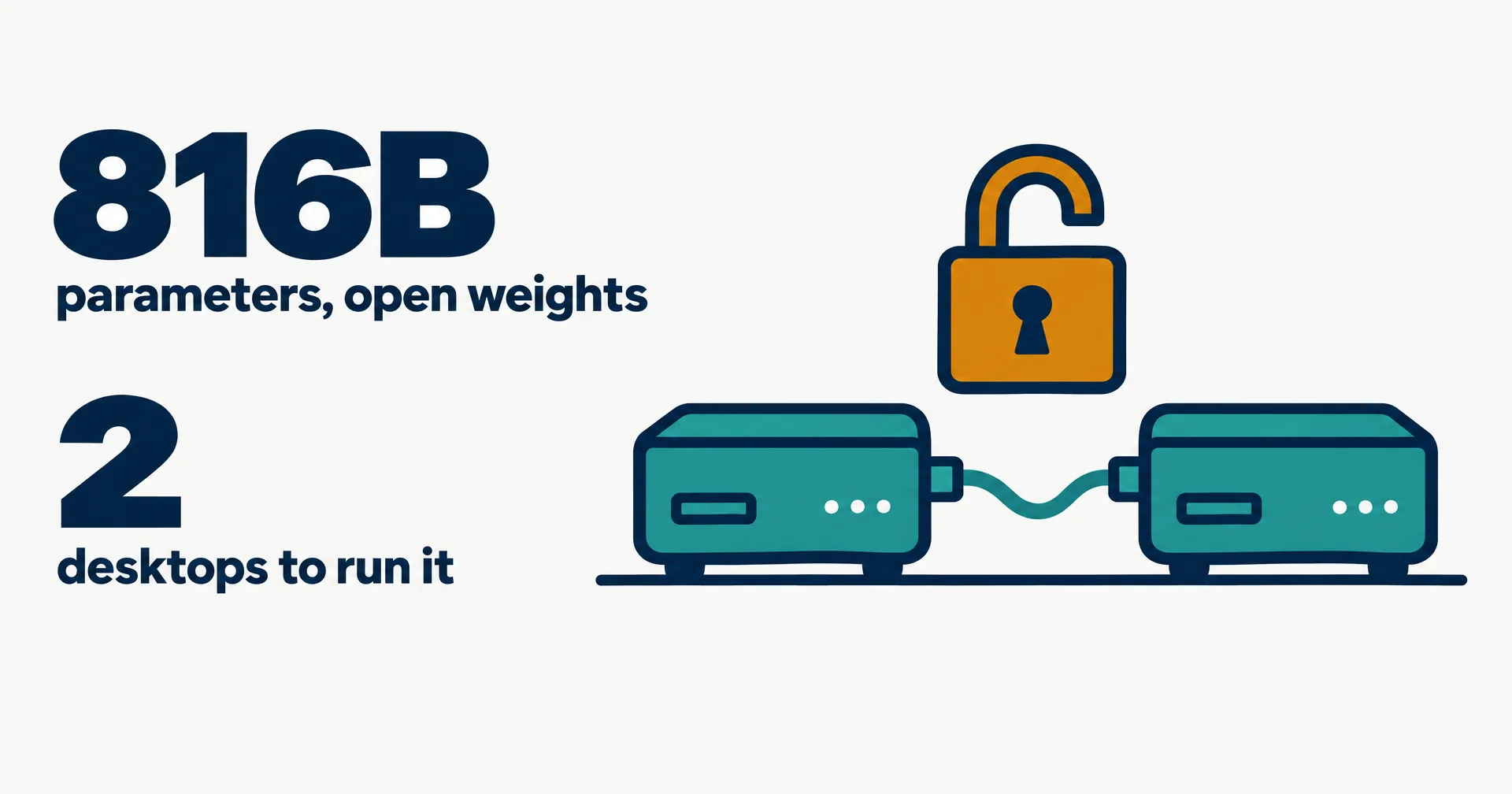
Meta released Muse Spark Open on October 15, 2026: an open-weight model with 816 billion parameters, 42 billion active per token, a 1 million token context window, and weights you can download and run yourself. Meta’s launch thread, posted at 17:08 UTC, calls it “the most capable US open-weight model to date” and says it is built for coding and agentic work.
The headline that traveled was the hardware. Meta says the model is optimized to run on two Apple M5 Ultra Mac Studios, and Apple’s machine learning team published benchmarks the same day showing it running across two and four Macs. CNBC framed it as Apple and Meta teaming up. It is a real collaboration, but a narrow one: local inference on Mac desktops, not Meta AI inside Siri or Apple Intelligence.
On this page · 6 sectionsOpen
 Meta released Muse Spark Open on October 15, 2026: 816 billion parameters, 42 billion active per token, a 1 million token context, and downloadable weights.
 Meta says it is optimized to run on two Apple M5 Ultra Mac Studios; Apple measured 15.74 to 36.73 tokens per second across two and four Macs.
 Meta trained it for agentic coding: reading codebases, writing and debugging code, and calling tools, with text, image, audio and video input.
 The Apple tie-up is local inference on Macs, not Meta AI in Siri or Apple Intelligence.
 Seven hosts serve it today; OpenRouter lists $1.25 input and $4.25 output per million tokens.
§ 01What Meta released
| Item | Detail |
|---|---|
| Size | 816 billion total parameters, 42 billion active per token |
| Experts | 256 per mixture-of-experts layer, 8 selected per token |
| Context | Up to 1 million tokens |
| Inputs | Text, images, audio and video; output is text |
| Weights | BF16 and NVFP4 checkpoints on Hugging Face, SageMaker, Google Cloud Model Garden and Microsoft Foundry |
| Hosted APIs | Baseten, Fireworks AI, Groq, Modal, Nebius, OpenRouter and Together AI |
| API price | $1.25 input and $4.25 output per million tokens on OpenRouter |
Hugging Face’s write-up says “Meta trained Muse Spark Open for agentic coding”: reading a codebase, writing and debugging code, and calling tools. It is the full-size sibling of Muse Glimmer, the small dense model Meta released in August, and shares its tokenizer. It is a different model from Muse Wonder, the closed frontier model Meta launched on October 12.
§ 02What two Macs actually do
Apple’s post is the clearest picture of what “runs on your desk” means. In its native precision the model needs more than 1.6TB of memory for the weights alone. Quantized to 4 bits (NVFP4) that drops to about 493GB, still too large for one 512GB Mac Studio once inference memory is added. So it has to be split across machines, linked over Thunderbolt.
| Setup | Tokens per second |
|---|---|
| Two Macs, pipeline split | 15.74 |
| Two Macs, tensor split | 24.99 |
| Four Macs, tensor split | 36.73 |
Apple says four Macs generate “over 36 tokens per second”, faster than most people read. Two is the minimum, and two M5 Ultra Mac Studios with enough memory is a serious desk budget, not a laptop. Hugging Face also reports about 21 tokens per second from a 3-bit quantization on a single 512GB M3 Ultra, a trade of quality for fitting on one machine.
§ 03How open is open
The weights are downloadable and fine-tunable; Hugging Face shows a full fine-tuning run with TRL. Meta’s thread says the weights ship under its own license, and coverage notes that license carries conditions, so “open weight” is the accurate term rather than open source. Read the license before building a commercial product on it.
Meta has not published a benchmark table comparing Muse Spark Open with GLM, DeepSeek or Qwen in the launch materials we read. “Most capable US open-weight model” is Meta’s claim; independent scores will come from Artificial Analysis and others in the coming days.
§ 04What it means if you run agents
For companies that cannot send data to a cloud model, this is a meaningful step: a frontier-sized, agent-trained model that a small team can run on hardware it owns, or rent cheaply from seven hosts. For everyone else, the useful comparison is price and task quality against the hosted models you already use, tested on your own work.
CellCog’s AI employees run on Claude Opus 5.5, not on Muse models. This post reads Meta’s, Apple’s and Hugging Face’s materials as published.
§ 05What we are watching
- Independent benchmark results, starting with Artificial Analysis.
- The full license terms and any use restrictions for large companies.
- Whether Apple ships Muse Spark Open support beyond MLX research, for example in its developer tools.
§ 06Sources
- Meta, Muse Spark Open launch thread on X, October 15, 2026.
- Apple Machine Learning Research, Local and Distributed Large LLM Inference with MLX and RDMA on Mac Studio, October 15, 2026.
- Hugging Face, Muse Spark Open: open-weight frontier multimodal mixture-of-experts model from Meta, October 15, 2026.
- OpenRouter, meta/muse-spark-open, read October 15, 2026.
- CNBC, Apple and Meta team up to make Muse AI model run on Mac computers, October 15, 2026.
Q1How big is Muse Spark Open?
816 billion total parameters with 42 billion active per token, 256 experts per layer with 8 chosen per token, and up to 1 million tokens of context.
Q2What hardware does it need?
Even at 4 bits the weights take about 493GB, so Apple splits it across at least two 512GB M5 Ultra Mac Studios. A 3-bit quantization runs on one 512GB machine at lower quality.
Q3How much does it cost to use?
OpenRouter lists $1.25 per million input tokens and $4.25 per million output tokens. The weights are free to download under Meta’s license.
Q4Is it open source?
It is open weight: you can download, run and fine-tune it, under Meta’s own license with conditions. Read the license before commercial use.
Q5Does CellCog use Muse Spark Open?
No. CellCog’s AI employees run on Claude Opus 5.5. This post reads Meta’s, Apple’s and Hugging Face’s materials as published.