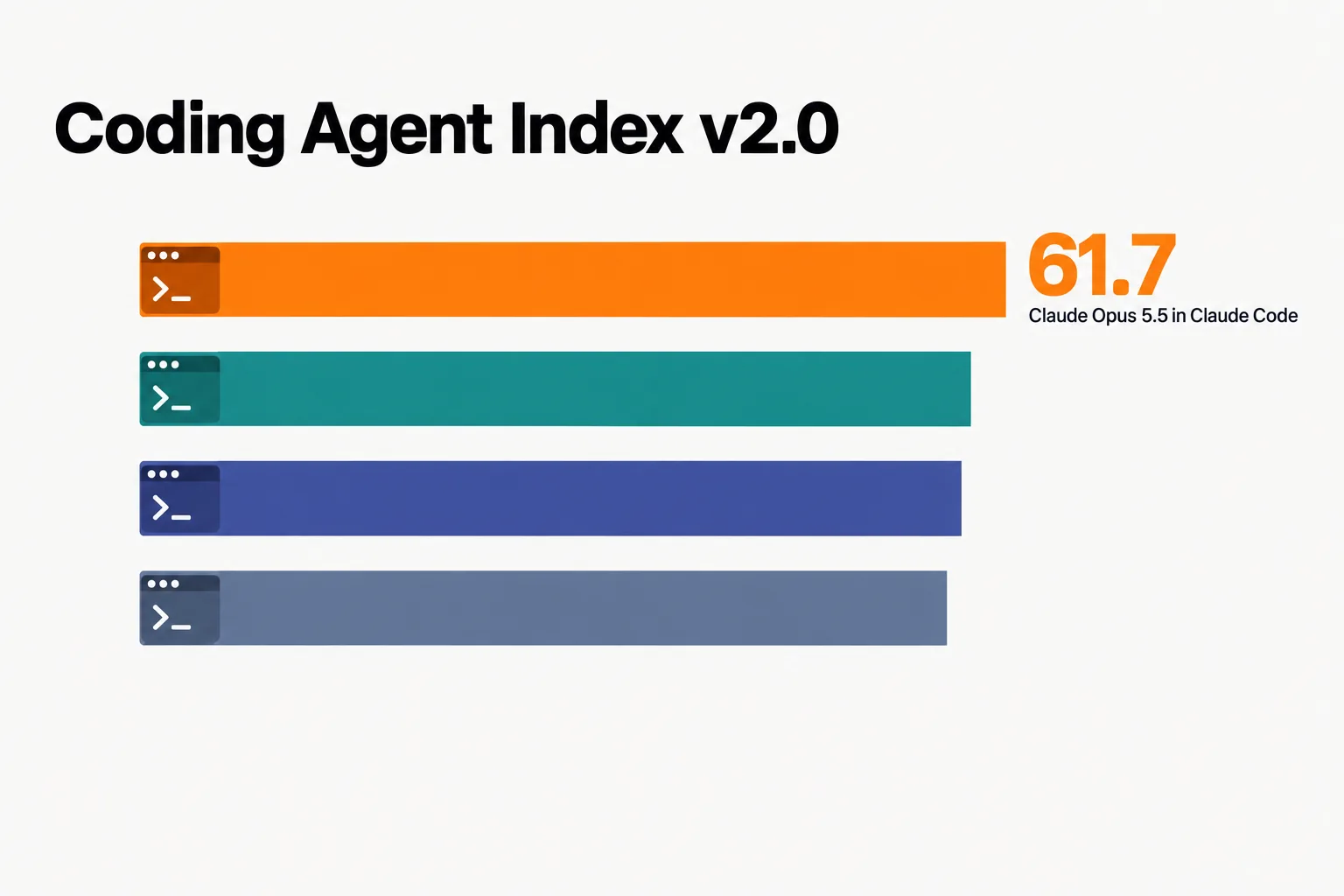
Artificial Analysis launched version 2.0 of its Coding Agent Index on October 23, 2026, and Claude Code running Claude Opus 5.5 leads it at 61.7. The index scores a model and its agent harness together, so the leaderboard ranks combinations like Claude Code with Opus 5.5 or Codex with GPT-6.1 Sol rather than bare models.
Version 2.0 swaps in Cognition’s FrontierCode for DeepSWE and tightens the grading of repository Q&A. This page reads the announcement on X, posted at 00:17 UTC, and the index on artificialanalysis.ai. Every number below is theirs.
On this page · 6 sectionsOpen
 Artificial Analysis launched Coding Agent Index v2.0 on October 23, 2026. It scores a model together with its agent harness across 290 tasks.
 Claude Code with Claude Opus 5.5 leads at 61.7, ahead of Claude Code with Sonnet 5.5 at 59.3 and Muse Code with Muse Wonder Full at 58.9.
 Cognition’s FrontierCode replaces DeepSWE. It grades whether a maintainer would merge the change, and Opus 5.5 leads it at 56.0%.
 Stricter grading on repository Q&A dropped the average of 21 returning configurations from 58.8% to 57.1%.
 The top score costs the most: $11.42 per task for Opus 5.5 in Claude Code against $0.39 for DeepSeek V4.1 Flash in Codex at 47.3.
§ 01The top four
The index now covers 290 tasks across software engineering, terminal use and repository Q&A, “with the three benchmarks weighted equally.” The top four sit within 4.1 points of each other, and three of them run in Claude Code.
| Rank | Harness and model (setting) | Index score |
|---|---|---|
| 1 | Claude Code, Claude Opus 5.5 (max) | 61.7 |
| 2 | Claude Code, Claude Sonnet 5.5 (max) | 59.3 |
| 3 | Muse Code, Muse Wonder Full (max) | 58.9 |
| 4 | Claude Code, Claude Fable 5.1 (max with fallback) | 57.6 |
Meta’s Muse Code is the only harness outside Anthropic in the top four. The first OpenAI entry, Codex with GPT-6 Astra, scores 54.7.
§ 02What FrontierCode changes
FrontierCode v1.1 replaces DeepSWE v1.1. It is Cognition’s benchmark: 100 software engineering tasks on real open-source repositories, with a private test set, “graded on whether a maintainer would merge the change.”
- Blocking checks decide pass or fail. An attempt that fails one scores zero.
- Non-blocking checks decide how good. An attempt that passes every blocking check scores between 70% and 100%.
- Shortcuts score zero. Artificial Analysis scans each run with a modified version of Cognition’s rule-based scanner, and “any attempt flagged for accessing solution material scores zero.”

This is where Opus 5.5 pulls ahead. On FrontierCode alone it scores 56.0%, against 52.6% for Codex with DeepSeek V4.1 Flash, 49.4% for Codex with GPT-6.1 Sol and 49.3% for Codex with GPT-6 Astra. Below the top the field is crowded: 15 of the 24 configurations score between 43% and 49%.
§ 03Stricter repository Q&A
The third benchmark keeps Scale AI’s 124 repository Q&A tasks and changes how they are judged. Artificial Analysis reworded 127 of the 1,306 rubric criteria, moved the judge to GPT-6 Luna at xhigh, and takes five votes per criterion. It renamed the result SWE-Atlas-QnA-AA and published the dataset and judge setup on Hugging Face.
The effect is a lower bar for everyone. Across the 21 configurations scored on both versions, the average fell 1.7 points, from 58.8% to 57.1%, and 14 of 21 moved down. Muse Code with Muse Spark Open fell 7.0 points; Codex with GPT-6.1 Sol gained 2.1.
§ 04The cost frontier
Four configurations sit on the cost frontier, where no other configuration scores higher for less money.
| Configuration | Index score | Cost per task |
|---|---|---|
| Codex, DeepSeek V4.1 Flash (max) | 47.3 | $0.39 |
| Codex, GPT-6.1 Sol (max) | 54.1 | $1.50 |
| Codex, GPT-6 Astra (max) | 54.7 | $7.04 |
| Claude Code, Claude Opus 5.5 (max) | 61.7 | $11.42 |

The spread is wide. The top score costs about 29 times the cheapest frontier point for 14.4 more points. GPT-6.1 Sol in Codex gets 54.1 for $1.50, a fraction of the price of Astra for almost the same score. Artificial Analysis adds: “Costs are pay-per-token API costs, not subscription prices.”
§ 05What the index does and does not tell you
- It ranks pairs, not models. Opus 5.5 is measured inside Claude Code; the same model in another harness can score differently.
- Max effort everywhere. Every leading entry runs at max or xhigh, which is also what drives the cost column.
- Benchmarks still disagree. The same day, a widely shared run of SlopCodeBench, which makes agents extend one program across several specs, put GPT-6 Astra and Sol at the top with scores near 16%. Long, changing work remains far from solved.
For us the result lands close to home: CellCog’s AI employees run on Claude Opus 5.5. The index tests Claude Code, not our harness, so we read it as a statement about the model, not about us.
§ 06What to watch
- Artificial Analysis says it will keep updating the index “with more evaluations and agents to come.”
- Whether Cursor, Grok Build and Kimi Code get scored on v2.0.
- Whether the next model releases move the FrontierCode ceiling above 56.0%.
Q1What is the Artificial Analysis Coding Agent Index?
An index that scores coding agents as a model plus its harness, such as Claude Code with Opus 5.5 or Codex with GPT-6.1 Sol. Version 2.0 averages three benchmarks with equal weight across 290 tasks.
Q2Which benchmarks are in v2.0?
FrontierCode v1.1 from Cognition for software engineering, Terminal-Bench 4.0 for terminal work, and SWE-Atlas-QnA-AA, Scale AI’s repository Q&A tasks with rubrics revised by Artificial Analysis.
Q3How does FrontierCode score an attempt?
It asks whether a maintainer would merge the change. Failing a blocking check scores zero; passing all of them scores 70% to 100% depending on the non-blocking checks, and an attempt flagged for using solution material scores zero.
Q4Is Opus 5.5 the best value?
It has the top score, not the lowest cost. Four configurations sit on the cost frontier, from DeepSeek V4.1 Flash in Codex at $0.39 a task to Opus 5.5 in Claude Code at $11.42.
Q5Do the costs match a Claude or ChatGPT subscription?
No. Artificial Analysis states the costs are pay-per-token API costs, not subscription prices.