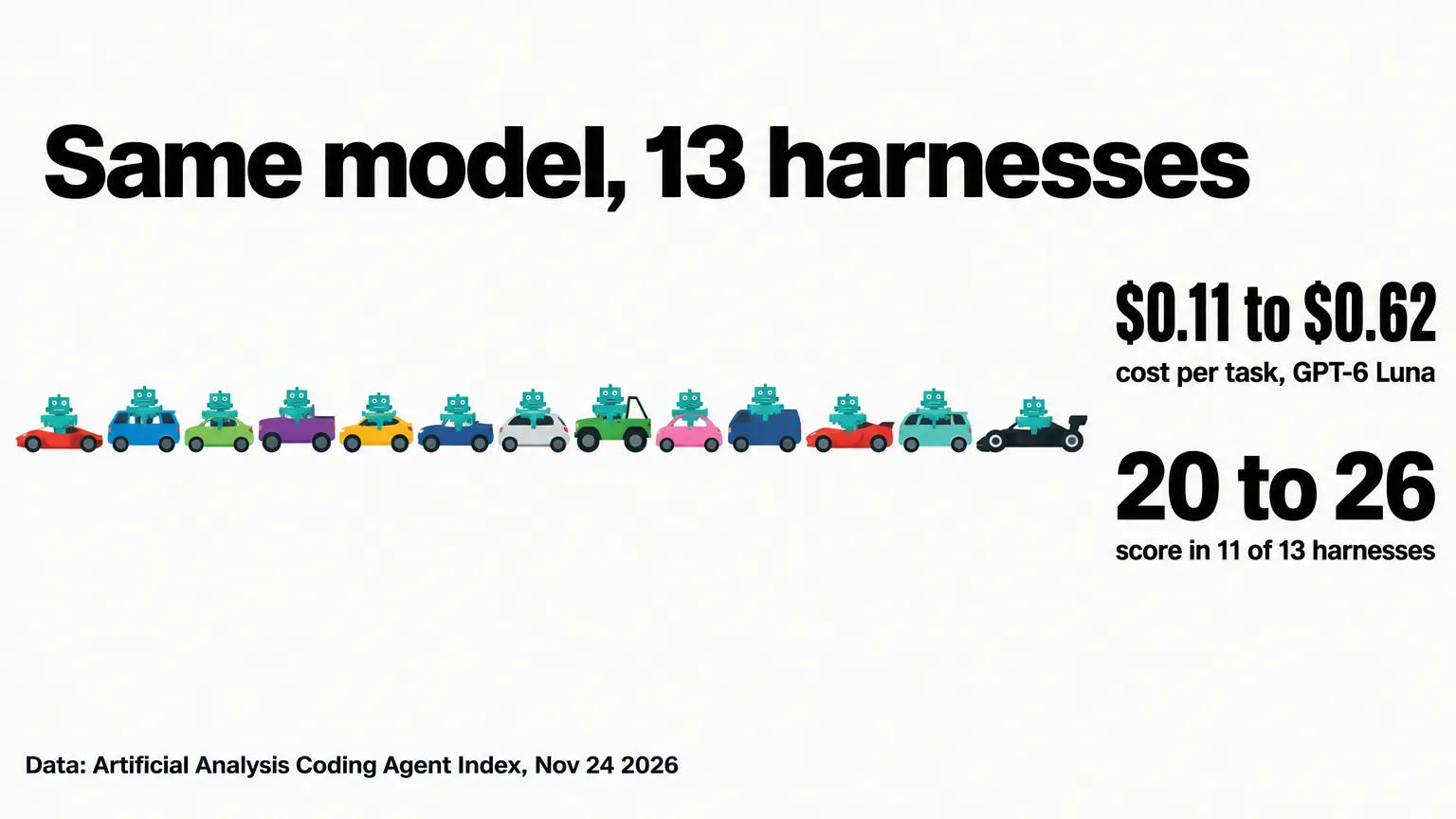
Artificial Analysis launched Harness Comparisons on its Coding Agent Index on November 24, 2026, holding two models fixed and changing only the harness. Its post on X puts the finding in one line: “the best harness varies between models, and harness choice has a greater impact on cost than score.” It had about 136,000 views when we read it through the X API at 03:30 UTC on November 25.
The test ran OpenAI’s GPT-6 Luna and Z.ai’s GLM-5.3-Flash “at max reasoning effort in 13 harnesses each, across v2.1 of the Coding Agent Index.” Every number below is from that post; we did not open the index page itself.
On this page · 6 sectionsOpen
- Artificial Analysis launched Harness Comparisons on its Coding Agent Index on November 24, 2026: two models held fixed, 13 harnesses each.
- No harness was best for both. GPT-6 Luna scored highest in Codex (26); GLM-5.3-Flash scored highest in Claude Code (39) and ranked last in Codex.
- The harness moved cost far more than score: 11 of 13 harnesses scored 20 to 26 with GPT-6 Luna, while cost per task ran from $0.11 in Pi to $0.62 in Muse Code.
- With GLM-5.3-Flash, cost per task ran from $0.38 in Mistral Vibe to $0.91 in Devin CLI, while 10 of 13 harnesses scored 35 to 39.
- No harness sat on the best price-for-score line for both models.
- GLM-5.3-Flash wrote 52k output tokens per task in Codex against 97k to 202k elsewhere; Artificial Analysis thinks that terse reasoning cost it score.
§ 01No harness wins for both models
The same harness landed at opposite ends for the two models. Codex, OpenAI’s own harness, gave GPT-6 Luna its top score of 26 and gave GLM-5.3-Flash its lowest. Claude Code gave GLM-5.3-Flash its top score of 39 and ranked 6th with GPT-6 Luna.
| Model | Harness | Score | Cost per task (USD) |
|---|---|---|---|
| GPT-6 Luna | Pi | 21 | 0.11 |
| GPT-6 Luna | mini-swe-agent | 25 | 0.16 |
| GPT-6 Luna | Codex | 26 | 0.19 |
| GLM-5.3-Flash | Mistral Vibe | 37 | 0.38 |
| GLM-5.3-Flash | Kimi Code CLI | 37 | 0.56 |
| GLM-5.3-Flash | Claude Code | 39 | 0.58 |
“No harness is on the Pareto frontier for both models,” the post says: none of the six harnesses above made the best-value list for the other model.
§ 02Cost moves more than score
For GPT-6 Luna, 11 of the 13 harnesses scored between 20 and 26. Cost per task in the same runs ran from $0.11 in Pi (with mini-swe-agent at $0.16) to $0.62 in Muse Code, a 5.6x spread.
GLM-5.3-Flash showed the same shape: 10 of 13 harnesses scored 35 to 39, while cost per task ran from $0.38 in Mistral Vibe to $0.91 in Devin CLI.

§ 03Why Codex hurt GLM-5.3-Flash
Artificial Analysis found that GLM-5.3-Flash changes how it thinks inside Codex: it “reasons in terse fragments in Codex and in full prose in the other 12 harnesses.” It wrote 52k output tokens per task there against 97k to 202k elsewhere. The post’s reading is careful: “We believe this contributes to its lowest performance occurring in the Codex harness.” That is a hypothesis from the testers, not a measured cause.
§ 04What it means if you pick tools
- Choose the model first, then the harness. A harness ranking without a model attached hides the biggest swing in the data.
- Compare cost per finished task. Within the band most harnesses hit, the bill moved several times more than the score.
- Test on your own work. Two models are a small sample; the order may change with a third.
§ 05Where CellCog stands
Our conflict, declared: CellCog is a harness too, built for AI employees rather than coding from a terminal, and it was not part of this comparison. The result fits what we see on our own side: the same model behaves differently depending on the tools, memory and loop around it. Our harness ranking covers the field month by month.
§ 06Sources
- Artificial Analysis on X, November 24, 2026, 03:31 UTC (Harness Comparisons launch, Coding Agent Index v2.1)
- OpenAI Codex on GitHub, mini-swe-agent on GitHub and Claude Code docs, harnesses named in the test
Q1What is a harness?
The software around a model that gives it tools, files and a loop to work in, such as Codex, Claude Code or Devin CLI.
Q2Is Codex a bad harness?
Not for its own model: GPT-6 Luna scored highest there. It ranked last with GLM-5.3-Flash, which reasoned in terse fragments inside it.
Q3Why does cost vary so much?
Harnesses differ in how many turns and output tokens a model spends per task; GLM-5.3-Flash used 52k to 202k output tokens per task depending on the harness.
Q4Was CellCog tested?
No. CellCog is not in the comparison; it is a harness for AI employees rather than a coding CLI.
Q5How should I choose a harness?
Pick the model first, then test two or three harnesses with it on your own tasks, and compare cost per finished task as well as the score.