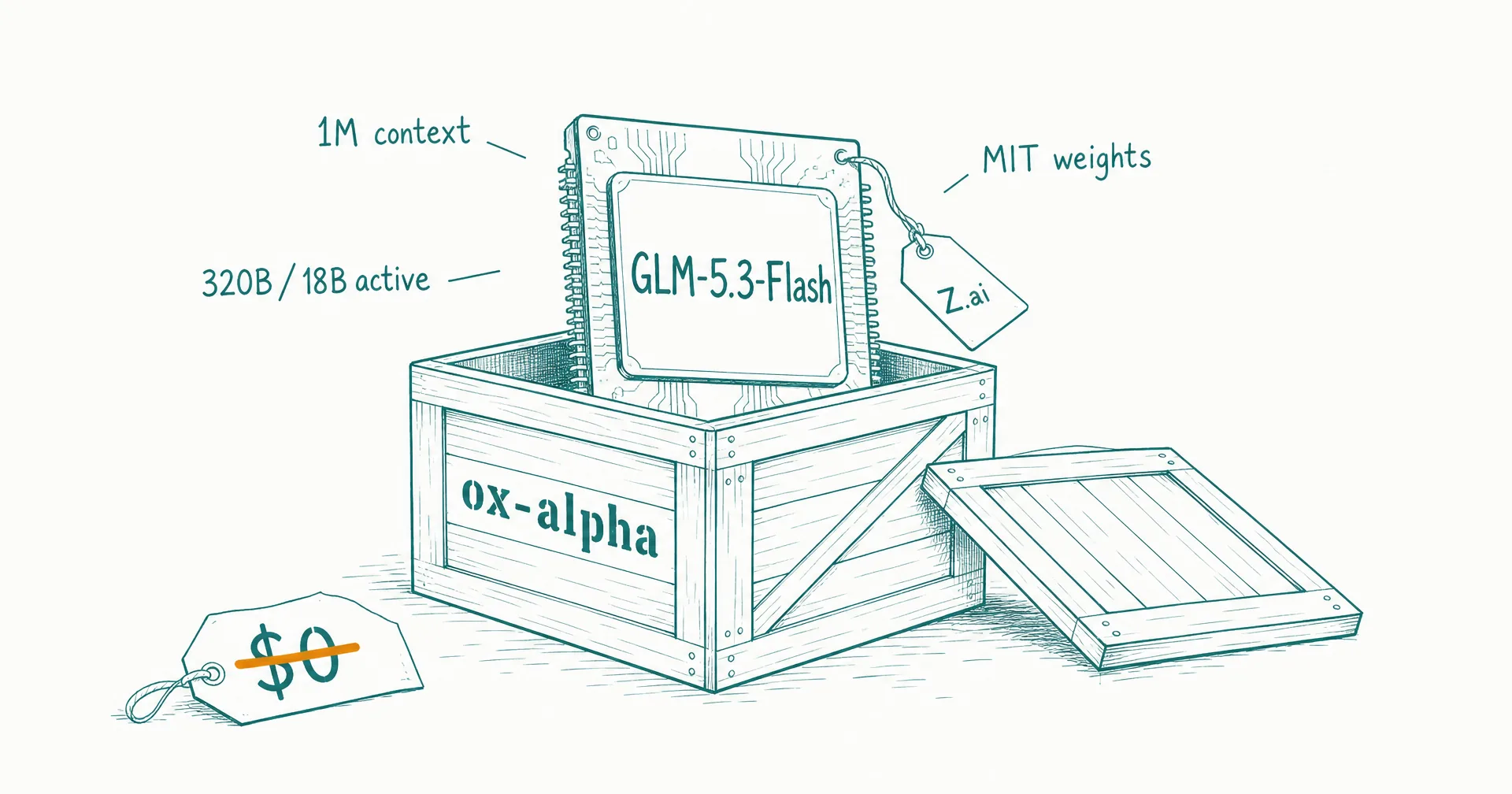
The mystery box got its paperwork. At 09:00 UTC on August 26, Bloomberg published Z.ai’s confirmation that Ox Alpha, the anonymous stealth model that burned through the agent-tools world for six days, was “a new iteration of its GLM series.” Five hours later, at 13:59 UTC, OpenRouter’s production catalog gained a new entry: z-ai/glm-5.3-flash, carrying the exact context window, output ceiling, and modality list the stealth listing had shown all along. The launch blog, the MIT-licensed weights, and a real price list landed the same day.
We tracked the stealth window as it happened in the Ox Alpha explainer and the pricing page, both now updated to the resolved record. This post is the reveal itself: what GLM-5.3-Flash is, what it costs, and what changes if you were one of the 221,000 people using it for free.
On this page · 10 sectionsOpen
- The reveal, hour by hour
- What GLM-5.3-Flash actually is
- What Z.ai claims, and what exists independently
- Update, August 30: the engineering write-up and the full official table
- What it costs now
- Update, September 9: the promo ended, and the routes split
- If you built on the free window
- The scoreboard on the stealth-era evidence
- The question the reveal did not answer
- The layer above the reveal
- On August 26, 2026, Z.ai confirmed to Bloomberg that Ox Alpha was a new GLM-series model. Five hours later, OpenRouter’s production catalog listed z-ai/glm-5.3-flash, and Z.ai published its launch post and MIT-licensed weights on Hugging Face.
- GLM-5.3-Flash is the first natively multimodal model in the GLM-5 series: 320B total parameters, 18B active, trained on a 30T-token multimodal corpus, with a 1,048,576-token context window and 131,072-token max output.
- It is, per Z.ai, the first open-source frontier model with a hybrid sparse-plus-linear attention architecture, cutting attention computation 3.01x and KV cache size 4.44x versus GLM-5.3.
- Real pricing replaced the $0 window: Z.ai lists $0.15/M input and $0.50/M output, and the 50 percent launch promo ($0.075 and $0.25) ended September 9. At 19:00 UTC that day OpenRouter’s route still charged the promo numbers, the first split between the two routes.
- The stealth/ox-alpha slug is gone from OpenRouter’s active catalog with no documented alias: anything built on the free endpoint needs the new model ID, a self-hosted deployment, or a budget.
- The stealth-era evidence trail (95-of-95 tokenizer match, Z.ai error strings, video-encoder fingerprints) called the GLM family correctly. The one question the reveal did not answer: what happened to prompts sent during the anonymous window.
- August 30 update: Z.ai’s engineering write-up publishes the full official table, adding NL2Repo (56.3) and Toolathlon Verified (78.4), details the 45-layer hybrid-attention architecture, and officially confirms the stealth traffic ran on Chinese AI accelerators.
§ 01The reveal, hour by hour
| Time (UTC) | Event | Source |
|---|---|---|
| ~09:00 | Z.ai confirms to Bloomberg that Ox Alpha is a new GLM-series model, weights coming “tonight” | Bloomberg News |
| 13:59 | z-ai/glm-5.3-flash appears in OpenRouter’s production catalog with real pricing |
OpenRouter API |
| Same day | Official launch post: “GLM-5.3-Flash: Frontier Intelligence, Flash Cost” | z.ai/blog/glm-5.3-flash |
| Same day | MIT-licensed weights public at zai-org/GLM-5.3-Flash | Hugging Face |
| Same day | stealth/ox-alpha absent from OpenRouter’s active catalog |
OpenRouter API |
One detail worth noticing: the Hugging Face repository’s creation timestamp is August 25 at 06:43 UTC, a full day before the reveal. This was a prepared launch, not a leak forced into the open. The six-day free window, in hindsight, looks exactly like what we guessed it was: launch marketing with the launch list pre-assembled.
§ 02What GLM-5.3-Flash actually is
| Item | Detail |
|---|---|
| Developer | Z.ai (Zhipu AI) |
| Architecture | Mixture-of-experts, 320B total parameters, 18B active per token |
| Attention | Hybrid sparse plus linear attention (first in the GLM series) |
| Pretraining | 30T-token multimodal corpus |
| Context window | 1,048,576 tokens |
| Max output | 131,072 tokens |
| Inputs | Text, images, video |
| Reasoning | Mandatory, with low/high/max effort settings |
| Agent features | Tool calling, structured output |
| License | MIT, weights on Hugging Face |
| Local serving | SGLang, vLLM, TokenSpeed, KTransformers (day one) |
Three architecture notes stand out from Z.ai’s own materials. First, it is the first natively multimodal model in the GLM-5 series: vision is not a bolted-on encoder for chat, it is wired into the coding loop, and Z.ai’s docs lean hard on “visual coding,” the model observing rendered interfaces and iterating against what it sees. Second, the hybrid attention design is the cost story: Z.ai calls it the first open-source frontier model to combine sparse and linear attention, and quantifies the win as 3.01x less attention computation and a 4.44x smaller KV cache than GLM-5.3. At a million tokens of context, KV cache is the bill, so that number is the entire economic argument. Third, the training corpus is 30T tokens. Keep that separate from the 16T figure that circulated during the stealth window: that was inference usage on one client in three days, not training data. Two different numbers that happen to sound alike.
§ 03What Z.ai claims, and what exists independently
Z.ai’s model card makes two headline claims: that GLM-5.3-Flash “outperforms GLM-5.2 across benchmarks and real-world workloads at one-tenth the price,” and that it approaches Claude Opus 4.8 on coding and agentic benchmarks. The card’s own chart lets you check both. These are Z.ai’s numbers, transcribed exactly:
| Benchmark | GLM-5.3-Flash | GLM-5.2 | DeepSeek-V4-Vision-Exp | Claude Opus 4.8 | GPT-5.6 Terra | Gemini 3.7 Flash |
|---|---|---|---|---|---|---|
| Terminal-Bench 2.1 | 84.3 | 81.0 | 83.9 | 85.0 | 87.4 | 85.8 |
| DeepSWE v1.1 | 63.4 | 46.2 | 59.3 | 58.0 | 69.6 | 65.3 |
| Agents’ Last Exam | 26.3 | 20.4 | 27.3 | 27.0 | 28.0 | not shown |
| AutomationBench | 48.8 | 26.2 | 38.8 | 41.0 | 37.2 | 52.3 |
| HLE w/ Tools | 55.3 | 54.7 | 55.1 | 57.9 | not shown | not shown |
| GDPval-AA v2 (Elo) | 1773 | 1504 | 1675 | 1582 | 1571 | 1527 |
Read against the claims, the chart is honest and, in places, undersells. The GLM-5.2 claim is unambiguous: Flash wins every row, with the two biggest jumps exactly where agent work lives, DeepSWE (46.2 to 63.4) and AutomationBench (26.2 to 48.8). The Opus claim is the modest one: “approaches” is accurate on Terminal-Bench, Agents’ Last Exam, and HLE, but on the chart’s own numbers Flash outscores Claude Opus 4.8 outright on DeepSWE, AutomationBench, and GDPval-AA. The vendor caveats still apply, these are Z.ai’s runs with Z.ai’s harness choices, and the card’s methodology footnotes (harnesses, temperatures, timeouts, per benchmark) at least make the runs reproducible. One reconciliation worth spelling out: the official DeepSWE 63.4 and the community stealth-window run’s 58.4 are both real, produced under different harnesses and budgets; Z.ai’s footnote specifies the mini-swe-agent harness with a 6-hour timeout and 400K context, more generous than the community setup.
The independent record is thinner but real, because the stealth window was itself a giant public evaluation. The completed 113-task DeepSWE community run resolved 58.4 percent with one attempt per task. Needle-retrieval tests held to roughly 934K tokens, so the million-token window is substance, not metadata. And the consistent shape of user reports held from day one: people who put it in a real agent harness with tools and a terminal rated it far higher than people who chatted with it. Whatever the official chart says, this is a model built for harness work.
§ 04Update, August 30: the engineering write-up and the full official table
Z.ai followed the reveal with its complete technical article, “More Intelligence with Less Compute,” dated August 31 China time, which is August 30 in the US. It adds three things to the record above.
First, the full official table against GLM-5.2, with two benchmarks the reveal-day chart did not include, NL2Repo and Toolathlon Verified:
| Benchmark | GLM-5.3-Flash | GLM-5.2 |
|---|---|---|
| Terminal Bench 2.1 | 84.3 | 81.0 |
| DeepSWE v1.1 | 63.4 | 46.2 |
| NL2Repo | 56.3 | 48.9 |
| Toolathlon Verified | 78.4 | 59.9 |
| AutomationBench v1.0.6 | 48.8 | 26.2 |
| Agents’ Last Exam | 26.3 | 20.4 |
| HLE with Tools | 55.3 | 54.7 |
| GDPval-AA v2 (Elo) | 1773 | 1504 |
The shape confirms the reveal-day read: the two biggest jumps are DeepSWE and AutomationBench, exactly where agent work lives, and the write-up frames all eight as measures of “planning, tool use, environmental feedback, and multi-step execution” that generalize past software development. It also publishes a multimodal set for the vision side: OfficeQA Pro 62.4, CharXiv Reasoning with Tools 89.4, Chartography with Tools 78.0, MVBench 77.8, MMVU 80.5.
Second, the architecture behind the price. The efficiency numbers now have their mechanism: 45 layers against the GLM-4.5 series’ 92, active parameters cut from 32B to 18B, linear attention for local dependencies plus a lightweight sparse-attention indexer for global retrieval, Manifold-Constrained Hyper-Connections in the training recipe, and IndexPool, which compresses four cached key vectors into one to hold indexer latency down at million-token context. The claimed result matches reveal day: roughly 3.0x less attention compute and a 4.4x smaller KV cache than GLM-5.3. The write-up keeps one honest caveat worth quoting: the KV-cache footprint still runs slightly larger than some comparable Flash-class models.
Third, the stealth window is now officially on the record, hardware included: “Before its official release, we evaluated GLM-5.3-Flash anonymously as Ox Alpha under real-world traffic, with all traffic served on Chinese AI accelerators.” The anonymous window was a demonstration of the domestic accelerator stack as much as of the model. What the write-up still does not say: anything about the prompts users sent during that window. The data question at the bottom of this page stands.
§ 05What it costs now
The $0 era ended with the name. Here is the full picture:
| Route | Input | Output | Cached input | Notes |
|---|---|---|---|---|
| Z.ai API, launch promo (ended) | $0.075 | $0.25 | $0.015 | 50 percent discount, August 26 to 24:00 Sept 9, 2026 (UTC+8); gone from the pricing page |
| Z.ai API, list | $0.15 | $0.50 | $0.03 | The current first-party price; cache storage still limited-time free |
| OpenRouter | $0.075 | $0.25 | $0.015 | Still the promo numbers at 19:00 UTC Sept 9, now half of Z.ai’s list |
| GLM Coding Plan | Subscription | Subscription | n/a | “Fully available” with 3x the quota, per Z.ai’s docs |
| Self-hosted | Your hardware | Your hardware | n/a | MIT weights; it is a 320B MoE, so plan accordingly |
For scale: GLM-5.3, the flagship, lists at $1.40 input and $4.40 output. Flash at list price is roughly a tenth of that, which is exactly the ratio Z.ai’s marketing leads with. Against the broader market, $0.15/$0.50 list positions it in the aggressive open-weight tier rather than anywhere near frontier-flagship rates, which is what the stealth-era GLM theory predicted the pricing would look like.
§ 06Update, September 9: the promo ended, and the routes split
The 50 percent launch discount expired at 24:00 Singapore time on September 9, and Z.ai’s pricing page now shows GLM-5.3-Flash at list only: $0.15 per million input tokens, $0.03 cached input, $0.50 output, with the promo sentence removed. Three hours after the deadline, OpenRouter had not moved: the endpoint OpenRouter labels Z.AI and the DeepInfra endpoint both still quoted $0.075, $0.25 and $0.015 at 19:00 UTC, which makes the aggregator half the price of Z.ai’s own API for the same model, for as long as that lasts. Reveal day’s table said the two routes matched exactly; that stopped being true today, and the lag runs in the buyer’s favor. We will note it here when it closes.
| Route | Input | Output | Cached input | Note |
|---|---|---|---|---|
| Z.ai API, list | $0.15 | $0.50 | $0.03 | Promo line removed from the pricing page |
| OpenRouter, Z.AI endpoint | $0.075 | $0.25 | $0.015 | Still the launch-promo numbers |
| OpenRouter, DeepInfra | $0.075 | $0.25 | $0.015 | Same as the Z.AI endpoint |
Update, September 11: the gap closed on Z.ai’s own route. OpenRouter’s endpoint list now shows the Z.AI endpoint at $0.15 in and $0.50 out, matching list; DeepInfra still serves the model at $0.075 and $0.25, and Relace at $0.09 and $0.30, so the cheapest paid route is now a third party, not Z.ai. Read September 11, 2026, 08:28 UTC. | OpenRouter, Wafer | $0.10 | $0.35 | $0.02 | Third-party host | | OpenRouter, GMICloud | $0.1125 | $0.375 | $0.0225 | Third-party host |
Two other facts landed in the same window. Z.ai is running a GLM Coding Plan usage campaign from September 3 to September 20, 2026, 23:00 to 09:00 UTC+8 daily: zero quota consumption in ZCode and doubled quota in other supported agents, for paid Coding Plan users, per Z.ai’s notice. And the option that outlives every promo is the weights: the MIT-licensed release has community quantizations on Hugging Face with six-figure download counts (unsloth’s GGUF build alone passed 187,000 downloads by September 9), which is where the search demand for running it free or locally now points.
§ 07If you built on the free window
Three practical consequences, in order of urgency. First, the slug: stealth/ox-alpha is out of OpenRouter’s active catalog and no alias is documented, so anything calling the old model ID should switch to z-ai/glm-5.3-flash now rather than waiting for requests to fail. Second, the meter is on: the same workload that cost nothing on Monday costs real money today, and the 50 percent promo window ended September 9, so the price you calibrate against is the list price (or, for now, OpenRouter’s lagging promo rate). Third, there is now a third option that did not exist during the window: the weights are MIT-licensed with day-one support in SGLang, vLLM, TokenSpeed, and KTransformers, so teams with datacenter GPUs can take the model in-house entirely.
§ 08The scoreboard on the stealth-era evidence
Worth a moment of respect for how this was called. Nobody leaked it: the identification was assembled in public from technical fingerprints, and every class of evidence held up. The 95-of-95 tokenizer probe match pointed at the GLM-5 vocabulary: correct. The API error envelopes matched Z.ai’s serving stack: correct, and that was operator evidence, not just lineage evidence. The video-token accounting matched GLM-5V-Turbo’s encoder: correct in direction, since the revealed model is natively multimodal GLM. The code-style fingerprints matched GLM-5.3: correct family. The competing Gemini theory, which ran on vibes and researcher winks, was wrong. The lesson for the next stealth model, and there will be one: tokenizers and error strings do not know how to lie.
§ 09The question the reveal did not answer
During the anonymous window, the retention terms disagreed by route: OpenCode said zero retention, OpenRouter’s stealth listing said the provider retains prompts and completions. The reveal converts “unknown counterparty” into “Z.ai,” which is a real improvement, because there is now a named company with published terms to hold to account. But as of reveal day we found no Z.ai statement about what happened to the prompts sent during the stealth window itself: whether they were retained, whether they touch training, whether deletion applies retroactively. If you sent sensitive code to a mystery box in exchange for free tokens, the mystery is solved and the question is not. That trade-off was the real price of the window, and it was on the label the whole time.
§ 10The layer above the reveal
Our standing argument through the whole Ox Alpha episode was that the harness layer, not the model layer, is where working AI gets decided, and reveal day is the cleanest demonstration of it. The model did not change on August 26. The same weights answered the same prompts. What changed was everything around it: the name, the price, the accountability, the slug your code points at. Teams whose work lived in the harness absorbed that as a config change; teams whose work lived on the free endpoint got a migration project. That layer is where we build, so discount accordingly: CellCog is the employee layer above models like this one, and GLM-5.3-Flash is now one more strong, honestly priced option in the rotation underneath it. We ranked the harness layer itself in our agent harness ranking, and the full stealth-window record stays preserved in the Ox Alpha explainer.
Q1Who makes Ox Alpha, and when was it confirmed?
Z.ai (Zhipu AI). Bloomberg published Z.ai’s confirmation that Ox Alpha was a new GLM-series iteration on the morning of August 26, 2026, and OpenRouter’s production catalog added the official z-ai/glm-5.3-flash entry at 13:59 UTC the same day, with identical specs to the stealth listing: same 1,048,576-token context, same 131,072-token output ceiling, same text, image, and video inputs.
Q2What happens to the stealth/ox-alpha endpoint?
It is gone from OpenRouter’s active model catalog, and no alias or redirect is documented. The old informational page still loads, but code pointed at stealth/ox-alpha should switch to z-ai/glm-5.3-flash. Do not assume the old slug keeps answering.
Q3How is GLM-5.3-Flash different from GLM-5.3?
It is a smaller, cheaper, natively multimodal sibling, not a quantized copy. GLM-5.3-Flash starts from a newly trained base model with 320B total and 18B active parameters, versus the much larger flagship, and adds a hybrid sparse-plus-linear attention design that Z.ai says cuts attention computation 3.01x and KV cache 4.44x relative to GLM-5.3. Z.ai’s own claim is that it outperforms GLM-5.2 across benchmarks at one-tenth the price.
Q4What does GLM-5.3-Flash cost after the promo ends?
Z.ai’s list prices are $0.15 per million input tokens, $0.50 per million output, and $0.03 per million cached input. The 50 percent launch discount ended at 24:00 on September 9, 2026, Singapore time, and the pricing page now carries those figures with no promo line. Cached-input storage is still marked limited-time free.
Q5Is GLM-5.3-Flash in the GLM Coding Plan?
Yes. Z.ai’s docs state it is fully available on the GLM Coding Plan with three times the quota, alongside GLM-5.3, GLM-5.2, and GLM-5-Turbo.
Q6How good is it, actually?
Per Z.ai’s own chart: it beats GLM-5.2 on every published benchmark (DeepSWE 63.4 vs 46.2, AutomationBench 48.8 vs 26.2) and outscores Claude Opus 4.8 on three of six rows, including DeepSWE (63.4 vs 58.0), while trailing on Terminal-Bench 2.1 (84.3 vs 85.0). The largest independent datapoint is still the stealth window itself: a completed 113-task DeepSWE community run resolved 58.4 percent under a leaner harness, and needle tests held to roughly 934K tokens of context.