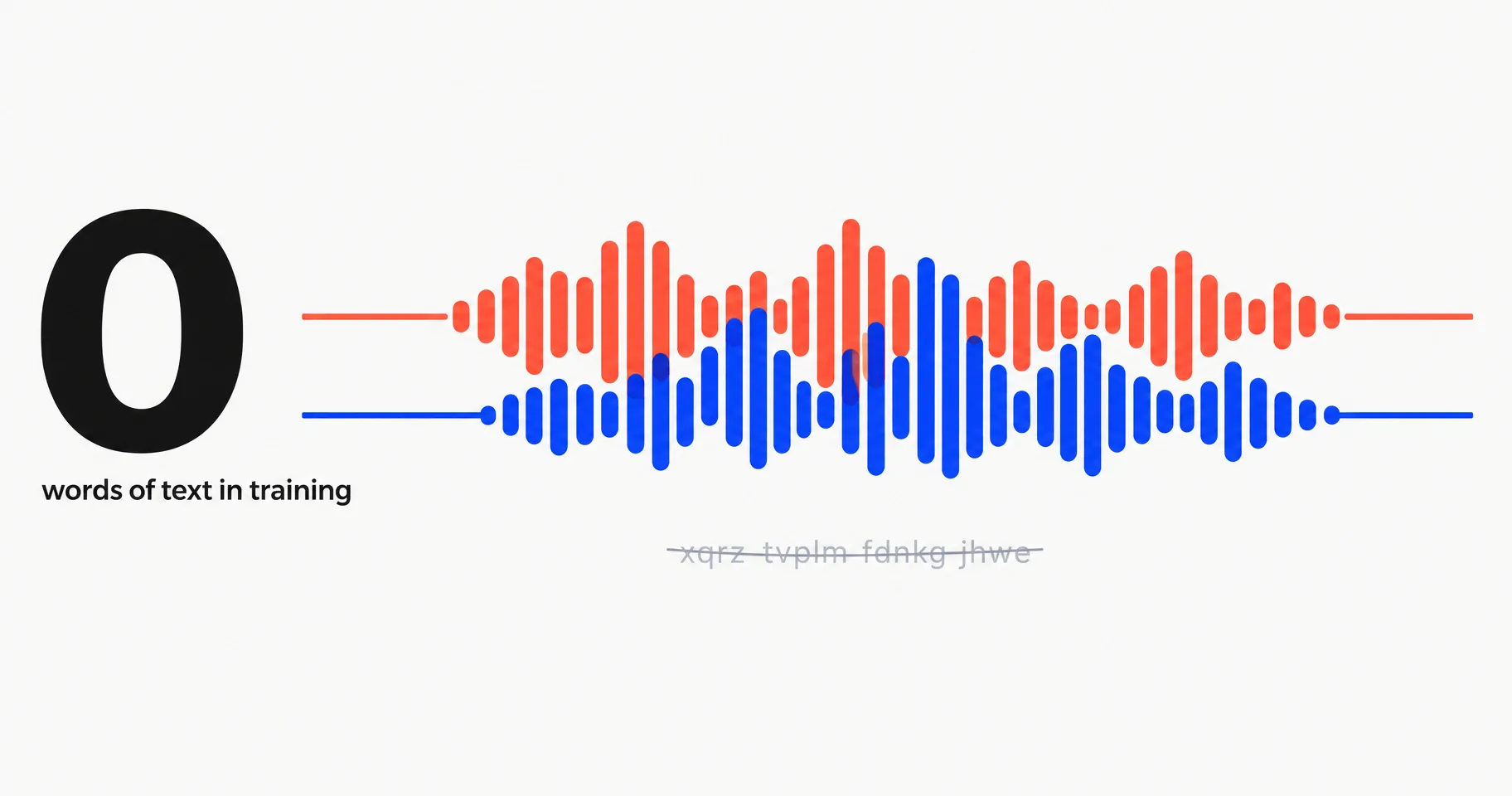
Block has shown Dessa, a speech model that learned to hold a live conversation from recorded human speech alone, with no text and no pretrained model underneath. Jack Dorsey announced it on X at 18:23 UTC on October 23, 2026, calling it “the most authentic full-duplex speech model ever built”. The post had about 4.1 million views by 02:20 UTC the next day.
It is a research preview. Block’s Dessa page has recordings, a waitlist and an application form for safety researchers. It has no weights, API, price or benchmark. This page reads that page directly and sets Dessa beside the live voice models you can use today.
On this page · 7 sectionsOpen
 Block showed Dessa on October 23, 2026: a full-duplex speech model that listens and talks at the same time, trained only on recorded human conversation.
 Block says it used no text and no pretrained model, and trained Dessa on a single NVIDIA GB200 NVL72 rack.
 Block says it runs faster than real time and locally on a MacBook Pro M4 Max or better, with no latency figure.
 It is a research preview: a waitlist and early access for AI safety researchers, with no weights, API or price published.
 The evidence is recordings Block chose. There are no benchmarks, no model size and no list of languages yet.
§ 01What Block released
| Item | What the page says |
|---|---|
| What it is | A research preview of a full-duplex, speech-to-speech model |
| Training data | Human conversation audio only: no text, no pretrained models |
| Training compute | One NVIDIA GB200 NVL72 rack |
| Speed | Inference faster than real time, no figure given |
| Hardware | Runs locally on a MacBook Pro M4 Max or better |
| Access | A waitlist, plus early access for a small group of AI safety researchers |
| Weights, API, price | None published; launch links are marked as coming soon |
| Benchmarks | None; the evidence is a set of recorded conversations |
The team is a small research lab inside Block, founded by former members of Dessa, the Toronto deep learning startup. The page says the group has built deep learning models since 2012 and generative speech models for over eight years, reports directly to Dorsey, and is led by Ragavan Thurairatnam.
The training claim is the headline. Block says it trained Dessa from scratch on conversation audio: “Sounds! No text, no pretrained models.” It also says “we figured out how to train Dessa on only one NVIDIA GB200 NVL72”, a single rack of 72 GPUs, which is small next to the clusters behind frontier text models. On data, Block says Dessa learned language from “hundreds of times fewer words” than a large language model needs, without giving a number.
§ 02How Dessa differs from today’s voice AI
Most voice assistants are a relay: speech becomes text, a text model writes a reply, and a voice reads it out. Block’s argument is that the relay throws away what text cannot carry, such as tone, sarcasm, a sigh or a laugh. In the page’s words: “Run speech through text and all of that is gone”.

Dessa takes audio in and gives audio out, and it is full-duplex: it listens while it talks. That lets it cut in, back off when interrupted, and make the small listening noises people make while someone else speaks. Block says “It learned to hold a real-time conversation simply by listening.” Its example of what text loses is one sentence about stolen CUDA code, said aloud with the stress on a different word each time. The words never change; the meaning changes every time.

Block frames this as a safety issue too. “Imagine being in serious pain while a voice AI has no idea and just keeps going.” Its answer is to put the model in front of outside safety researchers before any wider release.
§ 03How it compares
| Model | Maker | How you get it | Latency on record | Price on record |
|---|---|---|---|---|
| Dessa | Block | Waitlist and safety-researcher access | Faster than real time, no figure | None |
| Moshi | Kyutai | Open weights under CC-BY 4.0; code under MIT and Apache | 160 ms in theory, about 200 ms on an L4 GPU | Free to run on your own hardware |
| GPT-Realtime-2 | OpenAI | Hosted API | No figure on the model page | $32 per 1M audio input tokens, $64 per 1M output |
| Gemini 3.8 Live | Hosted API, 70 languages, barge-in | No figure on the overview page | $0.005 per minute of audio in, $0.018 out (paid tier) |
Moshi is the closest research comparison: a full-duplex model Kyutai released with weights, a 7B-parameter core and a published latency, with “a practical overall latency as low as 200ms on an L4 GPU”. OpenAI and Google sell hosted live voice models with prices, documentation and support for many languages. Dessa has the most striking claim of the four, speech-only training, and the least evidence: recordings Block chose, no numbers, and no way to try it.
One recording has Dessa talking to OpenAI’s voice model, with a disclaimer under it: “The developer of GPT-Live-1 is not affiliated with Block and has not reviewed or endorsed Dessa.”
§ 04What is still unproven
- Quality outside the clips. Block says “Every clip below is a live recording of a person talking to Dessa.” That shows the model can do it; it does not show how often.
- What it knows. Every fact Dessa holds came from sound. Block itself lists how efficiently such a model learns facts and languages as open research questions.
- Languages. The page names none.
- Running on a laptop. Claimed for a MacBook Pro M4 Max or better; nobody outside Block has tested it yet.
- Acting on anything. The page does not say whether Dessa can call a tool, read a document or look something up. For a voice agent that answers a business phone, that is most of the job.
§ 05Where CellCog stands
Our conflict, declared: we build CellCog, a platform where a business hires AI employees that keep memory and work as a team. Our AI employees join meetings and take phone calls in a live voice from another vendor, and our agent tiers run Claude Opus 5.5. We do not use Dessa and had no part in it. We follow voice models because the voice decides how an AI employee sounds on a call, and a voice that hears tone is half of a good one. The other half is a brain behind the voice that can use tools and remember, which is what Dessa’s page does not cover yet.
§ 06What we are watching for
- Launch links, which the page says are coming soon.
- The first outside reports, from the safety researchers Block is letting in.
- Numbers: a latency figure, a model size, any benchmark.
- Weights or an API, and at what price.
§ 07Sources
- Jack Dorsey, announcement on X, October 23, 2026, 18:23 UTC (time computed from the post id); about 4.1 million views read at 02:17 UTC October 24.
- Block, Dessa, read October 24, 2026, 02:20 UTC.
- Kyutai, Moshi README, read October 24, 2026.
- OpenAI, GPT-Realtime-2 model page, read October 24, 2026.
- Google, Gemini API pricing and Live API overview, read October 24, 2026.
Q1When did Block announce Dessa?
October 23, 2026. Jack Dorsey’s post on X went up at 18:23 UTC, a time computed from the post id.
Q2Who built Dessa?
A small AI research lab inside Block, founded by former members of Dessa, the Toronto deep learning startup, and led by Ragavan Thurairatnam. It reports directly to Jack Dorsey.
Q3Is Dessa open source?
No. Block’s page offers no weights, code or license. Kyutai’s Moshi is the full-duplex model with open weights, under CC-BY 4.0.
Q4How is Dessa different from ChatGPT voice or Gemini Live?
Block says Dessa never turns speech into text and was trained without text at all. OpenAI and Google sell hosted live voice models with published prices; Dessa has no API yet.
Q5Does CellCog use Dessa?
No. CellCog’s agent tiers run on Claude Opus 5.5, and its AI employees’ meeting and phone voice comes from another vendor. We follow voice models because they decide how an AI employee sounds on a call.