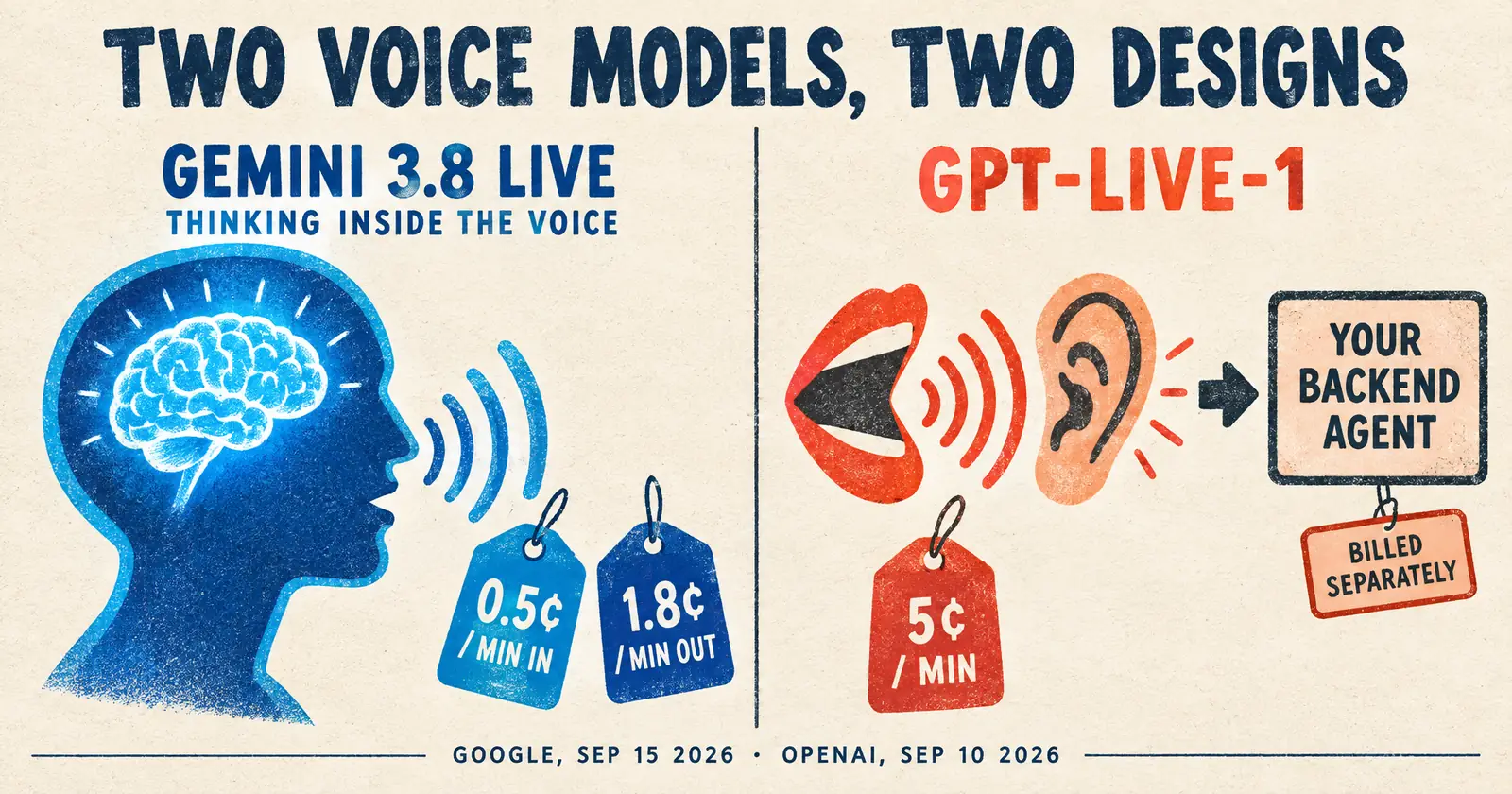
Google released Gemini 3.8 Live and Gemini 3.8 Live Extended Thinking on September 15, 2026, at 17:00 UTC (the blog post’s own timestamp; Google DeepMind’s X post followed at 17:05 UTC: “The models talk, think, and handle tasks in the background without breaking your flow”). The Gemini API changelog marks both generally available the same day. Five days earlier OpenAI released GPT-Live-1, and the two launches make opposite bets about where the thinking in a voice agent should live.
This page is the record: what shipped, what it costs, the numbers Google published, the protocol changes a developer meets on upgrade, and how the design compares with OpenAI’s. Every quotation is from Google’s announcement, the developer post, the model pages, the pricing page or the changelog, all read on release day.
On this page · 8 sectionsOpen
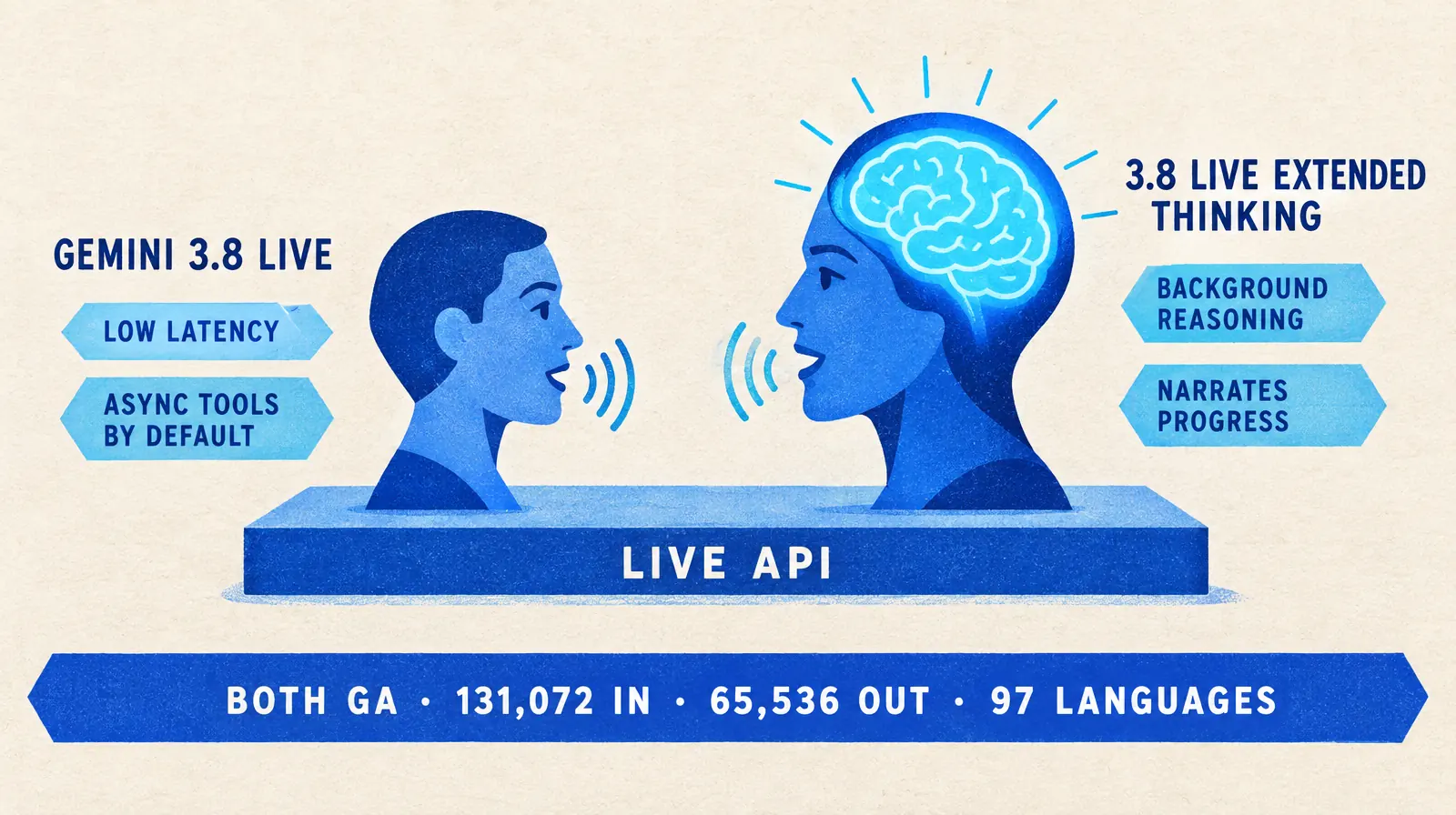
 Google released two audio-to-audio models on September 15, 2026, both generally available in the Gemini API and Google AI Studio: gemini-3.8-live, described as “Built for scale and cost efficiency, combining conversational intelligence with fluid dialogue and visual grounding”, and gemini-3.8-live-extended-thinking, “Built for high-complexity tasks, with increased intelligence and multi-step reasoning”.
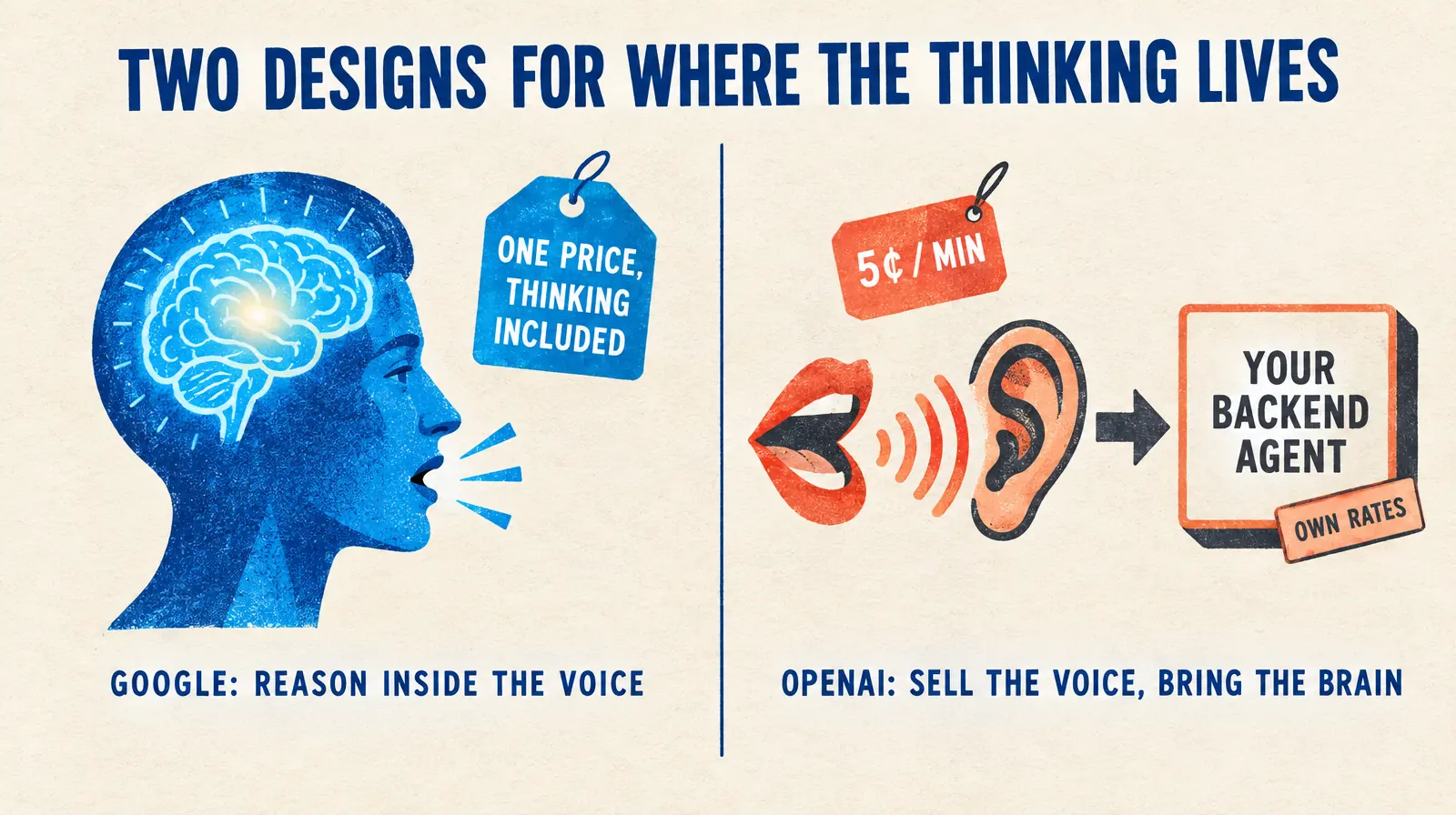
 The thinking lives inside the voice model. 3.8 Live has interleaved reasoning and no thinking level to set; Extended Thinking “reasons and speaks simultaneously”, takes a low, medium or high thinking level, and narrates its progress while it works. OpenAI’s GPT-Live-1, released five days earlier, does the opposite: the voice model delegates reasoning to a backend you choose.
 Prices, paid tier: audio in $3.00 per million tokens or $0.005 a minute, audio out $12.00 per million or $0.018 a minute, text $0.75 in and $4.50 out per million, image and video in $1.00 per million or $0.002 a minute. Output prices include thinking tokens. GPT-Live-1 is $0.05 a minute for the voice layer, with the backend billed on top.
 Google’s numbers, all Google’s own: Extended Thinking scores 82.6 and the number one spot on Artificial Analysis’ Speech to Speech Quality Index, 68.6% on tau-Voice, 35.1% on Sierra’s tau-Voice-banking, 97.7% on Big Bench Audio; 3.8 Live places second in the Speech Agent Arena; both sit on the ServiceNow EVA-Bench Pareto frontier.
 Specs shared by both: text, image, audio and video in, text and audio out; 131,072 tokens in and 65,536 out; 97 languages detected and switched mid-conversation; asynchronous function calling by default; proactive audio permanently on; affective dialogue removed; grounding with Google Search supported; no caching, no batch, no structured outputs.
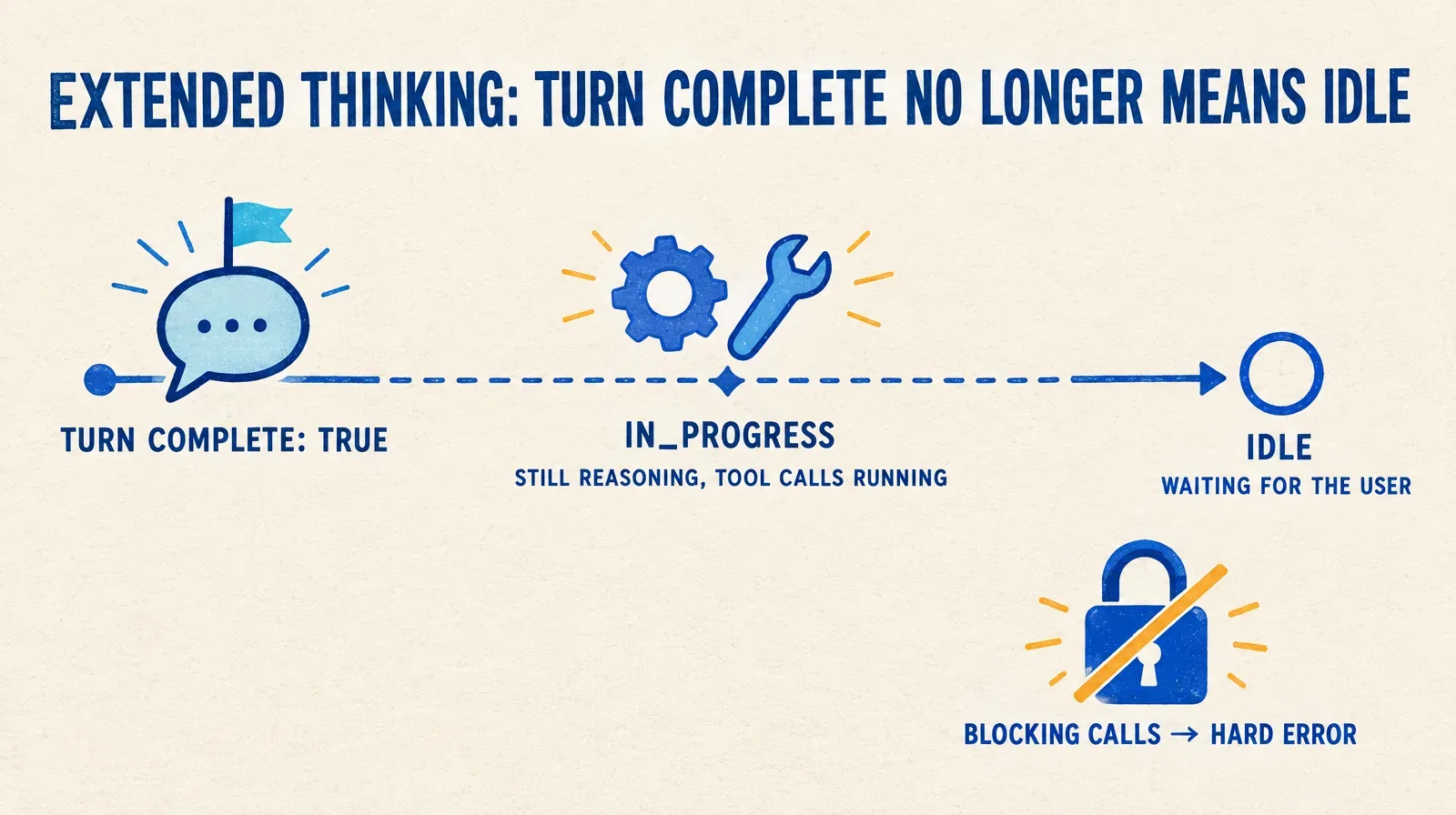
 Extended Thinking changes the session contract: “turnComplete: true no longer indicates that the model is idle”, clients read interaction_status for IN_PROGRESS or IDLE, blocking function calls return a hard error, and MINIMAL thinking is not supported. Migrating from gemini-3.1-flash-live-preview to 3.8 Live means dropping thinking_level and accepting async as the default.
§ 01What shipped
| Item | Gemini 3.8 Live | Gemini 3.8 Live Extended Thinking |
|---|---|---|
| Model code | gemini-3.8-live | gemini-3.8-live-extended-thinking |
| Status | Stable, GA September 15, 2026 | Stable, GA September 15, 2026 |
| Google’s one line | “Built for scale and cost efficiency, combining conversational intelligence with fluid dialogue and visual grounding” | “Built for high-complexity tasks, with increased intelligence and multi-step reasoning” |
| Inputs | Text, images, audio, video | Text, images, audio, video |
| Outputs | Text and audio | Text and audio |
| Token limits | 131,072 in, 65,536 out | 131,072 in, 65,536 out |
| Thinking | Interleaved reasoning; thinking_level not supported | Background reasoning; thinking_level low, medium or high; MINIMAL not supported |
| Function calling | Asynchronous by default; blocking still allowed | Asynchronous only; blocking returns a hard error |
| Also | Search grounding supported; caching, batch, structured outputs, code execution, URL context not supported | Same |
| Languages | 97, detected and switched mid-conversation | 97 |
| Where else | Search Live; private preview in Gemini Enterprise | Gemini Live; Docs Live for AI Pro and Ultra; Gmail Live and Keep Live for all AI subscribers; private preview in Gemini Enterprise |
Both models replace a cascade. Google’s developer post: “These models represent a step-change from our previous live models and provide a more streamlined alternative to cascaded architectures”. The model page for 3.8 Live lists the migration from gemini-3.1-flash-live-preview, which is the model these two sit beside on the pricing page; Google publishes no deprecation notice for it today.
§ 02Thinking inside the voice
The headline capability is that the model keeps talking while it works. Of 3.8 Live, Google writes: “It executes tools and API calls in the background while continuing the conversation, so the model can acknowledge requests and keep chatting while tasks finish in the background”. Of the larger model: “3.8 Live Extended Thinking reasons and speaks simultaneously”, acknowledging a request out loud and narrating progress while the reasoning runs behind the conversation. It “automatically detects and transitions between 97 supported languages mid-conversation”.
That design shows up in the session contract, and the Extended Thinking model page is blunt about it: “turnComplete: true no longer indicates that the model is idle”. The client keeps listening after the turn ends and reads a new interaction_status field, IN_PROGRESS while background reasoning or asynchronous tool calls are still running, IDLE when the server is waiting on the user. Function calls are asynchronous only on Extended Thinking: “Synchronous blocking mode is not supported and returns a hard error”. On both models, “Proactive audio is now permanently enabled” and “Affective dialogue is removed from the API”.
§ 03The numbers Google published
| Claim | Model | Source line |
|---|---|---|
| Artificial Analysis Speech to Speech Quality Index | Extended Thinking | “capturing the #1 overall spot” at 82.6 |
| tau-Voice | Extended Thinking | 68.6%, “leads in agentic task completion” |
| Sierra tau-Voice-banking | Extended Thinking | 35.1% |
| Big Bench Audio | Extended Thinking | 97.7% |
| Speech Agent Arena | 3.8 Live | “securing a second place” |
| ServiceNow EVA-Bench | Both | “our models push the Pareto Frontier for complex workflows by successfully balancing accuracy with conversational quality”; run on the Live API on Gemini Enterprise Agent Platform |
Two of these are third-party boards Google reports its placing on; the rest are Google’s runs of published benchmarks. No outside run of either model existed on launch day. One customer quote in the developer post, from Ambr AI, credits the Extended Thinking model with faster, more expressive training simulations delivered in over 70 languages through one integration.
§ 04Pricing: two rates for Google, one for OpenAI
Google’s pricing page lists one paid-tier block covering gemini-3.8-live, gemini-3.8-live-extended-thinking and gemini-3.1-flash-live-preview. The developer post’s own line: “Competitively priced at $0.005/min for audio input” and $0.018 a minute for audio output.
| Line | Per 1M tokens | Per minute |
|---|---|---|
| Audio in | $3.00 | $0.005 |
| Audio out (thinking tokens included) | $12.00 | $0.018 |
| Text in | $0.75 | |
| Text out | $4.50 | |
| Image and video in | $1.00 | $0.002 |
| Grounding with Google Search | 5,000 free requests a month shared across Gemini 3.x, then $14 per 1,000 |
OpenAI’s GPT-Live-1 is $0.05 a minute of session, billed per second, for the voice layer only; whatever backend model does the reasoning is billed at its own rates on top. The two schemes do not convert exactly, since a Gemini minute is billed per stream and a GPT-Live minute covers the whole session, but the shape is clear: a minute of speaking on Gemini costs under two cents including the thinking, a minute on GPT-Live-1 costs five cents before the thinking.
§ 05Two designs for where the thinking lives
| Gemini 3.8 Live Extended Thinking | GPT-Live-1 | |
|---|---|---|
| Released | September 15, 2026, GA | September 10, 2026, GA |
| Who reasons | The voice model itself, in the background | A backend model or agent the developer chooses |
| Tool calls | The voice model executes them asynchronously | The backend executes them; the app owns permissions and task state |
| Pricing shape | Per token or per minute, thinking tokens inside the audio output price | Per minute for the voice, backend billed separately |
| Session state | interaction_status IN_PROGRESS or IDLE from the server | The app tracks backend lifecycle; interrupting speech does not cancel backend work |
| What the developer configures | thinking_level, tools, grounding | The backend model or harness, in Responses or client delegation |
Google’s bet is that one model should hear, think and speak, and that the operator should not have to build the thinking half. OpenAI’s bet is that the conversation and the worker are different things, and that the developer should bring the worker. Both are defensible. The Google design is simpler to ship and cheaper by the minute; the OpenAI design lets the thing that reasons be the thing that already holds your memory, your credentials and your rules, and lets you swap it without touching the voice.
§ 06Where we sit
Our conflict, declared: we build CellCog, an AI employee platform. Our agents route to Claude Fable 5.1 at Core and Max and Gemini 3.8 Flash at Flash; none of our modes routes to a Live model, and nothing here is a claim about Google or OpenAI voices inside CellCog.
We do have a stake in the argument. Since September 15 our AI employees attend Google Meet and Zoom calls, and we built that on the split design: a real-time voice layer does the hearing and the talking, and the employee, with its memory, its task board and its approval rules, does the thinking behind it and types anything that binds the company. We chose the split because the employee already existed and already held the context; the voice was the last piece, not the first. Google’s launch is the strongest case yet for the other way round, and a business that has no employee behind the phone yet will find Extended Thinking the shorter road. The question the two launches leave open is the same one: when the call ends, where does what was said go, who remembers it next week, and who was allowed to promise what. That is not a model property; it is the employee behind whichever model was talking.
§ 07What we are watching for
- Independent benchmarks. Google’s Artificial Analysis and Speech Agent Arena placings are board results; the first outside run of tau-Voice or Big Bench Audio on either model gets folded in here.
- Vertex and Gemini Enterprise GA. The announcement names private preview in Gemini Enterprise and nothing about Vertex AI; a GA notice flips the availability row.
- A deprecation date for gemini-3.1-flash-live-preview. The migration guide exists; the deprecations page carries no date today.
- Per-minute versus per-token drift. Google publishes both; if the per-minute rate moves independently of the token rate, the table above changes.
- Gemini 3.5 Transcribe pairing. The developer post ships the two Live models alongside Google’s speech-to-text model (85+ languages, 4.0% streaming WER by Google’s figure); a bundled price or product would be its own record.
§ 08Sources
Google, Introducing Gemini 3.8 Live and 3.8 Live Extended Thinking, Tom Ouyang and Malini Jaganathan, published 2026-09-15T17:00:00Z. Google, Build real-time voice applications with Gemini 3.8 Live and 3.5 Transcribe, September 15, 2026. Google DeepMind on X, announcement thread, 2026-09-15T17:05:22Z. Gemini API, Gemini 3.8 Live model page, Gemini 3.8 Live Extended Thinking model page, pricing, release notes, all read September 15, 2026. OpenAI, Build more natural voice experiences with GPT-Live-1 in the API, September 10, 2026; our GPT-Live-1 record.
Q1Which model should a developer pick?
Google’s changelog draws the line: gemini-3.8-live is “The default option for most low-latency voice agent experiences and real-time dialogue without reasoning delays”; gemini-3.8-live-extended-thinking is “recommended when higher background reasoning is required”. The two share a price block, so the choice is latency and reasoning depth, not cost.
Q2Where can people use them outside the API?
Per Google’s announcement, 3.8 Live is in Search Live for everyone and in private preview in Gemini Enterprise; Extended Thinking is in Gemini Live, in Docs Live for Google AI Pro and Ultra subscribers, and in Gmail Live and Keep Live for all Google AI subscribers, with private preview in Gemini Enterprise and Workspace business rollout to come.
Q3What breaks when I upgrade from Gemini 3.1 Flash Live?
Per the model page: change the model string; drop thinking_level (not supported on 3.8 Live); asynchronous function calling is now the default and blocking is opt-in on 3.8 Live but returns a hard error on Extended Thinking; proactive audio is always on; affective dialogue is gone from the API; and on Extended Thinking, turnComplete no longer means the model is idle, so read interaction_status.
Q4Are the benchmarks independent?
Two are third-party leaderboards Google cites its scores on (Artificial Analysis’ Speech to Speech Quality Index, where Google reports the top spot at 82.6, and the Speech Agent Arena, where 3.8 Live is second). The tau-Voice, Sierra tau-Voice-banking, Big Bench Audio and EVA-Bench figures are Google’s own runs, and Google notes the EVA-Bench run used the Live API on Gemini Enterprise Agent Platform.
Q5Does CellCog use Gemini 3.8 Live?
Not as of this page. Our agents route to Claude Fable 5.1 at Core and Max and Gemini 3.8 Flash at Flash, none of which is a Live model. Our AI employees do attend Google Meet and Zoom calls since September 15, and that product uses the split design, a real-time voice layer with the employee reasoning behind it; this page is about the models, not that supplier.