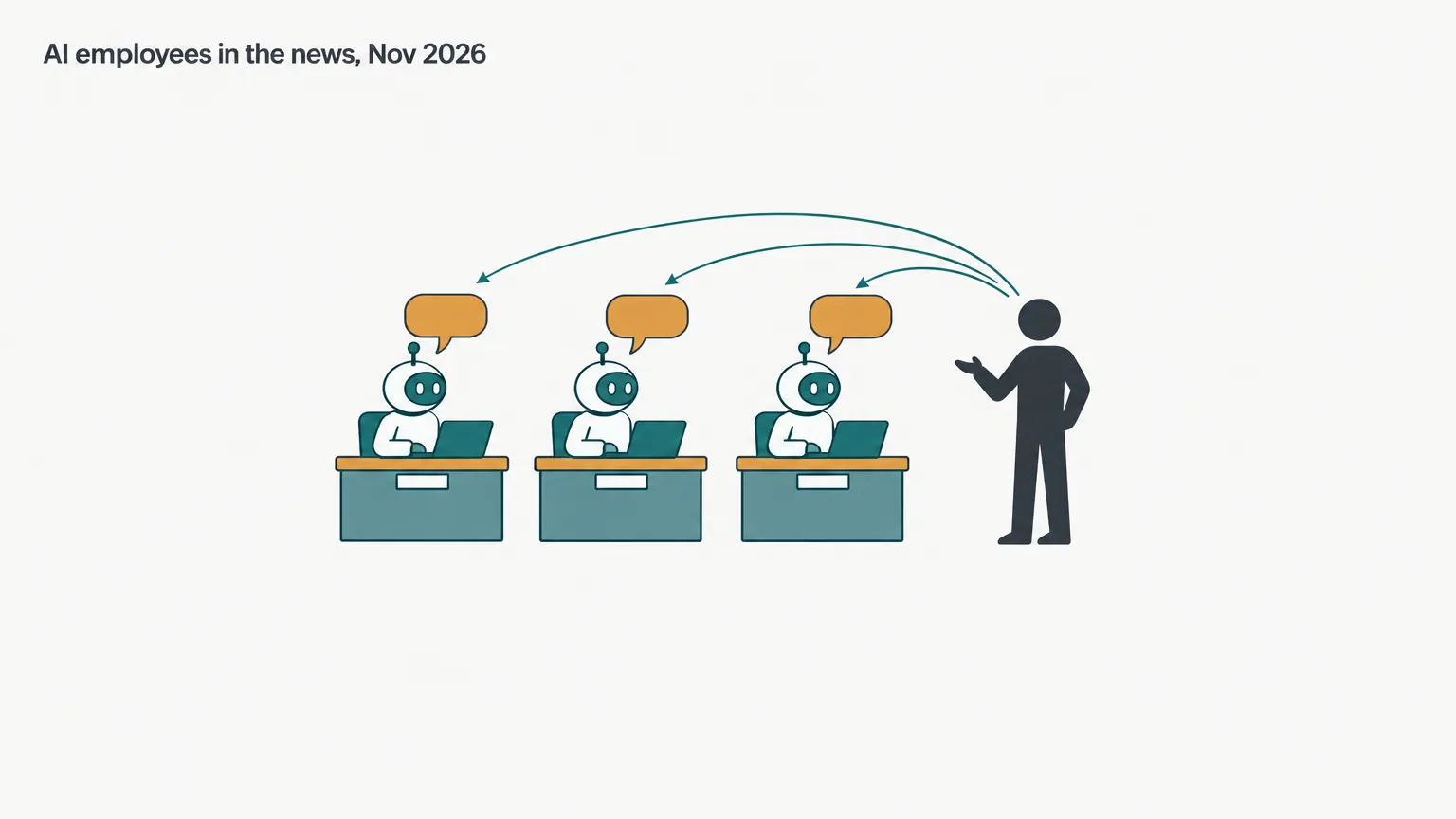
A handful of small companies have started giving AI agents real executive titles, and this week The Wall Street Journal went looking at what that actually means in practice. CellCog is one of the companies in the story, so read this with that in mind: we build the product being described.
The reporting, by Patrick Coffee for CMO Today on November 5, 2026, lands on a careful conclusion. These agents are doing real senior work, and the humans around them still watch closely. Both things are true at once, and that is the honest version of where AI employees are right now.
 The Wall Street Journal’s CMO Today reported on November 5, 2026 that small companies are giving AI agents real executive titles, with CellCog as one of the examples.
 The WSJ wrote that marketing, growth and engineering agents are the top-selling products at CellCog, a startup that makes a core model behave like an AI employee.
 Reporter Patrick Coffee interviewed two CellCog agents live; they kept deferring to the CEO and saying they probably should not answer, which he read as the agents trained to check back.
 That deferral is the design: every CellCog AI employee classifies its actions and anything above the owner’s set level waits for a human.
 Users in the story agree human oversight stays mandatory, especially when an agent hits a case it was not trained for.
 It is the second major outlet to cover CellCog in a month, after The New York Times in October.
§ 01What the WSJ found
The piece opens at SaaStr, a software-events company running with three full-time human employees and a “superagent” that has held the title of VP of marketing since March. Its chief AI officer starts each day checking in with the agent that does her old job and calls it “a lot of mental overhead” to manage agents that are “constantly working.” The company says the agents made it more efficient: SaaStr reports 8% of its invoices have been late since the agents took over, down from 56% under humans.
CellCog appears next. In the Journal’s words, “Marketing, growth and engineering agents are the top-selling products at CellCog,” described as a startup that specializes in “taking a core large language model and figuring out orchestration around it to make it behave like an AI employee.” Our founder, Nitish Garg, is quoted on why he built his own: he grew frustrated with the company’s pace and started testing the product on himself.
| Company | What the agent does | Human oversight |
|---|---|---|
| SaaStr | A “superagent” leads marketing; three human staff remain | Chief AI officer reviews the work daily |
| CellCog | Marketing, growth and engineering agents | Founder trained them to check back at every opportunity |
| Ravenopus | One founder plus 35 agents writing copy and buying ads | Founder says you cannot ignore what they are doing |
§ 02The part we are glad they noticed
In a companion CMO Today newsletter, Nat Ives asked Coffee what it was like to interview two of our agents live. His answer is the quote we would have chosen ourselves: our marketing and growth agents “kept deferring to the CEO” and saying “I probably shouldn’t answer that.” As Coffee put it, “he’s trained them to check back with him at every opportunity.”
That is not a bug in the demo. It is the design. Every CellCog AI employee classifies what it is about to do, and anything above the approval level the owner sets waits for a human. An agent that defers on a reporter’s question is an agent that will defer before it sends an email, spends money, or ships something to your customers. The interview surfaced the safety model better than any pitch could.
§ 03The honest frame
The users in the story agree on one thing, and so do we. As Ravenopus founder Linara Bozieva told the Journal, “I don’t think that you can hire that team, then not pay any attention to what they are doing and expect that there will be a good result.” Human oversight is mandatory, especially when an agent hits a situation it was not trained for. That is exactly why the approval gate is the center of how CellCog works, not an afterthought.
This is also the second major outlet to cover us in a month, after The New York Times wrote in October that “CellCog helps other companies hire A.I. employees.”
§ 04Sources
- Patrick Coffee, Can an AI Agent Be Your Next CMO? At Some Small Startups, It Already Is., The Wall Street Journal, November 5, 2026.
- Nat Ives, Startups Test the Waters With the AI Executive, WSJ CMO Today newsletter, November 5, 2026.
- Our record on the best AI employee platforms, where the New York Times coverage is noted.
Q1When did the WSJ cover CellCog?
On November 5, 2026, in a CMO Today article by Patrick Coffee and a companion newsletter by Nat Ives, both about AI agents taking on executive roles at small companies.
Q2What is CellCog, per the WSJ?
A startup that specializes in taking a core large language model and figuring out orchestration around it to make it behave like an AI employee, according to founder and CEO Nitish Garg.
Q3Why did CellCog's agents defer to the CEO in the interview?
By design. Every CellCog AI employee classifies its actions, and anything above the approval level the owner sets waits for a human. An agent that defers on a question will defer before a send, a spend, or a customer-facing action.
Q4Has CellCog been in other press?
Yes. The New York Times covered CellCog in October 2026, writing that CellCog helps other companies hire AI employees.