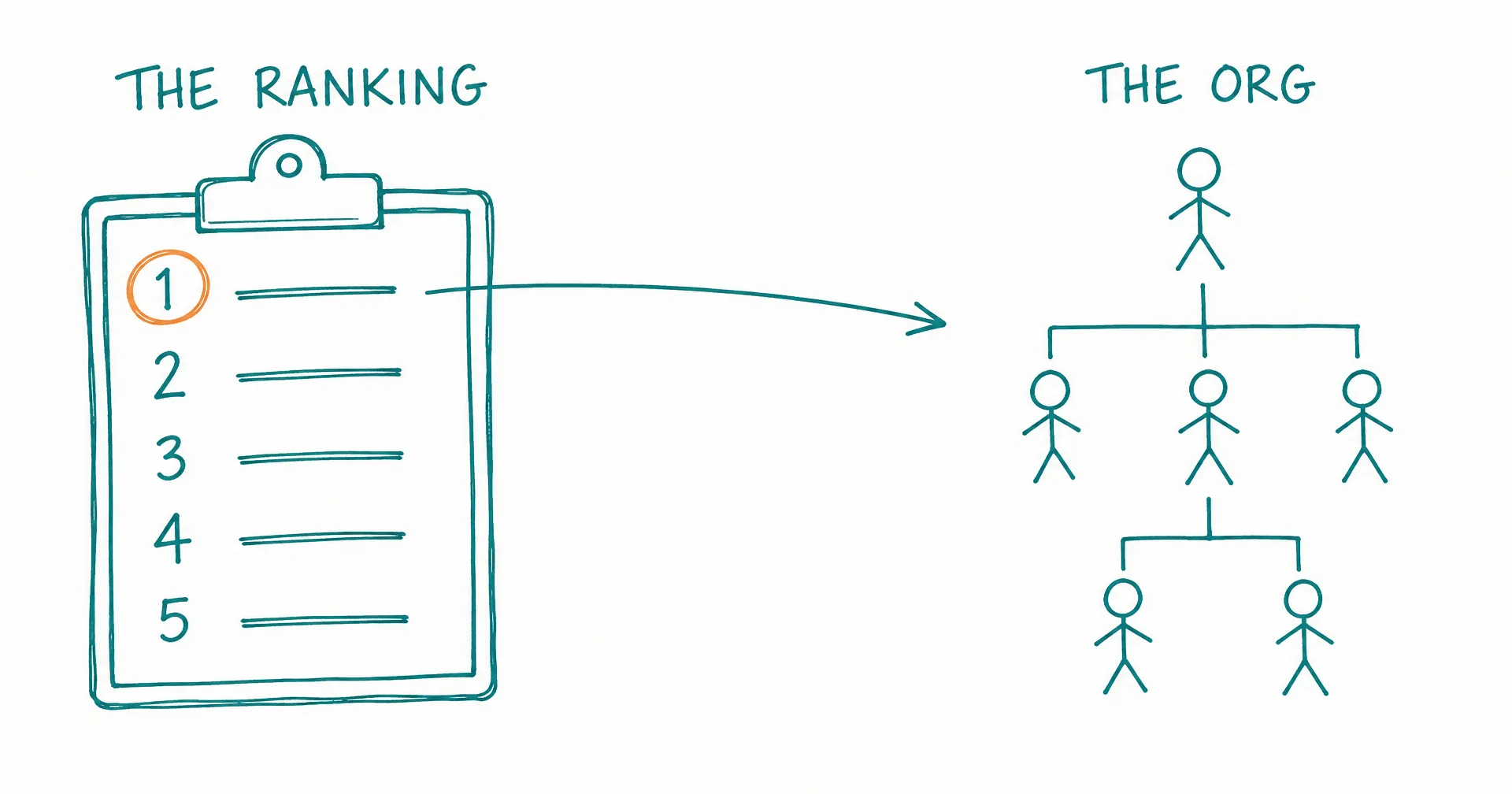
Search for “best AI employee platform” today and you will find a strange market: the phrase covers at least three different products. Some vendors sell standing workers you hire into roles. Some sell no-code builders that assemble workflows and call the result an employee. Some sell one specialist, usually a sales rep, packaged with the infrastructure to run it. Comparing them on one axis flatters whoever wrote the list.
This page is our entry in that search, first written August 26, 2026 and re-ranked on the first of every month at this same URL, and we run one of the platforms in it. So the method is the point: every price below was re-verified on the vendor’s own site today, every claim about a competitor comes from their own documentation or dated coverage, every claim about us carries a receipt you can check, and where a competitor beats us on an axis, we say so and name them. The spec-by-spec table version of this page lives at /compare/ai-employee-platforms; this is the ranked, opinionated version.
One more reason the timing matters: pricing in this category keeps moving. Since August, Lindy cut its entry plan, Artisan retired its published price, Coworker.ai and Relevance AI moved to sales-led enterprise pricing, 11x took down its pricing page, and Grok Bot’s plan gate changed twice. A list from last month is already wrong.
On this page · 17 sectionsOpen
- The three shapes, so the ranking makes sense
- The ranking, October 2026
- 1. CellCog: standing AI employees, and the org layer above them
- 2. Lindy: the no-code workflow pick
- 3. Grok Bot: the big-lab bundled entry
- 4. Coworker.ai: the per-seat teammate
- 5. Viktor: the managed employee in your chat tools
- 6. Sintra: the preset helper cast
- 7. Relevance AI: the orchestrated workforce
- 8. Artisan: the specialist AI BDR
- 9. 11x: the enterprise digital worker
- 10. Ema: the enterprise universal employee
- What changed since September
- The enterprise track, briefly
- How to choose, in five questions
- The honest caveats
- Update log
- Our ranking for October 2026 (prices re-verified on vendor sites October 1): CellCog first for standing AI employees with a real org layer, Lindy for no-code workflow automations, Grok Bot as the big-lab bundled entry.
- The phrase AI employee platform covers three different shapes: general platforms where you define any role, no-code workflow builders, and specialist employees that do one job, usually sales.
- Every price on this page was re-read on the vendor’s own site on October 1, 2026, and the category kept moving: Coworker.ai and Relevance AI replaced their published plans with sales-led enterprise pricing, 11x’s pricing page is gone, and Grok Bot is now included from Cursor Pro at $20 a month.
- We publish this page and rank ourselves first. Every CellCog claim is dated and linked or explicitly attributed to a user report; discount us and check the receipts.
- Specialists beat generalists at their one job: for outbound sales with managed mailboxes and deliverability, read Artisan and 11x as your real top of this list.
- Enterprise buyers have a separate track: OpenAI Frontier, Ema, and Aidan are sales-led deployments with no public pricing.
§ 01The three shapes, so the ranking makes sense
General platforms let you define any role and hire a standing worker into it. The worker persists: it has an inbox, a task board, a schedule, and memory that carries between sessions. CellCog is this shape; Grok Bot and Coworker.ai approach it from different architectures.
Workflow builders automate defined, recurring processes with no code. The result is dependable and cheap, and it is a workflow rather than a worker: it does what you wired, and the coordination stays with you. Lindy leads this shape; Relevance AI builds fleets of them.
Specialists do one job deeply, with the surrounding infrastructure managed for you. Almost all of them sell sales: Artisan, 11x, and Aidan. If their one job is your whole job, they deserve to win your evaluation.
The ranking below runs across all three shapes because that is how people actually shop this query. The “best for” column is the honest tiebreaker.
§ 02The ranking, October 2026
| Rank | Platform | Shape | Best for |
|---|---|---|---|
| 1 | CellCog | General: standing AI employees that form teams | Work that is a role, not a session |
| 2 | Lindy | No-code AI workflow builder | Defined recurring business workflows |
| 3 | Grok Bot | Big-lab AI teammates, subscription-bundled | Existing Cursor and SuperGrok subscribers |
| 4 | Coworker.ai | Enterprise AI teammate with org memory | Enterprises that want an AI coworker with company context |
| 5 | Viktor | Managed employee inside Slack and Teams | Companies that live in chat tools |
| 6 | Sintra | Fixed cast of 12 preset helpers | Solo founders who want ready-made personas |
| 7 | Relevance AI | Orchestrated agent workforce | Ops teams building multi-agent processes |
| 8 | Artisan | Specialist AI BDR | Outbound sales with managed deliverability |
| 9 | 11x | Enterprise digital sales workers | Sales orgs with enterprise budgets |
| 10 | Ema | Enterprise universal AI employee | Governed, sales-led enterprise deployments |
| Platform | Published entry price | Pricing page |
|---|---|---|
| CellCog | Plans from $8 a month; usage-based; the cost depends purely on how much work you assign | cellcog.ai/pricing |
| Relevance AI | Enterprise plan only, custom pricing through sales | relevanceai.com/pricing |
| Lindy | $29.99 per user per month (cut from $49.99 this summer) | lindy.ai/pricing |
| Coworker.ai | Enterprise, scoped through a demo | coworker.ai/pricing |
| Grok Bot | No standalone price; bundled from Cursor Pro at $20 a month | x.ai/bot |
| Sintra | Sintra X listed at $97 per month, frequent promotions | sintra.ai/pricing |
| Viktor | $100 per month for a shared workspace | getviktor.com/pricing |
| Artisan | Quote-based; the published $600 plan is retired | artisan.co/pricing |
| 11x | No public price; the pricing page is gone (Growth was $3,750 a month in August) | 11x.ai |
| Ema | Sales-led, no public price | ema.co |
CellCog does not appear as a bar because it is not a monthly plan: you pay for the work, not the hire, and the cost depends purely on how much work you assign. Coworker.ai, Relevance AI, Artisan, 11x and Ema are sales-led with no public price, so none of them is a bar either.
We publish this ranking and we are in it, at the top. That is a conflict of interest, so this page is written to be audited rather than believed: every CellCog claim below is either a dated public link or an explicitly attributed user report, the caveats at the bottom apply to us hardest, and the entries name who beats us where.
§ 031. CellCog: standing AI employees, and the org layer above them
CellCog is our platform, so read this as the vendor’s case with the receipts attached. The unit of work is a standing AI employee: a worker you hire into a role you define, with its own inbox, task board, schedule, dashboards, and an isolated workspace with per-employee permissions and approvals. They don’t reset; what they learn one day carries into the next.
The receipts. The research engine behind the platform ranked #1 on Deep Research Bench (July 2026), a public leaderboard. Output is natively multimodal: research, code, dashboards, spreadsheets, PDFs, video, and images from the same worker. Users who run identical work through CellCog and the big-lab coding agents report CellCog’s output ahead; treat that as you would any vendor-relayed user report, then run your own comparison. Pricing is usage-based from the start: try it free with no credit card, plans from $8 a month, and you pay for the work, not the hire; the cost depends purely on how much work you assign.
Then the part nothing else on this page can demo: the org layer. CellCog employees form teams, onboard and manage each other, and report along real lines with task boards and handovers between sessions. Ours run the company that sells them, and the org chart is public at /ai-organization, generated from the live org data. How AI employees work together walks through the mechanics.
Where we point you elsewhere: if outbound sales is your entire job, the specialists at numbers eight and nine package managed mailboxes and deliverability infrastructure we do not sell, and you should read them as your real top of this list. If your work is exclusively code inside an editor, our own agent harness ranking says plainly that a dedicated coding harness is the deeper tool for that job.
§ 042. Lindy: the no-code workflow pick
Lindy is the ease-of-use winner for defined, recurring business automations: inbox triage, meeting notes, CRM updates, lead routing. As of October 1, 2026, its pricing page lists Plus at $29.99 per user per month with 3,000 credits, Pro at $99.99, and Max at $199.99, with credits pooled across seats; the entry plan was $49.99 as recently as this summer, so the category’s price pressure is visible here too. If the “employee” you want is really three predictable workflows, Lindy gets you there with the least setup of anything on this page. The trade is the shape itself: workflows do what you wired, and open-ended roles are the wrong fit.
§ 053. Grok Bot: the big-lab bundled entry
SpaceXAI’s Grok Bot is the loudest validation this category has received: always-on AI teammates on a persistent cloud computer, from the biggest lab in consumer AI. It is also the most conditionally priced entry here. As of October 1, 2026, there is no standalone plan: x.ai/bot lists it as included with Cursor Pro, Pro+ and Ultra, SuperGrok, SuperGrok Plus and Heavy, Cursor Standard and Premium Teams, and Enterprise, with entry prices of $20 a month for Cursor Pro, $30 a month for SuperGrok and $40 per seat for Cursor Teams Standard. The documented trades: all of a user’s Bots share one computer and credential pool (their docs say plainly not to use separate Bots as a security boundary, as of August 22, 2026), memory their own FAQ calls advisory, and weekly allowances heavy users outrun. If you already pay for an eligible plan, it is a genuinely good bundled deal; our full comparison covers the architecture differences, and our record of the September 28 Team Bots launch covers xAI’s shared bots for teams.
§ 064. Coworker.ai: the per-seat teammate
Coworker.ai sells a general AI teammate built around organizational memory. Its pricing page changed since the August edition: the published per-seat plans (Pro at $29.99 and Max at $149.99 per user per month) are gone, and as of October 1, 2026 the page reads “Customized around your enterprise”, scoped through a demo. Its memory system is now OM2, with routing across more than 20 models. The structural difference from the top slot is now the buying motion: an enterprise deployment scoped with sales, against an employee you can hire today and pay for by the work.
§ 075. Viktor: the managed employee in your chat tools
Viktor deploys a managed AI employee inside Slack and Microsoft Teams, which is exactly where a lot of company work already happens. Its published pricing is still inconsistent: the pricing page shows a Team plan at $100 per month for 40,000 shared credits while the same page’s title says plans start from $50 a month (both read October 1, 2026). The free tier with $100 in credits that never expire makes finding out cheap. Best fit: teams that want one shared employee living in their channels rather than a roster of role-holders.
§ 086. Sintra: the preset helper cast
Sintra sells a fixed cast of twelve helper personas (marketing, support, sales, and so on) under one subscription. Sintra X lists at $97 per month standard, with promotions running as of October 1, 2026 (the one-month plan showed $48.50, half off). One freshness note that most rival lists still miss: Sintra’s own help center stated on August 26 that the $39 individual-helper plans are no longer sold, while its pricing page still displays them as of October 1, so plan on the bundle price. Best fit: solo founders who want ready-made personas and chat-driven help. The trade: you drive each task; the helpers do not own outcomes between conversations.
§ 097. Relevance AI: the orchestrated workforce
Relevance AI sells an AI workforce for teams that want to design multi-agent processes: build agents, wire them into fleets, and orchestrate the flow. Its pricing changed since August: as of October 1, 2026 the pricing page lists only an Enterprise plan with custom Actions and vendor credits, through sales, and the $19 Pro and $234 Team plans published in August are gone. It fits operations-minded teams building around defined processes, and it is heavier to adopt than the plug-and-play entries above. The coordination layer is powerful and remains yours to design: the platform orchestrates what you architect.
§ 108. Artisan: the specialist AI BDR
Artisan sells Ava, an AI business development rep, packaged with lead data, managed mailboxes, and deliverability infrastructure. A pricing change worth knowing: the previously published $600 per month Employee plan is gone; as of October 1, 2026, Artisan’s pricing page scopes quotes by lead volume across Team (about 2,500 leads contacted per month) and Scale (about 6,000) tiers. If outbound is the entire job, this is what a purpose-built employee looks like: the infrastructure a general platform will not run for you is the product. The trade is the mirror image: one role, sales-led purchase, and pricing you learn on a call.
§ 119. 11x: the enterprise digital worker
11x sells digital sales workers, led by Alice for outbound, at enterprise contract sizes. In August its published Growth plan started at $3,750 per month billed annually, with 2,000 new prospects a month, managed mailboxes, warmup, and CRM sync; as of October 1, 2026 its pricing page returns page-not-found and the site lists no price, so expect a sales conversation. It is the loudest replace-the-function pitch in the category. Best fit: sales organizations with enterprise budgets that want volume outbound run as a managed motion. If that describes you, evaluate 11x against Artisan directly and skip the generalists.
§ 1210. Ema: the enterprise universal employee
Ema positions itself as a Universal AI Employee for the enterprise: agentic workers assembled per workflow, deployed through a sales-led motion. There is no public pricing or self-serve tier as of October 1, 2026; buyers go through a demo and a custom agreement. It earns the list because the ambition matches the category’s endpoint, and it sits last among the ranked entries for the same reason: nothing here is verifiable from the outside, so a buyer cannot audit the claims the way this page invites you to audit ours.
§ 13What changed since September
Every vendor page was read again on October 1, 2026. No rank moved; the buying motion did.
| Platform | Before | October 1 |
|---|---|---|
| Coworker.ai | Pro $29.99 per user per month (August read) | Enterprise only, scoped through a demo; OM2 memory |
| Relevance AI | Pro $19 per month on annual billing (August read) | Enterprise plan only, through sales |
| 11x | Growth from $3,750 per month (August read) | Pricing page gone, no public price |
| Grok Bot | From $40 per seat or $60 for Pro+ (August read) | Included from Cursor Pro at $20 a month; Team Bots added September 28 |
| Lindy | Plus $29.99 per user per month | Unchanged |
| Viktor | Team $100 per month | Unchanged |
Coworker.ai and Relevance AI keep their slots on the product, not the price list. The change that matters for a buyer is that neither can be bought self-serve any more, so if you want to start this week, the self-serve options are CellCog, Grok Bot, Lindy, Sintra and Viktor.
October 9 watch: Cue by Manus. Manus launched Cue on September 28: personal agents that each get their own email, phone number, wallet and computer, with a dedicated computer depending on availability, per Manus’s Google Play listing. It is invite-only and free in early access, and the phone-number subscription is sold separately at a price Manus has not published, so Cue is not ranked here yet; it enters the November review once there is a price to verify. Our explainer is Cue by Manus, and for agents that hand work to each other in teams, see the multi-agent platform rankings.
§ 14The enterprise track, briefly
Two more names belong on your radar without fitting a self-serve ranking. OpenAI Frontier is the biggest lab’s enterprise platform for AI coworkers: agent execution, scoped identities, observability, and forward-deployed engineers, sold through OpenAI sales with no published pricing (as of August 26, 2026). Aidan, from Sable, launched July 16, 2026 with $45 million from Sequoia and 8VC: a real-time AI sales agent that runs live demos with computer use, enterprise-only and sales-led. Two launches from the last days of September sit at the edge of this category: OpenAI’s dots, hosted personal agents, and Meta’s Muse for small business; both are agents a person runs rather than roles you staff, so neither is ranked yet. If your buying process starts with a security questionnaire and ends with a master services agreement, that track is real, and it is a different purchase from everything ranked above.
§ 15How to choose, in five questions
- Is the work a role or a workflow? Roles that persist between conversations point to standing employees (CellCog, Coworker.ai). Predictable, repeating processes point to Lindy.
- Is the work one job or many? One job, done at volume, favors a specialist (Artisan, 11x for sales). Many jobs, or jobs that evolve, favor a general platform.
- Will you rely on memory? If yes, prefer platforms where memory is structural: schedules, handovers, persistent workspaces. Be careful with products whose own docs tell you to double-check what the worker remembers.
- What pricing shape can you plan around? Per-seat rewards headcount-shaped work; subscription bundles reward customers already inside an ecosystem; usage-based pricing rewards variable workloads. Know which buyer you are.
- What does the work produce? If deliverables go beyond text into dashboards, spreadsheets, PDFs, video, and images, check output modality first; most of this category is text-and-workflow only.
§ 16The honest caveats
Everything on this page decays, and this category is decaying faster than most: three vendors changed published pricing this summer, two more moved to sales-led enterprise pricing in September, 11x took down its pricing page, and one vendor still contradicts itself between its own pages. Vendor funding and ARR figures are company-disclosed unless noted. The smaller entries publish less, so their rows lean on their own materials. And we are a participant, not a referee: we rank ourselves first, we said why, and the discount you apply is yours to choose. We re-verify the dated facts on this page on a running cadence, and the “as of” stamps are literal.
The one claim we will defend without a hedge, because it is the one with a live public demo: an org chart of AI employees that form teams, manage each other, and run the company that sells them is not a feature anyone ships in a sprint. It is the layer this entire category is converging toward, and as of today it is the difference between hiring a worker and staffing an organization.
§ 17Update log
- October 9, 2026: Cue by Manus added as a watch line (invite-only, no published price), with links to the Cue explainer and the multi-agent rankings. No rank changed.
- October 1, 2026: October edition. Every vendor price re-read on its own page; Coworker.ai and Relevance AI moved to sales-led enterprise pricing, 11x’s pricing page is gone, Grok Bot is now included from Cursor Pro at $20, and the Viktor link now points to getviktor.com. No rank changed. The Marblism, Wix Symphony and HighLevel review moves to the November edition.
- September 24, 2026: The title no longer carries the month; the ranking is still re-checked on the first of every month at this URL, and the date above says when.
- September 3, 2026: September edition. Title and ranking re-dated; page now re-ranked on the first of every month at this URL. Prices below stand as verified August 26, 2026; the October edition re-verifies every vendor page and reviews Marblism, Wix Symphony and HighLevel for the table.
- August 26, 2026: First edition.
Q1What are the best AI employee platforms?
For October 2026: CellCog for standing AI employees with team formation and per-employee isolation, Lindy for no-code recurring automations, Grok Bot for existing Cursor and SuperGrok subscribers, Coworker.ai for enterprise AI teammates with organizational memory, Viktor for a managed employee inside Slack or Teams, Sintra for preset helper personas, Relevance AI for orchestrated agent fleets, Artisan and 11x for specialist outbound sales, and Ema for governed enterprise deployments.
Q2What is the difference between an AI employee platform and an AI agent builder?
An agent builder gives you tools to assemble task-runners; the result is a workflow you own and maintain. An AI employee platform gives you a standing worker that owns a role: it has an identity, an inbox, a schedule, a task board, and memory that carries between sessions. The practical test: if nothing happens when you close the tab, you bought an agent, not an employee.
Q3How much do AI employee platforms cost?
Prices re-read on vendor sites October 1, 2026: CellCog is usage-based with plans from $8 a month; you pay for the work, not the hire, and the cost depends purely on how much work you assign. Grok Bot is included from Cursor Pro at $20 a month, Lindy starts at $29.99 per user per month, Sintra X lists at $97 a month with frequent promotions, and Viktor’s Team plan is $100 a month for a shared workspace. Coworker.ai, Relevance AI, Artisan, 11x and Ema sell through sales with no public price.
Q4Can AI employees really work together as a team?
On most platforms, no: you get individual workers or workflows and the coordination stays with you. CellCog employees form teams, onboard and manage each other, and report along real lines with task boards and handovers between sessions; the company’s own org chart of AI employees is public at cellcog.ai/ai-organization. Treat that as a vendor claim with a live demo attached: the chart is generated from the real org data.
Q5Which platform should a sales team pick?
If outbound sales is the entire job, a specialist is the honest answer: Artisan packages an AI BDR with managed deliverability at quote-based pricing, and 11x sells enterprise digital sales workers through a sales-led contract. A general platform like CellCog makes sense when the sales role is one of several you plan to staff, or when the work spans research, content, and reporting beyond the sequence itself.