Anthropic published research on October 16, 2026 that explains where the NIST elliptic-curve seeds came from, a question cryptographers have argued about for more than 25 years. The seeds behind P-192, P-224, P-256, P-384 and P-521 were never hashes of a secret phrase. They are plain output from lrand48, the random-number generator that shipped with 1990s C libraries, started from Unix timestamps between May 1997 and April 1998. According to Anthropic’s post, an internal research model worked this out in under half an hour.
We ran Anthropic’s published code ourselves. It regenerates all nine NIST seeds it covers (five prime curves and four binary curves), and each one matches the seed printed in the FIPS 186-2 standard character for character. A control run that stops one candidate early does not match. The run took under a second.
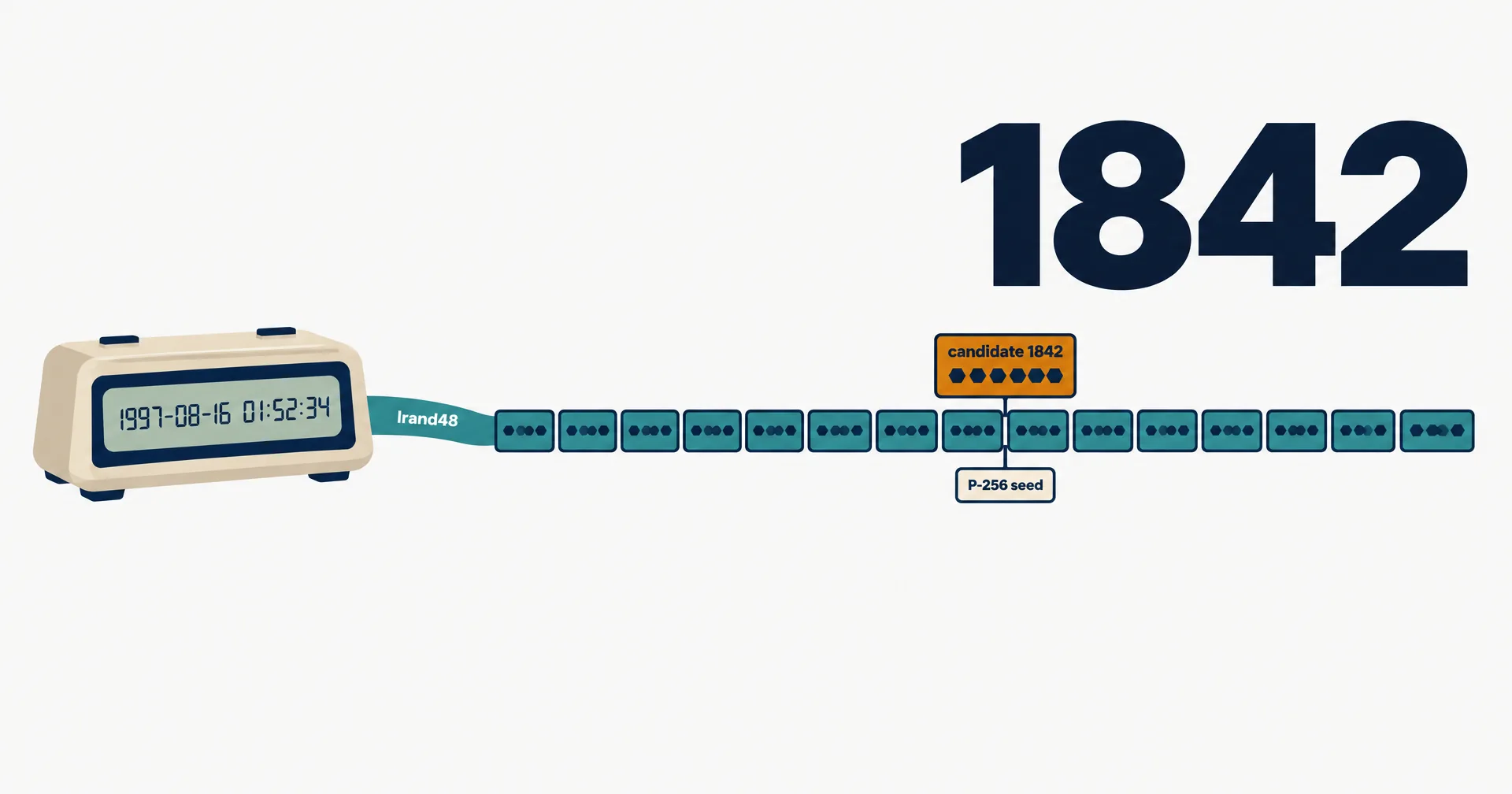
@figure ecdsa-clock-to-seed.svg | A clock time starts lrand48; candidate 1,842 is the P-256 seed in FIPS 186-2 | Animation: a 1997-08-16 01:52:34 clock seeds the lrand48 generator, 20-byte candidate cards stream out on a belt, candidate 1,842 lifts out in amber as the P-256 seed and lands on the standard with a check: matches FIPS 186-2, no hash, no secret phrase
On this page · 6 sectionsOpen
 Anthropic said on October 16, 2026 that an internal research model explained the NIST ECDSA curve seeds in under half an hour.
 The seeds are output from lrand48, a 1990s C-library random generator, started from Unix timestamps between May 1997 and April 1998.
 P-256’s seed is candidate 1,842 of a run started at 01:52:34 UTC on August 16, 1997; we reran the code and all nine NIST seeds match FIPS 186-2.
 Anthropic says it is not a break or a weakness, and that it makes a deliberate backdoor in the curves much less plausible.
 Claude also explained six base points, including P-192’s, from the FreeLIP generator; Anthropic says no NIST base point had been explained before.
 Still open: why some usable candidates were skipped, the B-163 seed, and the base points of P-224, P-256, P-384 and P-521.
§ 01The 25-year mystery
ECDSA is the most widely used elliptic-curve signature standard. NIST adopted it in 2000 in FIPS 186-2, which lists a set of standard curves. For each curve it publishes a 160-bit seed, and the SHA-1 hash of that seed defines the curve’s coefficient b. The NSA supplied the seeds without saying how it made them. P-256’s seed is C49D3608 86E70493 6A6678E1 139D26B7 819F7E90.
That gap fed years of suspicion that the curves might hide a backdoor. Neal Koblitz and Alfred Menezes summed up the debate in A Riddle Wrapped in an Enigma. The best-known story came from Jerry Solinas, a longtime NSA employee. In 2015 he said the seeds were hashes of a joke phrase along the lines of “Give Bob and Jerry a raise”, but nobody could find the details. Solinas died in 2023. A public bounty of $36,864 stayed open for anyone who found the real origin, and Anthropic says several of its own employees chased the phrase theory without success.
§ 02What Claude found
Each seed is one 20-byte candidate drawn from lrand48 after the generator was seeded with srand48(timestamp). The program drew 20 bytes at a time: candidate 1 is the first 20 bytes, candidate 2 the next 20, and so on. P-256’s published seed is candidate 1,842 of the run started at 01:52:34 UTC on August 16, 1997.
| Curve | Run started (UTC) | Candidate | Matches FIPS 186-2 |
|---|---|---|---|
| P-192 | 1997-05-18 14:45:34 | 139 | Yes |
| P-521 | 1997-08-08 01:12:04 | 1,136 | Yes |
| P-256 | 1997-08-16 01:52:34 | 1,842 | Yes |
| P-384 | 1997-08-30 14:50:08 | 2,688 | Yes |
| P-224 | 1998-04-03 12:52:07 | 7,026 | Yes |
| B-233 | 1998-04-17 15:24:18 | 155 | Yes |
| B-283 | 1998-04-17 15:27:44 | 32 | Yes |
| B-409 | 1998-04-17 15:30:18 | 60 | Yes |
| B-571 | 1998-04-17 15:32:08 | 73 | Yes |
The four binary-curve times are a reading, not a certainty. Their starting values decode as February 1984, and only with the clock doubled do they land on April 17, 1998, two weeks after the P-224 run, so Anthropic suggests the program may have halved the clock. The same lrand48 runs also produced five example curves in the ANSI X9.62 standard (prime192v2, prime192v3 and prime239v1 to v3). We did not have that standard’s text, so we did not check those five.
§ 03How it was found
Searches built on the joke-phrase rumor had come up empty, so Claude worked from the other end: what software would a 1990s team have used to make random bytes? Old C-library generators are weak enough that their output can be recognized. Claude wrote a scanner that slid along each published seed one bit at a time and tested whether neighbouring chunks were consecutive outputs of a 1990s generator, across 34 combinations of generator and output slice.
The tell was in the top bits. Written as five 32-bit words, four of the ten seeds have a 0 in the top bit of all 20 words. “That would happen by chance with probability 1/5810.” It is exactly what lrand48 produces, because it returns only the top 31 bits of a 48-bit state.

From there it was arithmetic:
- For those four seeds, Claude tried all 131,072 values of the 17 hidden bits in the first word and checked that the next four words followed.
- The prime-curve seeds keep fewer bits of each output (
lrand48() >> 23), so recovering the state is a textbook lattice problem. Claude solved it with LLL basis reduction, run over every possible window. - lrand48 runs backwards as easily as forwards, so Claude stepped each state back to the form
srand48sets, with the low 16 bits equal to 0x330E. That form turns up once every 65,536 steps by chance, but for all ten prime-curve seeds the value it held was a Unix timestamp between May 1997 and April 1998.

Each recovered 48-bit state regenerates all 160 bits of its seed, which does not happen by coincidence. Anthropic published the model’s reaction at the moment it saw the match: “This is astonishing: it solves the 25-year-old mystery.” It then spent several lines asking whether it was inside a test before concluding the result was real.
§ 04The base points too
Every curve also has a base point, G: the fixed point every ECDSA public key is a multiple of. The seed does not determine it. While checking the seeds, Claude found that the base points of six curves made in May 1997 come from the random-number generator in FreeLIP, Arjen Lenstra’s long-integer package. The recipe: seed it with a small integer, throw away seven outputs, then draw candidate x-coordinates until one lands on the curve. “As far as we know, no NIST base point has been explained before.”
| Curve | FreeLIP seed | Tries to land on the curve |
|---|---|---|
| P-192 (prime192v1) | 20000 | 2 |
| prime239v1 | 20420 | 3 |
| prime239v2 | 20507 | 2 |
| prime239v3 | 20509 | 1 |
| prime192v2 | 20512 | 5 |
| prime192v3 | 20517 | 1 |
The base points of P-224, P-256, P-384 and P-521 do not fit this recipe.
§ 05What it means for ECDSA
Anthropic is direct: “This is not a cryptographic break, new attack, or weakness in the ECDSA curves.” A clock-seeded generator that anyone can now rerun leaves little room for a hidden choice, so the finding makes a deliberate backdoor much less plausible. For anyone running ECDSA today: “There is no action to be taken or things to do differently.”
Three questions stay open:
- Skipped candidates. For P-256, candidate 876 of the same run also gives a usable prime-order curve, yet candidate 1,842 was published. P-224’s run passed over three such curves, and the ANSI runs seven more. Anthropic does not know the criteria, and argues that the small number of skips makes deliberately weakened curves implausible.
- B-163. “The fifth binary seed, B-163, fits nothing Claude has tried and remains unexplained.”
- The other base points. How the base points of P-224, P-256, P-384, P-521 and the binary curves were chosen is still unknown.
The $36,864 bounty goes to the Internet Security Research Group, the nonprofit behind Let’s Encrypt. Filippo Valsorda organized the bounty, and Anthropic credits the work to ten of its researchers, including Nicholas Carlini and Steve Weis.
§ 06Why it matters past cryptography
This is the second result Anthropic published on October 16 in which Claude settled an open technical question; the same morning it showed Claude designing cheaper quantum circuits. The shape is the interesting part. People chased the wrong lead for years by guessing phrases. The model reasoned about what code could have produced the numbers, built a scanner and a lattice solver to test that, and handed back a result anyone can check: the code is public domain, and our rerun matched the 2000 standard on the first try.
That last step is the one most teams skip. A finding is only as good as the check behind it, which is why we reran the code against the original standard before writing a word.
Q1Is ECDSA or P-256 broken?
No. Anthropic says this is not a cryptographic break, attack or weakness, and that there is nothing to change; it makes a deliberate backdoor much less plausible.
Q2What is lrand48?
A pseudorandom number generator in standard C libraries. It keeps a 48-bit state, returns the top 31 bits, and is started with srand48, here from the clock.
Q3Who supplied the seeds?
The NSA supplied them for FIPS 186-2 in 2000 with no explanation. The old account of a hashed joke phrase does not fit: none of the five prime seeds came from a hash.
Q4Can I reproduce it?
Yes. Anthropic published Python that regenerates the seeds, dedicated to the public domain. We ran it and all nine NIST seeds matched FIPS 186-2.
Q5Which Claude model did this, and what does CellCog run?
Anthropic only says an internal research model. Every CellCog tier runs Claude Opus 5.5.