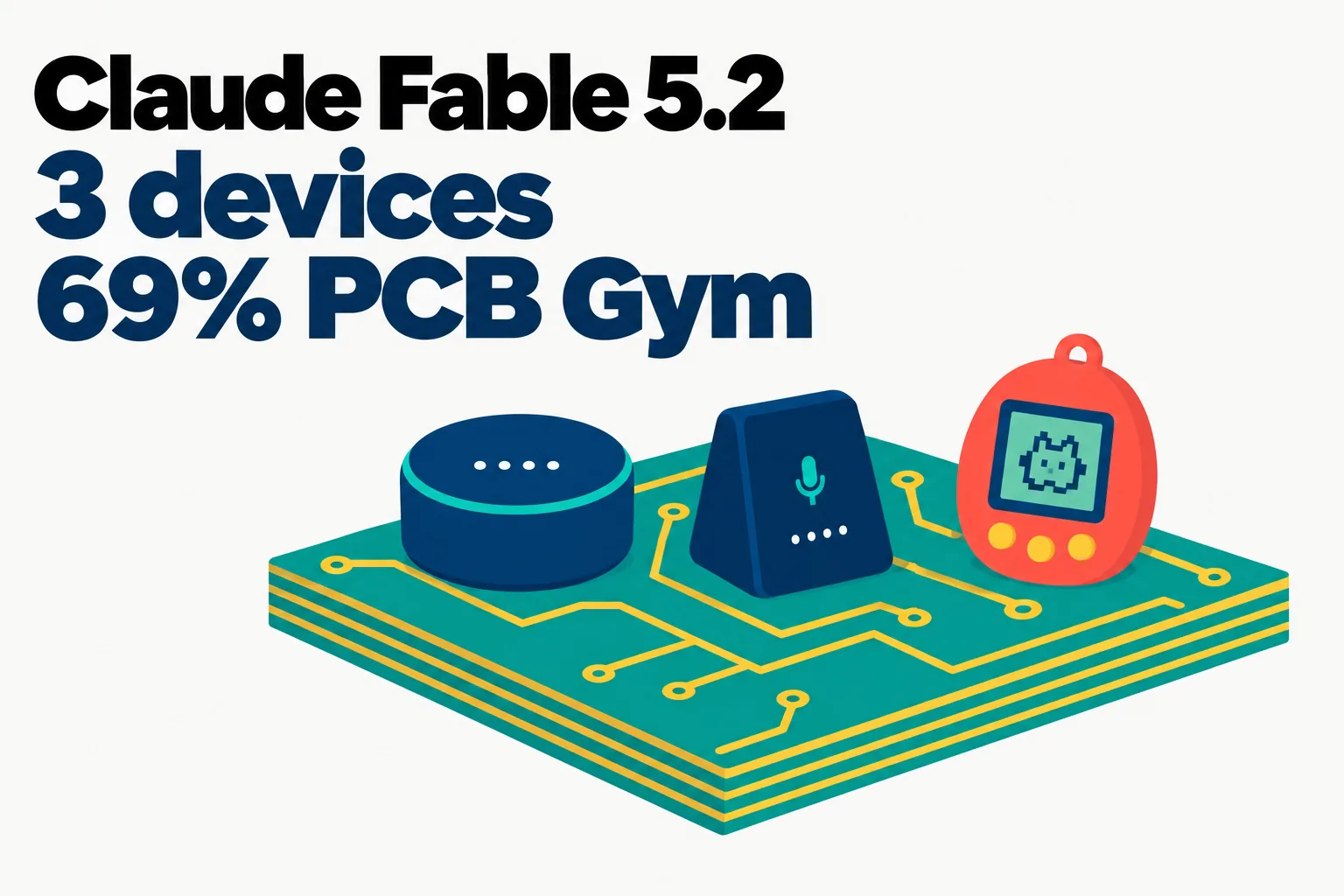
Anthropic says Claude Fable 5.2 designed three working electronic devices from short prompts: a USB speakerphone, a home voice-assistant hub and a handheld virtual pet. Claude wrote the specifications, laid out and routed the circuit boards, designed 3D-printable enclosures and wrote the firmware. Engineers at Diode Computers built the prototypes, which worked without any fixes to their circuitry, per Anthropic’s research post published November 9, 2026.
Claude’s thread on X passed 200,000 views within about 40 minutes of posting. Anthropic notes that it has a commercial relationship with Diode, which also built the benchmark below. The two began this work a little over a year ago, when earlier Claude models could not reliably lay out a board (Anthropic’s earlier write-up).
On this page · 6 sectionsOpen
 Anthropic says Claude Fable 5.2 designed three working devices from short prompts: a speakerphone, a voice-assistant hub and a handheld virtual pet.
 Claude wrote the specs, laid out and routed four-layer circuit boards, designed 3D-printable cases and wrote the firmware.
 On Diode’s PCB Gym benchmark, Fable 5.2 scored 69% against 25% for Fable 5; it scored 83.5% on the public BenchCAD 2.1.
 When a layout got tangled, Claude tore it up and rerouted dozens of times, and wrote its own routing tool in about half an hour.
 Diode built the boards straight from Claude’s files; the devices are prototypes, untested for certification or mass production.
§ 01What Claude did on each device
Each device started from a short prompt. The speakerphone prompt asked for “a puck that plugs into a computer over USB-C and includes microphones and a speaker, supporting Bluetooth with a PCB antenna.”
| Step | What Claude did |
|---|---|
| Specification | Wrote the device spec from the prompt |
| Schematic | Drew the schematics and chose the parts, reading datasheets |
| Board layout | Placed components and routed copper on four-layer boards |
| Enclosure | Modeled a 3D-printable case and checked the board fits inside |
| Firmware | Wrote the software that runs each device |
| Manufacturing | Ran manufacturing and parts-sourcing checks and fixed what failed |
| Build | Diode assembled the boards and ran the firmware under Claude’s direction |
Anthropic’s thread sums up the pace: “Each board was ready for manufacture in under a day.” Diode manufactured all three boards directly from Claude’s design files, without the usual rounds of back-and-forth over adjustments.
§ 02The benchmark jump
| Benchmark | Fable 5.2 | Earlier Claude |
|---|---|---|
| PCB Gym (Diode, internal) | 69% | 25% (Fable 5) |
| BenchCAD 2.1 (public) | 83.5% | Nearly half that (Fable 5.1) |
PCB Gym asks a model to place components and route connections on real board designs whose layouts have been removed. Anthropic says the biggest change from earlier models is geometric reasoning: where parts go on a board and how the copper connects them.
§ 03How it worked through the hard parts
- Most important wires first. Fable 5.2 routed the connections that carry high-speed signals or high currents, or are sensitive to noise, before anything else, and added small zigzags so paired signals arrive at the same time.
- Starting over when stuck. Earlier models rarely revised their own layouts. On the voice hub, Claude noted the copper was “getting too tangled to trace visually”, deleted the tracks and rerouted them dozens of times until one arrangement worked.
- Writing its own tool. When routing long tracks one at a time in KiCad would take too much guidance, Claude wrote its own router in about half an hour; it laid each long track in roughly a second.
- Following decisions downstream. It found the speakerphone board would only fit its case if tilted about 25 degrees during assembly, and added that step to the instructions. It worked out that a 25 mm microphone port would resonate near 3.4 kHz, “right in the voice band”, and reshaped the hub into a wedge so the ports shrank to about 10 mm and the resonance moved to about 8.9 kHz.
- Checking for the factory. Manufacturing checks flagged six slivers of solder mask as too thin; Claude widened the openings without moving any parts, and correctly ignored a flag on a deliberate ground connection.

§ 04What this does not show
- They are prototypes. Anthropic says the devices have not been through electrical validation, antenna tuning, thermal testing or certification, and were not designed for mass production.
- Humans built them. Claude was not connected to test equipment or to the machines that make boards; Diode engineers built and tested every device.
- The benchmark is the partner’s. PCB Gym is Diode’s internal benchmark, and Anthropic has a commercial relationship with Diode. No independent group has repeated the results yet.
- Prompting was light, not zero. Diode’s prompts were short directives such as “clean up the schematic” and “continue”.
- Others are here too. Anthropic notes that OpenAI recently wrote about using its models to design a handheld device.
§ 05Where CellCog fits
Every CellCog AI employee and chat tier runs on Claude Opus 5.5 today; none moved to Fable 5.2 on release day (our Fable 5.2 release record has the specs and prices). CellCog employees do not design circuit boards. What carries over is the engineering habit this research shows: write the spec, check the work, start over when it is wrong.
§ 06Sources
- Anthropic, Claude can design electronic prototypes from start to finish, November 9, 2026
- Claude on X (21:06 UTC, November 9, 2026)
- Anthropic, Making Claude a better electrical engineer
- BenchCAD 2.1 release
- OpenAI, Accelerating engineering for the physical world
Q1Which model designed the devices?
Claude Fable 5.2, released November 9, 2026, during pre-release testing.
Q2What is PCB Gym?
Diode’s internal benchmark that asks a model to place components and route connections on boards whose layouts were removed. Fable 5.2 scored 69%, Fable 5 scored 25%.
Q3Did humans help?
Diode engineers built and tested the devices and gave short directives such as clean up the schematic and continue.
Q4Are these products?
No. Anthropic says they are prototypes that have not had electrical validation, thermal testing or certification.
Q5Does CellCog use Fable 5.2?
Not today. Every CellCog AI employee and chat tier runs on Claude Opus 5.5.