Anthropic’s biology research lab has used Claude to determine the first 3D structure of a vault particle found in a microbe, and the headline is less the structure than the speed: a small team with little background in structural biology solved it in under four months. The lab published the work on November 4, 2026, with a preprint submitted to bioRxiv.
Vaults are one of biology’s long-running puzzles. They are large, hollow barrels of protein found in cells across the tree of life, first seen in 1986, and after forty years no one knows what they do. The honest caveat sits right next to the result: this work maps a structure, not a function, and Claude made real mistakes along the way.
On this page · 9 sectionsOpen
 Anthropic’s biology lab used Claude to solve the first 3D structure of a vault particle found in a microbe, published November 4, 2026, with a preprint submitted to bioRxiv.
 Vaults are large, hollow protein barrels found across the tree of life since 1986; after forty years, their biological function is still unknown.
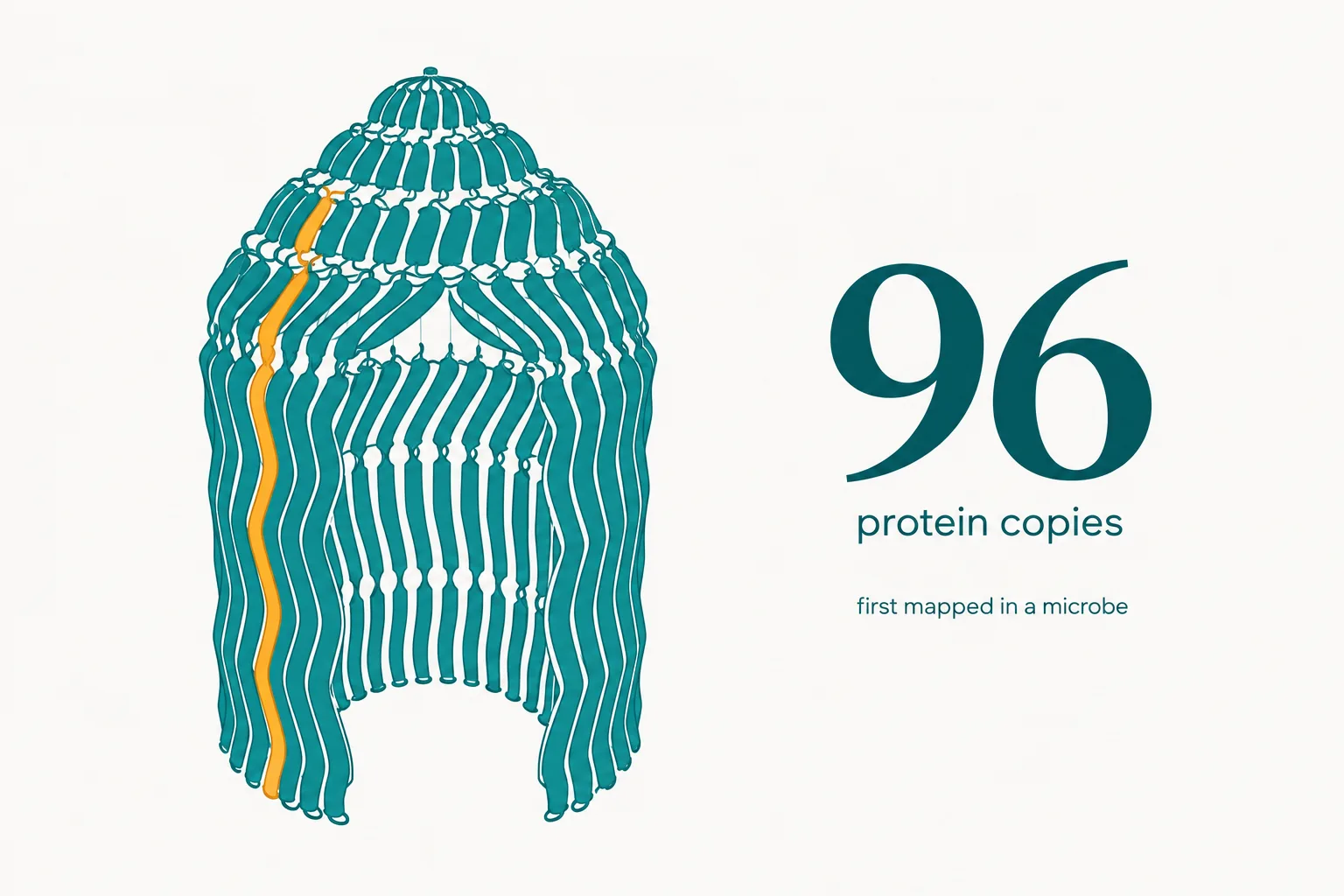
 The phage L05 vault is built from 96 protein copies, against 78 in human vaults, and its cap narrows to a point in three tiered steps.
 Claude cut a three-day purification to about 90 minutes and had a first structural model 34 hours later, work the team estimates would normally take weeks.
 Claude made real errors: a flawed growth-medium step cost two weeks, and it once produced a mirror-image map until the team told it to stop improvising.
 A team with little structural-biology experience solved the structure in under four months, which Anthropic says a typical lab could mostly reproduce.
§ 01What a vault particle is
A vault is a ribbed protein shell, named because its arched form reminded its discoverers, Leonard Rome and Nancy Kedersha, of a cathedral’s vaulted ceiling. At roughly three times the mass of a ribosome, it is one of the largest known molecular complexes in complex cells. Vaults turn up almost everywhere in the eukaryotic tree, from slime molds to humans, which is why biologists assume they must do something useful. Yet mice bred without vaults develop normally, and every proposed function, from shuttling molecules to shielding cells from toxins, remains unconfirmed.
Anthropic’s team went looking in a simpler place. Related proteins had been spotted in the genomes of bacteria and the phages that infect them, but no one had shown they assemble into real vaults. A vault in a prokaryote, a simple cell like a bacterium, would be far easier to grow and study than a mammalian one.
§ 02What they found
Working from a bacteriophage protein the team calls L05, Claude and the lab solved the structure by cryo-electron microscopy. The phage vault is built from 96 copies of a single protein, more than the 78 in human vaults, and it is shorter, wider and more spherical.

| Feature | Phage L05 vault | Human vault |
|---|---|---|
| Protein copies | 96 | 78 |
| Copies per half | 48 | 39 |
| Wall segments per copy | 7 | 9 |
| Length by width | 54 by 45 nm | 67 by 40 nm |
| Enclosed volume | about 25% more | baseline |
The caps are the elegant part. A wall 48 copies around has to narrow to a point, and it does so in three steps, like a tiered dome: in every trio of neighbors, one ends at the first step, one at the second, one reaches the tip. The team then edited the protein to prove the point, making 15 variants; single changes near the cap left the shell open in rosette shapes, and copying two wall segments produced an even larger vault with about 20% more volume.
§ 03How Claude did the work
The method is the real story, and Anthropic lays it out step by step.
Under the team’s direction, Claude searched a database of about 15 billion predicted proteins and found vault relatives in 29 phyla of bacteria and four of archaea, though in under 1% of species. It turned the chosen protein sequences into DNA, and 15 of 24 produced usable protein in E. coli. For isolation, Claude first argued against the faster column method, then helped make it work, and even proposed loading ruptured cells straight onto the column, an unconventional idea that worked. Conventional purification takes three days; the optimized version takes about 90 minutes. For the structure itself, Claude drove the cryo-EM processing software in an internal harness, and a first full model was ready 34 hours later, work the team estimates would normally have taken weeks. Claude also flagged a small molecule tucked in each of the 96 copies whose shape resembles coenzyme A, a possible first hint at a function.
§ 04Where Claude slipped
Anthropic is candid about the failures, which is the useful part. A protocol Claude wrote called for a growth-medium additive that interferes with getting DNA into cells and set the project back two weeks. Early in the cryo-EM processing it skipped a standard step and produced a flawed map blended with its own mirror image, until the team told it to do normal things unless they do not work. The lab shared its notes with the researchers who train Claude, so the model would learn from the errors. In areas the team knew well, they caught mistakes fast; in areas they did not, the mistakes cost time.
§ 05A new way of doing science
What makes this notable is who did it. None of the team had worked with a protein assembly this large, and they had limited structural-biology experience; they took the project on because Claude could cover what they did not know. Most of the work, Anthropic says, could be reproduced by a typical lab with existing Claude products. Only the cryo-EM step, which leaned on hundreds of GPUs, needed more compute than a university usually has. Leonard Rome, brought on to advise, put it plainly: the broadness of the finding suggests “it is going to be a complicated function and an interesting ride.”
§ 06Where CellCog fits
CellCog is our product, an AI employee platform, and this is the same division of labor our employees run: the AI takes the searchable, checkable steps, and the human keeps the judgment. An AI research assistant can read across a literature, turn a question into a plan, run and chart the analysis and draft the write-up, while keeping its own memory of the project between conversations. The science, the lab bench and the call on what to pursue stay with you, exactly as they did here. For how scientists are already splitting work this way, see our record on how researchers use Claude.
§ 07What is not established yet
- The function. The structure is solved; what vaults actually do is still unknown, in microbes and in us.
- The preprint. The results are in a preprint submitted to bioRxiv, not yet peer reviewed.
- In the wild. The vaults have been made only in E. coli so far, not yet in the bacteria and phages where they occur naturally.
- The coenzyme A hint. The small molecule in each copy is unidentified; its resemblance to coenzyme A is a lead, not a finding.
§ 08Where to watch
- The bioRxiv preprint going live, and whether peer review holds up the structure.
- Any experiment that finally pins down what a vault does.
- Whether other labs reproduce the sub-four-month, Claude-driven workflow on their own hard problems.
§ 09Sources
- Anthropic, Investigating vault particles with Claude, November 4, 2026, read 20:06 UTC.
- Anthropic, How Claude designed protein binders against scorpion neurotoxins, October 20, 2026, the lab’s prior science result.
- Vault (organelle), background on the 1986 discovery and the open question of function.
- Our record on how researchers use Claude, November 5, 2026.
Q1When did Anthropic publish this?
On November 4, 2026, on Anthropic’s research site, with a preprint submitted to bioRxiv. The work is not yet peer reviewed.
Q2What is a vault particle?
A large, hollow, ribbed barrel of protein found in cells across the tree of life, discovered in 1986 and named for its cathedral-vault shape. Its function is unknown.
Q3How is the phage vault different from the human one?
It is built from 96 protein copies against 78 in humans, is shorter and wider but more spherical, and its wall has seven repeating segments per copy against nine.
Q4Did Claude get everything right?
No. A protocol it wrote cost the team two weeks, and it once produced a mirror-image map until corrected. The lab shared those errors with the researchers who train Claude.
Q5Where does CellCog fit?
CellCog is our product, an AI employee platform. An AI research assistant takes the searchable, checkable steps and leaves the science and the judgment to you.