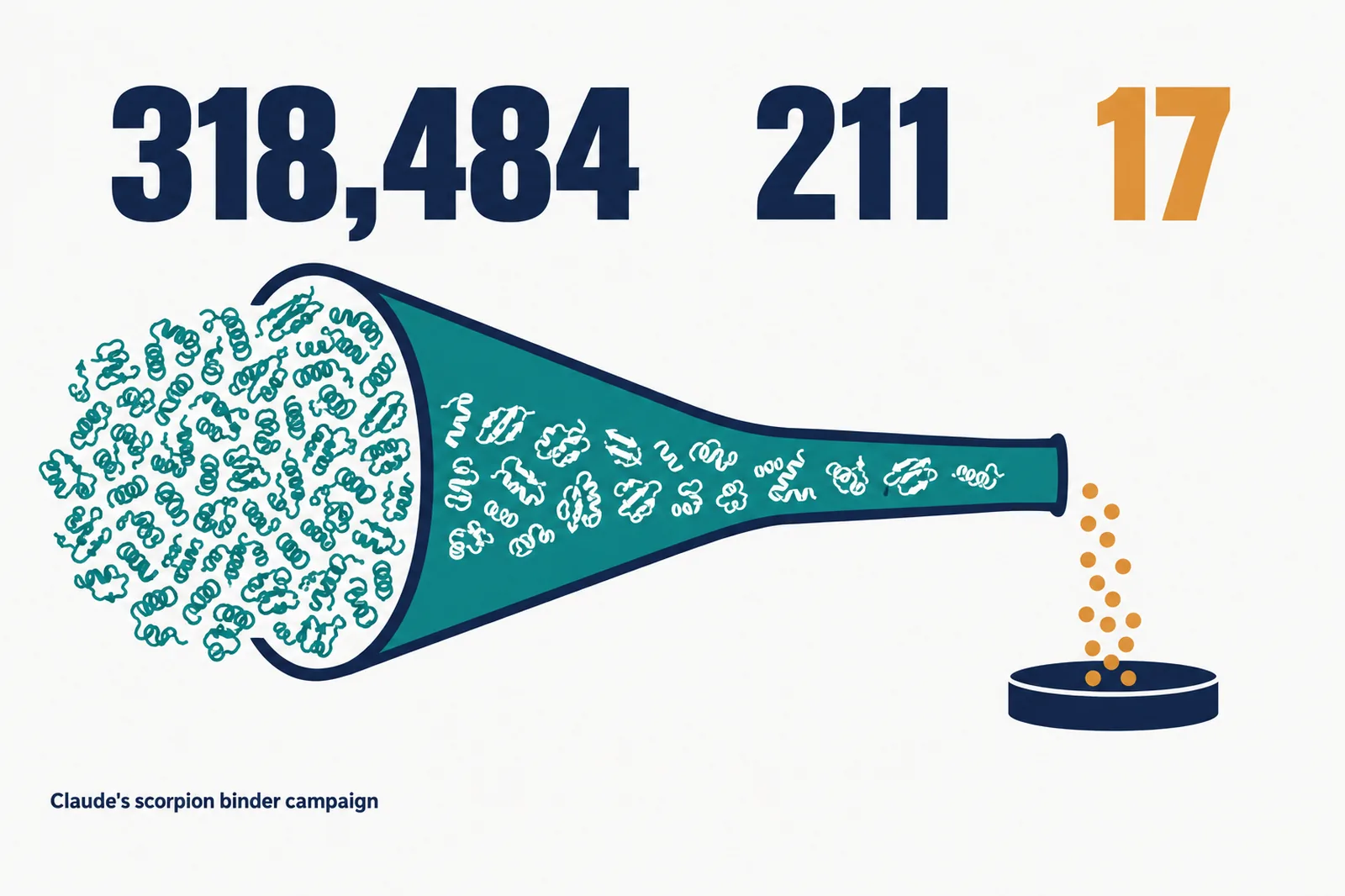
Anthropic gave Claude a prompt and four follow-ups, and 64 hours later it had designed 180 candidate proteins aimed at scorpion neurotoxins. Two labs tested 211 designs; 17 of them bound. The write-up went up at 13:01 UTC on October 20, 2026, with a 69-page technical report and all 211 designs released as data.
The honest headline is in Anthropic’s own sentence: “We have not confirmed whether these binders neutralize scorpion venom in a cellular environment, so we do not claim to have produced an antivenom.” What the run does show is how much of a design campaign an agent now runs on its own.
On this page · 8 sectionsOpen
 Anthropic published the results on October 20, 2026: it asked an internal Claude research model to design protein binders against five scorpion neurotoxins.
 Claude generated 318,484 designs and screened 553,052 design-toxin pairs, then produced its final list of 180 designs 64 hours after the first prompt, with four follow-ups.
 Adaptyv Bio and Twist Bioscience lab-tested 211 designs. 17 met Anthropic’s binding criteria: seven against Cn2, four each against AaH II and AaH I, two against LqhIII, none against Ts1.
 None of the 151 designs aimed at more than one toxin bound more than one, so the cheap universal cocktail Anthropic was testing for did not come out of this run.
 Anthropic does not claim an antivenom: nothing was tested in cells or animals, and all 211 designs and their data are released publicly.
§ 01What Claude ran
The target was five sodium-channel toxins from four regions: Cn2 (Mexico), Ts1 (Brazil), AaH I and AaH II (North Africa) and LqhIII (the Middle East). Claude picked the toxin structures from the Protein Data Bank and the AlphaFold database, chose five hotspot positions on each, set the quality thresholds a design had to clear, and decided how much to lean on each design tool.
| Step | Number |
|---|---|
| Designs generated with 12 design tools | 318,484 |
| Design-toxin pairs screened | 553,052 |
| Pairs ranked with at least five seeds | 28,451 |
| Designs Claude selected for testing | 180 |
| Designs added later by the team, with Claude’s help | 31 |
| Designs lab-tested | 211 |
| Designs meeting the binding criteria | 17 |

The campaign used on the order of 10,000 H100 GPU hours, which Anthropic concedes is “much more than most researchers have access to.” A footnote adds the more interesting number for everyone else: with faster models and “a simplified prompt using a single agent and a single GPU over 24 hours,” Claude reached comparable in-silico scores.
§ 02What the labs found
Adaptyv Bio made the proteins in a cell-free system; Twist Bioscience made them in human kidney cells as antibody-stem fusions. Both measured binding by surface plasmon resonance. A design counted as a binder only if it was a hit at both labs in every replicate, every dissociation constant was 1 micromolar or tighter, and it showed no signal against CLEC12A, an unrelated human protein used to catch stickiness.
Among the 60 designs aimed at a single toxin, 11 bound, an 18% hit rate that Anthropic calls “consistent with typical protein design campaigns, including our previous work.”

The two strongest, Cn2-B1 and Cn2-B2, bound at single-digit nanomolar affinity and competed with LR, an antibody fragment reported to neutralize Cn2 in mice, which suggests they land on the same part of the toxin that grabs the sodium channel.
§ 03The part that failed
The commercially interesting goal was one protein that neutralizes several toxins at once, because that is what a cheap universal cocktail would need. It did not happen.
| Design group | Designs | Binders |
|---|---|---|
| Single toxin | 60 | 11 (18%) |
| Two beta-family toxins | 30 | part of 5 across both groups (8%) |
| Three alpha-family toxins | 30 | part of 5 across both groups (8%) |
| All five toxins | 91 | 1 |
“None of the 151 multi-toxin designs met the criteria for binding against more than one toxin.” Anthropic lists the candidate explanations without picking one: its own prompting, the limits of the design tools, or whether multitoxin design is biologically feasible at all.
§ 04Why scorpions
Scorpions sting more than 1.2 million people a year and kill more than 3,250, mostly children with limited access to care. Today’s antivenoms are made by milking venom from live scorpions, immunizing horses and purifying their antibodies, a process that takes months and produces a product that is costly and often in short supply. Citrini Research, the investment research firm that proposed the project, notes that scorpion venom runs at $39 million per gallon.
That is the case for de novo binders: designed from scratch, optimized for stability, and manufacturable without animals. It is also why the gap between a binder and a drug matters so much here.
§ 05What is not proven
Anthropic is specific about the distance left. The results show binding only against recombinant toxins grown from genes, not toxin purified from venom. Nothing was tested in cells by patch-clamp recording to show it stops the toxin acting on the channel, and nothing was tested in mice. Two outside experts, Susana Vazquez Torres and Timothy P. Jenkins, called it a promising first step while naming the same limit; as Vazquez Torres puts it, “binding itself is no longer the main bottleneck.”
§ 06Where CellCog stands
CellCog does not do drug discovery; every CellCog agent tier runs on Claude Opus 5.5. We follow runs like this because a 64-hour autonomous campaign with its own thresholds and tool choices is the same shape of work our customers hand their AI employees, at a far higher stake.
§ 07What we are watching for
- Whether Cn2-B1 is tested against toxin purified from venom, then in patch-clamp recordings and mice.
- Whether other groups find multitoxin binders where this campaign did not.
- How quickly the single-GPU, 24-hour version Anthropic footnotes reaches ordinary labs.
§ 08Sources
- Anthropic, How Claude designed protein binders against scorpion neurotoxins, October 20, 2026, 13:01 UTC. Read directly.
- Anthropic, technical report, 69 pages, October 20, 2026. Read directly.
- Anthropic, data release of all 211 designs, Hugging Face, CC BY 4.0.
- Citrini Research, account of the collaboration. Read directly.
Q1When was this published?
Anthropic posted the research write-up at 13:01 UTC on October 20, 2026, with a 69-page technical report and a public dataset.
Q2How long did the design campaign take?
Claude produced its final list of 180 designs 64 hours after the initial prompt, working mainly autonomously with four follow-ups from the team, on the order of 10,000 H100 GPU hours.
Q3How strong are the best binders?
The two strongest, Cn2-B1 and Cn2-B2, bound the Mexican scorpion toxin Cn2 at single-digit nanomolar affinity at both labs, and competed with LR, an antibody reported to neutralize Cn2 in mice.
Q4Why does a multitoxin binder matter?
One molecule that neutralizes several toxins would cut the size of a universal antivenom cocktail. The five toxins share a fold but are only 26% to 62% identical in sequence, and none of the 151 multitoxin designs worked.
Q5Who ran the lab work?
Adaptyv Bio tested the designs in a cell-free system and Twist Bioscience in human kidney cells, both measuring binding by surface plasmon resonance. The project was developed with Citrini Research.
Q6Does CellCog do drug discovery?
No. Every CellCog agent tier runs on Claude Opus 5.5. We cover campaigns like this because they show what long autonomous runs by an agent produce, and how carefully the claims have to be read.