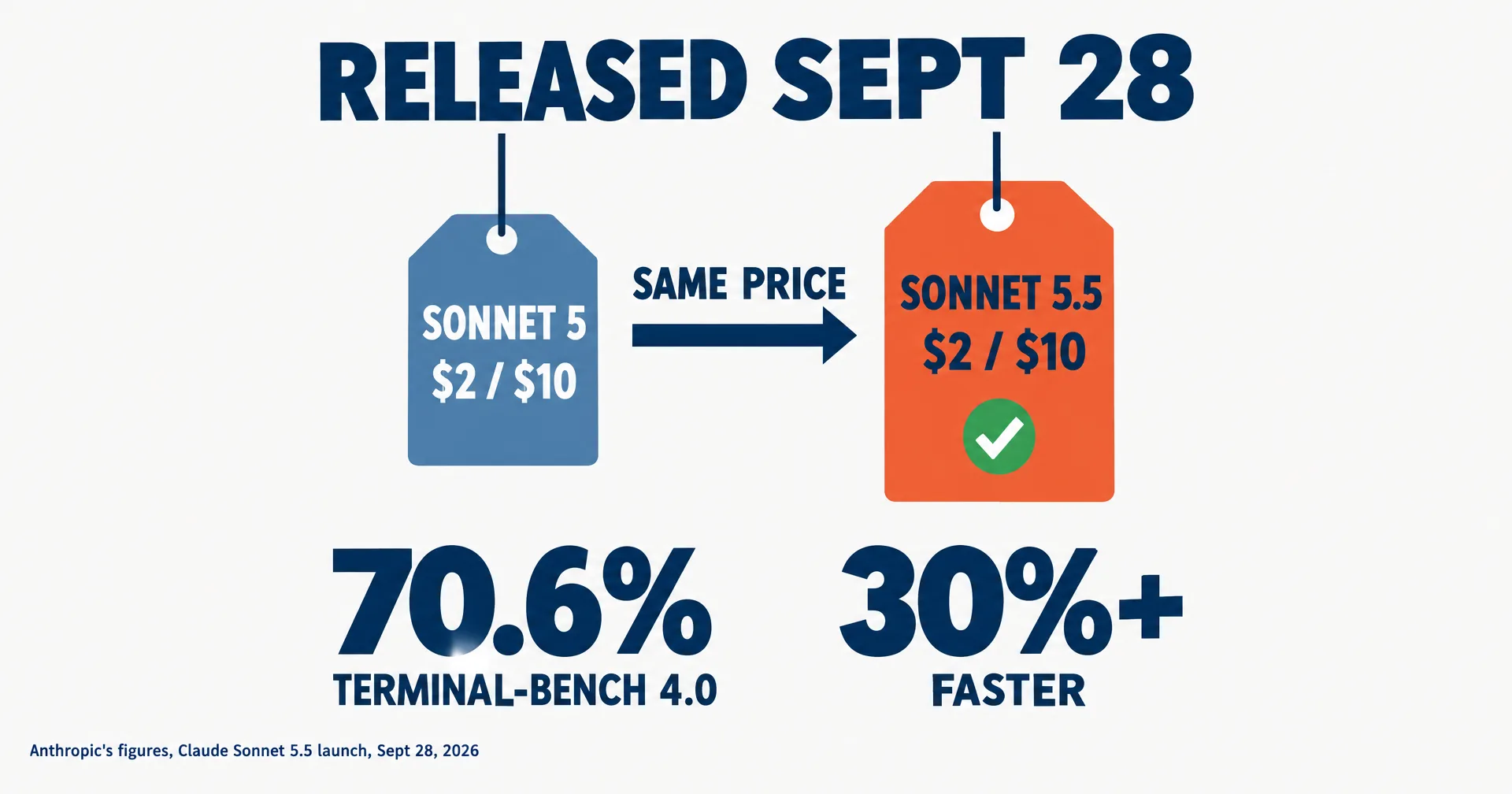
Claude Sonnet 5.5 is out. Anthropic released it on September 28, 2026, six days after saying it would “follow in the coming weeks”. Anthropic calls it “the second model in the Claude 5.5 family” and says it “runs 30%+ faster, and costs up to 30% less for most work.” Its model page sums it up as “The best combination of speed and intelligence.”
This page opened on September 23 as a rumor tracker. It is now the release record on the same URL, with every claim from the tracker graded below.
On this page · 9 sectionsOpen
 Anthropic released Claude Sonnet 5.5 on September 28, 2026, at 18:03 UTC, as claude-sonnet-5-5 on the Claude API, Amazon Bedrock, Google Cloud and Microsoft Foundry. It came six days after Anthropic said it would follow Opus 5.5 in the coming weeks.
 The price did not move: $2 per million input tokens and $10 output, the same as Sonnet 5, with cache reads at $0.20. Anthropic says it needs fewer tokens for the same work and costs up to 30% less per task.
 On Anthropic’s table it scores 70.6% on Terminal-Bench 4.0 against Sonnet 5’s 10.3% and Opus 5.5’s 66.4%, and 1844 on GDPval-AA against Opus 5.5’s 1846. Anthropic adds that Opus 5.5 remains clearly stronger on complex, open-ended work.
 The rumors mostly held on timing and missed on specs. September was right and near-Opus performance at Sonnet pricing was right; the 2M-token context window was wrong (it is 1M), and so was our own arithmetic that the price would fall 20%.
 CellCog runs every Claude tier on Claude Opus 5.5 and does not route to Sonnet today. Sonnet 5.5 at the same price with a near-Opus score is now a candidate for our lighter work, and the decision will land here.
§ 01What Anthropic released
| Item | Value |
|---|---|
| Released | September 28, 2026 |
| Model ID | claude-sonnet-5-5 (Bedrock: anthropic.claude-sonnet-5-5) |
| Where | Claude API, Amazon Bedrock, Claude Platform on AWS, Google Cloud, Microsoft Foundry |
| Price | $2 input, $10 output per million tokens; cache reads $0.20; Batch API 50% off |
| Context window | 1M tokens |
| Max output | 128K tokens (300K on the Batch API, beta) |
| Thinking | Adaptive, default effort high |
| Knowledge cutoff | June 2026 |
Anthropic positions it as the faster, cheaper partner to Opus 5.5: strongest at “well-scoped everyday tasks, fixing bugs, and creating polished documents, slides, and spreadsheets.” It is also the first Sonnet launched with the cyber safeguards Anthropic uses on its top models.
§ 02The benchmarks
| Benchmark | Sonnet 5.5 | Sonnet 5 | Opus 5.5 |
|---|---|---|---|
| Terminal-Bench 4.0 | 70.6% | 10.3% | 66.4% |
| CursorBench 4.0 | 55.5% | 34.1% | 57.8% |
| GDPval-AA v2.1 | 1844 | 1449 | 1846 |
| Humanity’s Last Exam (with tools) | 64.5% | 54.9% | 67.7% |
| OSWorld 2.1 (partial) | 80.1% | 57.0% | 81.8% |
| Chartography (no tools) | 61.6% | 15.6% | 64.4% |
These are Anthropic’s numbers, run by Anthropic. Its own caveat is worth quoting in full: “Opus 5.5 remains clearly stronger at complex, open-ended work requiring sustained judgment.” Read the table as a cheaper model closing most of the gap on benchmarks, not as a Sonnet that replaces Opus.
§ 03The rumors, graded
| Claim | Source | Verdict |
|---|---|---|
| Coming weeks after Opus 5.5 | Anthropic, Sep 22 | True: six days |
| Launch in September | X posts, Aug 4 and Sep 4 | True: September 28 |
| Near Fable 5.1 level at Sonnet pricing | X post, Sep 4 | Largely true on price and benchmarks: same price, GDPval-AA 2 points below Opus 5.5, which Anthropic puts at Fable 5.1 level |
| 2M-token context window | X posts, Aug 9 and Sep 4 | False: 1M tokens |
| Codename Fennec | X posts from Aug 9 | Unconfirmed: no Anthropic document names it |
| A 20% price cut like Opus 5.5 | Our own arithmetic, Sep 23 | Wrong: the price is unchanged |
| Date | Event | Source |
|---|---|---|
| Jun 30 | Claude Sonnet 5 released at $2 and $10 per million tokens | Anthropic |
| Aug 4, 09:51 | Sonnet 5.5 in the final stages before release, as early as next month | @Mr_Salio on X |
| Aug 9, 08:52 | Codename Fennec, rumored 2M-token context window | @Mr_Salio on X |
| Aug 13, 04:32 | Fennec already associated with the earlier Sonnet 5 leak | @vepsi__ on X |
| Aug 20, 13:43 | Nearing release, will approach Fable 5 level | @Mr_Salio on X |
| Sep 4, 00:22 | Could land this month, near Fable 5.1 at Sonnet pricing | @0x0SojalSec on X |
| Sep 22, 16:31 | Sonnet 5.5 and Haiku 5.5 follow in the coming weeks | Anthropic |
| Sep 23, 12:05 | Already finished, waiting to be released | @Mr_Salio on X |
| Sep 23, 14:40 | Docs, release notes, pricing, OpenRouter catalog: no Sonnet 5.5 | Our read |
| Sep 28, 18:03 | Claude Sonnet 5.5 released: claude-sonnet-5-5, $2 and $10 per million tokens | Anthropic |
§ 04What Anthropic’s rhythm said, and what happened
| Model | Released | Days since previous Sonnet |
|---|---|---|
| Claude Sonnet 4.5 | September 29, 2025 | first of this run |
| Claude Sonnet 4.6 | February 17, 2026 | 141 |
| Claude Sonnet 5 | June 30, 2026 | 133 |
| Claude Sonnet 5.5 | September 28, 2026 | 90 |
The fastest Sonnet turnover of this run, and the 5.5 family is filling in faster than the 4.5 family did.
| Generation | First | Second | Third |
|---|---|---|---|
| 4.5 (2025) | Sonnet 4.5, Sep 29 | Haiku 4.5, Oct 15 (+16 days) | Opus 4.5, Nov 24 (+56 days) |
| 5.5 (2026) | Opus 5.5, Sep 22 | Sonnet 5.5, Sep 28 (+6 days) | Haiku 5.5, coming weeks |
§ 05Before you switch
Anthropic lists five breaking changes for code written against Sonnet 5. Thinking is turned off with between_tools rather than disabled. Forced tool use (tool_choice any or tool) returns an error. Thinking blocks are tied to the model and the conversation. On the Claude API and Google Cloud the older computer use tool is rejected. And the advisor tool refuses some older advisors. Effort levels are also recalibrated, so a setting carried over from Sonnet 5 will not behave the same.
Thinking now stays with the account that made it
One of the five changes drew most of the attention a day later. Anthropic’s release notes say thinking blocks that Sonnet 5.5 produces “work only in the account that produced them, or in an account linked to it.” When a different account sends one of those blocks back, the API drops it before the model sees it and the request still succeeds, so the model answers without that earlier reasoning. Blocks from earlier models are not affected.
Anthropic’s developer account gave the reason on September 28, 2026 at 18:36 UTC: the change is meant “to curb distillation attacks via account-switching.” A session that moves to another account mid-conversation still works; Claude rereads the session and thinks again. Without Anthropic’s thinking-binding beta header, the drop is silent, so a tool that routes one conversation across several API keys will not see an error, only a model that has lost its earlier thinking.
For teams running Sonnet 5.5 through one account, or through Claude Code, nothing changes. For anyone rotating keys across accounts in one session, the fix is to keep a conversation on one account (or on linked accounts).
§ 06Where CellCog stands
Every Claude tier in CellCog runs on Claude Opus 5.5, with the tier setting how hard it thinks (what changed); we do not route to Sonnet today. A Sonnet 5.5 two GDPval points below Opus 5.5 at half the price per token is a real candidate for lighter work, and we will test it on our own agentic runs before any switch. The result lands on this page.
§ 07What we are watching for
- Independent scores: Artificial Analysis, Terminal-Bench’s own board, SWE-Bench.
- Claude Haiku 5.5, which Anthropic says follows in the coming weeks.
- How the breaking changes land in agent frameworks that force tool use.
§ 08Update log
As of September 23, 2026, 14:40 UTC: page opened. Anthropic’s statement is in the coming weeks; the rumored September window had one week left.
September 29, 2026, 14:55 UTC: added the account-bound thinking rule from Anthropic’s release notes and its developer account (thinking blocks now work only in the account that made them).
September 28, 2026, 18:15 UTC: Claude Sonnet 5.5 released at 18:03 UTC. Page flipped from tracker to release record on the same URL: spec table, Anthropic’s benchmark table, the rumor scorecard, the release-gap chart, the breaking changes and a new hero. Our Sep 23 price arithmetic was wrong and is marked so.
§ 09Sources
- Anthropic, Preserved thinking: thinking blocks stay with the account that produced them, read September 29, 2026.
-
Claude Developers on X, September 28, 2026, 18:36 UTC.
-
Anthropic, Introducing Claude Sonnet 5.5, September 28, 2026, read 18:13 UTC.
- Anthropic, Claude Sonnet 5.5 model page, what is new and the release notes entry for September 28, 2026, read 18:11 UTC.
- Claude on X, launch thread, September 28, 2026, 18:03 UTC; OpenRouter lists anthropic/claude-sonnet-5.5 from 18:04 UTC.
- Anthropic, Introducing Claude Opus 5.5, September 22, 2026.
- Anthropic, models overview, pricing and release notes, read September 23, 2026, 14:40 UTC.
- OpenRouter, Anthropic catalog, read September 23, 2026, 14:40 UTC; first-listing dates from the models API.
- X: @Mr_Salio, August 4, August 9, August 20 and September 23; @vepsi__, August 13; @0x0SojalSec, September 4. All read directly; times computed from the post ids.
Q1When was Claude Sonnet 5.5 released?
September 28, 2026. Anthropic’s release notes and model page date it that day, and the launch thread went out at 18:03 UTC. It came 90 days after Sonnet 5 and six days after Opus 5.5.
Q2What is the context window of Sonnet 5.5?
1M tokens, with up to 128K output tokens on the synchronous API and 300K on the Batch API under a beta header. The 2M-token rumor from August was wrong.
Q3Is Sonnet 5.5 a drop-in replacement for Sonnet 5?
Not quite. Anthropic lists five breaking changes: thinking is turned off with between_tools instead of disabled, forced tool use returns an error, thinking blocks are tied to the model, the older computer use tool is rejected on the Claude API and Google Cloud, and some advisor pairings are refused.
Q4Is Claude Haiku 5.5 out?
Not yet. Anthropic says Haiku 5.5 will join the Claude 5.5 family in the coming weeks.
Q5Does CellCog use Sonnet 5.5?
Not today. Every CellCog tier runs on Claude Opus 5.5, with the tier setting how hard it thinks. Sonnet 5.5 is now a candidate we will test on our own work.