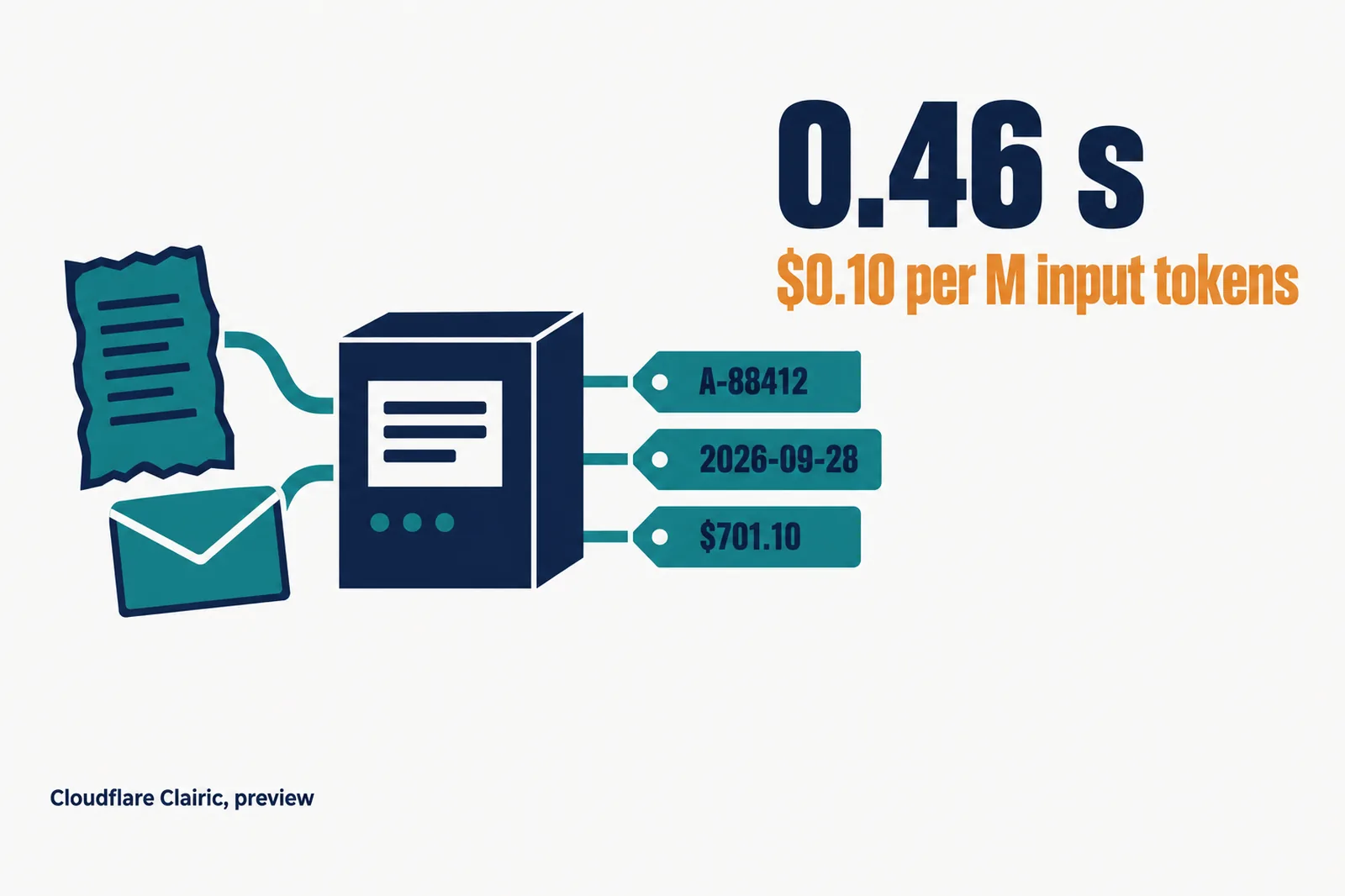
Cloudflare has released Clairic, a model that pulls typed values out of emails, receipts and photos in a single pass instead of writing an answer like an LLM. “Today, we’re announcing a preview of a new class of System One-style models: extraction models.” The launch post went up at 17:48 UTC on October 19, 2026, by Alex Reneau, Michelle Chen and Kevin Flansburg, and Clairic is live on Workers AI as @cf/cloudflare/clairic.
It is the second System One model class after decision models such as TypeSafe’s Jev and Cloudflare’s own Clef. Where those pick among options you list, Clairic returns values: a total, a date, a list of damages, an estimate with a range. This post reads Cloudflare’s launch post, model page and pricing page directly.
On this page · 8 sectionsOpen
 Cloudflare released Clairic in preview on Workers AI on October 19, 2026, as the first System One extraction model, and says open weights will follow.
 Clairic answers in one parallel pass with no output tokens: you declare typed fields and get each value back with a confidence score, or null when it is not in the input.
 It costs $0.10 per million input tokens on Workers AI, reads text plus up to four images, and has a 65,536-token context window.
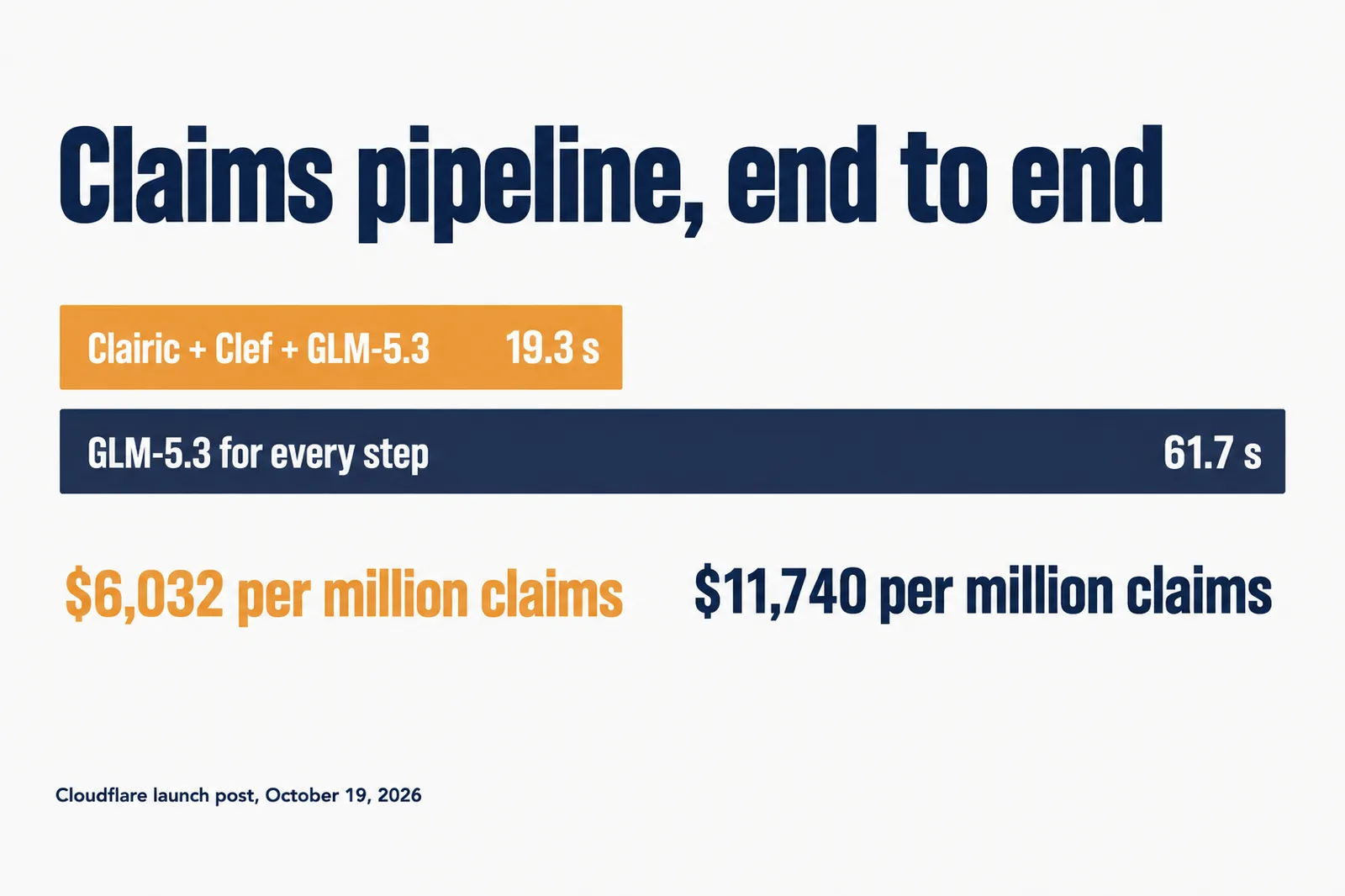
 In Cloudflare’s claims test, Clairic plus its decision model Clef plus GLM-5.3 finished in 19.3 seconds against 61.7 for GLM-5.3 alone, at 49% lower cost.
 Cloudflare’s own limits: multi-step arithmetic is not reliable yet, estimates need evidence in the input, and forecasting is basic.
§ 01What Clairic returns
You send a state (text, plus up to four images) and a map of named, typed fields. Clairic reads the input once and fills every field in the same pass, so asking for thirty fields costs about what three do. There is no reasoning and no output text to parse.

| Type | What comes back |
|---|---|
| Extracted value | A span copied from the input, with character offsets and a confidence score |
| Computed value | A number, date, time, duration or list read from the input or worked out from it |
| Estimated value | A distribution inside the bounds you declare, with a median and an 80% interval |
| Forecasted value | One estimate per future step of a series, each with its own 80% interval |
| Missing value | null, with the probability that the value is absent and the model’s best guess |
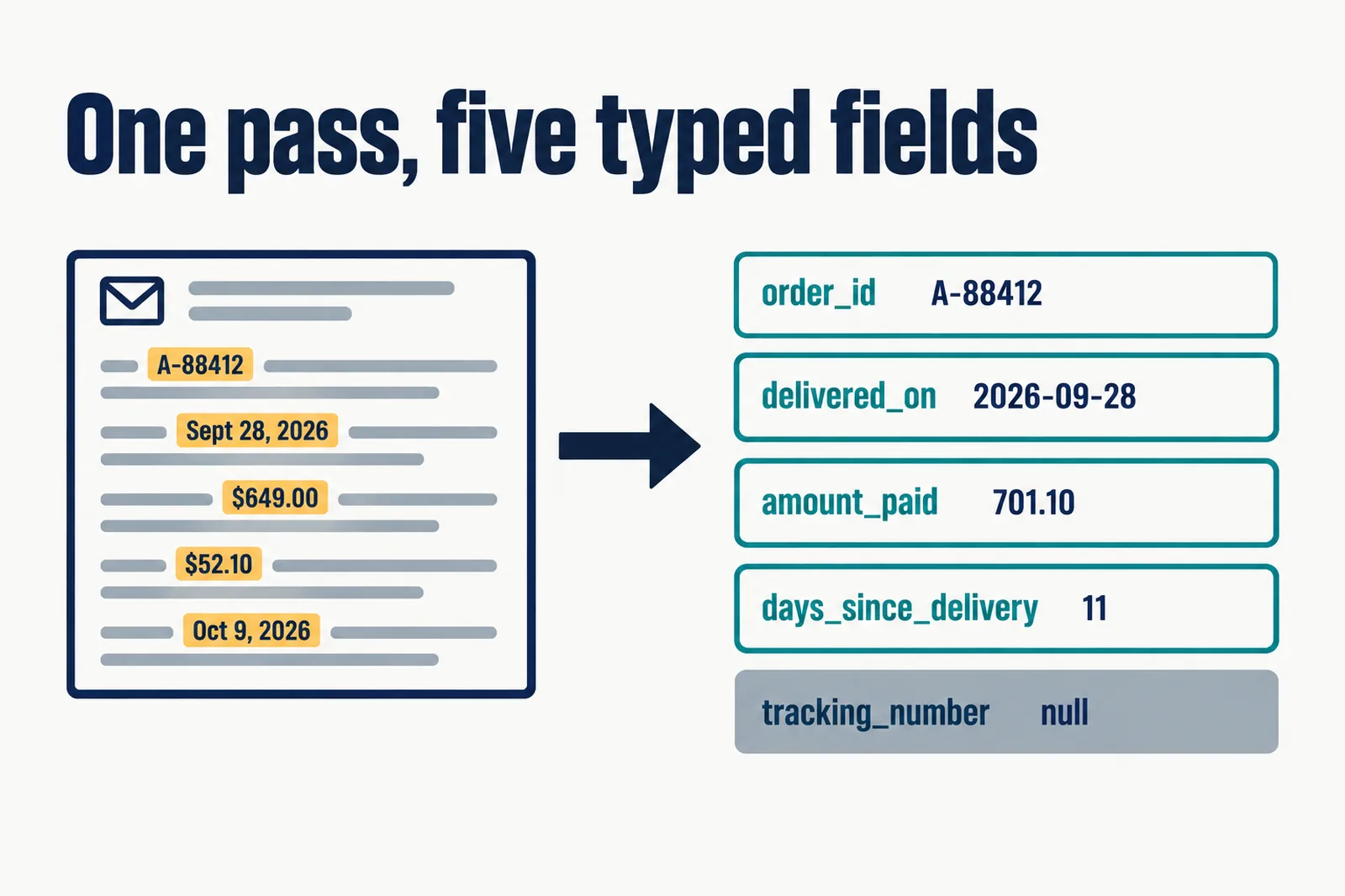
Cloudflare’s worked example is a support email. Clairic adds $649.00 and $52.10 tax into an amount paid of 701.1, counts 11 days between delivery and the email, lists both kinds of damage as spans, and returns null for a tracking number the email never mentions. In a house-price example, the 80% interval for price is narrow ($370,000 to $470,000) while days on market is wide (24 to 148), which shows how much the input actually supports each answer.
§ 02What it costs
| Model | Kind | Price per million input tokens |
|---|---|---|
| @cf/cloudflare/clairic | Extraction | $0.100 |
| @cf/cloudflare/clef-omni | Decision | $0.150 |
| @cf/cloudflare/clef-flash | Decision | $0.038 |
All three charge only for input tokens. The model page lists a 65,536-token context window and vision support for Clairic.
§ 03Cloudflare’s pipeline test
Cloudflare ran an insurance-claim workflow two ways: Clairic extracts, Clef decides, and GLM-5.3 writes the reply; or GLM-5.3 does all three steps from the same email, policy and prompts.

| Step | Cascade | GLM-5.3 for every step |
|---|---|---|
| Extract | Clairic, 0.46 s | GLM-5.3, 16.1 s |
| Decide | Clef, 0.22 s | GLM-5.3, 21.9 s |
| Reply | GLM-5.3, 18.6 s | GLM-5.3, 16.4 s |
| End to end | 19.3 s | 61.7 s |
| Cost per million claims | $6,032 | $11,740 |
The cascade took 69% less time and cost 49% less. GLM-5.3’s three steps add up to 54.4 seconds; the 61.7-second figure is the end-to-end time Cloudflare reported. Both pipelines got the facts and the decision right in every run, but Clairic’s repair estimate was identical each time while GLM-5.3’s moved between $250 and $220. Cloudflare also reports that Gemma 4 and Qwen failed the all-LLM version because they could not work out values like the repair cost.
§ 04What Cloudflare says it cannot do yet
The post is unusually frank about this checkpoint: “Reading is strong, but multi-step arithmetic isn’t yet.” One- and two-step sums and date math work; long chains of dependent steps and totals across many table rows do not. Its advice: “At least for now, have Clairic predict the value and let code do the math.”
Estimates need comparables or history in the input, intervals can run narrow on unfamiliar data, and forecasting is meant for general patterns, not detailed long-range work. The summary line is the one to keep: “The architecture makes every answer well formed, not necessarily correct.” Every answer carries a confidence score and a null probability so you can decide what to automate and what to check.
§ 05Where it fits
Clairic is for the repeated, structured steps that teams now send to a frontier LLM: invoice totals, delivery dates, claim amounts. The pattern Cloudflare describes is a split of labor: extraction models turn input into values, decision models turn values into choices, and an LLM turns choices into words. “We intend to release the model open-weights soon.”
§ 06Where CellCog stands
CellCog does not host Clairic; every CellCog agent tier runs on Claude Opus 5.5. We track System One models because they change what the small, repeated steps inside agent workflows cost.
§ 07What we are watching for
- The open-weights release Cloudflare says is coming.
- Independent tests of Clairic’s calibration on outside data.
- Whether TypeSafe or Microsoft answer with extraction models of their own.
§ 08Sources
- Cloudflare, Introducing Clairic, a new System One class of extraction models, Alex Reneau, Michelle Chen and Kevin Flansburg, October 19, 2026, 17:48 UTC. Read directly.
- Cloudflare, clairic model page, Workers AI docs, read October 20, 2026.
- Cloudflare, Workers AI pricing, read October 20, 2026.
- Michelle Chen on X, launch post, October 19, 2026, 17:54 UTC.
Q1When was Clairic released?
Cloudflare published the launch post on October 19, 2026 at 17:48 UTC. The model is a preview on Workers AI as @cf/cloudflare/clairic.
Q2Is Clairic open source?
Not yet. Cloudflare says it intends to release the model with open weights after more work. Today it is a hosted endpoint only.
Q3What kinds of values can it return?
Text spans with character offsets, numbers, dates, times, durations, lists, estimates with an 80% interval, and forecasts for a series, each typed and bounded by the schema you send.
Q4What is a System One model?
A fast, single-pass model with typed outputs, named after Kahneman’s fast thinking. TypeSafe’s Jev introduced the idea for decisions; Clairic applies it to extracting values.
Q5Where does Clairic struggle?
Cloudflare says long chains of dependent arithmetic, aggregating many table rows, estimates without evidence and detailed forecasting are weak spots in this checkpoint.
Q6Does CellCog use Clairic?
No. Every CellCog agent tier runs on Claude Opus 5.5. We follow System One models because they change what it costs to run the small, repeated steps inside agent workflows.