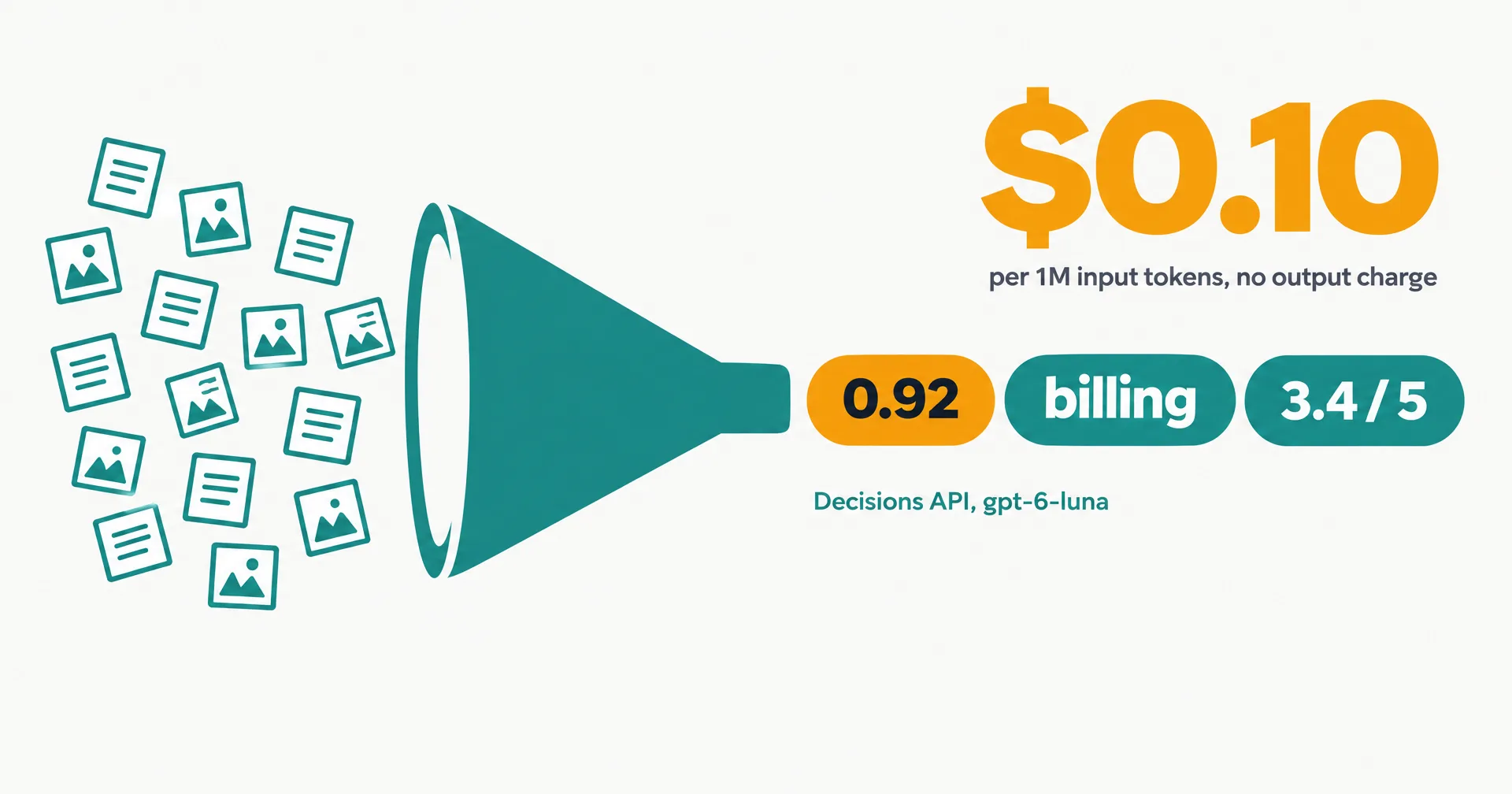
OpenAI released the Decisions API in beta on October 6, 2026: a new endpoint, POST /v1/decisions, that takes text or images plus a list of questions and returns typed answers (a probability, a choice or a score) instead of written text. It runs only on gpt-6-luna, charges $0.10 per million input tokens and nothing for output, and OpenAI says it “returns typed answers about 10x faster than the Responses API”. The product is a direct answer to Jev, the decision model from TypeSafe AI that spread through Vercel’s AI Gateway in September. This page reads OpenAI’s API changelog, the Decisions guide, the GPT-6 Luna model page and the pricing page, as of October 6, 2026.
On this page · 6 sectionsOpen
 OpenAI released the Decisions API in public beta on October 6, 2026: POST /v1/decisions takes text or images plus typed questions and returns answers instead of written text.
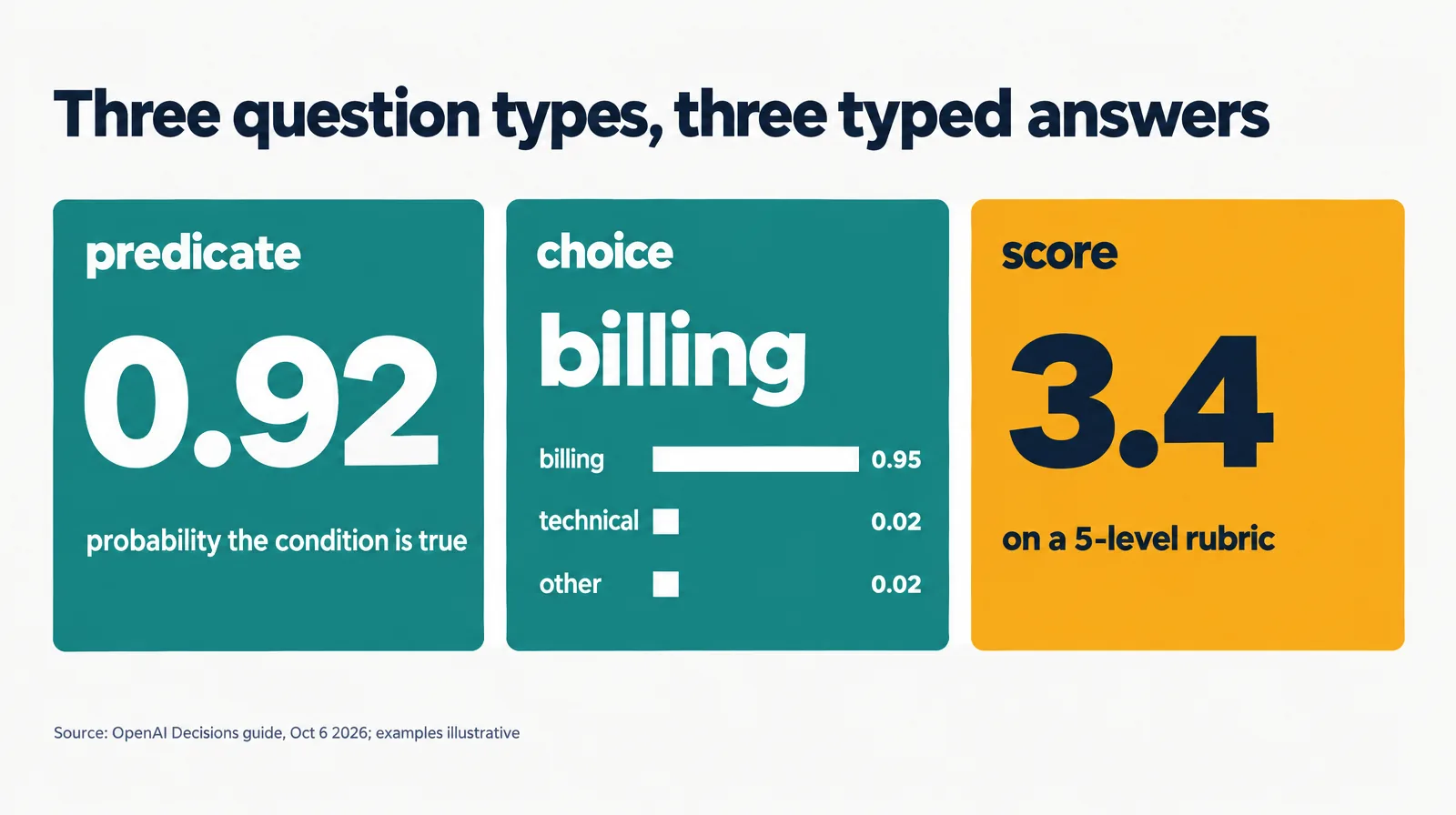
 Three question types: predicate returns a probability that a condition is true, choice returns one option plus probabilities, score returns a weighted position on ordered levels.
 It runs only on gpt-6-luna and charges $0.10 per million input tokens, with no output, cache-read or cache-write charges; Luna on the Responses API costs $0.50 per million output tokens.
 OpenAI says it returns typed answers about 10x faster than the Responses API and expects general availability in the coming weeks.
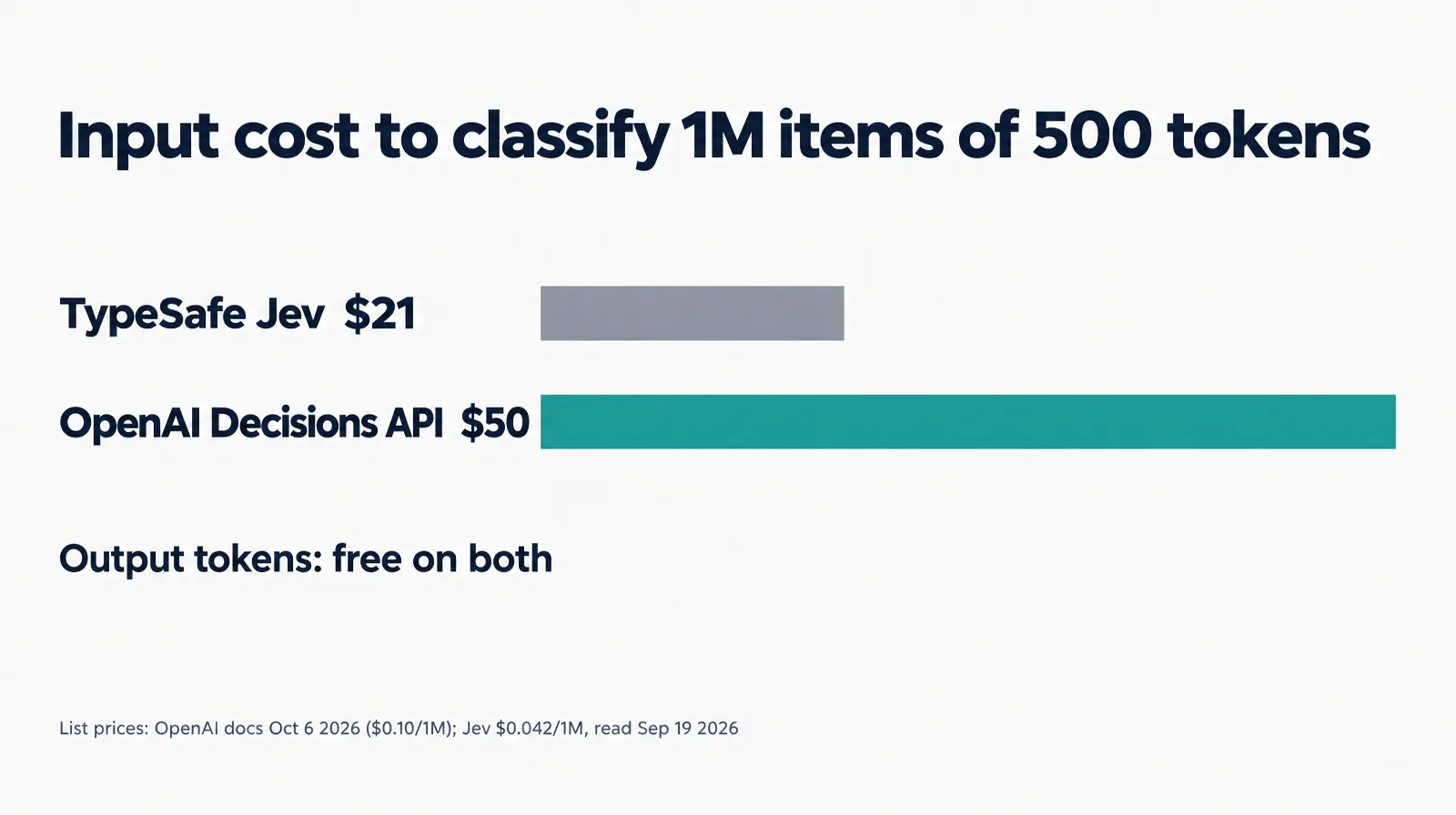
 TypeSafe’s Jev lists $0.042 per million input tokens, so 1M classifications of 500 tokens cost about $21 on Jev against $50 on OpenAI; neither vendor has published head-to-head accuracy.
 Images must be inline base64; hosted image URLs and file IDs are refused. Zero Data Retention and HIPAA are available to eligible customers, with US and EU data residency.
§ 01What OpenAI shipped
A request has three parts: the model (only gpt-6-luna today), the input (a text string, or user messages mixing text and images) and the questions, each with a unique name, a type and instructions. The response is an answers array keyed by those names. On status, the guide is plain: “The Decisions API is in public beta, and we expect to GA in the coming weeks.”
| Item | Decisions API |
|---|---|
| Released | October 6, 2026, public beta |
| Endpoint | POST /v1/decisions |
| Model | gpt-6-luna only |
| Inputs | Text, or text and images (images as inline base64 only) |
| Question types | Predicate, choice, score |
| Price | $0.10 per million input tokens; no output, cache-read or cache-write charges |
| Speed claim | About 10x faster than the Responses API |
| Data controls | Zero Data Retention and HIPAA for eligible customers; US and EU data residency |
| Playground | platform.openai.com/decisions |
§ 02The three question types
Each type returns a different kind of answer, and the guide gives one worked example per type: a damaged-product photo, a billing complaint routed to a department, and a bug scored for severity.
| Type | Use it to | What comes back |
|---|---|---|
| predicate | Check whether a condition holds, such as visible damage in a photo | A probability from 0 to 1 that the condition is true |
| choice | Pick one option from a fixed set, such as a department | The chosen value, a probability for every option, and a confidence |
| score | Rate an input on ordered levels, such as severity | The probability-weighted average of the level indices, which can fall between levels |
OpenAI’s advice on reading the numbers is to set thresholds from your own labeled examples, weighed by the cost of a false positive against a false negative. When the task is to produce an object of your own shape (extracted fields, a written explanation), the guide points back to Structured Outputs on the Responses API; Decisions is for answers, not generation.
§ 03What it costs, and the Jev comparison
The pricing is the headline. On the guide’s own wording: “You pay only for input tokens: there are no cache-read, cache-write, or output-token charges.” Regional processing premiums and long-context multipliers still apply. The same model through the Responses API costs $0.10 per million input tokens and $0.50 per million output tokens, so a Decisions call removes the output bill entirely.
| Item | OpenAI Decisions API | TypeSafe Jev 1.13 | gpt-6-luna on Responses |
|---|---|---|---|
| Input price per 1M tokens | $0.10 | $0.042 | $0.10 |
| Output price per 1M tokens | None | Free | $0.50 |
| Images | Yes, inline base64 | No, text only | Yes |
| Answer types | Predicate, choice, score | Boolean, choice, score | Free text or your JSON schema |
| Status | Public beta | Early access; on Vercel AI Gateway | Generally available |
The worked example is our arithmetic: one million inputs of 500 tokens is 500 million tokens, $50 at OpenAI’s rate and $21 at Jev’s list price on our September 19 record. Jev stays cheaper per token and text-only; OpenAI’s version reads images, sits inside an account most teams already have, and carries ZDR and HIPAA eligibility. Neither vendor has published a head-to-head accuracy number, so the right test is your own labeled set on both.
§ 04What changes if you build on it
- Routing and triage get a native endpoint. Ticket routing, content moderation, lead scoring and relevance checks used to be a chat call parsed back into a label. Here the label and its probability come back typed.
- Images must be inline. The endpoint takes base64 data URLs only; hosted image links and uploaded file IDs are refused, so pipelines that pass URLs need a fetch-and-encode step.
- Beta terms apply. OpenAI expects general availability in the coming weeks; plan for field names and limits to move until then.
- Voice is wired in. The guide links a voice delegation pattern that pairs the Live API with Decisions to choose actions from spoken requests.
§ 05What we are watching
- General availability. The GA date, and whether more models than
gpt-6-lunajoin the endpoint. - Accuracy numbers. A published calibration or accuracy benchmark from OpenAI or an independent tester, against Jev or a Responses baseline.
- Jev’s reply. Any TypeSafe price or feature change after October 6.
- The 10x claim. Independent latency measurements of the speed gap OpenAI states.
§ 06Sources
- OpenAI API changelog, October 6, 2026: developers.openai.com
- OpenAI Decisions guide: developers.openai.com
- GPT-6 Luna model page: developers.openai.com
- OpenAI API pricing: developers.openai.com
- Our record of TypeSafe’s Jev, September 2026: cellcog.ai
Q1What is the OpenAI Decisions API?
The Decisions API is an OpenAI endpoint, POST /v1/decisions, released in public beta on October 6, 2026. It takes text or images plus a list of questions and returns typed answers: a probability for a predicate, one option for a choice, or a score on ordered levels. It runs on gpt-6-luna.
Q2How much does the Decisions API cost?
With gpt-6-luna, input costs $0.10 per million tokens and there are no output, cache-read or cache-write charges, according to OpenAI’s guide. Regional processing premiums and long-context multipliers still apply.
Q3Is the Decisions API faster than the Responses API?
OpenAI says it returns typed answers about 10x faster than the Responses API. We have not seen an independent latency measurement yet.
Q4How does the Decisions API compare with TypeSafe's Jev?
Both return typed decisions with no output charge. Jev lists $0.042 per million input tokens and accepts text only; OpenAI charges $0.10 and accepts images. Neither has published a head-to-head accuracy benchmark, so test both on your own labeled data.
Q5Can the Decisions API read images?
Yes, but only as inline base64 data URLs inside user messages. Hosted HTTP or HTTPS image URLs and file IDs are not supported by this endpoint.