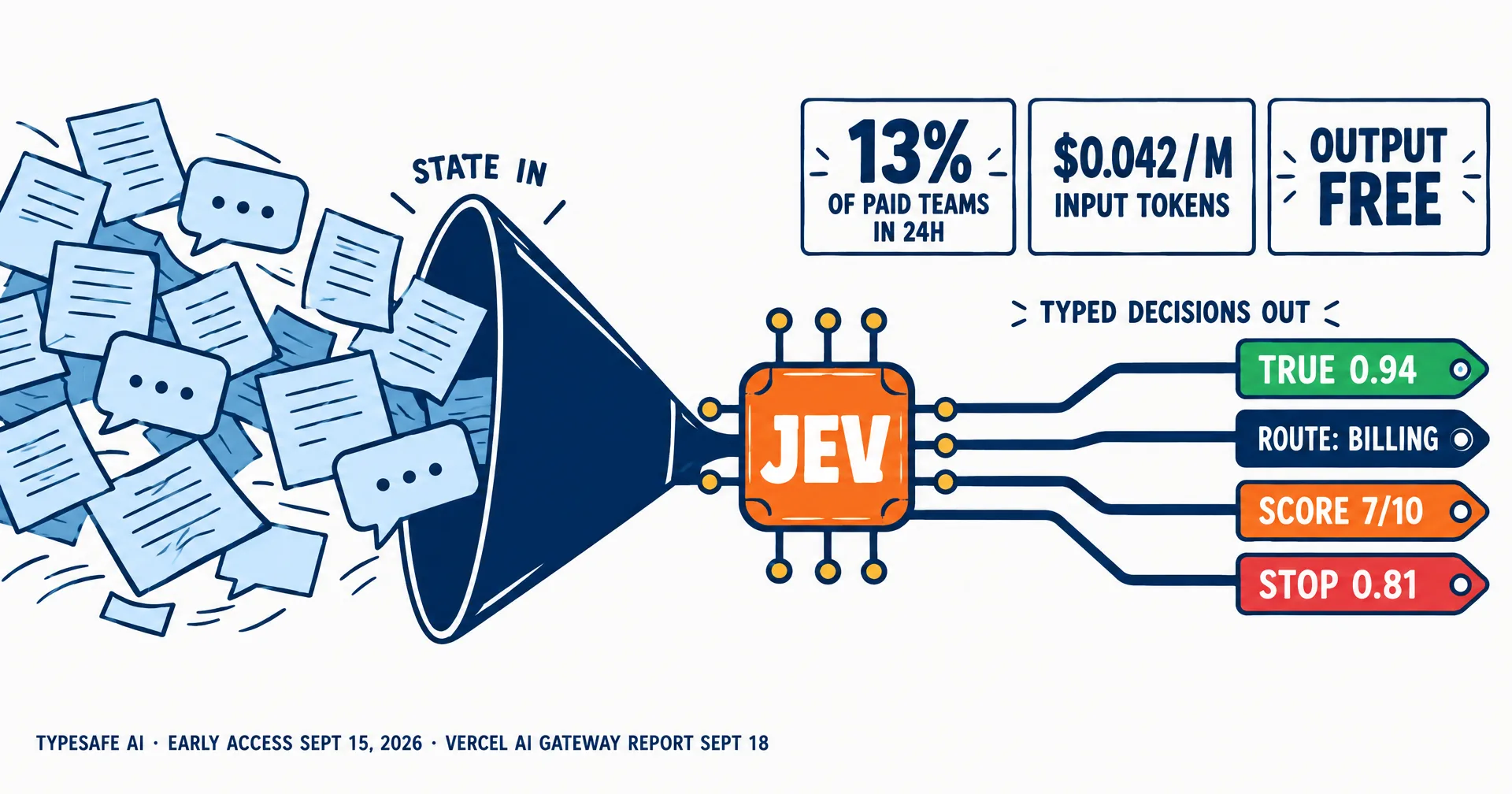
Three days after it appeared, a model that refuses to write a sentence became the fastest-adopted launch in the history of Vercel’s AI Gateway. Jev, from TypeSafe AI, takes a state and a list of typed questions and returns choices, scores and probabilities, all at once, for $0.042 per million input tokens and nothing for output. This page holds what TypeSafe claims, what it concedes, what Vercel measured and what independent developers found, dated, and flips as the numbers move.
On this page · 10 sectionsOpen
 Jev is a transformer that does not write text. An application sends it a state (a document, a ticket, an agent’s trace) and a set of typed questions; it returns choices, scores and true-or-false answers with calibrated probabilities, all evaluated in parallel. TypeSafe AI, founded by former OpenAI researcher Diogo Almeida, released it in early access on September 15, 2026 and calls the class a System One model.
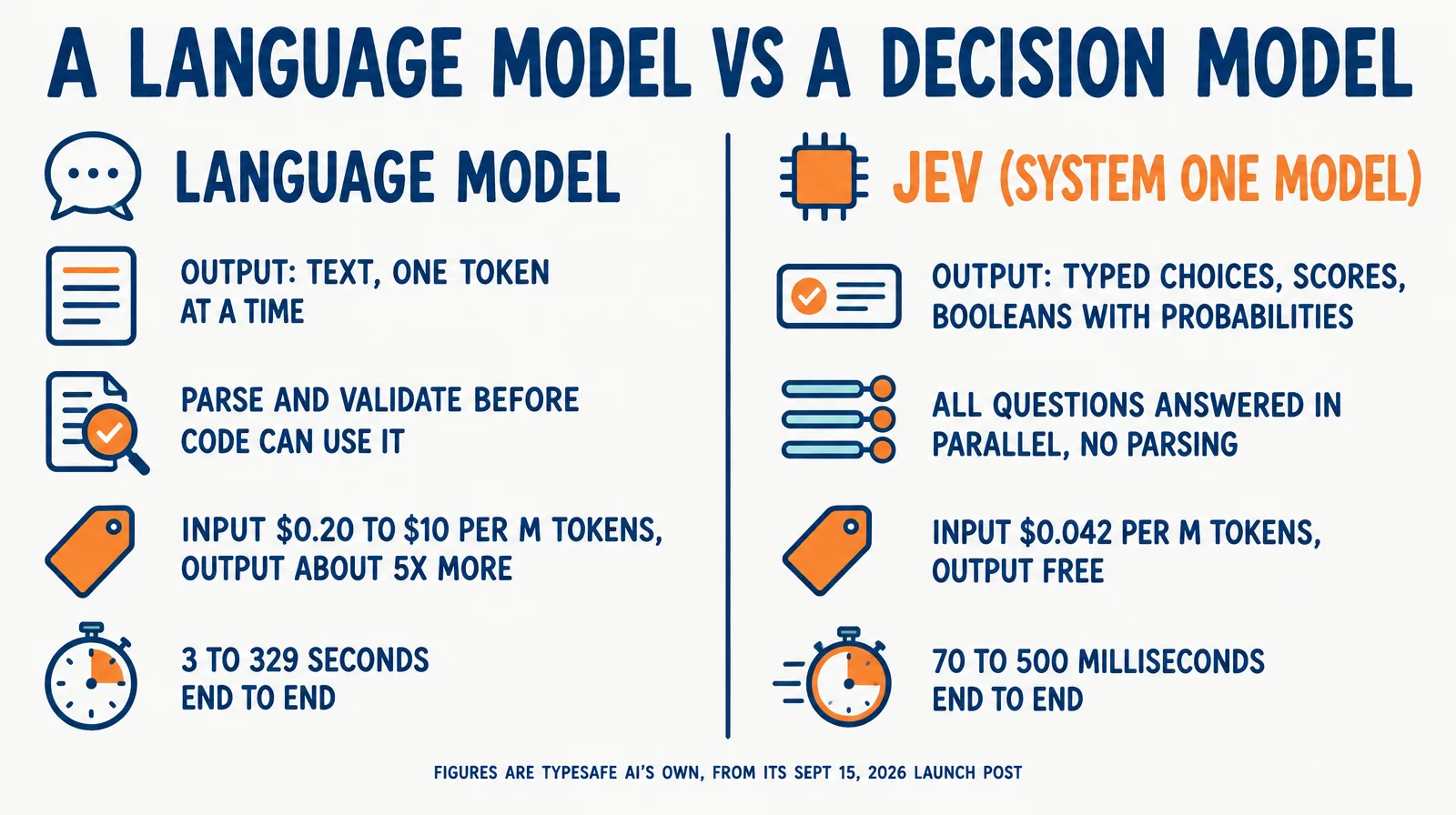
 The price is the story: $0.042 per million input tokens, output tokens free, 64k context, 250,000 tokens per second and 1,200 requests per minute on the public tier. TypeSafe’s own launch figures put end-to-end latency at 70 to 500 milliseconds against 3 to 329 seconds for frontier language models, and its workflow evaluations at 193.6 times faster and 444.6 times cheaper than an average of GPT-6 Astra and Fable 5.1.
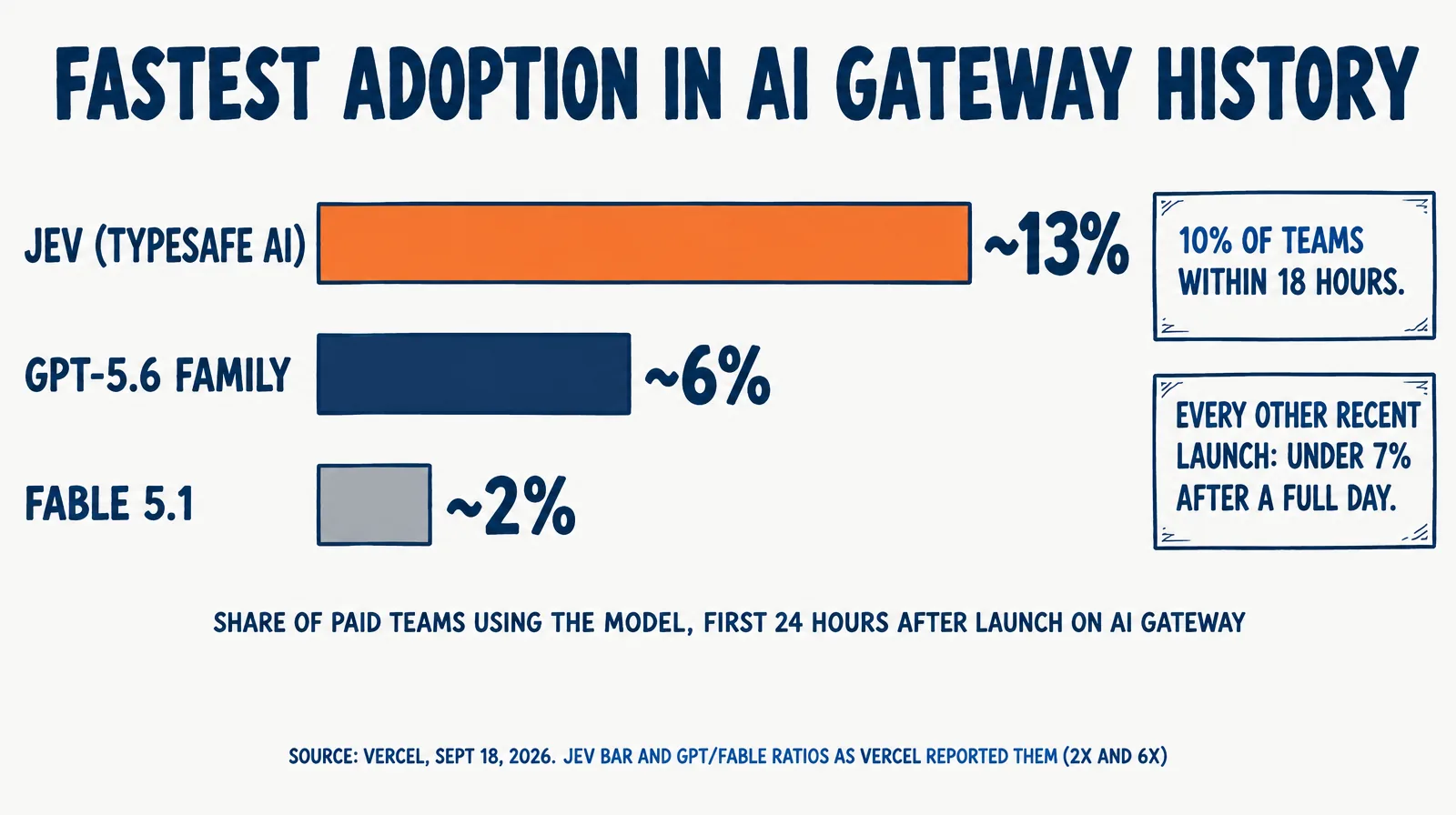
 Three days after launch, Vercel reported that Jev was the fastest-adopted model in AI Gateway history: nearly 13 percent of paid teams in its first 24 hours, twice the GPT-5.6 family and more than six times Fable 5.1, a tenth of teams within 18 hours. It is free on the gateway through September 25, 2026, which is part of the number.
 The independent data points are small and mixed. Per TechCrunch, a Vercel engineer replaced a GPT-5.6 Luna safety classifier with Jev and got results 5 to 18 times faster with greater accuracy; a Bryo AI test found Gemini slightly more accurate at classifying business emails but 10 to 20 times more expensive. TypeSafe’s headline multipliers come from workflows its own team built, which the company says itself.
 What it cannot do is in the docs: text only, no images, audio or video; a 32k limit on state plus the longest question; rate limits that TypeSafe says can change without notice while demand is being served; and an architecture the company will not describe, which outside observers suspect sits on an open-weight language model. Cannot hallucinate means the answer is always inside the schema you defined, not that it is right.
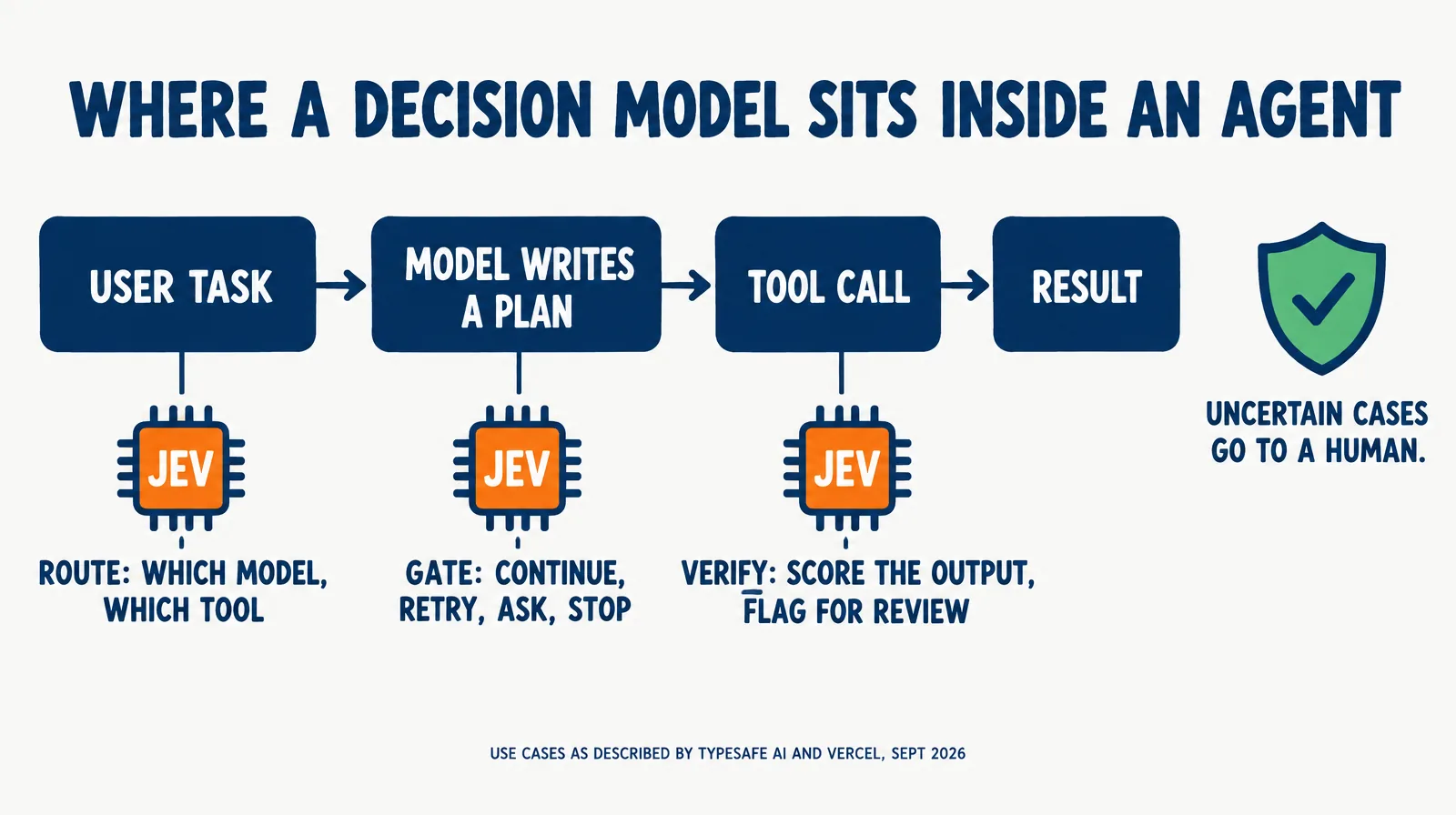
 Its natural home is the plumbing around a language model rather than in place of one: choosing which tool or model an agent calls next, deciding whether a workflow continues, retries, asks or stops, scoring risk before an action, and grading another model’s output. Those are the calls an agent makes dozens of times per task, and they are the ones a 100-millisecond, calibrated, schema-bound answer changes.
 For CellCog, a decision model is the class of component that sits under classification and routing, the layer that decides before the expensive model speaks. We do not route to Jev today; we read it as the first credible model built for that layer alone, and this page tracks whether Vercel’s first-day curve holds past the free week.
§ 01What Jev is
TypeSafe’s founder Diogo Almeida opens the launch post with the question the company was built on: “Models have been superhuman at chat for years, so where is all the automation?” His answer is a model that gives up strings. “Think of Jev as a frontier-intelligence function call: unstructured state in, typed probabilistic decisions out.”
| Item | Value |
|---|---|
| Model ID | jev-1.13.0 (aliases jev-latest, jev-preview) |
| Endpoint | POST /v1/systemone |
| Input price | $0.042 per million tokens ($42 per billion) |
| Output price | Free |
| Context | 64k tokens per request; 32k for the state plus the longest question |
| Input types | Text only: strings, JSON objects, arrays of text; no image, audio or video |
| Outputs | Choice (one of a declared set), Score (an ordered rubric), Boolean (a probability of true), with confidence |
| Rate limits | 250,000 tokens per second, 1,200 requests per minute; TypeSafe says these can change without notice while demand is being served |
| Availability | Early access at typesafe.ai; Vercel AI Gateway since September 16 as typesafe-ai/jev, free there through September 25, 2026 |
| Training | Synthetic data only, a method TypeSafe calls Reinforcement Learning for Calibrated Decisions (RLCD), per the launch post and TechCrunch |
The word TypeSafe leans on is calibrated. A language model asked for its confidence tends to be overconfident and inconsistent; Jev’s stated objective is that a 95 percent answer is right about 95 percent of the time, and that similar inputs return similar answers. That is what makes a decision automatable: the code can act above a threshold and hand everything below it to a person.
§ 02What TypeSafe claims, and what it concedes
| Dimension | Existing language models, per TypeSafe | Jev, per TypeSafe |
|---|---|---|
| Output | Strings that code must parse and validate; can be anything, including hallucinations and refusals | Type-safe structured values defined in advance; the model never makes a type error |
| Sampling | Sequential, one token at a time | Parallel, all outputs in one query |
| Input cost | $0.20 to $10 per million tokens | $0.042 per million tokens |
| Output cost | About five times the input price | Free |
| End-to-end time | 3 to 329 seconds for frontier models | 70 to 500 milliseconds |
| Workflow evaluations | Reference: the average of GPT-6 Astra and Fable 5.1, wrapped for structured output | Up to 193.6 times faster and 444.6 times cheaper |
The launch post is unusually candid about which of these you can check yourself and which you cannot. Speed and price per call, it says, are easy to verify. The no-type-errors claim is a property of the schema. The multipliers are the bold claim, and TypeSafe writes the caveats into the same section: the workflows were made by its own model capabilities team, “some bias could exist”, the reference answers are biased toward OpenAI’s and Anthropic’s models, and the side-by-side demo used a short, dense input that “paints our model in an advantageous light”. It also says it cannot prove the pricing is not subsidized. “Extraordinary claims require extraordinary evidence”, the post says, and then lists where its evidence is thin. That is more than most launch posts do.
§ 03What happened on Vercel
Vercel added Jev to AI Gateway on September 16 through the AI SDK’s evaluate API, and on September 18 published the number that made this page: “the fastest-adopted model in gateway history”.
| Measure | Value |
|---|---|
| Share of paid teams using Jev by hour 24 | Nearly 13 percent |
| Versus the GPT-5.6 family | Twice as many teams |
| Versus Fable 5.1 | More than six times as many teams |
| Time to a tenth of teams | 18 hours |
| Every other recent model launch | Below 7 percent after a full day |
| Price on the gateway during the window | Free, promotional pricing ending September 25, 2026 |
| Model | Share of paid teams, percent |
|---|---|
| Jev | 13 |
| GPT-5.6 family | 6.5 |
| Fable 5.1 | 2.2 |
Read the number for what it is. It is Vercel’s figure about Vercel’s paying gateway customers, during a week when the model cost them nothing, and Vercel is the one selling the gateway. Vercel says so in its own post: “the next test is whether that early adoption lasts”. The free week ends September 25; the first read after that is the one that matters, and it is on this page’s watch list. Guillermo Rauch, Vercel’s CEO, posted at 01:11 UTC on September 19 that free Jev on Vercel was his weekend plan, which is the other half of how a gateway launch gets to 13 percent.
§ 04What developers measured
TechCrunch’s Tim Fernholz collected the first independent numbers on September 18. They are small, real and mixed.
| Who | Test | Result |
|---|---|---|
| Pranit Sharma, Vercel | Replaced a GPT-5.6 Luna classifier that reviews commands for safety with Jev | Results 5 to 18 times faster, with greater accuracy, per Vercel |
| Nikhil Mudholkar, CTO, Bryo AI | Jev against Gemini for classifying business emails | Gemini slightly more accurate; Jev 10 to 20 times cheaper; Jev the only one returning a real probability |
| Armin Ronacher, CTO, Earendil (the Pi harness) | Reading the confidence output | The model hands the hallucination problem back to the user, who decides what a 50 percent answer versus a 95 percent answer is worth |
Mudholkar’s line is the one that explains the adoption: “it is the only one that hands back a real probability which makes it ideal for automating workflows!!” Ronacher’s frames the cost of that: “At the end of the day, it delegates the hallucination problem a little bit to the user”. Both are right, and they are describing the same feature. TechCrunch also reports that TypeSafe briefly lost the ability to serve its API because demand was so high, and that Ronacher expects competitors now that the utility is apparent. Mikhail Parakhin’s read, posted the same afternoon: “Jev model is very polarizing in my social vicinity”, exciting to people who met AI through ChatGPT, baffling to pre-ChatGPT machine-learning people who see a calibrated classifier with a good API.
The demo videos are a separate matter. Steve Sewell, Builder.io’s CEO, posted at 01:12 UTC on September 19: “Jev is awesome but for the love of god please STOP posting fake demos”. One reply, from a developer who had run one of the demonstrated tasks: “an actual test on browser use it fails”. Read the two beside the launch post: TypeSafe claims typed decisions and no text, so a clip of Jev operating a browser on its own is showing an agent loop built around the model, not the model.
§ 05Where a decision model sits inside an agent
Strip the launch language and Jev is a fast, cheap, calibrated classifier that answers many questions at once and refuses to answer outside the schema. That is not a small thing; it is the component most agent systems build badly out of a language model and a regex. An agent makes dozens of small decisions per task: which tool, which model, continue or stop, is this output acceptable, does this command touch the outside world. Today those decisions are usually made by the same expensive model doing the work, in prose, then parsed. A decision model moves them to a layer that answers in 100 milliseconds with a probability the code can threshold.
The use cases TypeSafe and Vercel both list are exactly that layer: choosing an agent’s next tool or subagent, deciding whether a workflow should continue, retry, ask the user or stop, scoring urgency or risk before an action, verifying another model’s output and enforcing guardrails, and detecting jailbreaks in prompts and traces. Ronacher’s addition is model routing: predicting whether a workload needs the big model before you pay for it. None of these replace the language model. All of them decide when and how it runs.
§ 06The headlines, graded
| Claim | Status |
|---|---|
| Jev is a new kind of frontier model | TypeSafe’s framing; a transformer trained on synthetic data to output typed probabilities, architecture undisclosed, which outside observers per TechCrunch suspect is built on an open-weight LLM |
| It cannot hallucinate | True as defined: outputs are always inside the declared schema; says nothing about whether the chosen answer is correct |
| 193.6x faster and 444.6x cheaper than LLMs | TypeSafe’s own workflow evaluations against an Astra and Fable average, built by its own team; the company calls these the high end of real-world gains |
| Fastest-adopted model in AI Gateway history | Vercel’s statement about its own paid gateway customers during a free promotion |
| 13 percent of paid teams | Nearly 13 percent, per Vercel, at hour 24 |
| Free | On Vercel through September 25, 2026; TypeSafe’s list price is $0.042 per million input tokens, output free |
| It replaces GPT-6 Astra or Fable | Not claimed by TypeSafe; it produces no text |
| Independent benchmarks confirm it | None yet; two developer tests reported by TechCrunch, one for and one mixed |
| The viral demo clips | Contested. Builder.io CEO Steve Sewell asked posters to stop sharing fake Jev demos on September 19 at 01:12 UTC; a reply reported an actual browser-use test failing |
§ 07Where CellCog stands
Our conflict, declared: we build CellCog, a platform where a business hires AI employees that keep memory and work as a team, and we choose the models under them. Our tiers run on Claude Fable 5.1, Claude Opus 5 and Gemini 3.8 Flash; we do not route to Jev. What we can say from the operating side is that every command an AI employee issues that reaches your world is classified before the platform lets it through, and that classification, routing and verification are the calls a decision model is built for. Jev is the first model we have seen built for that layer alone. Whether it belongs under a CellCog employee is a question of calibration on our own workloads, and this page will say so when we have an answer.
§ 08What we are watching for
- September 26. The first Vercel read after promotional pricing ends; whether the 13 percent holds at $0.042 per million is the test Vercel itself named.
- An independent benchmark. Anyone running Jev against an LLM classifier on a public dataset with published labels; the two TechCrunch tests are the only outside numbers so far.
- A second decision model. Ronacher expects competitors; the first one dates this page’s claim that Jev stands alone.
- The architecture. Any disclosure of what Jev runs on, or a paper on RLCD.
- TypeSafe on the demo clips. Whether the company addresses the fake-demo complaint; its launch post already separates the claims a reader can check from those they cannot.
- New modalities. TypeSafe told TechCrunch it will build more versions in new modalities; text-only is the current limit.
§ 09The record
As of September 19, 2026, 07:45 UTC: page opened. TypeSafe’s launch post is dated September 15, 2026 (the Hacker News thread on it opened at 19:25 UTC that day and stood at 1,899 points and 497 comments when read); Vercel’s changelog entry is dated September 16; Vercel’s adoption post is dated September 18 and its X post is timestamped 22:34:10 UTC (computed from the post id); TechCrunch published at 18:49 UTC on September 18. Pricing and limits read from docs.typesafe.ai and the Vercel model page at 07:33 UTC on September 19. Updated 13:20 UTC the same day: added the demo-clip pushback from Builder.io’s Steve Sewell (post timestamp computed from the post id).
As of September 24, 2026, 13:25 UTC: OpenClaw v2026.9.6 (published September 23, 23:21 UTC) adds Jev as an opt-in Decision Model through the separate @openclaw/typesafe plugin, off by default; the release notes say hosted evaluations send the supplied information to TypeSafe and incur its normal API charges, and that “Selecting a decision model does not start background work or give an agent new tools or permission to act.” Our OpenClaw 2.0 page carries the release.
§ 10Sources
- TypeSafe AI, Diogo Almeida, Introducing System One Models and Jev, September 15, 2026; Models documentation, read September 19, 2026, 07:33 UTC.
- Vercel, TypeSafe AI’s Jev now available on AI Gateway, September 16, 2026; Jev is the fastest-adopted model in AI Gateway history, September 18, 2026; Jev model page, read September 19, 2026; @vercel on X, 2026-09-18T22:34:10Z.
- TechCrunch, Tim Fernholz, A new kind of AI model from a ChatGPT inventor is thrilling developers, published 2026-09-18T18:49 UTC.
- Guillermo Rauch on X, 2026-09-19T01:11Z; Mikhail Parakhin on X, 2026-09-18T19:51Z; times computed from the post ids.
- Hacker News, Introducing System One Models and Jev, opened 2026-09-15T19:25:03Z, read September 19, 2026.
- CellCog routing statements reflect our configuration on September 19, 2026.
Q1Who is behind TypeSafe AI?
Diogo Almeida, who writes in the launch post that at OpenAI he helped build the methods that made language models useful at following instructions and talking with people, the research behind ChatGPT, and left about two years ago to build TypeSafe in stealth. TechCrunch reports the model is trained exclusively on synthetic data with a method the company calls reinforcement learning for calibrated decisions, and that Almeida is tight-lipped about the architecture.
Q2What is a System One model?
TypeSafe’s name for a model optimized for fast, structured decisions rather than language: unstructured state in, typed probabilistic decisions out, with the possible outputs defined in advance so the model cannot produce a type error. The name borrows the intuition-versus-reasoning distinction; the company’s stated training objective is calibrated probabilities, meaning higher confidence should mean higher accuracy.
Q3Where do the 193.6x and 444.6x figures come from?
From TypeSafe’s own workflow evaluations, published alongside the launch: every model runs the same decision workflow, and the reference answers are the average of GPT-6 Astra and Fable 5.1 wrapped for structured output. TypeSafe writes that the workflows were made by its own model capabilities team, that some bias could exist, and that it expects these to be on the higher end of real-world gains.
Q4Why is it named Jev?
After William Stanley Jevons, the nineteenth-century economist whose paradox describes a falling price leading to more consumption, per TechCrunch. The bet is that cheap, fast intelligence gets used in far more places than expensive intelligence.
Q5Does CellCog use Jev?
Not as of September 19, 2026. Our AI employees run on Claude Fable 5.1, Claude Opus 5 and Gemini 3.8 Flash by tier. A calibrated decision model is the kind of component that belongs under classification and routing, and we will say so on this page if that changes.