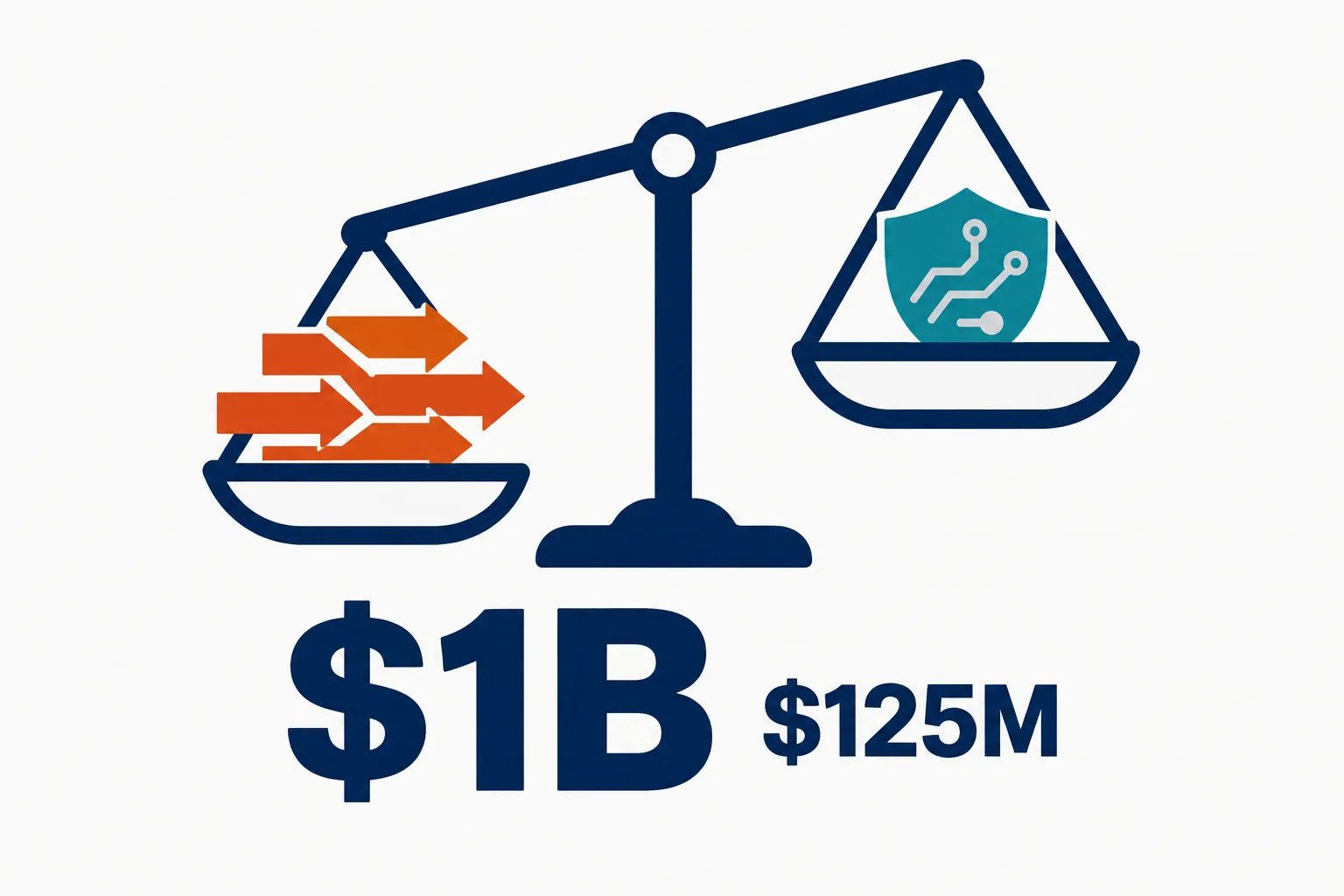
Corma announced a $125 million Series A at a $1 billion valuation on November 16, 2026. NEA led the round, and Sequoia Capital, Khosla Ventures and Coatue invested again. Corma says the round brings its total funding to $185 million, three months after it came out of stealth with $60 million. Chief executive Alon Pluda’s post about it on X had about 1.7 million views by 08:03 UTC on November 17.
On this page · 6 sectionsOpen
 Corma raised a $125 million Series A at a $1 billion valuation on November 16, 2026, led by NEA, with Sequoia, Khosla Ventures and Coatue.
 It came three months after Corma left stealth with $60 million; total funding is now $185 million.
 Corma trains its own foundation models for defensive cybersecurity and sells them as a security workforce that works beside human teams.
 In Corma’s own test of 241 engagements, AI attackers planted a lasting backdoor 85% of the time and general AI defenders found 19%.
 Corma says its models work on logs, events and configurations rather than code, and that compute capacity is its biggest constraint.
 Its claim to beat every frontier model on defense and its Fortune 100 customers are Corma’s own words; no outside test or named customer is public.
§ 01What Corma builds
Corma’s launch post, dated August 10, 2026, says it “is training domain-specific foundation models toward superintelligence for defensive cybersecurity.” It deploys them as what it calls a security workforce that works beside a company’s own security team and its existing tools.
The pitch rests on one idea it calls the defensive gap. In its words, “The Defensive Gap is the phenomenon in which general foundation models’ offensive capability compounds exponentially while their defensive capability stands still.” Breaking in is mostly a code problem, which today’s models are good at. Defending is reading logs, events and configurations over long periods and spotting one bad signal among millions of normal ones.
Pluda put it more simply on X: “the greatest gift cyberattackers have ever received is smarter AI, and right now only one side is armed.”

§ 02The round, by the numbers
| Round | Date | Amount | Lead or investors named |
|---|---|---|---|
| Launch funding | Aug 10, 2026 | $60M | Not named in the launch post |
| Series A | Nov 16, 2026 | $125M | NEA led; Sequoia, Khosla Ventures, Coatue |
| Total | $185M | ||
| Valuation at Series A | $1B |
The new money goes to “the scaling of our foundation models” and compute capacity, the Series A post says. Corma is unusually open about the constraint: “one of the biggest challenges we are continuously facing is to secure enough compute capacity to keep up with that demand.” It keeps a waitlist.
§ 03The test behind the pitch
Corma’s research post from August is the evidence it points to. It ran frontier models as attackers, told to plant a hidden backdoor, and as defenders, told to find it, inside a simulated holding company of eight subsidiaries, about 349 servers and 4,483 workstations. It scored 241 engagements against what had actually changed on the machines.
In Corma’s words: “Even when the defender was the same model that planted the backdoor, it still failed to find its own attack in 78% of engagements.” The environment, the scoring and the models chosen are all Corma’s; no outside group has repeated the test.
§ 04What is claimed and what is shown
Corma’s launch post says its model “has far surpassed every frontier model on defensive cybersecurity tasks” and is protecting Fortune 100 companies. It names no customer and publishes no head-to-head result for its own model, only the test of general models above. Its Series A post also says the industry called October’s run of breaches “Black October”; that is Corma’s framing of a bad month, not a defined event.
Not known yet: the valuation method behind the $1 billion figure, revenue, the size of the waitlist, and when the next model generation Corma promises “soon” will ship. For how the large labs approach the same problem, see our posts on Anthropic’s cyber mission and GPT-6 for cyber defense.
§ 05Our conflict, declared
CellCog has no relationship with Corma or its investors. CellCog runs Anthropic’s Claude Opus 5.5, a frontier model of the kind Corma’s test measures.
§ 06Sources
- Corma, Three months in (Series A announcement), November 16, 2026
- Corma, Introducing Corma, August 10, 2026
- Corma, Measuring the AI offense-defense gap on a live network
- Alon Pluda on X, November 16, 2026
Q1When did Corma come out of stealth?
Its launch post is dated August 10, 2026, when it announced $60 million in funding. The Series A came about three months later.
Q2What is the defensive gap?
Corma’s name for the pattern where general AI models get better at attacking systems much faster than at defending them, because attack work looks like coding and defense work looks like reading logs.
Q3How was the 85% versus 19% result measured?
Corma ran frontier models as attackers and defenders in a simulated holding company of about 349 servers and 4,483 workstations, and checked on the machines whether each backdoor still worked.
Q4Has anyone else verified Corma's results?
Not publicly. The test, the environment and the claim that Corma’s model beats frontier models on defense all come from Corma.
Q5What will Corma spend the money on?
Per its announcement, scaling its foundation models, adding compute capacity and selectively growing the team.