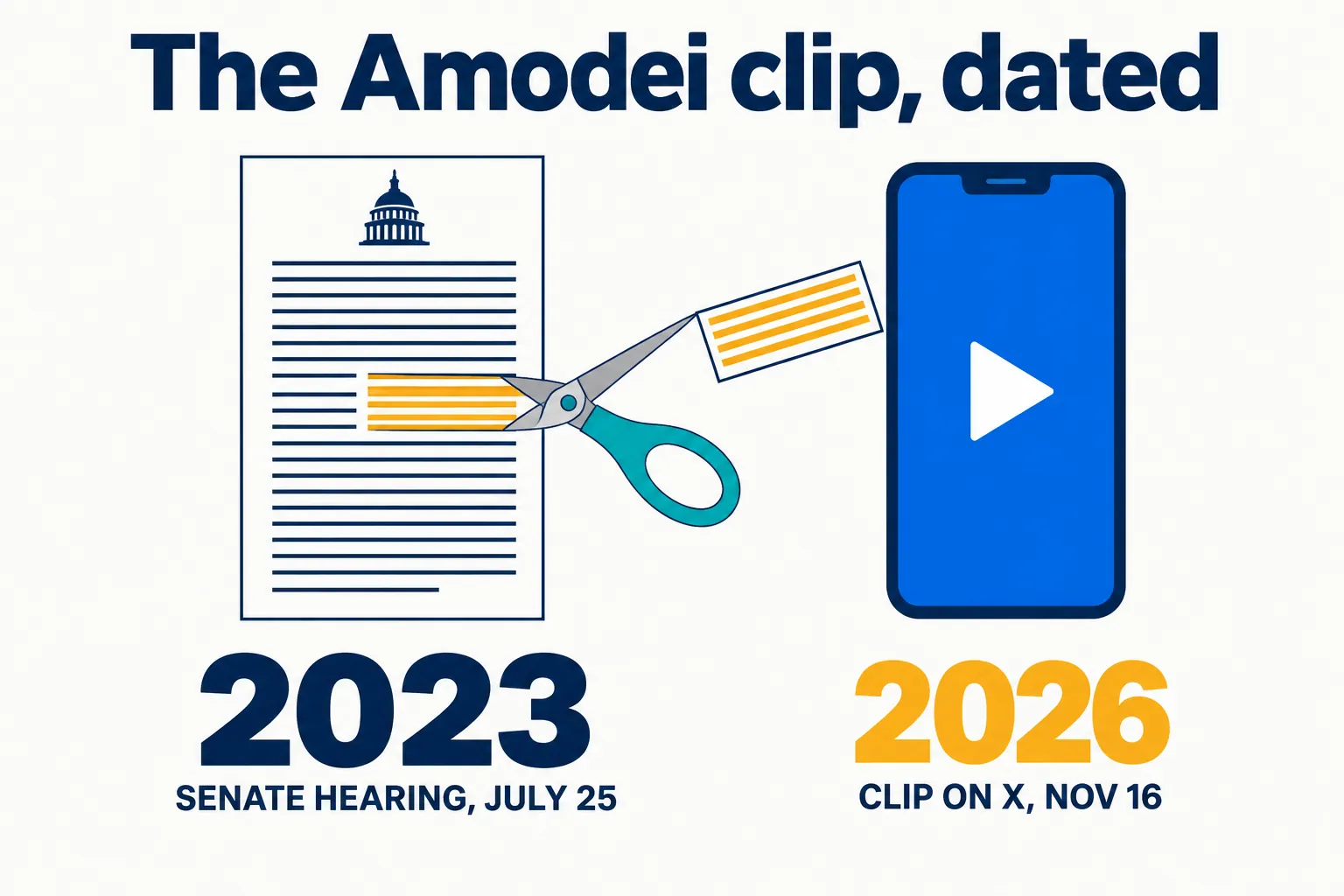
A clip of Anthropic chief executive Dario Amodei warning about open-source AI has passed 615,000 views on X. It was posted on November 16, 2026, and gives no date or source. The words are not new. They come from his testimony to a Senate Judiciary subcommittee on July 25, 2023, more than three years ago.
We read the official hearing transcript on GovInfo and checked every quoted line against it. The quotes are accurate. This page gives the full answer, the question that led to it, and what the clip leaves out.
On this page · 7 sectionsOpen
 A clip of Dario Amodei warning about open-source AI passed 615,000 views on X. It was posted on November 16, 2026 with no date or source.
 The words come from his testimony to a Senate Judiciary subcommittee on July 25, 2023, at the hearing Oversight of A.I.: Principles for Regulation.
 The lines quoted in the post match the official hearing transcript published on GovInfo.
 In the same answer he said open source is good in most scientific fields and that the open models released by then carried relatively limited risk.
 His concern was the scaling of open releases of much larger models. He did not call for a ban in this answer.
§ 01What the post says
An account called @vikktorrrre posted the clip at 15:37 UTC on November 16 under the line “Dario Amodei on open source models”. The post quotes three passages: that the path could lead “to a very dangerous place”, that a company deploying a model can monitor and revoke access, and that a model released openly is out of its maker’s hands. It had 615,541 views when we read it through the X API at 13:59 UTC on November 17.
The post links to one from the day before. On November 15 at 23:52 UTC, @alexinexxx wrote “Anthropic & OpenAI wants to own intelligence. Open models want to free it”. That post had 274,213 views. Replies to the clip split the way that line suggests. Nathan Lambert, a researcher who works on open models, wrote that “Dario’s comments on the state of the technology are largely agreeable”, while arguing that Amodei had mixed that agreement with forecasts that experts do not share.
| Date (UTC) | What | Views |
|---|---|---|
| July 25, 2023 | Amodei testifies to the Senate Judiciary subcommittee | (hearing) |
| November 15, 2026, 23:52 | @alexinexxx: open models want to free intelligence | 274,213 |
| November 16, 2026, 15:37 | @vikktorrrre posts the clip, no date or source | 615,541 |
| November 17, 2026, 12:09 | Nathan Lambert replies to the clip | 5,142 |
§ 02Where it comes from
The clip is cut from a hearing called Oversight of A.I.: Principles for Regulation. The Senate Judiciary Subcommittee on Privacy, Technology, and the Law held it on Tuesday, July 25, 2023, at 3:00 p.m. in room 226 of the Dirksen Senate Office Building, with Senator Richard Blumenthal presiding.
- Witnesses. Stuart Russell, professor of computer science at UC Berkeley; Yoshua Bengio, founder and scientific director of Mila, the Quebec AI institute; and Dario Amodei, chief executive of Anthropic.
- The record. The committee’s page links each witness’s written testimony, an archived video and the printed hearing record. The record is published on GovInfo as hearing CHRG-118shrg53503.
- The moment. Blumenthal raised open source near the end of his questions. He said each witness had raised the security risk of models that are open source or leaked, that open source can also be an extraordinary resource, and that tools already released had been abused. Bengio answered first. Amodei followed.
§ 03The full answer
Amodei opened by saying he shared Bengio’s view and wanted to be precise. In the transcript, the answer runs in four steps.
- Where open source is fine. He said “in most scientific fields, open source is a good thing. It accelerates progress.” He added that there is room in AI for smaller and medium models, which he did not think anyone saw as seriously dangerous.
- Where it stood in 2023. “even up to the level of open source models that have been released so far, the risks are relatively limited”, he said. Read narrowly, he was not sure he had an objection.
- The worry. “I’m very concerned about where things are going”, he said, pointing to two to three years for frontier models and biological risk. On the scaling of open models: “if the path continues, I think we could get to a very dangerous place”.
- The argument. Then the lines in the clip: “when you control a model and you’re deploying it, you have the ability to monitor its usage”. He went on: “You can revoke a user’s access. You can change what the model is willing to do.” And: “When a model is released in an uncontrolled manner, there’s no ability to do that. It’s entirely out of your hands.”
He ended with two points the clip does not carry. “There may be ways to release models open source so that it’s harder to circumvent the guardrails, but that’s a much harder problem”, he said, and its advocates should be challenged to solve it. And he said “open source is a little bit of a misnomer here”: open source usually meant small developers iterating quickly, which he called a good thing, while the case he meant was “a more uncontrolled release of larger models” by much larger companies.
§ 04What the clip leaves out
The quoted lines are real and in order. What the post drops is the frame around them.
- The date. A 2023 answer reads differently in 2026. In July 2023 he was describing a risk he expected within two to three years, not a judgment of open models released since.
- The concession. He said open source helps science and that the open models released by then carried limited risk.
- The scope. His concern was the open release of much larger models by large companies, not small developers.
- The remedy. He described a hard technical problem and asked advocates to solve it. He did not call for a ban in this answer.
§ 05What is not established
- Which cut. We did not find which upload the clip was cut from, or who first cut it. The committee’s archived video is the original recording; we did not watch it and checked the words against the printed transcript instead.
- His view today. This page records what he said in 2023. We did not read any newer statement by Amodei or Anthropic on open models for this page.
- The reaction. The view counts are as read through the X API on November 17 and will change.
§ 06Where CellCog sits
Our conflict, declared: we build CellCog, a platform where a business hires AI employees, and those employees run on Anthropic’s Claude models. We follow what Anthropic’s leaders say because it shapes the models we build on. This page was written from the Senate’s own record.
§ 07Sources
- Oversight of A.I.: Principles for Regulation, Senate Judiciary Committee, July 25, 2023
- Hearing record CHRG-118shrg53503, GovInfo
- Dario Amodei’s written testimony, July 2023
- The clip on X, November 16, 2026
- The post it links to, November 15, 2026
- Nathan Lambert on X, November 17, 2026
Q1Where is the Amodei open-source clip from?
From the Senate hearing Oversight of A.I.: Principles for Regulation, held on July 25, 2023 by the Judiciary Subcommittee on Privacy, Technology, and the Law. Amodei testified alongside Stuart Russell and Yoshua Bengio.
Q2Is the quote in the clip accurate?
Yes. The lines quoted in the post match the official transcript on GovInfo word for word. The post leaves out the start and the end of the same answer.
Q3What did Amodei say before the quoted lines?
That open source is good in most scientific fields, that smaller and medium models are not seriously dangerous, and that the open models released by 2023 carried relatively limited risk.
Q4Did Amodei call for banning open-source AI?
Not in this answer. He said there may be ways to release models openly that make guardrails harder to remove, called that a much harder problem, and said its advocates should be challenged to solve it.
Q5Why did the clip spread in November 2026?
It was posted on November 16, 2026, the day after a widely shared post saying Anthropic and OpenAI want to own intelligence while open models want to free it. The clip’s post links to that post.