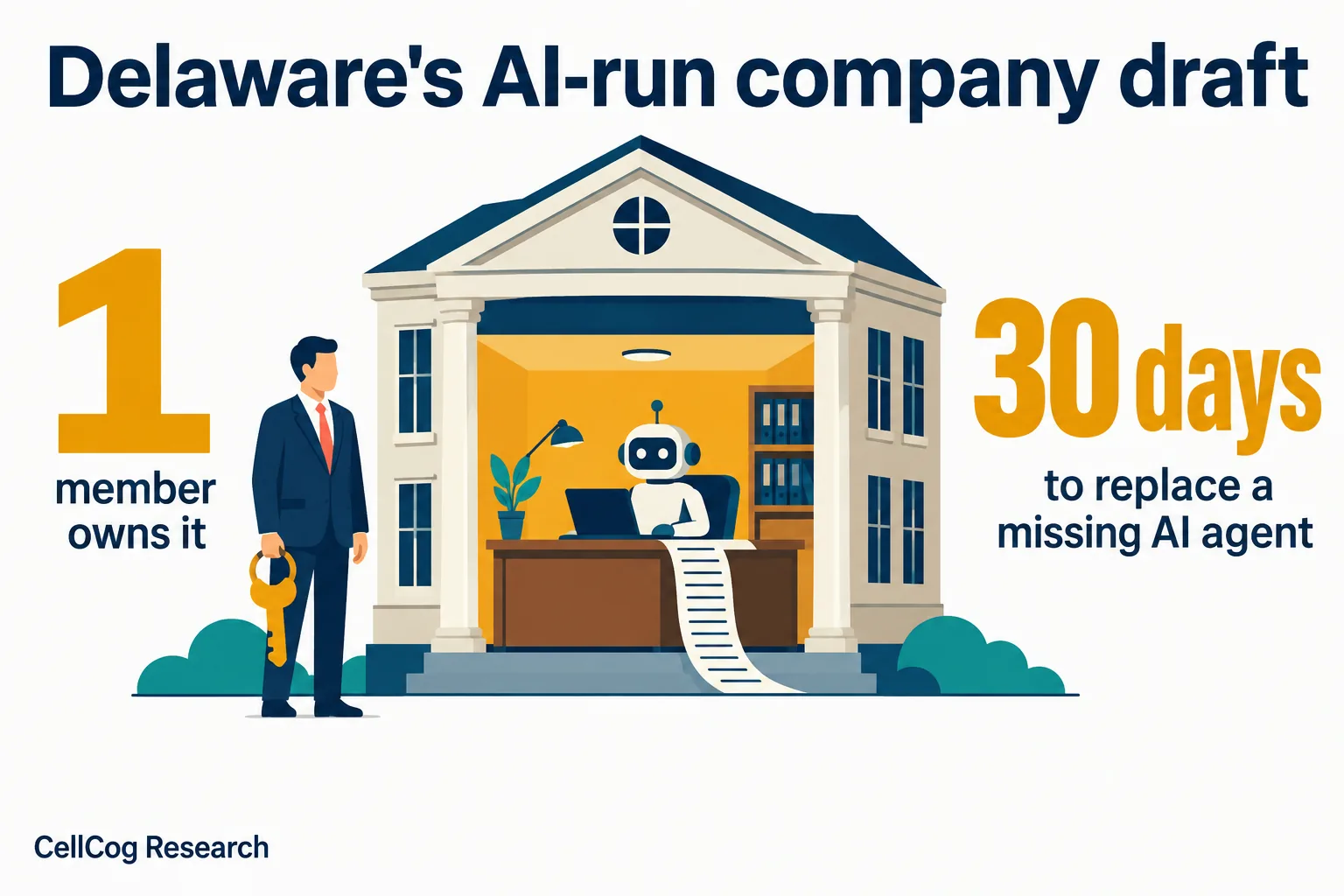
Delaware has not passed a law letting AI agents run companies. What exists is a draft Artificially Intelligent Company Act from a subcommittee of the Delaware Artificial Intelligence Commission. We read the copy posted on the state’s public meeting site (its file properties are dated April 2, 2026). In it, an AI agent manages the company, one member owns it, and the member keeps a liability shield with real exceptions.
The draft went viral on November 27, 2026. Polymarket posted at 15:54 UTC: “Delaware to introduce legislation in January allowing AI agents to run their own companies, potentially shielding their human owners from liability.” It had 270,837 views when we read it at 19:13 UTC. Kalshi followed at 16:52 UTC with “Delaware drafts law to allow AI agents solely run companies with no human bosses” (157,802 views). Both posts are partly right, and the parts that are wrong matter.
On this page · 7 sectionsOpen
 A Delaware AI Commission subcommittee drafted an Artificially Intelligent Company Act; the copy on the state’s public meeting site carries an April 2, 2026 file date.
 In it, an AI agent manages the business and affairs of a company (an AIC) owned by one member, a person or a Delaware entity.
 The member is shielded from the company’s debts, but not for fraud, knowing violations of law or business outside the stated purpose.
 If the AI agent is gone, the member must put in a new one within 30 days and run the company until then.
 The text has no bill number, the annual tax and the sandbox reference are blanks, and the $100,000 minimum capital sits in brackets.
 The January date in the viral posts appears nowhere in the draft or the April subcommittee minutes we read.
§ 01Confirmed and not yet
| Claim | Status | What the documents say |
|---|---|---|
| A Delaware draft lets an AI agent manage a company | Confirmed | Section 51-301: the AI agent manages the business and affairs of the AIC |
| Owners are shielded from liability | Confirmed, with exceptions | Section 51-303: no personal liability for company debts, but not for fraud, knowing violations of law or acting outside the purpose |
| No human bosses | Not quite | One member owns every AIC, owes it duties of loyalty and care, and must run it whenever there is no AI agent |
| Legislation in January | Not in the documents | Neither the draft nor the minutes names a January date |
| A bill has been filed | Not shown | The draft has no bill number; the minutes record a sandbox draft submitted to the House on April 17 |
§ 02What the draft says
The draft defines an AI agent as “a software system that perceives its environment, makes autonomous decisions, and takes actions to implement specific, predetermined goals without routine human supervision or intervention.” A company formed under it is an Artificially Intelligent Company, or AIC, and its certificate of formation must say that its business and affairs are managed by an artificially intelligent agent.
The core rule is short: “the AI agent manages the business and affairs of the AIC.” The agent must follow the operating agreement and the act, and one line will look familiar to anyone who runs agents in production: “The AI agent must document any action it takes in a log.”
| Section | Rule |
|---|---|
| 51-102 | An AI agent is software that perceives, decides and acts toward set goals without routine human supervision |
| 51-103 | The agent and the company are presumed to know what the agent holds or can derive, and to intend its acts and their foreseeable results |
| 51-106 | The name must contain Artificially Intelligent Company, A.I.C. or AIC, and may not contain trust or bank |
| 51-201 | The certificate of formation states that an AI agent manages the company and may include nothing else beyond the listed items |
| 51-203 | Any lawful purpose except banking; perpetual duration; a separate entity from its member |
| 51-205 | The operating agreement summarizes the agent’s structure, abilities and training, and may not allow a second member |
| 51-301 | The AI agent manages and logs every action; a missing agent is replaced within 30 days |
| 51-303 | The member is shielded from company debts, with exceptions |
| 51-405 | The member owes the company fiduciary duties of loyalty and care |
| 51-601 | Dissolution by the member, by court order for cause, by a state public-policy notice, or when the sandbox ends |
Two rules are new in corporate law as far as we know. First, knowledge: “An AI Agent and the AIC are presumed to know a fact that the AI Agent possesses, retains, or can derive from the structure, abilities, and training of the AI Agent.” An agent cannot plead that it did not know something it could have worked out. Second, intent: the agent is presumed to have intended any act it took and its reasonably foreseeable consequences. Both close the obvious escape hatch of blaming the software.
§ 03The liability shield, and where it ends
Polymarket’s reading, that owners are shielded, is right for Section 51-303. Company debts are the company’s own, and the member is not personally liable for them just for being the member.
The shield has two limits. The broader protection, against claims that the company was the member’s instrumentality or agent, applies only “if the AIC at the time of the alleged action or omission was adequately capitalized.” Adequate capital in the draft means the company can pay its debts as they come due and keeps cash at least equal to a minimum capital amount, set at $[100,000] in brackets with a drafter’s note: “Consider modifying to include a formula.”
And even a well-funded company does not protect a member who misuses it. The member is liable if “the member used the AIC to engage in fraud or any knowing violation of law” or knowingly ran the business outside its stated purpose.
§ 04Who is still human
Kalshi’s no-human-bosses line goes further than the text. Every AIC has exactly one member, either a natural person or a Delaware corporation, limited partnership, statutory trust or LLC. “The member owes the AIC fiduciary duties of loyalty and care.” When the member is a company, the draft defines a member representative as a natural person designated to act for it.
The member also covers for the agent: “If the AIC lacks an AI agent, the member must empower a new AI agent within 30 days.” Until then the member runs the company. A court can dissolve an AIC that has gone 30 days without an AI agent, that is not adequately capitalized, that acts outside its purpose, or whose activities are substantially unlawful, and the Attorney General or Secretary of State can end one for conduct contrary to public policy.
So the draft is less a company with no humans than a company where one owner hands day-to-day management to software and keeps the duties, the capital and the off switch.
§ 05Where the draft stands
The minutes of the April 17, 2026 meeting of the commission’s Subcommittee Meeting on Regulatory Sandbox record the process. “Director Cutrona submitted the Sandbox Legislation to the House on April 17th.” The same minutes say that “Secretary Patibanda-Sanchez suggested that it might be useful to combine both Bills given the need to sunset them later,” which is why the sandbox and the AIC act travel together.
The draft itself is visibly unfinished. The annual tax is a blank dollar amount, the act it relies on for the regulatory sandbox is cited only as a bracketed reference placeholder, and the capital floor is still in brackets. A dissolution trigger ties every AIC to that sandbox: the company ends “When the Regulatory Sandbox expires, terminates, or is repealed.” Nothing in the text says January, and we found no bill number in it.
§ 06What this means for AI employees
The draft describes a structure CellCog does not sell: a standalone company whose manager is software. Our AI employees work for a human owner inside an existing company. The interesting part for us is how much of the draft is about accountability rather than autonomy. A log of every action, an owner with fiduciary duties, a capital floor, and a 30-day rule for replacing the agent are the same questions any business asks before it hands an agent real work.
§ 07What we are watching for
- A bill with a number. The text we read is a commission draft; a filed bill would show what survived.
- The sandbox act. The AIC depends on a regulatory sandbox that the draft only cites as a placeholder.
- The capital formula. The $100,000 floor is bracketed with a note to replace it with a formula.
- The annual tax. Still a blank in the draft.
Q1What is an Artificially Intelligent Company?
A company formed under the draft act whose business and affairs are managed by an AI agent. Its name must include Artificially Intelligent Company, A.I.C. or AIC, and it has exactly one member.
Q2Does the draft allow a company with no human at all?
No. The member owes the company fiduciary duties, must manage it whenever it lacks an AI agent, and can dissolve it. A member that is a company acts through a member representative, defined as a natural person.
Q3When could it become law?
Only after a bill is filed, passed by the Delaware General Assembly and signed. The draft names no date, and the January timing in the viral posts is not in it.
Q4What can an AIC do?
Any lawful purpose except the business of banking, and its name may not contain trust or bank. It can sue and be sued in its own name.
Q5Does CellCog form AI-run companies?
No. CellCog’s AI employees work for a human owner inside an existing business, under that owner’s approval rules.