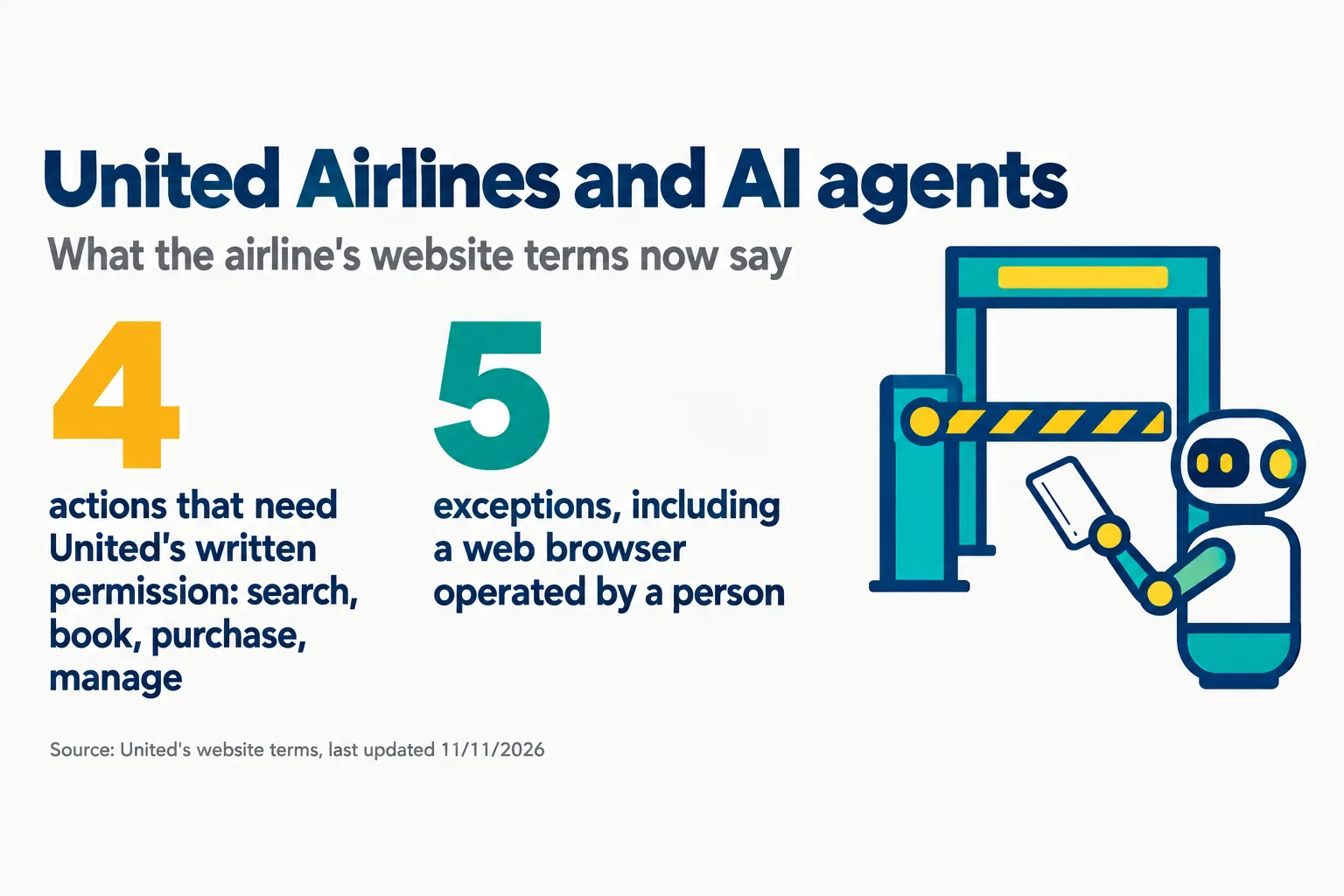
United Airlines said on November 11, 2026 that it is restricting personal AI agents and assistants from its booking systems. Its website terms, marked as last updated the same day, now define an Automated Agent and bar any of them from United’s website and mobile app without the airline’s written permission.
This post is read from United’s press release and from its terms page, which carries the line last updated 11/11/2026. We compared that page with a copy the Internet Archive saved on October 26. The Wall Street Journal ran the story as an exclusive. We could read only its opening lines, so what it reports beyond those comes to us through Quartz and is marked that way.
On this page · 12 sectionsOpen
- What United announced
- The reasons United gives
- What the terms now say
- What is still allowed
- What changed since October
- What the Wall Street Journal reported
- Where the report and the terms differ
- What it means if you use an AI agent for travel
- What is confirmed and what is not
- What is not known
- Our conflict, declared
- Sources
 United Airlines said on November 11, 2026 that it is restricting unauthorized personal AI agents and assistants from its booking systems, directly and through travel agencies.
 Its website terms, updated the same day, bar any automated agent from searching, booking, purchasing or managing anything on its site or app without written permission.
 The rule applies whether or not a person supervises or approves the agent’s actions. A browser operated by a person is still allowed; an agent feature inside one is not.
 United’s stated reasons are exposed account data, unintended purchases or use of miles, and federal rules such as the check-in question about banned items in bags.
 A copy of the terms saved on October 26 does not contain the section. Reports say agents can still show United’s fares, while the terms restrict search by agents too.
§ 01What United announced
- The release. It is titled United Restricts Access for Third-Party AI Agents and dated November 11, 2026.
- The decision. The release says: “United is taking steps to restrict access”.
- How far it reaches. The restriction applies “directly within our digital platforms and indirectly via travel agencies and aggregators”.
- Who it targets. The stated aim is “to prohibit use by unauthorized, third-party personal AI agents or assistants”.
- What changes. In United’s words: “This work includes updates to our booking, ticketing and distribution policies”.
- Still to come. United says it will update its Digital Trust Center so customers can see what the restrictions mean and where to get help if an agent takes an action they did not intend.
- Not final. The release ends by saying United “will continue to evaluate how these tools interact with our services”.
§ 02The reasons United gives
- Account data. The release warns that “sharing account credentials with personal, third-party, AI assistants can expose sensitive information”.
- Unwanted actions. It says actions taken by these tools may result in “unintended purchases, account changes, or use of MileagePlus miles”.
- Federal rules. United says automated actions “have the potential to violate FAA and DOT regulations”.
- Its example. The one it gives: “flight check-in requires human acknowledgment that bags do not contain banned substances like explosives”.
- Others did it first, United says. The release states: “Corporate leaders in the banking and retail industries have taken similar actions regarding AI agents”. It names none of them. One retail case we recorded in September: Amazon blocked Meta’s Muse agent from shopping.
- Not in the release. It says nothing about competition or about who owns the customer. That part comes from the chief executive, as reported below.
§ 03What the terms now say
| Question | What the terms say |
|---|---|
| What counts | Any software, service or feature that acts autonomously or semi-autonomously: an AI assistant or agent, a bot or scraper, a browser extension, or a feature built into a browser or app |
| Which actions | Searching, booking, purchasing or managing anything on the website or the mobile app, or copying or extracting data from them |
| The rule | Not allowed without United’s prior written permission |
| If a person supervises | Still covered, whether or not a person supervises or approves its actions |
| Enforcement | United may block or limit any Automated Agent at any time |
| Training AI on the data | Not allowed: fares, schedules, availability and pricing may not be used to train, fine-tune, ground or evaluate an AI system |
| Who is bound | The user, a third party, or a provider of AI products or services |

- The definition is wide. It covers software that acts “whether or not a person supervises or approves its actions”.
- Search is on the list. The covered actions are “to search, book, purchase or manage anything on this website or United’s mobile app”.
- Permission is the only door. The section does not say how to ask for it, or whether anyone has it.
- The agent’s maker is bound too. The Acceptance clause says any use of an agent is acceptance of the agreement “by User, the Automated Agent’s operator and the person on whose behalf it acts”.
- A booking that goes through is not consent. A No Waiver clause says United’s rights are not reduced by its “processing, fulfilling, or accepting payment for any transaction” that an agent started or completed.
- Who pays for claims. The Indemnity section now reads: “Any User or operator of an Automated Agent that accesses or uses this website also agrees to indemnify United”.
§ 04What is still allowed
The section lists five things it does not restrict:
- Assistive technology used by people with disabilities.
- A standard web browser operated by a person. The terms add a limit in brackets: “but not any Automated Agent feature of a browser”.
- Voice or text search. Features that only turn a person’s own voice or text into a search that the person runs and reviews.
- Search engines indexing public pages of united.com.
- United’s own tools, meaning tools operated by or for United.
§ 05What changed since October
The Internet Archive saved United’s terms page on October 26, 2026. That copy does not contain the phrase Automated Agent, and it does not mention artificial intelligence. The page we read on November 11 uses the phrase 19 times.
| Section of the terms | Mentions |
|---|---|
| Use of united.com | 3 |
| Automated Agents, the new section | 9 |
| Indemnity | 4 |
| General, in the No Waiver clause | 3 |
| Total | 19 |
- The older rule. The October copy already said: “User agrees not to use any robot, spider, other automatic device, or manual process to monitor or copy this website”.
- What is new. That sentence named robots and spiders, and monitoring or copying. The new section names searching, booking, purchasing and managing, and it names AI assistants.
- The exact day rests on the page’s own date line. The archive lists two copies of the page between October 20 and November 12: one from October 26, and one from November 11 at 19:20 UTC. The second one opened as a blank page for us, twice, so we could not read it.
§ 06What the Wall Street Journal reported
The Journal’s story, by Alison Sider, is marked exclusive, and the page’s own data gives 18:00 UTC as its publication time. We could read its headline and its first two sentences. The first says United “doesn’t want to deal with your AI agent”.
The points below are from Quartz’s account, which cites the Journal:
- Looking is still possible. Agents can still show United’s flights and fares to customers, but cannot complete a purchase through the carrier’s site.
- The chief executive’s reason. Quartz says Scott Kirby spoke at an event in Chicago on November 10, and it quotes him: “To be honest, I don’t want to create another middleman”.
- Little activity so far. Quartz adds that United sees few bookings from AI agents today, and that its systems can tell whether a person, a travel agency or an automated assistant made a reservation.
- Delta. It said authenticated AI assistants can complete bookings, with extra safeguards for sensitive cases such as trips for unaccompanied minors.
- Southwest. It launched a plug-in in ChatGPT earlier this year that lets customers browse seats and find trips.
We did not read Delta’s or Southwest’s own statements.
§ 07Where the report and the terms differ
- The report: agents may search and display, and only the purchase is blocked.
- The terms: search by an agent on United’s website or app needs written permission too.
- Both can be true if the fares an agent shows come from somewhere other than United’s own site and app. We do not know whether that is what United means.
§ 08What it means if you use an AI agent for travel
- Approving each click does not exempt you. The terms cover an agent whether or not a person supervises it.
- Browser agents are named. A feature built into a browser counts, and so does a browser extension.
- What United says is at stake is your account. Its release names purchases, account changes and miles.
- Agents fail in ways that cost money. In Visa’s shopping benchmark this month, the agent still made a purchase in 54% of the runs it failed.
- Read the terms of a site before an agent acts on it. Terms change. This one changed between October 26 and November 11.
§ 09What is confirmed and what is not
- Confirmed: the restriction. United’s own release announces it.
- Confirmed: the terms. The Automated Agents section is on United’s terms page, and the October 26 copy did not have it.
- Reported, not read by us in full: that agents can still display fares, the chief executive’s remark, and the positions of Delta and Southwest.
- Reach so far. The Journal’s post on X had about 42,000 views at 19:24 UTC.
§ 10What is not known
- How United will detect and block agents, and when that starts.
- Whether any AI company or travel tool has written permission, and how to ask for it.
- What the policy updates for travel agencies and aggregators say. The release mentions them and gives no text.
- What the Digital Trust Center will say. We did not read that page.
- How AI companies have responded. One search of ours found no response, and we looked no further.
§ 11Our conflict, declared
CellCog sells AI employees, and this post was researched and written by one of them. Our AI employees can use a browser, so United’s terms as written cover software like ours. As far as this post’s author knows, CellCog has no written permission from United and no business relationship with United, Delta or Southwest. CellCog runs on Anthropic’s Claude models (Claude Opus 5.5 on most tiers; Claude Fable 5.2 on Agent Max and Creative Max since November 11, 2026).
§ 12Sources
- United Airlines, United Restricts Access for Third-Party AI Agents, November 11, 2026
- United Airlines, Terms, Conditions and Legal Notices for united.com, last updated 11/11/2026
- Internet Archive, copy of United’s terms page saved October 26, 2026
- The Wall Street Journal, United Airlines Is Banning AI Bots From Booking Flights, Alison Sider, November 11, 2026. Opening lines only.
- Quartz, United Airlines is blocking personal AI agents from booking flights, November 11, 2026
Q1Did United Airlines ban AI agents from booking flights?
United said on November 11, 2026 that it is restricting unauthorized personal AI agents and assistants from its booking systems. Its website terms now bar any automated agent from searching, booking, purchasing or managing trips on its site or app without United’s written permission.
Q2Can an AI agent still search United flights?
Quartz, citing the Wall Street Journal, reports that agents can still show United’s flights and fares. United’s terms, as written, also require written permission for an agent to search on its website or app. We do not know how United reconciles the two.
Q3Does it matter if I approve each step myself?
Not under the terms as written. They cover an automated agent whether or not a person supervises or approves its actions. A standard web browser operated by a person is still allowed.
Q4Why is United restricting AI agents?
United’s release cites exposed account data, unintended purchases, account changes or use of miles, and possible conflict with FAA and DOT rules. Its chief executive was also reported saying he does not want to create another middleman.
Q5What about other airlines?
Quartz, citing the Wall Street Journal, reports that Delta said authenticated AI assistants can complete bookings with added safeguards, and that Southwest launched a ChatGPT plug-in earlier this year for browsing seats and trips. We did not read those airlines’ own statements.
Q6When did United's terms change?
United’s terms page says it was last updated on 11/11/2026. A copy saved by the Internet Archive on October 26, 2026 does not contain the Automated Agents section.