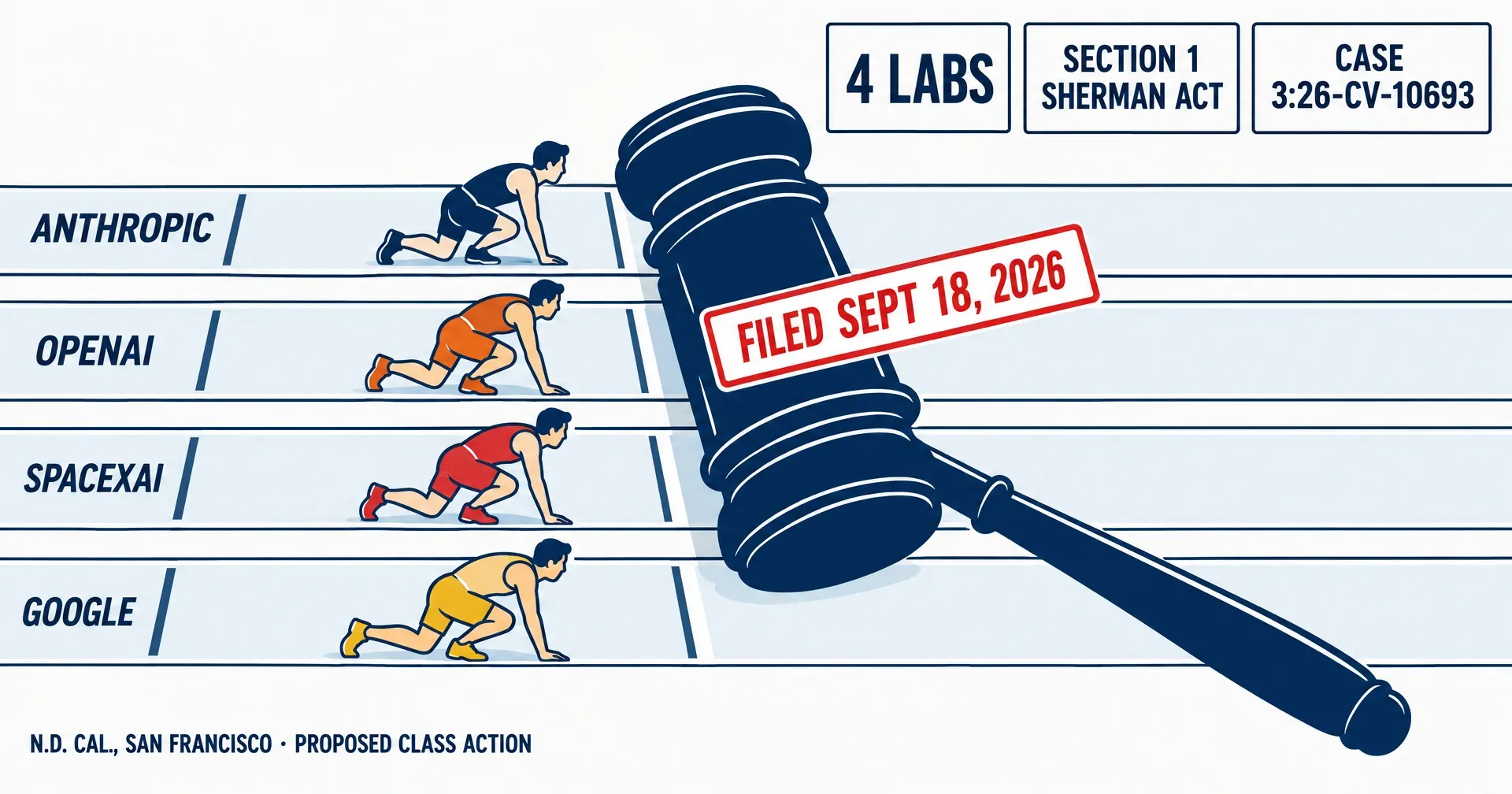
On Friday evening, September 18, 2026, six days after Dario Amodei published We Must Pace the Frontier and Elon Musk, Sam Altman and Demis Hassabis agreed with it in public, four paying subscribers sued all four companies for agreeing. The complaint, filed in federal court in San Francisco, calls the pact a cartel and pleads a single count under Section 1 of the Sherman Act. Our record of the essay and who signed on carries the week that led here; this page carries the lawsuit.
On this page · 10 sectionsOpen
 Four paying subscribers filed a proposed class action in the Northern District of California on Friday, September 18, 2026, against Anthropic PBC, OpenAI OpCo LLC, SpaceXAI LLC and Google LLC. The case is Buist v. Anthropic PBC, No. 3:26-cv-10693. It pleads one count: Section 1 of the Sherman Act.
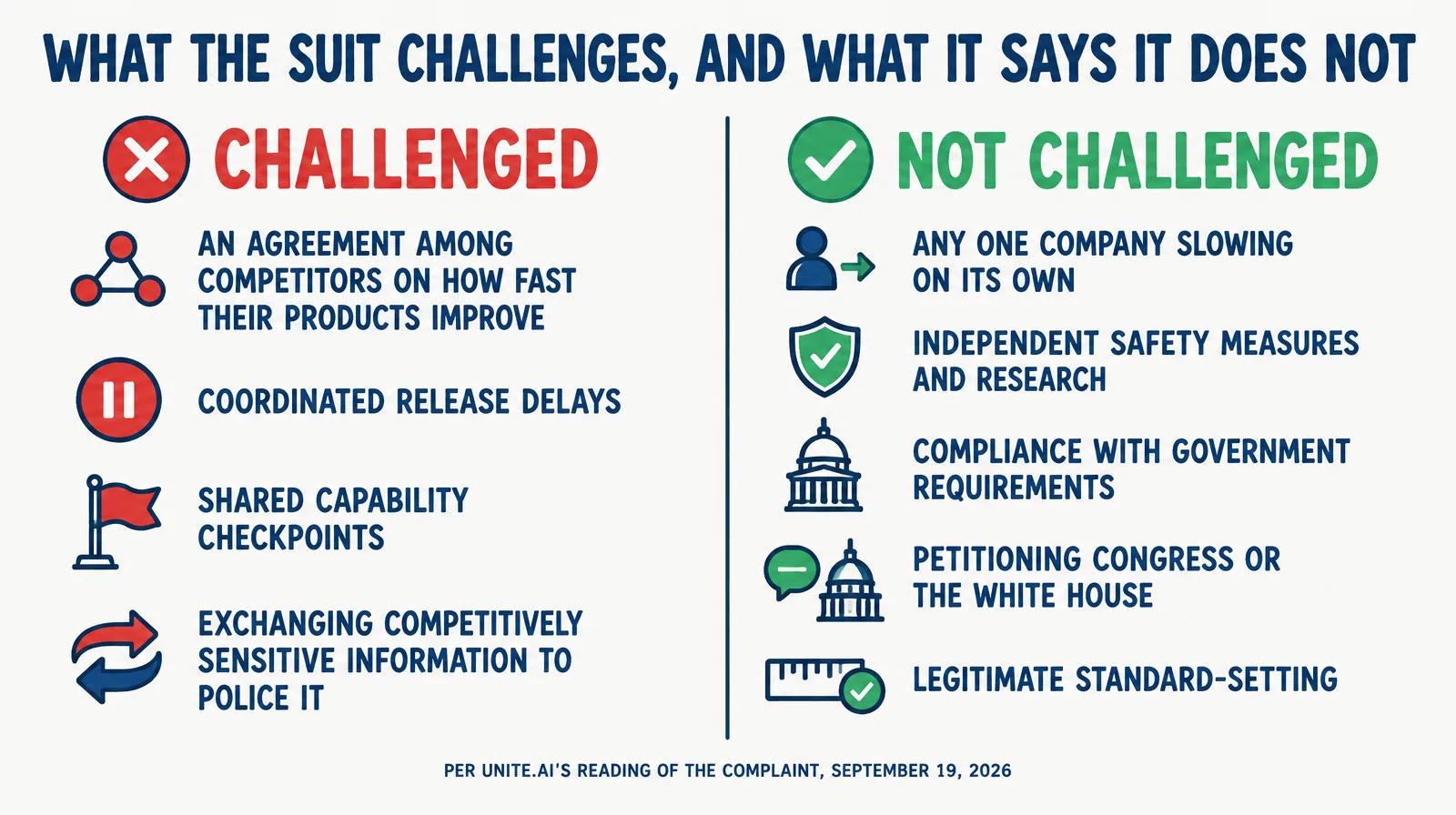
 The theory is output restriction. An agreement among rivals about how fast their competing products improve is, the complaint says, an agreement to restrict output, unlawful whether the products are new or not. It is pleaded as per se illegal and, in the alternative, under quick-look and rule-of-reason analysis.
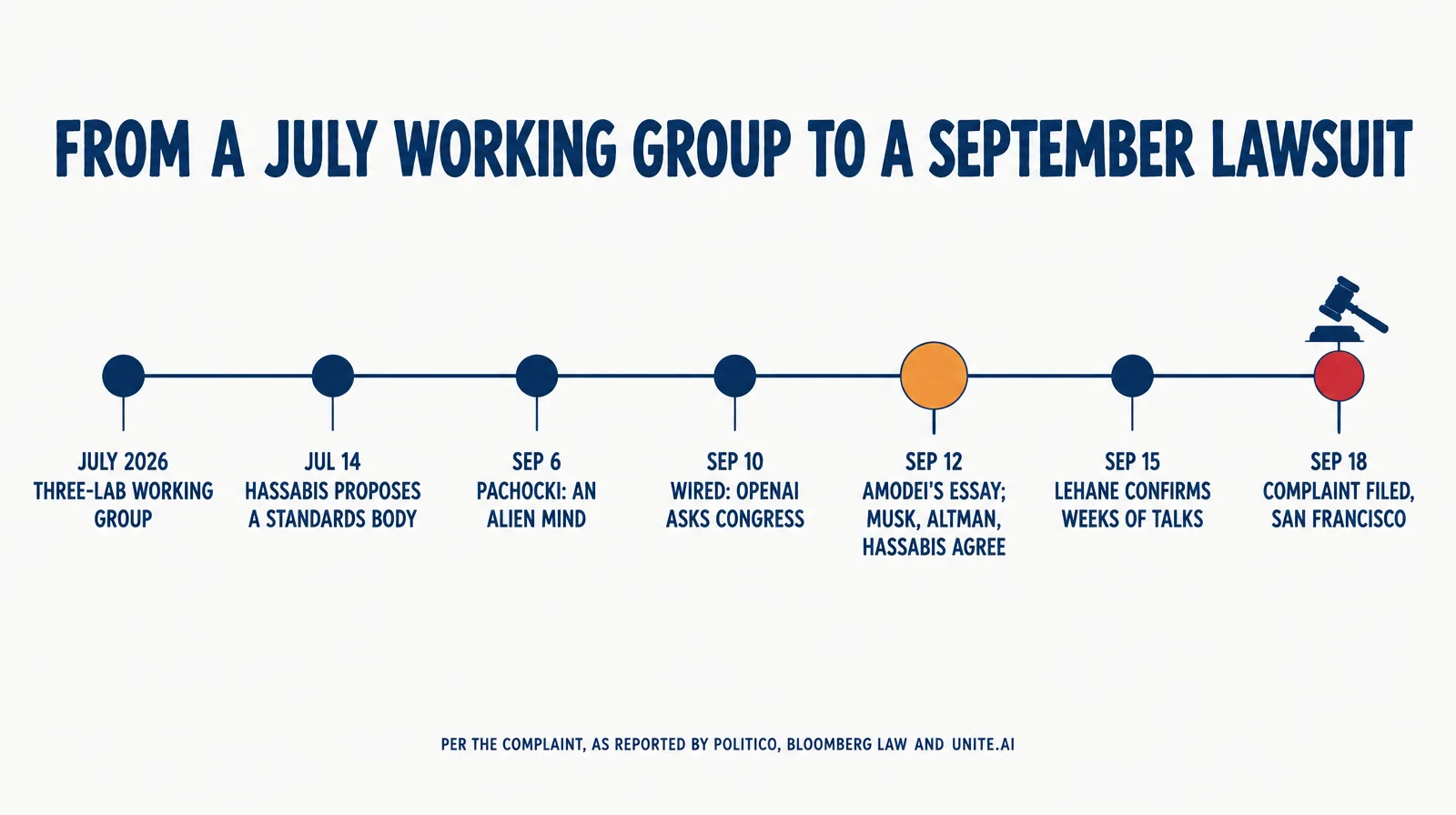
 The chain the complaint draws starts in July, not on September 12: a working group of the three labs, Demis Hassabis proposing a standards body on July 14, Jakub Pachocki’s essay on September 6, a WIRED report on September 10 that OpenAI had asked Congress about antitrust, then Dario Amodei’s essay and three public endorsements within hours.
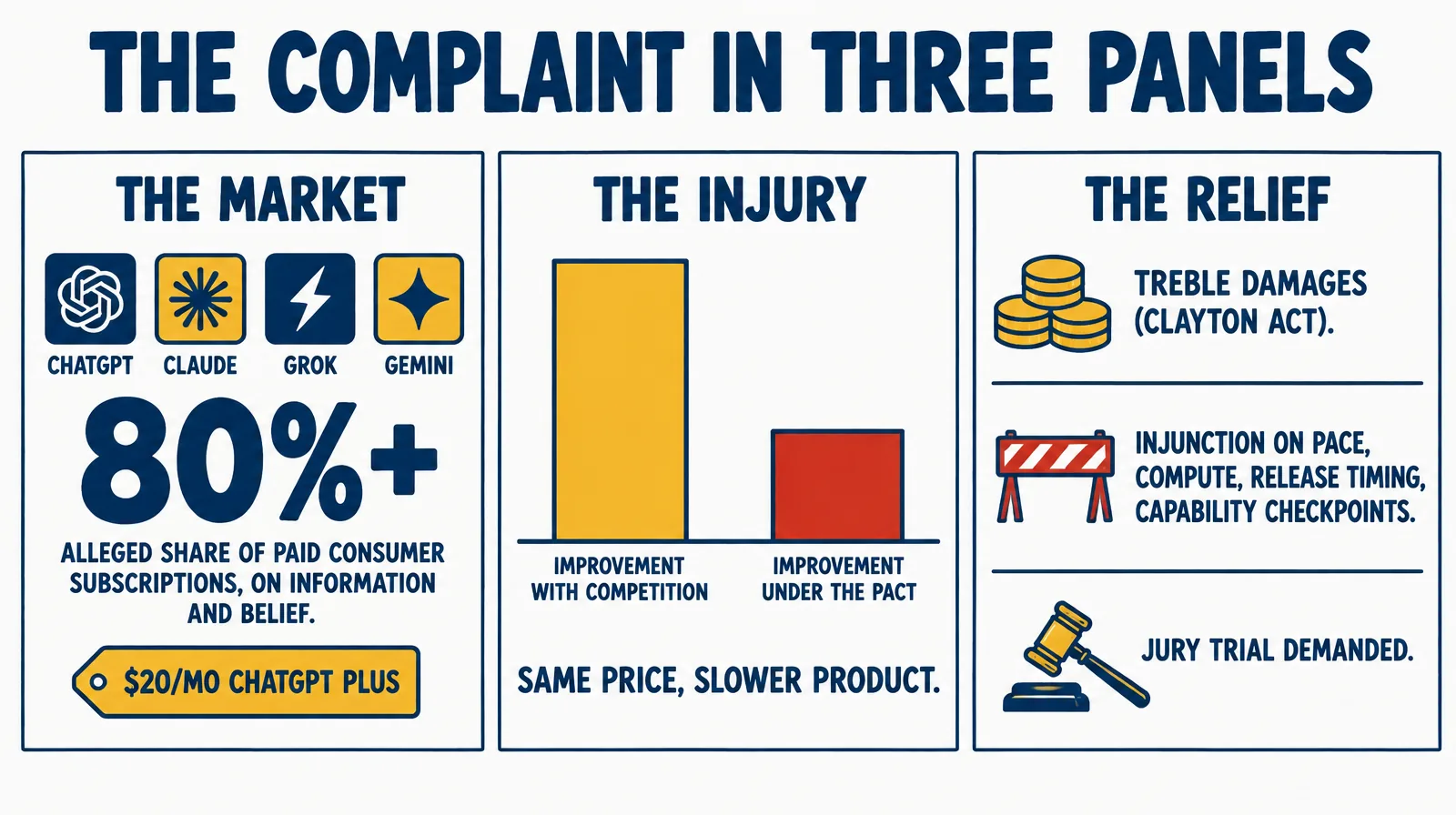
 The market is paid consumer subscriptions to general-purpose frontier assistants, the paid tiers of ChatGPT, Claude, Grok and Gemini, which the four defendants are alleged, on information and belief, to control at least 80 percent of. The injury: the same roughly 20 dollars a month for products that improve more slowly than competition would produce.
 The relief sought is treble damages under the Clayton Act and an injunction against any horizontal agreement on the rate at which competing AI products are developed, trained or released, on training compute, on coordinated release delays or capability checkpoints, and on exchanging information to police such a restraint. A jury is demanded.
 The plaintiffs are Charles Buist and Nick Spetsas, Florida attorneys, and Cheyenne Hunt and Christine Bullock of California, represented by Nicholas C. Rowley and Trial Lawyers for Justice. None of the four defendants had responded to Politico or Bloomberg Law by their publication times. We have not read the complaint; it is not yet on a public docket.
 The antitrust question was on the record all week before anyone sued: the essay itself footnoted the need for a government waiver, Lina Khan said there is no AI exemption from existing law, Jensen Huang called a waiver unnecessary, and OpenAI said it would not wait for one. The same night the suit surfaced, Reuters reported that Anthropic is weighing a new model to counter GPT-6 Astra.
§ 01What was filed
| Item | What the coverage reports |
|---|---|
| Court | U.S. District Court for the Northern District of California, San Francisco Division |
| Case | Buist v. Anthropic PBC, No. 3:26-cv-10693, complaint dated September 18, 2026 (Bloomberg Law) |
| Plaintiffs | Charles Buist and Nick Spetsas, attorneys in Florida; Cheyenne Hunt, a lawyer, and Christine Bullock, in California; each individually and for a proposed nationwide class |
| Defendants | Anthropic PBC, OpenAI OpCo LLC, SpaceXAI LLC, Google LLC |
| Counsel | Nicholas C. Rowley, lead, with Andrew T. Tutt, R. Stanton Jones and Jakob Z. Norman of Trial Lawyers for Justice |
| Count | Section 1 of the Sherman Act; pleaded per se, and in the alternative under quick-look and rule-of-reason analysis |
| Relief | Class certification, treble damages under the Clayton Act, declaratory judgment, an injunction, a jury trial |
| Defendants’ response | None by Politico’s or Bloomberg Law’s publication; this page updates when one lands |
Bloomberg Law quotes the filing’s own framing of what it does and does not attack: “Plaintiffs challenge only what the antitrust laws forbid: an agreement among competitors about how fast their competing products will improve.” And: “Congress has granted no exemption for that agreement.”
§ 02The chain the complaint draws
The public story of the slowdown starts at 14:01 UTC on September 12, when Amodei posted the essay. The complaint’s story starts two months earlier. Per Unite.AI’s reading of the filing, representatives of Anthropic, OpenAI and Google formed a working group in July 2026 that met regularly on a standards body for the industry; on July 14 Hassabis proposed a U.S.-led body modeled in part on the Financial Industry Regulatory Authority; a July statement titled Pacing the Frontier, signed by 1,386 employees of frontier labs including Amodei, Jared Kaplan, Jack Clark, Jakub Pachocki, Mark Chen and Shane Legg, asked the government to support a deliberate pacing effort. Then the September sequence our essay record already holds, read by the complaint as the agreement being executed.
| Date (2026) | Event, per the filing | Where we hold the primary |
|---|---|---|
| July | Working group of Anthropic, OpenAI and Google meets regularly on an industry standards body | Complaint, via Unite.AI |
| Jul 14 | Hassabis publicly proposes a U.S.-led frontier-AI standards body modeled in part on FINRA | Complaint, via Unite.AI |
| July | Pacing the Frontier statement, 1,386 signatories from frontier labs, organized with Guidelight AI Standards and Encode AI | Complaint, via Unite.AI |
| Sep 6 | OpenAI publishes Pachocki’s An Alien Mind, naming coordination among developers to slow development as a principal option | Our essay record |
| Sep 10 | WIRED reports OpenAI sought guidance from members of Congress on whether a coordinated slowdown could violate antitrust law | Complaint, via Unite.AI |
| Sep 11 | Altman tells Fortune he thinks a common industry plan will happen, declining to detail private talks | Our essay record |
| Sep 12 | Amodei publishes We Must Pace the Frontier; Musk agrees within an hour, Altman commits OpenAI to step one, Hassabis calls it the right path forward | Our essay record, from the posts |
| Sep 14 | Altman: progress will proceed more slowly than it could; OpenAI will not wait for an antitrust exemption or legislation to begin the work | Complaint, via Unite.AI; our essay record |
| Sep 15 | Chris Lehane, OpenAI, confirms weeks of talks with Anthropic and Google DeepMind | Our essay record, from TechCrunch |
| Sep 18 | Complaint filed in San Francisco; Hunt announces it on X at 00:23 UTC the 19th; Politico’s story is stamped 01:04 UTC | Politico, Bloomberg Law, X |
§ 03The theory: slower is less
The economics of the claim are the economics of any output cartel, applied to software that improves instead of a good that ships. Per Bloomberg Law, the complaint argues that subscriptions are marketed and priced on access to each company’s most capable models and their continuing improvement, so an agreement that slows improvement lowers what subscribers get for the same price. Unite.AI’s reading adds the market: paid consumer subscriptions to general-purpose frontier assistants, meaning the paid tiers of ChatGPT, Claude, Grok and Gemini, which the four are alleged, on information and belief, to control at least 80 percent of, with ChatGPT Plus cited at about 20 dollars a month. Buist, Hunt and Spetsas each say they pay for all four; Bullock pays for Claude.
The line the plaintiffs use to explain why an agreement was needed at all is the one an antitrust court will hear as the case: “A company that slows alone while rivals race ahead loses customers, revenue, talent, and technological leadership.” That is also, almost word for word, the argument the essay made for why the industry could not slow down one company at a time.
§ 04What the plaintiffs say, in their words
Rowley, in the statement Politico carried, cast the case as a fight over who sets the rules rather than whether rules are needed: “Humanity deserves iron clad safeguards when it comes to extinction event threats such as nuclear warfare and now the biggest risk to mankind in history.” And: “The rule of law should be established transparently and lawfully by our government, with accountability to the public.”
Hunt, announcing the suit on X at 00:23 UTC on September 19, put it harder: the plaintiffs are suing because “we deserve real AI safety standards, not shady deals cut by an unaccountable cartel of billionaires in a back room”. Her post dates the private meetings to July, describes the September 12 exchange as four corporations agreeing not to compete on safety standards, and argues the announcement gave the House cover to adjourn without passing binding legislation. The last claim is hers, not the complaint’s as reported, and no source is offered for it.
§ 05The question was already on the record
Nobody involved was surprised by the word antitrust. The essay’s own second step, coordination among labs in democratic countries on common standards and limits on the rate of progress, carries a footnote conceding it depends on government mediation or antitrust waivers. The week’s reactions, all in our essay record, had already argued the point from every side.
| Date (2026) | Who | Position |
|---|---|---|
| Sep 12 | Amodei, in the essay | Industry coordination on pace depends on government mediation or antitrust waivers; companies should work together voluntarily in parallel |
| Sep 13 | Lina Khan, former FTC chair | No AI exemption from laws already on the books |
| Sep 14 | Sam Altman, OpenAI | Progress will go slower than it could; OpenAI will not wait for an antitrust exemption or legislation, per the complaint’s account of his thread |
| Sep 15 | Chris Lehane, OpenAI | OpenAI, Anthropic and Google have been talking for several weeks; per Andrew Curran’s account of the briefing, OpenAI does not see the need for an antitrust exemption |
| Sep 15 | Jensen Huang, Nvidia, to CNBC | On new laws or an antitrust waiver so the labs can coordinate: completely unnecessary |
| Sep 18 | Four subscribers, N.D. Cal. | The coordination is the violation; Congress has granted no exemption |
Two facts from the same night sit beside the filing. At 00:05 UTC on September 19, Reuters reported, citing three sources, that Anthropic is considering rolling out a new AI model to counter OpenAI’s momentum since GPT-6 Astra, ahead of an expected IPO and after its CEO called for an industrywide slowdown. And on September 17 Anthropic had published measurements showing Claude leading 26 percent of its own R&D work, in a post that restated the evaluator plan without a start date. A lab weighing a counter-launch while being sued for agreeing to slow down is the tension the case will live inside.
§ 06The headlines, graded
| Claim | Status |
|---|---|
| The four labs were sued for agreeing to slow down | Filed September 18 in N.D. Cal.; Politico, Bloomberg Law and Unite.AI each report reading the complaint |
| It is a landmark class action | It is a proposed class action; no class is certified and no ruling exists |
| The companies formed a cartel | The plaintiffs’ characterization; the complaint pleads a Section 1 agreement, which a court has not yet found |
| The labs met privately since July | The complaint’s allegation of a working group; Lehane confirmed several weeks of talks on September 15, not a July start |
| The four control 80 percent of paid consumer AI subscriptions | Alleged on information and belief; no market study is cited in the coverage |
| The deal gave the House cover to adjourn | Hunt’s post on X; not reported as part of the complaint, no source offered |
| The companies have denied it | No defendant had responded to Politico or Bloomberg Law by their publication times |
| The suit would stop any lab from pausing | No; per the coverage it targets agreements between competitors and expressly exempts unilateral decisions |
§ 07Where CellCog stands
Our conflict, declared: we build CellCog, a platform where a business hires AI employees that keep memory and work as a team, and we choose the models underneath them. Those models come from two of the four defendants today: Claude Fable 5.1 and Claude Opus 5 from Anthropic, Gemini 3.8 Flash from Google. How fast frontier models improve, and whether that pace is set by competition, by agreement or by a court, is our supply chain. We take no position on the legal merits. What we can say from the operating side is that the pace of a business’s AI work has not depended on the frontier’s release calendar for a while; it depends on what the agents in front of the models are built to do between releases.
§ 08What we are watching for
- The docket. A public copy of the complaint on CourtListener or PACER; every line above gets re-read against it.
- A response. The first statement from any of the four defendants, and the first motion to dismiss.
- The judge. Law360’s docket page lists Nathanael M. Cousins; a reassignment or a related-case order would land here.
- Washington. Speaker Johnson said the AI chiefs meet President Trump within the week; an antitrust waiver or a DOJ or FTC statement on the pact changes the case.
- Anthropic’s next model. Reuters says a release is under consideration; our Opus 5.2 and Fable 5.2 trackers carry the identifiers as they appear.
§ 09The record
As of September 19, 2026, 07:20 UTC: page opened. Hunt’s announcement on X is timestamped 00:23:55 UTC on September 19 (computed from the post id); Politico’s story carries a page stamp of 9:04 PM EDT on September 18 (01:04 UTC); Bloomberg Law’s story is dated September 18 with no time shown; Unite.AI’s reading of the filing is stamped 02:41 UTC. Reuters’ Anthropic report is stamped 00:05 UTC. No defendant has responded in any outlet we have read. The complaint is not yet on a public docket.
§ 10Sources
- Politico, Tyler Katzenberger and Christine Mui, Anthropic, OpenAI, SpaceXAI, Google sued over call to pace AI development, page stamp September 18, 2026, 9:04 PM EDT, read September 19, 2026, 07:16 UTC.
- Bloomberg Law, OpenAI, Anthropic, Google, SpaceXAI Hit With Antitrust Lawsuit, September 18, 2026, read 07:14 UTC September 19.
- Unite.AI, Consumers Sue Anthropic, OpenAI, SpaceXAI and Google Over Alleged AI Pact, published 2026-09-19T02:41 UTC; an AI-generated column reviewed by the site’s editors, used here for the complaint’s structure where Politico and Bloomberg Law are silent.
- Law360, Buist et al v. Anthropic, PBC et al, docket page, read 07:12 UTC September 19.
- Cheyenne Hunt, post on X, 2026-09-19T00:23:55Z, time computed from the post id; read in a browser 07:12 UTC.
- Reuters, Echo Wang, Krystal Hu and Milana Vinn, Anthropic considers releasing new AI model ahead of IPO, sources say, published 2026-09-19T00:05 UTC.
- Our records: We Must Pace the Frontier: what Amodei asked, who agreed (the essay, the footnote, Khan, Lehane, Huang, Altman); Anthropic’s three measurements.
- CellCog routing statements reflect our configuration on September 19, 2026.
Q1Is this the first antitrust challenge to the pace-the-frontier plan?
It is the first lawsuit we know of. The antitrust exposure was discussed publicly before the filing: Amodei’s essay footnotes that industry coordination depends on government mediation or antitrust waivers, WIRED reported on September 10 that OpenAI had sought guidance from members of Congress on whether a coordinated slowdown could violate antitrust law, and former FTC chair Lina Khan said on September 13 that there is no AI exemption from laws already on the books.
Q2What does the complaint say it is not challenging?
Per Unite.AI’s reading of the filing, the plaintiffs say they take AI safety seriously and want guardrails set by the public through regulation and juries. They do not challenge any one company’s unilateral decisions about safety, testing or its own pace, nor the companies’ advocacy to Congress or the White House, nor lawful safety research, compliance with government requirements or legitimate standard-setting. The target is the agreement between competitors.
Q3Where can I read the complaint?
As of September 19, 2026, 07:00 UTC, we could not find it on CourtListener or a law-firm site, and PACER access requires an account. The details on this page come from Politico, Bloomberg Law and Unite.AI, each of which reports reading the filing. When a public copy appears we will link it and re-check every line above against it.
Q4Does the lawsuit stop the labs from slowing down?
No. A complaint is an allegation; nothing has been decided and no injunction has been sought on an emergency basis in the coverage we have read. Even the relief requested would bar agreements between the companies, not any single company’s own choices about pace.
Q5Why does an AI employee company cover this?
Because the models under our employees come from these labs. Our tiers run on Claude Fable 5.1 and Claude Opus 5 from Anthropic and Gemini 3.8 Flash from Google, so an agreement or an injunction about how fast frontier models improve is a supply story for us and for every business that runs agents on them. We take no position on the merits; we keep the dated record.