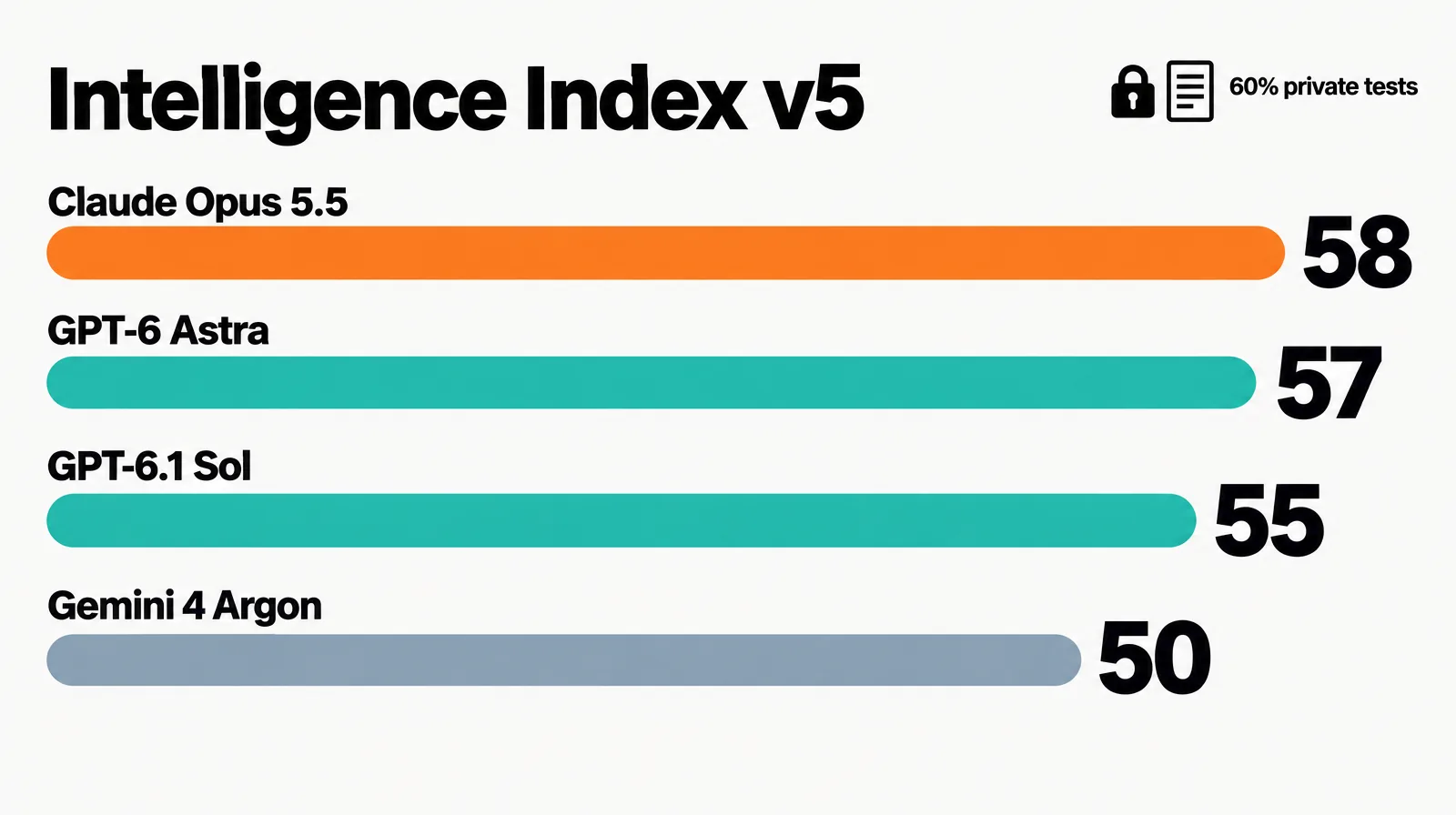
Artificial Analysis published Intelligence Index v5 on October 27, 2026, and Claude Opus 5.5 at max effort leads it at 58. GPT-6 Astra (max) follows at 57 and GPT-6.1 Sol (max) at 55, so Anthropic and OpenAI hold the top five models. Gemini 4 Argon (high) is next at 50. The announcement calls v5 the biggest upgrade since v4 launched in January.
The larger change sits under the scores: “With v5, 60% of the Index is now based on evaluations with private test sets or held-out answers.” Most of the exam can no longer be studied for, and the ranking it produces looks different from v4.3. The open-weights gap grew from 3 points to 12, and how hard a model is allowed to think now moves its score by more than the gap between the top labs.
On this page · 7 sectionsOpen
 Artificial Analysis published Intelligence Index v5 on October 27, 2026. For the first time, 60% of the Index runs on private test sets or held-out answers.
 Claude Opus 5.5 at max effort leads at 58, ahead of GPT-6 Astra at 57 and GPT-6.1 Sol at 55. Gemini 4 Argon is next at 50.
 No model leads all nine tests: Opus 5.5 leads three, GPT-6 Astra two, and Sonnet 5.5, Kimi K3.1 Pro, Gemini 4 Argon and Muse Wonder Full one each.
 The open-weights gap grew from 3 points to 12. Among released weights, DeepSeek V4.1 Flash 1017 and GLM-5.3 lead at 32, below Claude Haiku 5.5 at 36.
 Effort now moves scores more than before: Opus 5.5 scores 35 at low effort and 58 at max, at $0.98 versus $10.04 per task.
§ 01What changed in v5

Two benchmarks are new: FrontierCode 2.0 and Terminal-Bench-Science, 70 agentic research tasks run in a terminal. Three are upgraded: HLE-Diamond replaces Humanity’s Last Exam, AA-Omniscience v1.1 drops saturated and public questions, and CritPt v2 is scored on a private 40-question hard subset. GDPval-AA v2.1, SciCode and AA-LCR v1.1 left the Index.
| Group | Weight | Tests inside |
|---|---|---|
| Knowledge Work | 25% | AA-Briefcase 15%, AutomationBench-AA 5%, GDP.pdf 5% |
| Coding | 25% | FrontierCode 2.0 15%, Terminal-Bench 4.0 10% |
| Science | 25% | Terminal-Bench-Science 15%, CritPt v2 hard subset 10% |
| General | 25% | AA-Omniscience v1.1 15%, HLE-Diamond 10% |
FrontierCode 2.0 is Cognition’s new coding benchmark, launched the same morning. Its 132 tasks sit in real open-source repositories and are graded on whether a maintainer would merge the change; an attempt that fails any blocking check scores 0. Cognition built it because, in its words, “Models struggle to infer user intent, respect unstated constraints, and anticipate long-term consequences of their changes, forcing human intervention.” Artificial Analysis runs each task three times in its own harness, Stirrup. Opus 5.5 leads at 46%, with GPT-6 Astra, GPT-6.1 Terra and Claude Sonnet 5.5 at 42%. The best open-weights model, DeepSeek V4.1 Flash 1017, scores 28%. We covered the same benchmark’s debut in the Coding Agent Index v2.0.
§ 02The scores
The top open-weights model is Kimi K3.1 Pro at 46, but its weights were not yet released when the Index went up. Among models with released weights, DeepSeek V4.1 Flash 1017 and GLM-5.3 lead at 32, 26 points behind the leader and below Claude Haiku 5.5. The gap is widest on HLE-Diamond, where Kimi K3.1 Pro scores 37% against 68% for Opus 5.5, and on Terminal-Bench-Science, 34% against 63% for GPT-6 Astra.
§ 03No model wins all nine
“v5 leaves significant room for progress across all nine evaluations, and no single model leads them all,” Artificial Analysis writes. Opus 5.5 leads three tests, and five other models split the remaining six.
| Test | Leader | Score |
|---|---|---|
| FrontierCode 2.0 | Claude Opus 5.5 | 46% |
| HLE-Diamond | Claude Opus 5.5 | 68% |
| AA-Omniscience v1.1 | Claude Opus 5.5 | 48 |
| Terminal-Bench-Science | GPT-6 Astra | 63% |
| CritPt v2 hard subset | GPT-6 Astra | 72% |
| AA-Briefcase | Claude Sonnet 5.5 | 1812 Elo |
| Terminal-Bench 4.0 | Kimi K3.1 Pro | 67% |
| AutomationBench-AA | Gemini 4 Argon | 78% |
| GDP.pdf | Muse Wonder Full | 33% all-pass |
Two splits stand out. On physics (CritPt v2), GPT-6 Astra leads at 72% on high effort while Opus 5.5, the top model overall, scores 61%. On HLE-Diamond, knowledge questions are harder than reasoning ones: Opus 5.5 and GPT-6 Astra both score 78% on reasoning, against 58% and 50% on knowledge.
§ 04Effort and cost now matter more
The same model scores very differently depending on how much work it is allowed to do. Opus 5.5 scores 35 at low effort and 58 at max, at 10x the cost per task: $0.98 against $10.04. Claude Sonnet 5.5 now spans 29 points from low to max, up from 20 in v4.3, and GPT-6.1 Sol’s spread doubles from 10 points to 20.

“GPT-6.1 Sol (max) scores within 4 points of Claude Opus 5.5 (max) at about an eighth of the cost per task.” Among the 10 highest-scoring models, cost per task varies by more than 13x, from GPT-6.1 Terra to Claude Fable 5.1. The tasks also got heavier: median output per Index task rose by two thirds, from 35k tokens to 59k. The four agentic tests make up 55% of the weight but a median of about 90% of output tokens, and Terminal-Bench-Science alone accounts for about a third.
§ 05The Progress Index
Alongside v5, Artificial Analysis launched Progress Index v1. It uses item response theory to put language models released since November 2022 on one capability scale, so a model tested on older, easier benchmarks can be compared with one tested on newer ones. The company credits Epoch AI and Anthropic for ideas it built on. The Intelligence Index remains its primary measure of the current frontier; the Progress Index is for change over time.
§ 06What it means if you run work on these models
CellCog’s Agent, Creative and Team tiers at Core and Max have run on Claude Opus 5.5 since its release day, so the v5 lead is the model our AI employees already work on. The effort result matches what we see running them: the same model, asked to do more careful work, produces better work and uses more of it. That is why we price by the work assigned, not by the seat. An Index task is also one task; an employee’s job is many tasks that share memory, tools and context, which no single benchmark measures.
§ 07What to watch
- Kimi K3.1 Pro’s weights: once released, the top open-weights score with downloadable weights jumps from 32 to 46.
- Anthropic’s next model on v5, and whether Opus 5.5’s three-test lead holds; we track it in the Opus 5.6 tracker.
- Whether labs start publishing v5 numbers at launch, now that most of it cannot be studied for.
- How the Progress Index places this year’s models against GPT-4-era releases.
Q1What is the Artificial Analysis Intelligence Index?
A composite score of model capability across tasks that reflect real use. Version 5 averages four groups with equal weight: knowledge work, coding, science and general knowledge, across nine evaluations.
Q2Why do private tests matter?
A model cannot be trained on questions it has never seen. With 60% of v5 on private sets or held-out answers, a high score is harder to earn by memorizing public benchmarks.
Q3Which open-weights model scores highest?
Kimi K3.1 Pro at 46, but its weights were not yet released on October 27. Among released weights, DeepSeek V4.1 Flash 1017 and GLM-5.3 tie at 32.
Q4What is FrontierCode 2.0?
Cognition’s private coding benchmark, launched October 27, 2026. Its 132 tasks sit in real open-source repositories and are graded on whether a maintainer would merge the change. Opus 5.5 leads it at 46% in Artificial Analysis’s runs.
Q5What is the Progress Index?
A second index Artificial Analysis launched the same day. It places language models released since November 2022 on one capability scale, so models years apart can be compared. The Intelligence Index stays the measure of the current frontier.