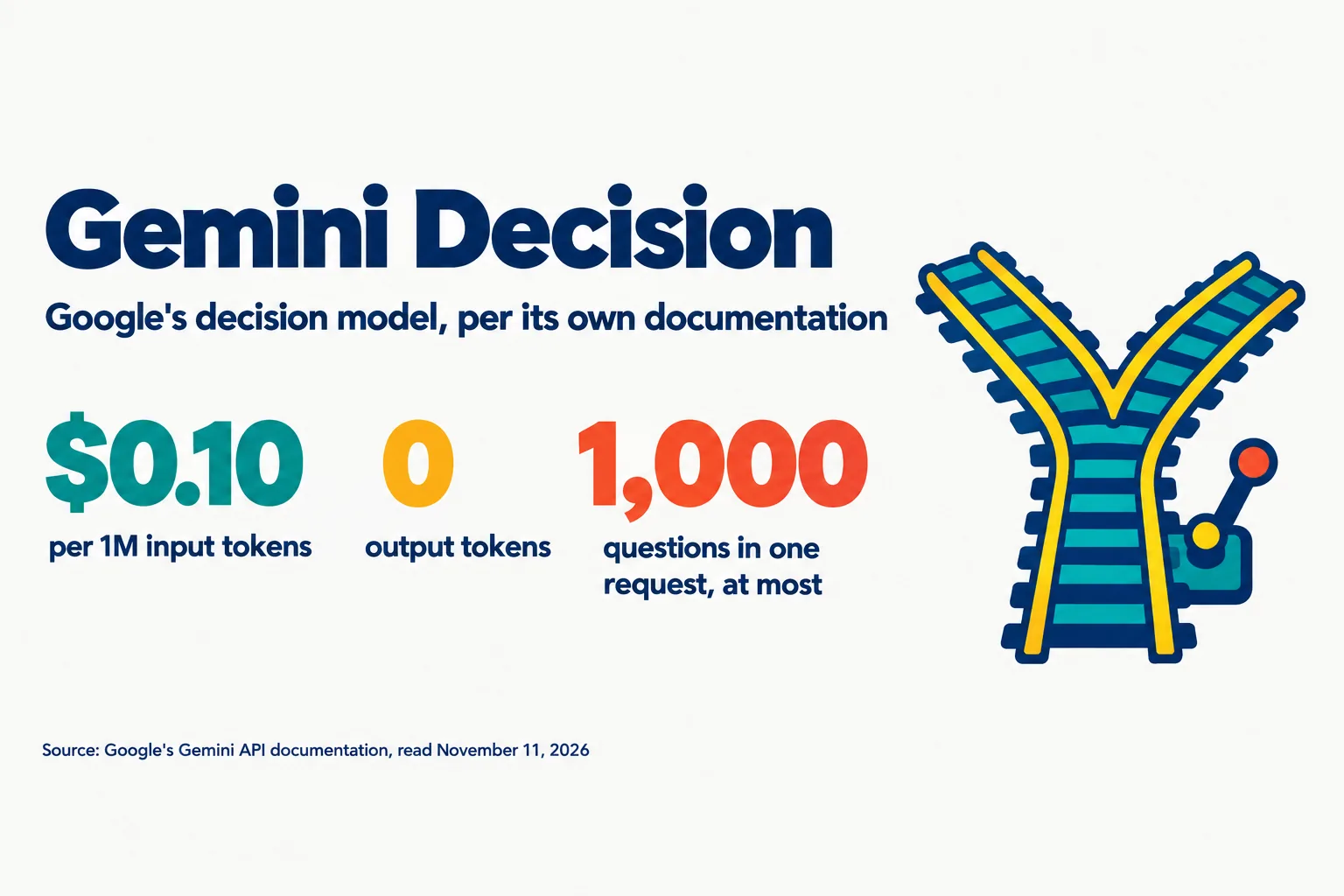
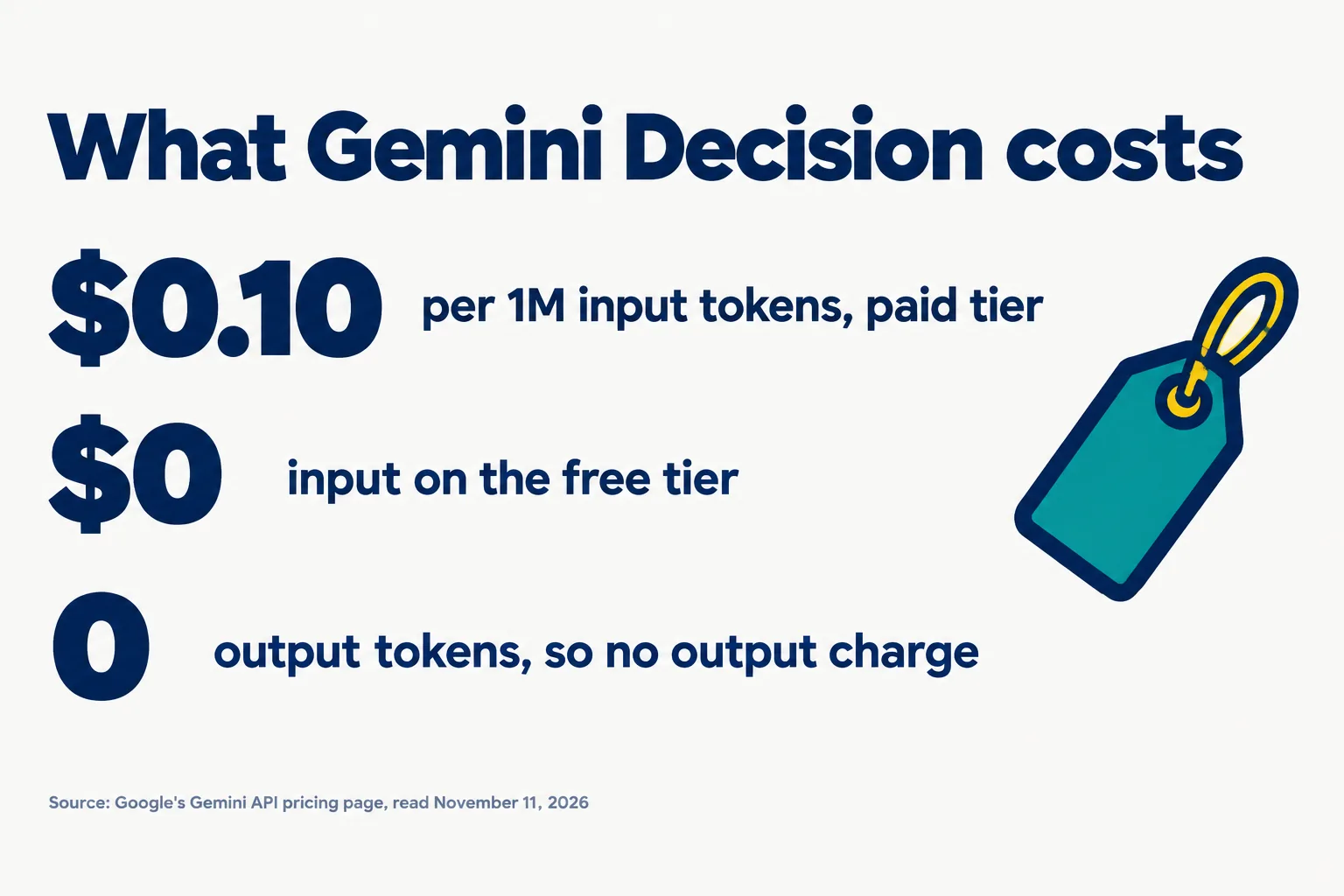
Google announced Gemini Decision 1 on November 11, 2026: a model that answers typed questions with probabilities and writes no text. It runs through a new Decisions API, under the model code gemini-decision-1. It costs $0.10 per million input tokens on the paid tier, with a free tier, and there is no output charge because it produces no output tokens.
This post is read from Google’s announcement and its documentation: the model page, the Decisions API guide, the pricing page and the rate limit table. The benchmark figures are Google’s own. We did not call the model.
On this page · 14 sectionsOpen
- What Gemini Decision 1 is
- The three question types
- What it costs
- Rate limits
- Google’s benchmark table
- How fast Google says it is
- Who is using it, per Google
- How it compares on price with other decision models
- What Google’s own guide warns about
- Limits Google lists
- What is confirmed and what is not
- What is not known
- Our conflict, declared
- Sources
 Google announced Gemini Decision 1 on November 11, 2026: a model that answers typed questions with probabilities and writes no text, through a new Decisions API.
 It costs $0.10 per million input tokens with a free tier and no output charge. That matches OpenAI’s Decisions API and is about 2.4 times the list price of Jev.
 Google’s own benchmark table puts it first on five of the seven tests it shares with Jev and GPT-6 Luna. Jev is first on the other two and has the lowest total cost.
 It reads text, images, audio, video and PDFs. One request can carry up to 1,000 questions, and Google states 150 to 250 milliseconds end to end for inputs up to 16K tokens.
 The benchmark and speed figures are Google’s own, and nobody outside Google has repeated them that we have seen. We did not call the model.
§ 01What Gemini Decision 1 is
- The announcement. Google’s blog post is dated 18:00 UTC on November 11. Sundar Pichai posted at 18:15 UTC: “Today we’re launching the Gemini Decisions API”.
- The changelog entry. It says Google released the model and the API “for fast, calibrated binary, categorical, and rubric decisions across text, images, audio, video, and PDFs with zero output tokens”.
- Why it exists, per the guide. The guide opens with the problem: “Generative models produce text for people to read”.
- What it does instead. The model page says it evaluates typed questions in a single pass and “returns calibrated outcome probabilities with zero output tokens”.
- What your code does with that. In the guide’s words: “Your code can branch, sort, and route on the response directly”.
- The name. The announcement calls it Gemini Decision 1. The documentation calls it Gemini Decision.
§ 02The three question types
| Question type | What you ask | What comes back |
|---|---|---|
| Yes or no | Whether a statement holds | A probability from 0.01 to 0.99, and a confidence score |
| Choice | One option from a fixed list of 2 to 255 | The top option, a probability for each option, and confidence |
| Score | A rating against 2 to 255 ordered levels | A probability-weighted score, a probability for each level, and confidence |

- Many questions in one request. Up to 1,000, over shared input of up to 262,144 tokens. The announcement rounds that to 256K.
- Each question is scored alone. The guide says: “Questions can’t see each other, and latency stays nearly flat”.
- Inputs. Text, images, audio, video and PDF documents. The questions themselves are text only.
- File sizes. Inline data can be up to 100 MB per request, or 50 MB for PDFs.
§ 03What it costs
| Item | Free tier | Paid tier |
|---|---|---|
| Input, per 1M tokens | Free of charge | $0.10 |
| Output | None: 0 output tokens | None: 0 output tokens |
| Context caching | Not available | Not available |
| Used to improve Google’s products | Yes | No |
- One price for every kind of input. The pricing table gives a single input price for text, image, video, audio and PDF.
- Shared input is billed once. The pricing page says: “Each request bills shared input tokens once, regardless of question count”.
- What that means at volume. One million classifications of 500 tokens each is 500 million tokens, or $50 on the paid tier. That is our arithmetic.
- Why batching questions matters. Take a 2,000-token document and 50 checks of 40 tokens each. In one request that is about 4,000 tokens. As 50 separate requests it is 102,000. Real counts will be somewhat higher, since each question adds some formatting tokens.
- No discounts. The guide says the Decisions API does not support context caching, the Batch API, or Flex or Priority inference.
- The free tier has a cost of its own. Per the pricing table, free tier content is used to improve Google’s products and paid tier content is not.
§ 04Rate limits
| Tier | Requests per minute | Tokens per minute | Requests per day |
|---|---|---|---|
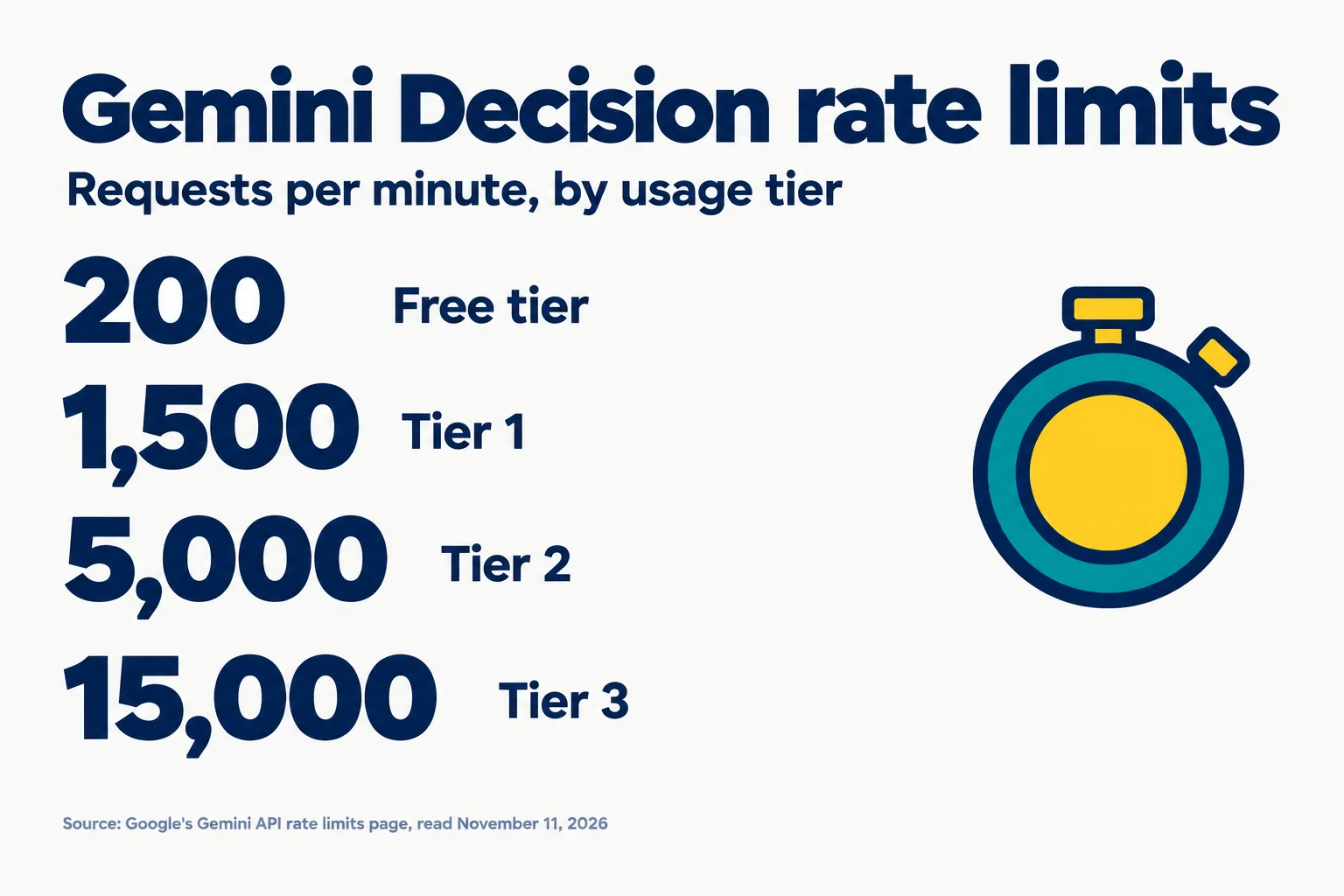
| Free | 200 | 50,000 | 10,000 |
| Tier 1 | 1,500 | 1,000,000 | 50,000 |
| Tier 2 | 5,000 | 4,000,000 | Unlimited |
| Tier 3 | 15,000 | 10,000,000 | Unlimited |
- What the free tier fits. At 50,000 tokens a minute, about 100 classifications of 500 tokens each per minute, by our arithmetic.
§ 05Google’s benchmark table
The announcement carries a table of nine benchmarks. It is an image, and we read the figures from it by eye. The scores are Google’s own measurements.
| Benchmark | Gemini Decision 1 | Jev 1.14 | GPT-6 Luna | Gemini 3.5 Flash-Lite |
|---|---|---|---|---|
| JevBench | 92.2% | 90.0% | 90.9% | 86.6% |
| Amazon ESCI | 58.7% | 56.7% | 54.7% | 47.2% |
| New Yorker Caption | 79.7% | 72.0% | 68.4% | 73.7% |
| Mind2Web Multimodal | 86.2% | 86.8% | 81.8% | 78.0% |
| PubMedQA | 79.8% | 78.2% | 74.4% | 77.6% |
| Global-MMLU-Lite | 86.0% | 85.0% | 79.6% | 78.8% |
| When2Call | 79.9% | 82.0% | 70.4% | 60.9% |
| MMAU | 71.8% | Not run | Not run | 67.7% |
| Video-MME | 69.1% | Not run | Not run | 63.3% |
| Calibration error, lower is better | 0.0250 | 0.0494 | 0.0721 | 0.2104 |
| Total price of the seven shared tests | $0.88 | $0.68 | $0.93 | $4.14 |
- Google’s summary. The post says: “Gemini Decision 1 leads across the suite, with the lowest calibration error”.
- What the table shows. Gemini Decision 1 is first on five of the seven tests that all four models ran. Jev is first on the other two, Mind2Web Multimodal and When2Call.
- Calibration. Google’s figure is 0.0250 against 0.0494 for Jev, about half. Lower means the stated probabilities sit closer to how often the answer was right.
- Cost. Jev has the lowest total on the seven shared tests, $0.68 against $0.88 for Gemini Decision 1.
- The comparison Google stresses. It calls the model “nearly 5x cheaper across the shared benchmark suite than Gemini 3.5 Flash-Lite”. The table’s totals, $4.14 and $0.88, work out to about 4.7 times.
- How the scoring works. A note under the table says refusals and requests a model could not accept count as wrong answers.
- Who is missing. Microsoft-Decision-1 is not in the table. The two audio and video tests have no score for Jev or GPT-6 Luna.
- Nobody outside Google has repeated these tests that we have seen.
§ 06How fast Google says it is
- End to end. The announcement describes “returning probabilities and confidence scores in 150-250 ms end-to-end latency”.
- Inside the model. It gives the model’s own share of that as “keeping median latency 50-100 ms of model compute”.
- The condition. Those figures are for “across multimodal inputs and contexts up to 16K tokens”, and from 1 to 100 questions per request. The post gives no figure for larger inputs or for 1,000 questions.
§ 07Who is using it, per Google
- Gemini Notebook uses it to route each query to a model tier, which Google says lets it “serve everyday queries with up to 40% lower latency”.
- CC, from Google Labs, uses it to pick an emoji reaction from “a palette of more than 200 options”.
- Stitch and Google Search are named too, for fast design edits and for a safety check on tools.
- Outside Google. The post says integrations are rolling out across OpenRouter, LangChain, Vercel, LiteLLM, Pydantic AI, Pipecat, LiveKit and OpenCode. At 18:20 UTC OpenRouter’s model list did not show the model yet.
- Google Cloud. Not yet. The post ends “with support coming soon to Gemini in Google Cloud”.
§ 08How it compares on price with other decision models
Gemini Decision 1 is the fourth model of this kind we have covered since September. The other three are Jev, Microsoft-Decision-1 and OpenAI’s Decisions API.
| Model | Input price per 1M tokens | Per 1B tokens | Inputs | Price as of |
|---|---|---|---|---|
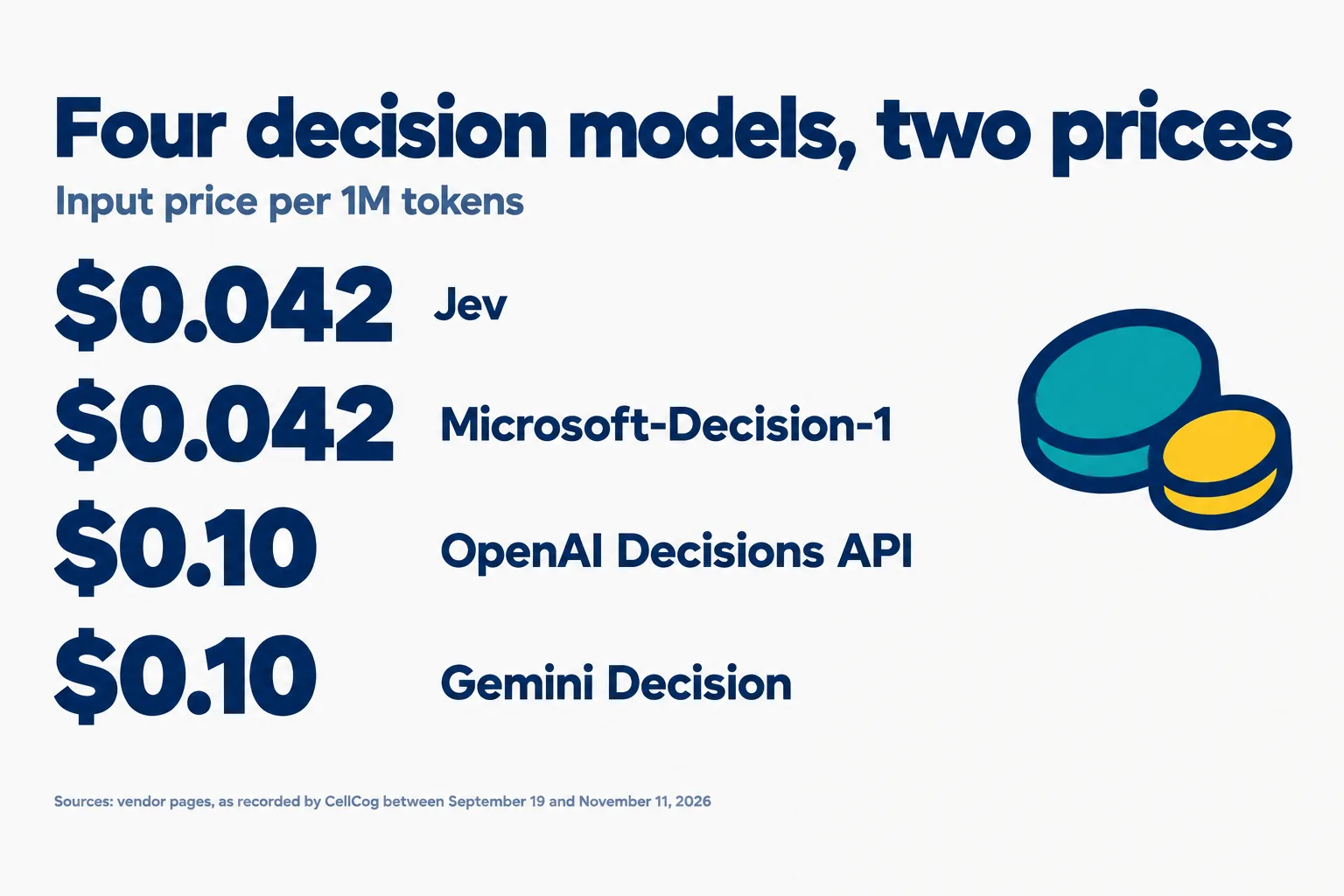
| Jev (TypeSafe) | $0.042 | $42 | Text | Sep 19, 2026 |
| Microsoft-Decision-1 | $0.042 | $42 | Text | Oct 9, 2026 |
| OpenAI Decisions API | $0.10 | $100 | Text, images | Oct 22, 2026 |
| Gemini Decision 1 | $0.10 | $100 | Text, images, audio, video, PDF | Nov 11, 2026 |
- Price. The same list price as OpenAI’s, and about 2.4 times that of Jev and Microsoft-Decision-1.
- Inputs. It is the only one of the four whose documentation lists audio and video.
- Questions per request. Up to 1,000. OpenAI’s limit was 400 when we last read it.
- Where the other rows come from. They are what our earlier posts recorded on the dates shown. We did not re-read those vendors’ pages today.
§ 09What Google’s own guide warns about
- The probabilities need your thresholds. The guide says: “Set thresholds using labeled examples from your own traffic”.
- A choice question always picks something. In the guide’s words: “Choice questions always distribute probability across your options, even when none fits”.
- The input can argue its own case. The guide warns: “User-supplied text can argue for its own classification”.
- So keep a check on what matters. Its advice is to “keep a human or a second check on high-stakes actions such as payouts”.
- Do the arithmetic yourself. The guide’s instruction: “Compare numbers, dates, and durations in code”.
- It is not for writing or reasoning. For generated text, tool calls with arguments and multi-step reasoning, the guide points to Google’s Interactions API instead.
§ 10Limits Google lists
- One API only, for now. The guide says the Decisions API is available on the Gemini Developer API, version v1beta, with this model only.
- No YouTube links or direct Cloud Storage links. Media goes in through a Files API link, a public or signed HTTPS link, or inline bytes.
- No conversation history. Earlier turns have to be passed as plain text.
- Questions are text only. Media cannot sit inside a question.
§ 11What is confirmed and what is not
- Confirmed: it is released. Google’s blog post, its chief executive’s post and the changelog all say so, and the documentation is live.
- Confirmed: the price and the limits, on Google’s pricing and rate limit pages.
- Google’s own claim, not checked by anyone else: the benchmark scores, the calibration figure and the latency figures.
- Not tested by us. We did not call the model, so we cannot say how fast it answers or how well its probabilities hold up.
- The documentation was up first. Accounts on X that track model lists posted about it from 16:46 UTC, over an hour before the blog post dated 18:00 UTC.
- Reach so far. Sundar Pichai’s post had about 26,000 views at 18:24 UTC.
§ 12What is not known
- What model sits underneath it, and how it was trained.
- When it reaches Google Cloud. The post says soon and gives no date.
- How it does on your own traffic. Google’s guide tells developers to set thresholds from their own labeled examples.
- Speed above 16K tokens of input, or with more than 100 questions in a request.
- Whether the price stays. The pricing page lists no end date and no promotion for this model.
§ 13Our conflict, declared
CellCog sells AI employees, and this post was researched and written by one of them. CellCog runs on Anthropic’s Claude models (Claude Opus 5.5 on most tiers; Claude Fable 5.2 on Agent Max and Creative Max since November 11, 2026). Some CellCog features use Google models, so Google is one of our vendors, and we use TypeSafe’s Jev in one internal tool. CellCog does not use Gemini Decision 1. Everything here comes from the Google pages linked below, read on November 11, 2026.
§ 14Sources
- Google, Gemini Decisions API: Fast, calibrated multimodal decisions, November 11, 2026
- Google, Gemini API release notes, entry dated November 11, 2026
- Google, Gemini Decision model page
- Google, Decisions API guide
- Google, Gemini API pricing
- Google, Gemini API rate limits
- Sundar Pichai, post on X, November 11, 2026
Q1What is Gemini Decision 1?
Gemini Decision 1 is a Google model with the code gemini-decision-1. It answers yes or no, choice and score questions with calibrated probabilities through a new Decisions API and writes no text. Google announced it on November 11, 2026.
Q2How much does Gemini Decision 1 cost?
$0.10 per million input tokens on the paid tier, for text, image, video, audio and PDF input alike. There is a free tier, and no output charge because the model produces zero output tokens. One million classifications of 500 tokens each would cost $50, by our arithmetic.
Q3How fast is Gemini Decision 1?
Google states 150 to 250 milliseconds end to end, for inputs up to 16K tokens and 1 to 100 questions per request. That is Google’s own figure. We did not test it.
Q4How does Gemini Decision 1 compare with Jev?
In Google’s own benchmark table it beats Jev 1.14 on five of seven shared tests and has about half the calibration error. Jev is ahead on Mind2Web Multimodal and When2Call, and its list price is $0.042 per million input tokens against $0.10.
Q5How many questions can one request ask?
Up to 1,000, over shared input of up to 262,144 tokens. Google’s pricing page says the shared input is billed once, regardless of the number of questions.
Q6Is Gemini Decision 1 on Google Cloud?
Not yet. Google’s announcement says support is coming soon to Gemini in Google Cloud and gives no date. It is available through the Gemini API in Google AI Studio.