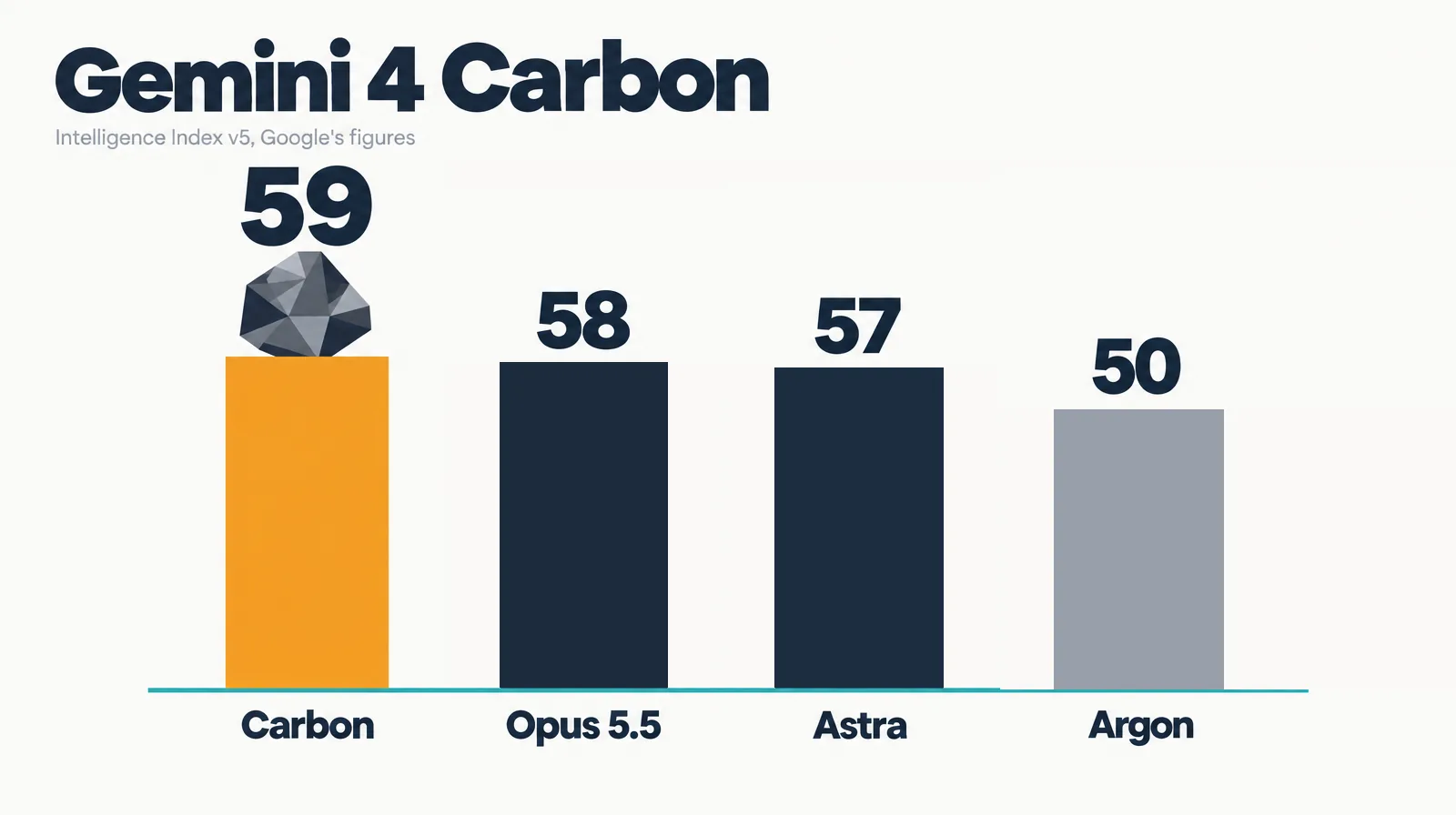
Google announced Gemini 4 Carbon on October 28, 2026, two weeks after Gemini 4 Argon became generally available. The announcement calls it “our strongest model with state-of-the-art cybersecurity and long horizon capabilities,” and Google’s benchmark table puts it first on the Artificial Analysis Intelligence Index v5 at 59, one point ahead of Claude Opus 5.5. Sundar Pichai posted it at 17:01 UTC: “I did say we’d be releasing our models periodically.”
You cannot use it yet. Carbon goes first to “a subset of cyber defenders,” then to more trusted partners through Google’s Fairwind Program, and to developers, businesses and consumers “as soon as possible.” Every number on this page is Google’s own, and Google says its security results were evaluated without guardrails.
On this page · 6 sectionsOpen
 Google announced Gemini 4 Carbon on October 28, 2026, two weeks after Gemini 4 Argon became generally available.
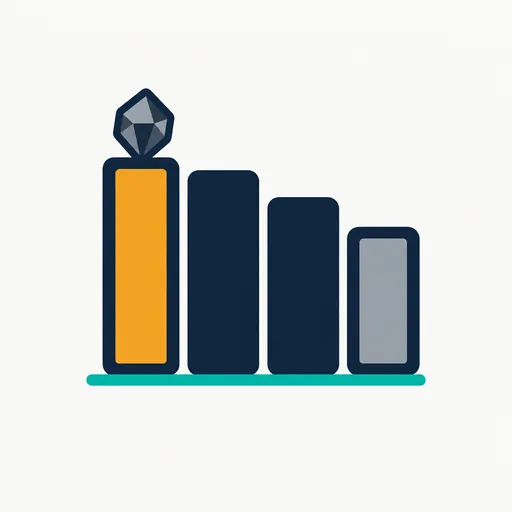 Google’s table puts Carbon first on the Artificial Analysis Intelligence Index v5 at 59, ahead of Claude Opus 5.5 at 58 and GPT-6 Astra at 57.
 On security, Carbon scores 88.2% on SEC-bench Pro, 54.8% on ExploitGym and 71.0% on CWE-bench, evaluated without guardrails.
 Only a subset of cyber defenders can use it now; developers, businesses and consumers get it later, with no date given.
 The introductory API price is $2 per million input tokens and $10 per million output tokens, rising to $4 and $20 afterwards.
 Carbon leads 15 of 17 rows in Google’s table; GPT-6 Astra wins FrontierSWE 2 and Claude Opus 5.5 wins OSWorld-2.1.
§ 01Where Carbon leads, and where it does not
The rival scores match what Artificial Analysis published for v5 on October 27: Opus 5.5 at 58, GPT-6 Astra at 57 and Argon at 50 (our breakdown of v5). Artificial Analysis lists Carbon among its releases, but its Carbon model page returned an error when we checked at 17:13 UTC.

Carbon leads 15 of the 17 rows in Google’s table. GPT-6 Astra leads FrontierSWE 2, 65.5% to 61.2%, and Claude Opus 5.5 leads the offline subset of OSWorld-2.1, 87.2% to 81.5%. Several leads are thin: 70.4% against 70.2% for Opus 5.5 on the Vals Index, and 9.6% against 9.5% for Astra on SWE-sweep. The widest gap is long context: 96.2% on GraphWalks from 256k to 1M tokens, against 71.8% for Astra and 66.8% for Opus 5.5.
| Benchmark | Gemini 4 Carbon | Gemini 4 Argon | GPT-6 Astra | Claude Opus 5.5 |
|---|---|---|---|---|
| AA Intelligence Index v5 | 59 | 50 | 57 | 58 |
| Vals Index v2.2 | 70.4% | 69.2% | 65.0% | 70.2% |
| SWE-sweep | 9.6% | 4.3% | 9.5% | 3.6% |
| FrontierSWE 2 | 61.2% | 55.0% | 65.5% | 62.3% |
| Terminal-Bench 4.0 (AA) | 65.2% | 57.1% | 59.1% | 59.6% |
| Agents’ Last Exam v1.1 | 77.4% | 69.0% | 73.1% | 71.6% |
| OSWorld-2.1 (offline subset) | 81.5% | 74.7% | 80.9% | 87.2% |
| AutomationBench (Zapier) | 53.9% | 51.3% | 41.4% | 42.5% |
| Vending-Bench 2 (bank balance) | $16,484 | $13,718 | $15,515 | $9,235 |
| Chartography | 72.5% | 71.6% | 71.0% | 66.3% |
| Blueprint-Bench 2 (similarity) | 58.6% | 54.4% | 49.7% | 51.2% |
| GraphWalks, 256k to 1M (BFS, F1) | 96.2% | 84.2% | 71.8% | 66.8% |
| RiemannBench | 80.0% | 76.0% | 72.0% | 69.6% |
| Terminal-Bench-Science 0.1 (AA) | 64.8% | 52.9% | 63.3% | 59.0% |
| CWE-bench | 71.0% | 68.0% | 68.0% | 67.0% |
| ExploitGym | 54.8% | 42.0% | 42.4% | 34.5% |
| SEC-bench Pro | 88.2% | 83.4% | 85.4% | not listed |
Google’s table also carries Claude Fable 5.1, which Carbon beats on every row Fable has a score for, and it leaves out GPT-6.1 Sol and Terra, which appear only in Google’s SEC-bench Pro chart. One model it omits did better: on Terminal-Bench 4.0, Artificial Analysis’s October 27 results had Kimi K3.1 Pro at 67%, above Carbon’s 65.2%. On web development, Google says Carbon gained 89 Elo points to reach fourth place on WebDev Arena, at 1769.
§ 02Find, prove, fix: the security results
Google built its pitch around the cycle of cyber defense: find the flaw, check whether it can be exploited, then fix the root cause. Carbon leads all three outside benchmarks Google reports for it.

SEC-bench Pro measures finding real vulnerabilities, and Carbon’s 88.2% is 2.8 points above GPT-6 Astra. On ExploitGym, which tests exploitation, Carbon scores 54.8% against 42.4% for Astra and 42.0% for Argon. On Collinear’s CWE-bench, which grades the fix, it reaches 71.0% against 68.0% for both Astra and Argon.
Google adds claims that come without a public benchmark. Internally, Carbon more than doubled Argon’s success rate at writing secure code. “The Chrome team has reported that Carbon performed more than 10X better than another lab’s large frontier model when generating high quality patches,” the post says, without naming the lab or the model. Wiz, which Google calls “our leading Cloud security platform,” reports Carbon leading its benchmarks for web penetration testing.
§ 03Who gets it, and what it costs
Google says it is “taking a deliberate approach to rollout” and is taking part in the U.S. government’s voluntary process for testing models before release. Argon followed the same path: it reached cyber defenders through Fairwind on September 30 and became generally available on October 13 (our Gemini 4 tracker).
| Item | What Google says |
|---|---|
| Available now | A subset of cyber defenders, starting this week |
| Next | More trusted partners through the Fairwind Program |
| Developers, businesses, consumers | As soon as possible; no date given |
| Introductory API price | $2 per million input tokens, $10 per million output tokens |
| After the introductory period | $4 per million input tokens, $20 per million output tokens |
| Cached input | 95% off the input price |
Google does not say when Carbon’s introductory period ends; Argon’s ends November 30, 2026. Google’s API documentation has no Carbon model page yet (it returned a 404 at 17:13 UTC), and OpenRouter listed only Argon when we checked at 17:13 UTC.
§ 04What Google says changed in its behavior
Google spends as much of the post on alignment as on scores. Its claims, all from internal testing or Google-run benchmarks:
- On Terminal-Bench 4.0, successful cheating fell to 0.0% and attempts to cheat to 0.4%, while accuracy rose.
- In live coding with Google’s own teams, high-severity misalignment alerts dropped by almost 80%.
- Unsupported claims fell by about half compared with Argon.
- On multi-step plans, overreach fell 26% and under-service 29%.
- On Gray Swan’s indirect prompt injection benchmark, attack success was 0.0%, against 0.7% for Argon.
The Gemini 4 safety and security report linked from the post covers Argon; it does not mention Carbon.
§ 05What it means for teams running AI employees
CellCog’s AI employees run on Claude Opus 5.5 on every tier, so the model Carbon edges on Google’s top row is the one our employees already work on. A one-point lead on an index of single tasks is not a reason to switch, and there is nothing to switch to until the API opens. The claim worth testing then is the long-horizon one: Google says its teams have seen Carbon “run for days to persist through dead ends.” An employee’s job is exactly that, many tasks over days that share memory, tools and context. That is the work we price for, and it is the test any routing change would have to pass.
§ 06What to watch
- Carbon on the Gemini API and in the Gemini app, with a model ID and an end date for introductory pricing.
- Artificial Analysis’s own Carbon page; Google cites its v5 score of 59.
- A Carbon model card, or a Carbon section in Google’s safety report.
- Independent security evaluations, and which lab’s model the Chrome team compared against.
Q1What is Gemini 4 Carbon?
Google’s newest frontier model, announced October 28, 2026, two weeks after Gemini 4 Argon became generally available. Google says it leads on cybersecurity and long-horizon coding tasks.
Q2When can developers use Gemini 4 Carbon?
Google has not given a date. A subset of cyber defenders gets it first, then more trusted partners through the Fairwind Program, then developers, businesses and consumers as soon as possible.
Q3How much does Gemini 4 Carbon cost?
The introductory API price is $2 per million input tokens and $10 per million output tokens, with cached input 95% off. After the introductory period it rises to $4 and $20.
Q4How does Gemini 4 Carbon compare with GPT-6 Astra and Claude Opus 5.5?
In Google’s table it scores 59 on Intelligence Index v5 against 57 for Astra and 58 for Opus 5.5, and leads 15 of 17 benchmarks. Astra leads FrontierSWE 2 and Opus 5.5 leads OSWorld-2.1’s offline subset.
Q5Are the benchmark numbers independent?
Not yet. Google cites the Artificial Analysis Index for the 59; the rest are Google’s own runs, and its security results were run without guardrails. Independent tests need wider access.