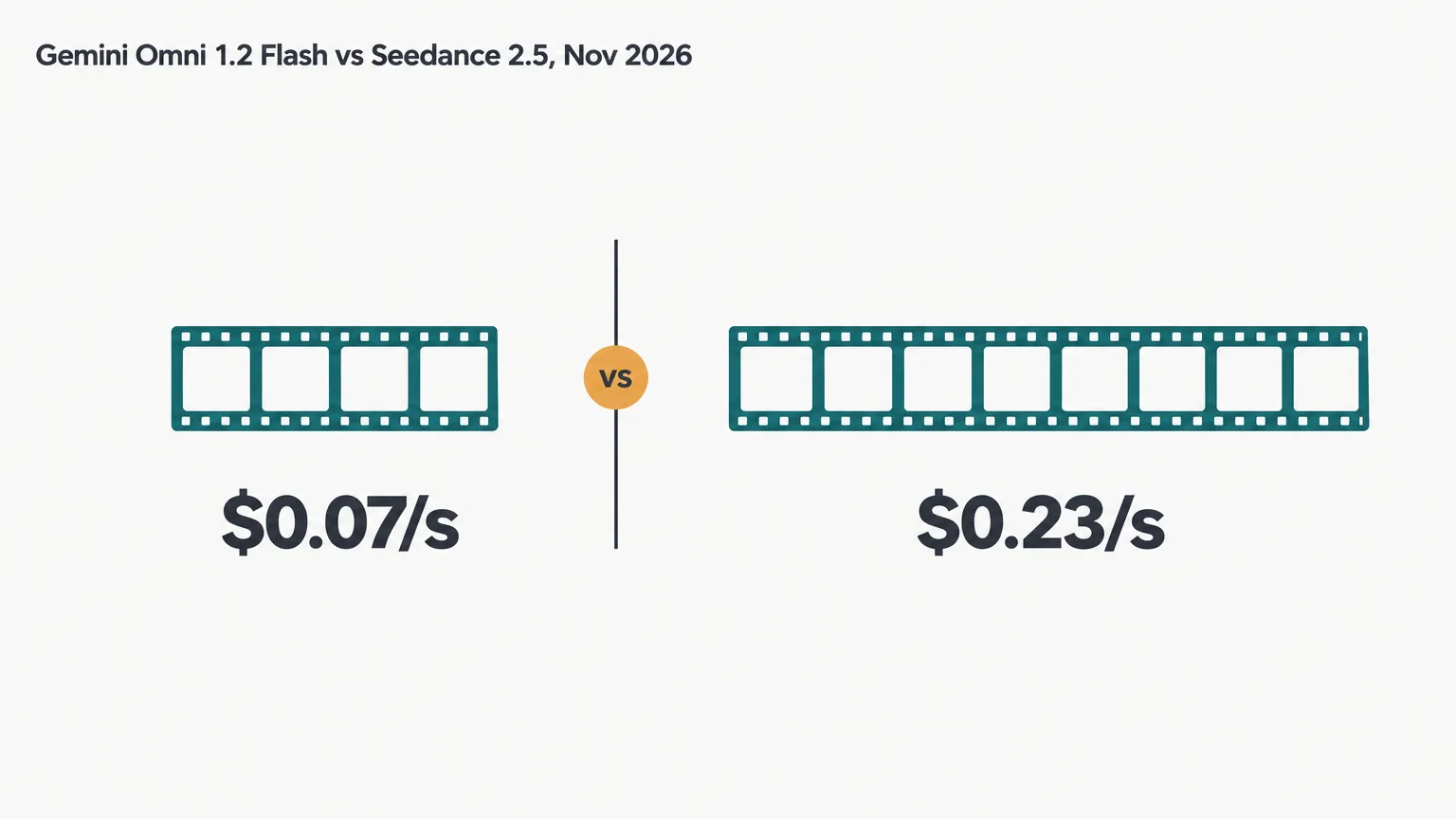
Google’s new Gemini Omni 1.2 Flash dropped its price to $0.07 a second the same week we have been shipping on Seedance 2.5, so the obvious question is which one belongs in a video pipeline. We make every CellCog video on Seedance 2.5, and we ran 10 head-to-head tests against Kling 4.0 last week, so this is a comparison with a house favorite declared up front. Here is how the two models line up on paper.
This page compares published specs and prices only; a full frame-by-frame test of Omni 1.2 against Seedance 2.5 is work we have not run yet. The numbers below come from each maker’s own pages, read November 5, 2026.
 Gemini Omni 1.2 Flash makes 3 to 15-second clips; Seedance 2.5 makes 4 to 30-second clips with a 50-asset reference bank for multi-shot scenes.
 On 720p price, Omni 1.2 Flash lists $0.07 a second; Seedance 2.5 is about $0.23 a second on its cheapest route, a real gap but smaller than the headlines imply.
 Omni 1.2 edits in conversation, so you fix one detail instead of re-rolling the clip; Seedance 2.5 regenerates the whole clip each time.
 Reference-to-video jobs bill on input plus output duration on many platforms, so a cheap per-second rate is not the whole bill.
 Omni 1.2 stamps every output with a SynthID watermark; Seedance 2.5’s pages state none.
 We make every CellCog video on Seedance 2.5 and have tested it against Kling 4.0, not yet against Omni 1.2.
§ 01The specs
| Gemini Omni 1.2 Flash | Seedance 2.5 | |
|---|---|---|
| Clip length | 3 to 15 seconds | 4 to 30 seconds |
| Native audio | speech, lip-sync | audio included |
| Reference inputs | character, product, style images, motion clips to 3s, audio cues | up to 50 assets: 30 images, 10 videos, 10 audio clips |
| Editing | multi-turn conversational edits | regenerate the clip |
| 720p price | $0.07 a second | about $0.23 a second (Replicate) |
| 1080p | upsampled, early reads near $0.104 a second | about $0.57 a second (BytePlus ModelArk) |
| Watermark | SynthID on every output | none stated |
The two models bet on different lengths. Omni 1.2’s 15-second ceiling fits a social ad or a product explainer; Seedance 2.5’s 30 seconds and its 50-asset reference bank fit a multi-shot scene with several characters, which is why our full-film pipeline runs on it.
§ 02Where the price actually lands
Omni 1.2’s $0.07 a second is genuinely cheap, and its editing-in-conversation model means you fix one detail instead of re-rolling the whole clip, which saves more than the sticker price suggests. But a 720p Seedance 2.5 clip is about $0.23 a second on the cheapest API route (Replicate), so the gap is real but smaller than the headlines imply once you compare the same resolution.
A caution the Seedance pricing taught us the hard way: reference-to-video jobs bill on input duration plus output duration on many platforms, so a cheap per-second rate is not the whole bill. Omni 1.2’s reference handling is new, and Google has not detailed how it meters motion-clip and audio inputs.
§ 03Which to reach for
- Short, cheap, lots of variants: Gemini Omni 1.2 Flash. Fifteen seconds, $0.07 a second, and conversational edits make it strong for ad variants and product spins, with a SynthID watermark to plan around.
- Longer, multi-character, multi-shot scenes: Seedance 2.5. Thirty seconds, a 50-asset reference bank and native audio carry a real narrative, which is why our stack runs on it.
- The honest gap: we have measured Seedance against Kling, not against Omni 1.2. The consistency claims Google makes are its own demos, and whether 15 seconds holds together under a real brief is exactly what an independent test has to settle.
§ 04Where CellCog sits
Our conflict, declared: CellCog is an AI employee platform, our employees generate video on Seedance 2.5, and Omni 1.2 is a model we are weighing. The useful takeaway for anyone else choosing is the same one our Seedance vs Kling test reached: pick on the job, not the headline price, and test on your own footage before you commit.
§ 05Sources
- Google, Gemini Omni 1.2 Flash, November 5, 2026.
- Our Gemini Omni 1.2 Flash record, read from Google’s pages.
- Our Seedance 2.5 pricing guide and Seedance 2.5 vs Kling 4.0 test, from the providers’ live pages and our own account.
Q1How long are clips from each model?
Gemini Omni 1.2 Flash makes 3 to 15-second clips. Seedance 2.5 makes 4 to 30-second clips at 24 fps.
Q2Does either watermark its output?
Gemini Omni 1.2 Flash stamps every output with an imperceptible SynthID watermark. Seedance 2.5’s provider pages state no watermark.
Q3Which does CellCog use?
CellCog makes its video on Seedance 2.5. We have run a frame-by-frame test against Kling 4.0, but not yet against Gemini Omni 1.2 Flash.
Q4Is $0.07 a second the real cost for Omni 1.2?
That is Google’s listed 720p rate. 1080p is upsampled and early reads put it near $0.104 a second, and reference inputs may add to the bill depending on metering.
Q5Where does CellCog fit?
CellCog is our product, an AI employee platform whose content-creator employees generate video, so both models are options our own stack weighs.