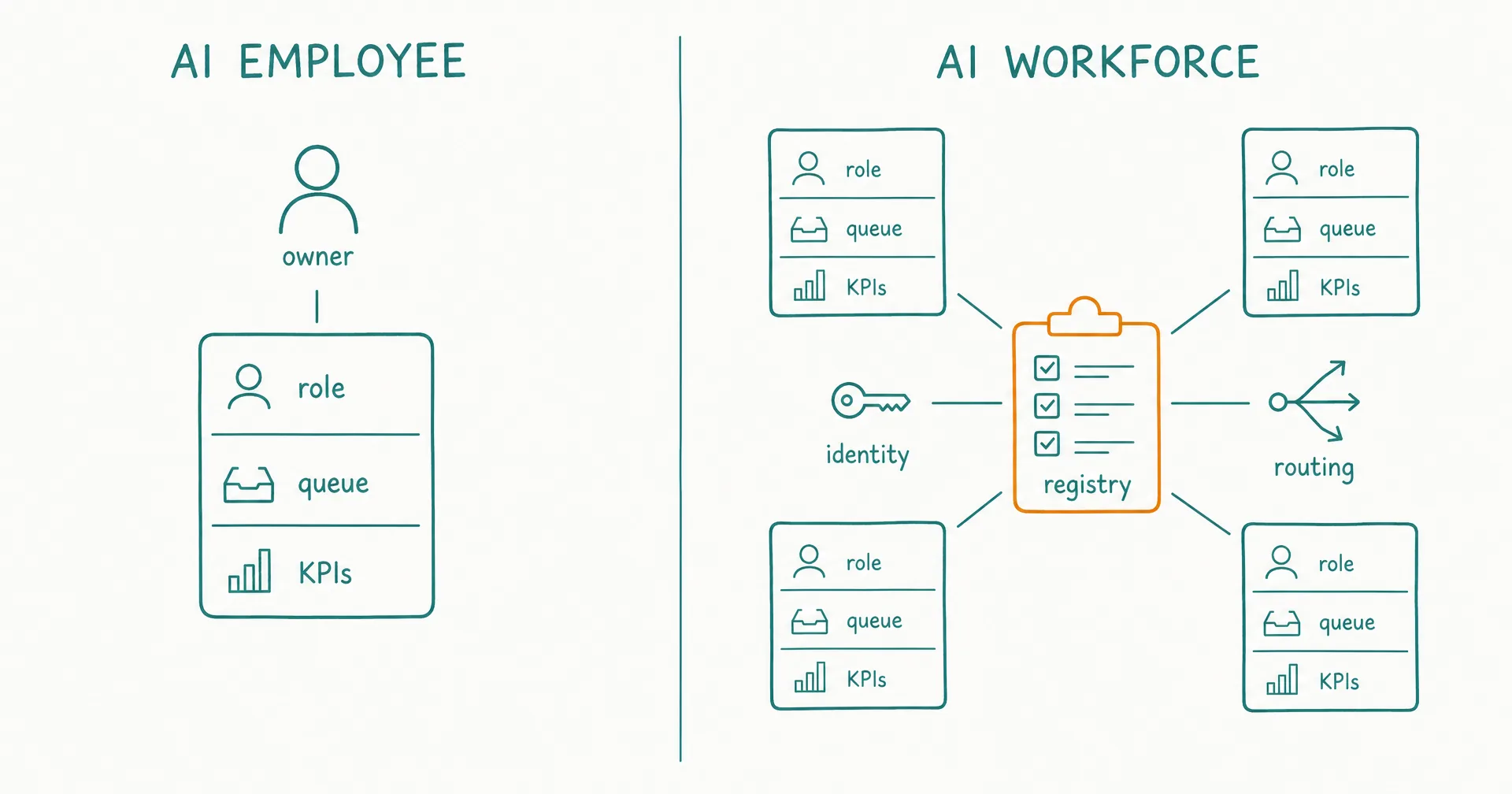
An AI employee is one standing software role with a bounded responsibility. An AI workforce is the portfolio and operating system used to govern multiple AI roles, agents, automations, and their work with people.
The practical distinction is unit versus system.
One AI employee needs a role, work intake, context, tools, permissions, metrics, escalation, and a human supervisor. An AI workforce also needs an inventory, identities, ownership boundaries, delegation rules, shared services, cross-role memory policy, cost controls, incident containment, and portfolio-level performance.
More agents do not automatically create a workforce. They can create more duplicated work, wider access, conflicting conclusions, and hidden supervision.
Start with one employee when one recurring outcome can prove value. Build a workforce only when several proven roles need coordinated capacity and the organization can govern their interactions.
On this page · 16 sectionsOpen
- AI Workforce vs AI Employee at a Glance
- What Is an AI Employee?
- What Is an AI Workforce?
- When Does a Collection of Agents Become a Workforce?
- What Additional Operating Layers Does a Workforce Need?
- How Is an AI Workforce Different From an AI Organization?
- Should You Start With One AI Employee or an AI Workforce Platform?
- When Is the Second AI Employee Justified?
- How Do Multiple AI Employees Work Together?
- Four AI Workforce Operating Patterns
- What Can Go Wrong When You Scale Too Early?
- How Should an AI Workforce Be Measured?
- How CellCog Fits the Workforce Model
- A 20-Question AI Workforce Buyer Checklist
- A Five-Stage Scaling Model
- Final Verdict
- An AI employee is one accountable operating role around agentic capability.
- An AI workforce is the managed portfolio of AI roles and supporting infrastructure across a team or organization.
- The workforce layer must answer who each agent is, who owns it, what it may access, which service it provides, how work moves, what context can cross boundaries, how cost is controlled, and how the whole system is paused or audited.
- A collection of chatbots, copilots, automations, and agents becomes a workforce only when it has shared governance and operating accountability.
- Scale from one role after accepted outcomes are stable, exception load is manageable, access is governed, and a second role removes a measured bottleneck.
- CellCog’s AI Organization demonstrates CellCog’s own multi-role pattern, including manager and specialist AI Employees; its current figures are first-party operating data, not a universal benchmark.
§ 01AI Workforce vs AI Employee at a Glance
| Decision dimension | AI employee | AI workforce | Buyer implication |
|---|---|---|---|
| Scope | One recurring role or outcome | Portfolio of roles and shared services | Prove the unit before scaling the system |
| Primary owner | Role supervisor or service owner | Business, platform, security, and portfolio owners | Ownership becomes layered |
| Identity | One scoped agent or role identity | Registry, sponsorship, lifecycle, and identity policy | Avoid shared or orphaned credentials |
| Work intake | Queue, schedule, inbox, event, or assignment | Routing across roles, services, and teams | Coordination becomes a product requirement |
| Memory | Role and task context | Role-specific, shared, and organization context | Sharing must be deliberate |
| Authority | Role-shaped permissions | Cross-role access, delegation, and separation of duties | One role must not silently expand another |
| Evaluation | Accepted outcomes, quality, intervention, cost, and risk | Service and portfolio health plus role metrics | Agent count is not capacity |
| Failure scope | One role and its connected systems | Cascading effects across roles, memory, queues, and managers | Containment matters before scale |
| Cost | Usage and operation of one role | Spend allocation, budgets, shared overhead, and coordination tax | Unit economics must survive the portfolio |
| Best starting point | One bounded recurring outcome | Several proven roles with explicit dependencies | Do not buy the org chart first |
An organization may use “AI workforce,” “digital workforce,” “agent workforce,” or “AI organization” differently. Treat the terms as product and operating labels rather than standards.
§ 02What Is an AI Employee?
An AI employee is agentic software assigned a continuing business responsibility. It can receive work from a schedule, message, event, queue, person, or another worker; preserve approved context and open-task state; use tools inside permissions; and report completion, evidence, blockers, or escalation.
The practical AI employee definition applies five tests: role, continuity, initiative, agency, and accountability.
One employee needs a complete operating loop
Even a single role needs a mission and explicit non-goals, one recurring outcome, approved sources, work-intake and priority rules, task states, tools and data scope, action-specific permissions, approval and escalation, accepted-output criteria, KPIs, handovers, and a named human owner.
If those objects do not work for one role, a larger workforce will multiply the uncertainty.
One role may still use several agents
An employee describes an organizational assignment, not necessarily one model process. A research employee could use a planner, a web-research specialist, a data-analysis tool, a citation checker, and an evaluator.
The role remains one employee if it owns one queue and one accepted outcome under one accountable operating contract. Internal components do not need separate organizational identities unless they independently receive authority or responsibility.
§ 03What Is an AI Workforce?
An AI workforce is a managed portfolio of AI workers, agents, and automations that contributes to organizational services and outcomes.
The portfolio may include personal assistants or copilots, team agents, standing AI employees, shared-service agents, specialist tools, manager or router agents, deterministic workflows, RPA bots, external vendor agents, and human owners and reviewers.
The category becomes useful when management extends beyond one worker.
The workforce’s natural unit is a service portfolio
An employee may own the weekly market brief. The workforce may provide market intelligence, content operations, sales research, customer support, executive reporting, data analysis, and shared compliance or evidence review.
Each service can contain several roles. Each role can call several tools. The workforce layer makes their boundaries, ownership, cost, and interactions visible.
A workforce is not a legal employment claim
AI agents are software systems. They do not become human employees or legal persons because they appear on an organization chart.
The human organization remains responsible for procurement, data and model providers, role design, access, actions, affected people, compliance, quality, incidents, and final business accountability.
“Workforce” is an operating metaphor for managed capacity.
§ 04When Does a Collection of Agents Become a Workforce?
Use seven tests.
| Workforce test | Evidence | Failure if missing |
|---|---|---|
| Inventory | Registry of roles, agents, versions, owners, and status | Shadow agents and unknown spend |
| Identity | Distinct agent or service identities with sponsors | Shared credentials and weak attribution |
| Service ownership | Named human owner for each end-to-end outcome | Technology exists without operating responsibility |
| Decision rights | Explicit autonomous, approved, and prohibited actions | Agents overreach or stall |
| Work routing | Accepted contracts for assignment and handoff | Duplicate or abandoned tasks |
| Observability | Service, role, action, cost, and incident telemetry | Activity cannot be tied to value or harm |
| Lifecycle | Onboard, change, pause, revoke, retire, and archive | Orphaned access and stale behavior |
If the business has 50 agents but cannot answer who sponsors them, what service they provide, or how to stop them, it has an agent inventory problem - not a functioning workforce.
Identity becomes a workforce problem
Microsoft’s current Agent ID documentation distinguishes agent identities from human and conventional application identities. It emphasizes right-sized access, attribution of AI-performed operations, policy at scale, sponsors, and retirement without orphaned permissions.
The general lesson is platform-independent: do not make several agents appear as one human account; do not reuse one high-privilege credential across roles; attach every agent to an accountable sponsor; record delegated versus direct authority; revoke access when the role is paused or retired; and preserve attribution when work crosses systems.
Identity is not branding. It is the basis for authorization, logging, incident scope, and lifecycle.
§ 05What Additional Operating Layers Does a Workforce Need?
One employee needs a good role. A workforce needs control across roles.
1. Registry and ownership
The registry should show the role name, service, business owner, technical owner, security owner, version, model and vendor, data classes, connected systems, identity, current permissions, budget, evaluation status, dependencies, incident status, and a retirement date or review cadence.
Workday’s Agent System of Record announcement reflects the market’s move toward centralized role, access, cost, lifecycle, and performance management for agent fleets. Treat vendor announcements as product evidence, not independent proof of business value.
2. Routing and work acceptance
When one employee delegates to another, the receiver needs to accept the task, goal, relevant context, source evidence, authority, budget, deadline, expected artifact, completion test, and return path.
Sending a message is not the same as transferring responsibility. Delegation is structured state transfer.
3. Shared-service boundaries
Some capabilities should remain shared: identity and access, model and vendor review, approved source retrieval, logging, evaluation infrastructure, secrets, incident response, cost allocation, and policy distribution.
Centralize controls that must be consistent. Keep business-role ownership near the team that understands the outcome.
4. Memory architecture
Not every role should read everything another role learned.
Separate task-local working state, role-specific operational memory, account or project context, organization-wide policy, shared reference data, and restricted sensitive records. Decide which context can cross a worker boundary and which requires explicit retrieval or handoff.
5. Portfolio evaluation
Individual role quality is necessary but insufficient. The portfolio should reveal the end-to-end service outcome, cross-role delay, duplicate work, handoff rejection, correction propagation, human supervision load, unit cost, shared infrastructure cost, incident concentration, and roles that create more coordination than value.
§ 06How Is an AI Workforce Different From an AI Organization?
The terms are often used interchangeably, but a practical distinction helps.
| Term | Useful meaning | Question it answers |
|---|---|---|
| AI employee | One standing role | What does this worker own? |
| AI workforce | Managed portfolio of AI capacity | Which workers and services exist, and how are they governed? |
| AI organization | Structure of human and AI roles, reporting, delegation, and decision rights | How does the organization coordinate and remain accountable? |
An AI workforce can exist without AI employees managing one another. A company might operate ten independent shared-service agents, each supervised by a human.
An AI organization adds explicit structure: manager and specialist roles, reporting lines, delegation, escalation, shared goals, span of control, review, and cross-team decision rights. Start there only after one or more roles have a dependable operating loop.
§ 07Should You Start With One AI Employee or an AI Workforce Platform?
Start with one employee unless a regulated or enterprise environment requires centralized controls before any agent can launch.
One-role-first advantages
One role makes it easier to define the outcome, build a representative evaluation set, restrict permissions, observe reviewer effort, understand cost, find failure patterns, identify real dependencies, and stop without organizational disruption.
The AI employee hiring guide converts a vague title into a bounded first assignment.
When platform-first controls are justified
Larger organizations may need registry, procurement, identity, logging, data policy, and vendor review before the first role touches production.
That does not mean launching many agents at once. It means establishing a safe minimum platform - approved providers, an identity standard, owner and sponsor fields, data classification, default-deny access, log retention, an evaluation gate, an incident path, spend control, and a retirement procedure - then piloting one service.
Avoid workforce theater
An animated org chart, named personalities, and dozens of role cards can create the appearance of capacity without evidence that work is accepted.
Ask: Which customer or internal outcome improved? What work stopped being repeated by people? What is the accepted-output rate? How many reviewer minutes remain? What is the exception burden? What did the second role improve that the first could not? Which role was retired because it failed?
A workforce should make operating performance easier to see, not easier to narrate.
§ 08When Is the Second AI Employee Justified?
Add a second role only for a measured bottleneck or a necessary separation of duty.
| Reason to add a role | Evidence | Weak rationale |
|---|---|---|
| Different expertise | The first role repeatedly produces weak outcomes in one domain | The title sounds specialized |
| Permission separation | One task requires access that the first role should not receive | More integrations are available |
| Independent review | Consequence justifies a separate evaluator | Two agents “debate” without a rubric |
| Parallel capacity | Queue delay is material and work can be partitioned | More activity looks productive |
| Different trigger/cadence | Work has a distinct service level and owner | One role feels busy |
| Context isolation | Data or client boundaries must remain separate | Shared memory seems convenient |
| Managerial routing | Several proven specialists need triage and synthesis | A manager agent sounds advanced |
The second role should have its own outcome, non-goals, permissions, metrics, and owner.
Split by responsibility, not by every task
Too many narrow workers create coordination tax.
Weak split: an email-reading agent, an email-classification agent, a drafting agent, a tone agent, a send agent, and a reporting agent.
Better split: a support-intake employee owns routine resolution; a policy specialist supplies bounded policy interpretation; and a human service owner handles exceptions and lifecycle.
Internal tools do not need employee identities unless they own independent work.
§ 09How Do Multiple AI Employees Work Together?
Collaboration should be expressed as state, not conversation alone.
Delegation flow
- Sender identifies a bounded task.
- Sender packages context, evidence, authority, and acceptance.
- Receiver checks scope and capacity.
- Receiver accepts, rejects, or requests clarification.
- Ownership changes visibly.
- Receiver performs work and records evidence.
- Result returns with completion or exception state.
- Final owner validates and closes the parent outcome.
Manager role
A manager agent may classify work, choose a specialist, allocate a budget, monitor status, apply a rubric, request revision, synthesize results, and escalate.
It should not automatically inherit every specialist’s permissions. Routing and review are a different job from domain execution - and they should be evaluated separately.
Human accountability remains explicit
The human owner decides which services exist, which agents may delegate, which outcomes require human approval, how conflicts are resolved, when the workforce is paused, and whether the operating benefit justifies the risk and cost.
AI management can reduce coordination work. It cannot assume the organization’s accountability.
§ 10Four AI Workforce Operating Patterns
The same number of employees can produce very different coordination and risk depending on topology.
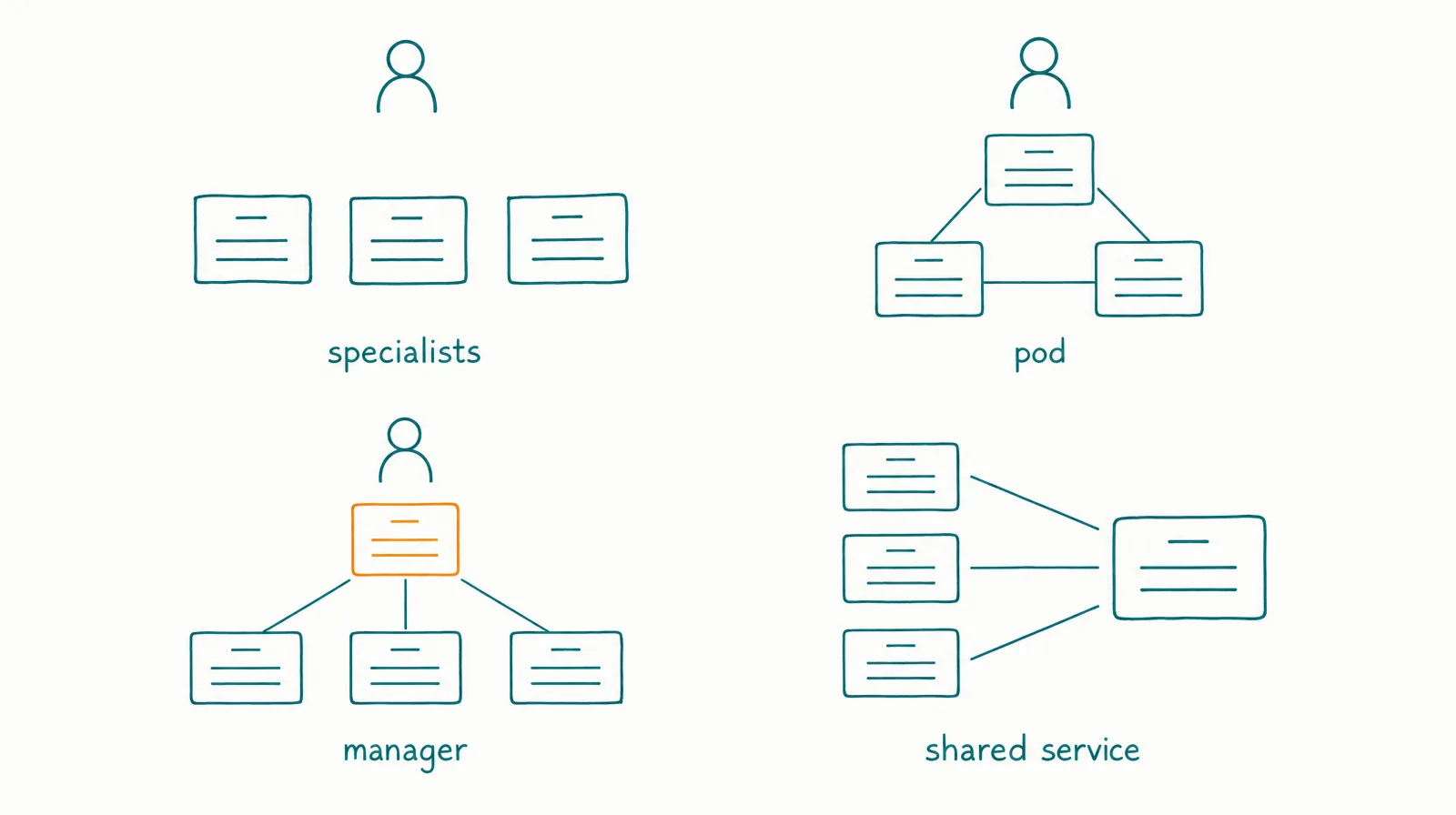
Pattern 1: human-owned specialists
Each AI employee reports directly to a person. Roles may share approved services, but they do not delegate to one another.
Best fit: two to five roles, distinct outcomes, manageable human review, limited cross-role dependency, and an organization still learning where failures occur.
Advantages: clear accountability, simple permission boundaries, no manager-agent failure layer, and easy pause and retirement.
Limits: the person carries routing and synthesis; shared work may be duplicated; and handoffs can become a manual coordination burden.
This is usually the safest first workforce pattern.
Pattern 2: human–AI functional pod
One human owns a service with several complementary AI employees - for example an intake-and-research employee, an execution specialist, and a quality/evidence reviewer.
Best fit: one end-to-end service, roles with different tools or data access, a useful separation between execution and review, and frequent but structured handoffs.
Advantages: specialization without removing human service ownership; permissions can follow responsibility; review can be independent; and service metrics span the pod.
Limits: cross-role delay, duplicated context, evaluator disagreement, and the human owner may become the routing bottleneck.
Use a shared task object so the pod works from one state rather than several conversations.
Pattern 3: manager–specialist hierarchy
A manager employee receives work, selects specialists, allocates budgets, reviews results, and returns a synthesized outcome.
Best fit: several proven specialist roles, repeatable routing decisions, one coherent service outcome, explicit evaluation rubrics, and bounded manager authority.
Advantages: lower human routing burden, centralized task state, reusable specialist capacity, and one result interface.
Limits: manager errors affect every branch; specialist evidence may be compressed or lost; manager latency and cost can dominate; and broad authority creates a large blast radius.
The manager should be evaluated on decomposition, routing, budget, review, and escalation - not on specialist domain quality.
Pattern 4: shared services across business roles
Several business roles call common evidence, policy, data, security, or artifact services.
Best fit: a source or control must remain consistent; several roles need the same bounded capability; duplicated implementations create risk; and service contracts can be explicit.
Advantages: one maintained source of truth, consistent policy enforcement, lower duplication, centralized monitoring, and easier version control.
Limits: the shared service becomes a dependency and failure concentration; data from one role may leak into another; changes affect several workflows; and unclear service ownership can stall the whole portfolio.
Choose topology from the work
| Work characteristic | Strong default |
|---|---|
| Few independent roles | Human-owned specialists |
| One service with complementary skills | Human–AI pod |
| Many proven specialists and repeated routing | Manager–specialist |
| Common controlled capability across teams | Shared service |
| Unclear role boundaries | Stay with one employee |
| High-consequence cross-role action | Human-controlled pod with separation of duty |
Do not choose the hierarchy because it resembles a human company. Choose it because it reduces a measured coordination cost without hiding accountability.
§ 11What Can Go Wrong When You Scale Too Early?
Duplicate work. Two roles research the same question, contact the same account, or update the same record because routing and ownership are unclear.
Conflicting goals. The sales worker maximizes meetings while the support worker minimizes risky promises. Without a shared policy, each may optimize locally.
Permission accumulation. Roles receive broad shared credentials for convenience. One compromised or confused agent can then affect several systems.
Memory contamination. An unsupported conclusion enters shared context and influences other workers. Repetition makes it look authoritative.
Handoff loss. The receiving role sees the output but not the source, constraint, prior action, or completion contract. It restarts or silently changes the task.
Manager bottleneck. One router reviews everything, creating latency, cost, and a single failure point.
Human supervision overload. Agent count grows faster than exception and review capacity. Approvals become rubber stamps or wait indefinitely.
Cascading retries. One failed task triggers several agents, each retrying or delegating, multiplying spend and external actions.
§ 12How Should an AI Workforce Be Measured?
Measure the service, the role, and the portfolio.
Service measures: accepted resolution or deliverable rate, quality, cycle time, service-level adherence, satisfaction, exception rate, reopened work, and cost per accepted outcome.
Role measures: first-pass acceptance, evidence completeness, correct tool and policy use, appropriate escalation, handoff acceptance, correction effort, action incidents, and the role-specific outcome.
Portfolio measures: active and dormant roles, owner coverage, identity and permission coverage, evaluation currency, spend by service and role, duplicate capability, cross-role queue delay, shared-system incidents, human span of control, and retired roles.
Avoid the agent-count metric
“We deployed 100 agents” says nothing about useful capacity.
A stronger statement is: three governed services delivered 420 accepted outcomes, 91% within the agreed service level, with 7 minutes of median review time, a known cost per accepted outcome, and no severity-one incidents.
The numbers must come from the actual environment and use declared denominators.
§ 13How CellCog Fits the Workforce Model
CellCog’s AI Employee layer provides individual roles with goals, KPIs, shifts, wake conditions, inboxes, memory, task boards, permissions, approvals, and handovers.
Its AI Organization page currently shows CellCog’s own structure with one human founder, manager and functional AI Employees, and specialist sales roles. It also reports first-party shift, task, email, dashboard, spend, and throughput figures for a dated operating period.
Those figures demonstrate how CellCog describes and operates its own system. They are not independent evidence that another organization will achieve the same outcome.
CellCog is relevant when a buyer wants to move from one standing AI role, to several named roles, to delegated work and handovers, to manager and specialist relationships, to visible operating metrics.
The buyer should still verify identity and access separation, exact delegation behavior, shared versus role memory, audit detail, approval coverage, pause and revocation, incident containment, cost allocation, and human ownership.
§ 14A 20-Question AI Workforce Buyer Checklist
A workforce platform should prove both worker quality and fleet governance.
Inventory and lifecycle
- Can an administrator list every active, dormant, testing, and retired agent?
- Does each agent have a human sponsor, service owner, version, and purpose?
- Can one role be paused without stopping unrelated services?
- Does retirement revoke credentials, triggers, delegated rights, and shared-queue access?
Identity and permission
- Does each independently acting role have attributable identity?
- Can access be scoped by tool, object, action, account, time, and environment?
- Are direct agent permissions distinguishable from rights delegated by a human?
- Can a manager delegate work without granting its full authority to a specialist?
Work routing and handoffs
- Does a task have one visible owner at every state?
- Can a receiver reject a task that is out of scope or over budget?
- Does the handoff carry source evidence, authority, deadline, and acceptance?
- Can the final owner trace a result back through every contributing role?
Memory and data
- Can the organization separate role, account, project, and shared memory?
- Is memory provenance, freshness, correction, and deletion visible?
- Can sensitive context be excluded from cross-role retrieval?
- Does policy update reach the correct roles without rewriting unrelated memory?
Evaluation, cost, and incidents
- Can performance be measured per role, service, and accepted outcome?
- Are shared infrastructure and coordination costs allocated rather than hidden?
- Can investigators reconstruct triggers, tools, approvals, handoffs, and state changes?
- Can the organization contain an incident by role, identity, queue, connector, or service?
What a strong demonstration looks like
Ask the vendor to run one realistic cross-role case:
- A trigger opens work.
- The first role accepts it.
- The role delegates a bounded subtask.
- The receiver shows only the required context and authority.
- A policy boundary forces approval.
- The result returns with evidence.
- The parent role validates and closes.
- The administrator reconstructs the complete chain.
- The administrator revokes one role and reruns the case.
- The system proves that unrelated roles remain available.
A slide showing multiple agents is not evidence for any of these controls.
Run the demonstration with a failed tool call and an expired approval as well as the happy path. The workforce layer should show who still owns the work, whether retry is permitted, which budget remains, what the user sees, and how a person intervenes. A system that collaborates only when every dependency succeeds has demonstrated orchestration, not dependable operations.
Normalize vendor language
| Vendor phrase | Evidence to request |
|---|---|
| “Deploy agents at scale” | Registry, identity, lifecycle, and spend controls |
| “Agents collaborate” | Ownership transfer, acceptance, and source-preserving handoff |
| “Shared brain” | Scope, access filtering, provenance, correction, and deletion |
| “AI managers” | Routing evaluation, authority boundary, budget, and escalation |
| “Enterprise governance” | Exact controls available in the proposed plan and environment |
| “Human oversight” | Named decision, approver, evidence, timeout, and resume behavior |
| “Measurable ROI” | Same-scenario cost and accepted-outcome denominators |
§ 15A Five-Stage Scaling Model
| Stage | Design | Promotion gate |
|---|---|---|
| 0. On-demand capability | Person uses an assistant or agent for tasks | Task quality is proven |
| 1. One AI employee | One recurring outcome, narrow access, one owner | Accepted outcomes and correct escalation are stable |
| 2. Human–AI pod | Human plus one or two complementary roles | Handoffs reduce measured delay or rework |
| 3. Multi-role service | Manager/router and specialists own one service | End-to-end service metrics and containment pass |
| 4. AI workforce | Several services share registry, governance, identity, and portfolio controls | Value, cost, risk, and supervision remain manageable |
Do not skip a gate because the platform can create roles quickly.
Stage 1 exit criteria: acceptance threshold met; reviewer burden viable; permissions reviewed; incidents within limit; cost per accepted outcome understood; the owner can pause and recover; and the second-role bottleneck is documented.
Stage 2 exit criteria: the handoff contract works; duplicate ownership is low; context sharing is scoped; no unexplained access inheritance; cross-role cost is visible; and one human can respond to exceptions on time.
Stage 3 exit criteria: the service owner is named; decision rights are documented; service-level and quality measures exist; manager and specialist evaluations are separate; cascading failure is tested; and incident containment can isolate a role or service.
§ 16Final Verdict
An AI employee is one standing worker. An AI workforce is the governed system that makes multiple workers legible, accountable, and useful together.
Start with one role when the organization is still proving task fit, access, quality, review burden, and economics. Build the workforce layer when multiple proven roles need coordinated services and common controls.
Do not scale agent count. Scale accepted capacity while keeping identity, ownership, permissions, handoffs, cost, and failure boundaries visible.
Explore CellCog AI Employees for the first role, and move to CellCog’s AI Organization model only after that role has a stable operating loop.
Q1How many AI employees make an AI workforce?
There is no universal threshold. Two coordinated roles can require workforce controls, while 20 isolated assistants may still be an unmanaged tool inventory. Use the registry, identity, ownership, routing, observability, and lifecycle tests rather than a count.
Q2Is an AI workforce the same as workforce management software?
No. Traditional workforce management software plans and administers human labor. An AI workforce refers to a managed portfolio of AI agents or roles. Some vendors are extending workforce systems to register and govern agents, but the categories are not identical.
Q3Should AI employees manage other AI employees?
They can perform bounded routing, monitoring, review, and synthesis. The manager role needs narrow authority, separate evaluation, budgets, escalation, and a human owner. It should not inherit unlimited access across its specialists.
Q4Does every tool-using agent need its own identity?
Every independently operated agent that authenticates, receives authority, or produces attributable actions needs an identity and sponsor appropriate to the environment. Internal components that run only as bounded tools may be covered by the parent service identity, depending on architecture and security policy.
Q5What is the biggest risk in moving from one employee to a workforce?
Coordination failures can expand the blast radius. Incorrect context, excessive authority, duplicated work, or retries can propagate across roles. Add containment, handoff contracts, role-specific permissions, and portfolio monitoring before scale.
Q6What should the first two AI employees be?
Choose one role that owns a proven recurring outcome and a second role that removes a measured bottleneck or provides necessary separation of duty. Avoid creating a manager agent before there are several proven specialist workloads to route and review.