Z.ai released GLM 5.3 on August 14, 2026, and it is the most interesting model launch of the month for one specific audience: people who run agents. Not because of chat quality, and not because of parameter count, which did not change. Because the entire upgrade was aimed at agentic work, and because the release itself came with an unusual admission: the model is capable enough that its own maker held the weights back to think about it.
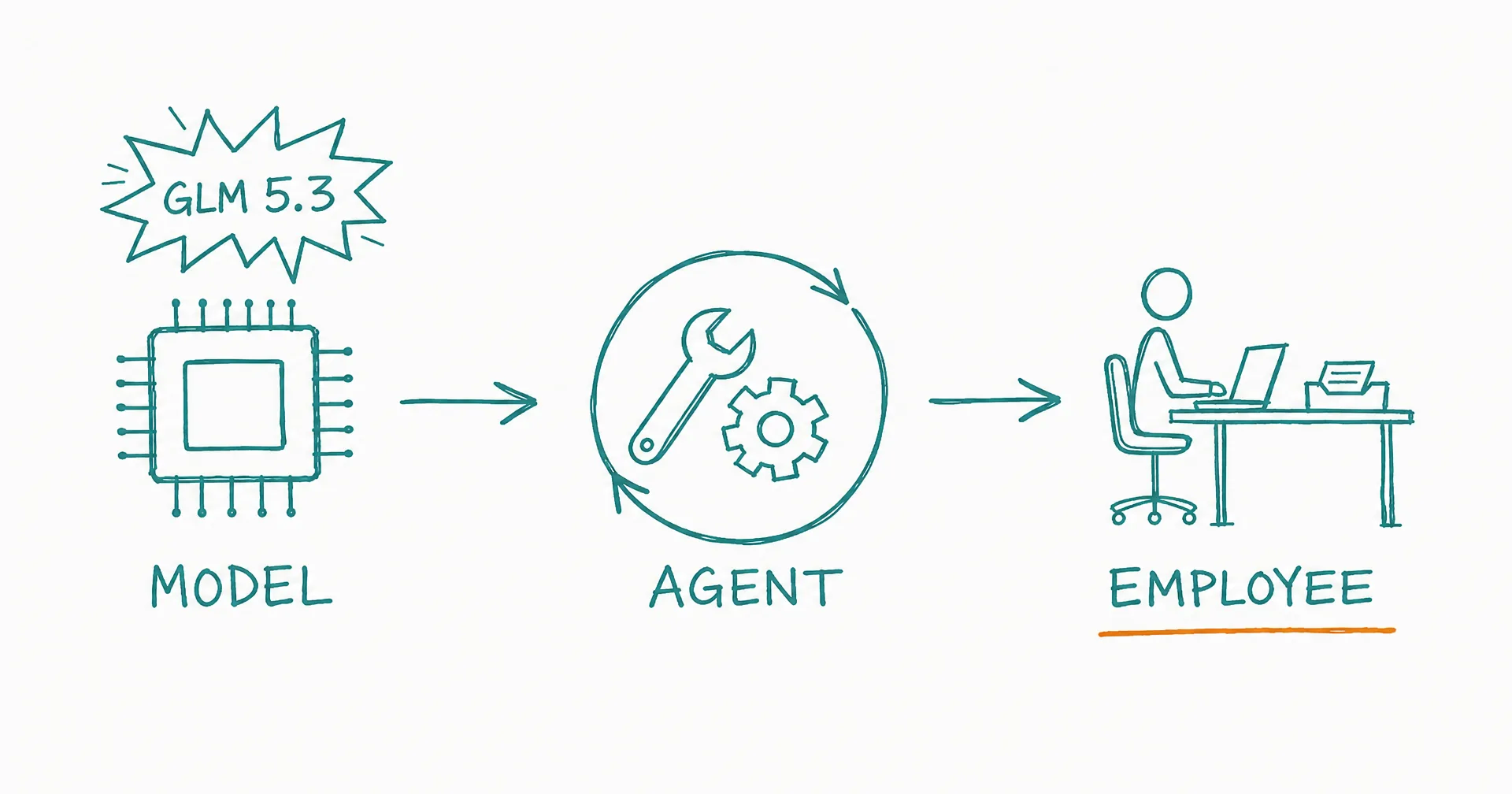
If you build with agents, employ AI employees, or are deciding whether to, here is what actually matters in this release, in three layers: the model, the agents it powers, and the standing workers above them.
Update, August 28, 2026: the weights are out. Z.ai published GLM-5.3 (plus a BF16 variant) on Hugging Face on August 28, right at the end of the stated two-week safety review, under a custom GLM-5.3 License: MIT-style permissions with one condition, that Model-as-a-Service operators above 10 billion dollars in trailing-12-month revenue pass a Z.AI security review before commercial use. API pricing is live too. Details are updated in place below.
- GLM 5.3 launched August 14, 2026: same ~744B MoE base as GLM 5.2, with scaled post-training delivering a claimed 50 percent coding improvement and a 1M-token context.
- The agentic numbers are the story: state-of-the-art open-weight results on Terminal-Bench 3.0 and Agents’ Last Exam (CLI), the benchmarks that measure long-horizon tool use rather than chat.
- Z.ai delayed the open weights roughly two weeks for safety review after the model showed emergent cyber capability, reportedly finding 2,436 real vulnerabilities across 269 open-source projects. Update: the weights landed on Hugging Face August 28.
- A model is not an agent: GLM 5.3’s gains only become useful work through a harness, runtime, or employee platform that gives it tools, memory, and boundaries.
- For teams running standing agents, the launch is a reminder that capability arrives faster than governance; permissions and approvals are what make strong models safe to employ.
- Model-agnostic platforms absorb launches like this automatically; teams wired to a single model inherit a re-evaluation project every launch week.
§ 01The model: post-training is the whole story
GLM 5.3 keeps the ~744B-parameter mixture-of-experts base of GLM 5.2 and changes nothing about the architecture. Every gain comes from scaled post-training, and the gains are aimed precisely: Z.ai claims roughly 50 percent better coding performance on its internal benchmark, state-of-the-art open-weight results on Terminal-Bench 3.0 and Agents’ Last Exam (CLI), and a 1M-token context with up to 128K output tokens.
Note which benchmarks those are. Terminal-Bench and Agents’ Last Exam measure long-horizon tool use: an agent operating a shell, recovering from errors, finishing multi-step jobs. These are agent benchmarks, not chat benchmarks. A model vendor spending its entire post-training budget there tells you where the market has gone.
Availability, updated August 28: live in Z.ai’s coding subscription tiers, the API is live ($1.40 per million input tokens, $4.40 per million output, per Z.ai’s pricing docs and matched on OpenRouter), and the open weights are on Hugging Face under the GLM-5.3 License, a permissive MIT-style grant whose one condition applies only to Model-as-a-Service providers above $10B in trailing-12-month revenue.
§ 02The security subplot agents should not ignore
The reason for the delayed weights is the most consequential detail in the launch. GLM 5.3’s cyber capability came out stronger than expected: 84.5 percent on the CyberGym vulnerability-discovery benchmark per Z.ai, up from 77.2 for GLM 5.2, and in testing the model reportedly found 2,436 real vulnerabilities across 269 open-source projects.
For defenders, that is a gift: code auditing at a scale human review cannot match. For anyone running agents with real access, it is also a plain warning. Models are getting genuinely good at finding the cracks in systems, and agents are how models touch systems. The lesson is not to avoid capable models; it is that capability and authority need to be granted separately. An agent’s power should come from explicit permissions and approvals, scoped by least privilege, not from whatever its model happens to be capable of. Z.ai pausing its own weights release is the model-layer version of that same principle.
§ 03A model is not an agent
It bears repeating in a launch week: GLM 5.3 will not do anything on its own. A model predicts text. An agent is a model wrapped in a loop with tools, memory, and boundaries; that wrapping is what we compared in our August harness rankings, and the difference between an agent and an employee is the subject of its own explainer.
So the practical question for a team is not “should we use GLM 5.3” but “where does a better agentic model actually show up in our stack.” Three honest answers:
- In a coding harness: better long-horizon reliability, fewer abandoned sessions, more finished multi-step jobs. This is where GLM 5.3’s specific gains land hardest.
- In an agent runtime: stronger individual workers to orchestrate, same coordination problems as before. Models do not fix handoffs.
- In an AI employee platform: invisibly, which is the point. The platform evaluates and adopts models; the worker keeps its role, inbox, task board, shifts, and memory. It doesn’t reset, and what it learns in one shift carries into the next, regardless of which engine powered the shift.
§ 04What it means if you run AI employees
The pattern from this launch week generalizes. GLM 5.3 on August 14, the first open-weight Max-class Qwen on August 12 (our full comparison covers both), Grok 4.6 on August 12: three frontier events in seven days. That pace is the new normal, and it quietly changes what you should optimize for.
Teams wired directly to a single model inherit a re-evaluation project every launch week: re-benchmark, re-prompt, re-test, migrate. Teams working at the employee layer inherit an upgrade. When CellCog moved to Fable 5 in July, the employees people had already hired simply started doing better work; nothing about their roles, permissions, or memory changed. That is what model-agnosticism buys: launch weeks become upside instead of homework.
The same routing is user-visible in CellCog’s chat modes: Agent for fast iterative work, Agent Creative for design and creative work, and Agent Team for multi-agent research, each at a Flash, Core, or Max depth tier (Creative starts at Core). A launch like GLM 5.3 lands as a better engine behind a tier you already use, not a new tool to learn. And the harness doing the absorbing has receipts of its own: #1 on Deep Research Bench (July 2026), and users who run the same coding work through both tell us CellCog’s output comes out ahead of Claude Code. Our August harness rankings make that case angle by angle, with the caveats attached.
The uncomfortable half of the same truth: the floor is rising for everyone, including whatever your competitors run. Capability is becoming a commodity that arrives on a schedule. Durable advantage is moving up the stack, to the things that compound: the roles you have defined, the context your workers have accumulated, and the trust you have built through permissions that let them act.
§ 05The honest caveats
Every number above is vendor-published; independent evaluation of GLM 5.3 is still accumulating, and launch-week numbers have a history of softening under third-party testing. The open-weights timeline held: the weights landed on August 28 under the GLM-5.3 License, permissive for nearly every team, with a security-review condition reserved for the largest Model-as-a-Service providers. And if you are evaluating GLM 5.3 for security work specifically, treat the capability with the respect its own maker just showed it: strong enough to pause a release is strong enough to deserve careful scoping in your stack.
Q1What is new in GLM 5.3 compared to GLM 5.2?
The base architecture is unchanged: the same ~744B-parameter mixture-of-experts. The gains come from scaled post-training. Z.ai claims roughly 50 percent better coding performance, state-of-the-art open-weight results on Terminal-Bench 3.0 and Agents’ Last Exam, and a jump on the CyberGym security benchmark from 77.2 to 84.5 percent, all per the August 14, 2026 launch materials.
Q2Why were GLM 5.3's weights not released immediately?
Z.ai held the weights for roughly two weeks of extra safety evaluation because the model’s vulnerability-discovery capability came out unusually strong; in testing it reportedly found 2,436 real vulnerabilities across 269 open-source projects. The hold resolved on schedule: the weights were published on Hugging Face on August 28, 2026.
Q3Is GLM 5.3 better than closed models like GPT-5.6 Sol or Claude Fable 5?
On some published agentic and security benchmarks it leads; on others the closed frontier still wins. The fair statement as of August 2026: GLM 5.3 is the strongest open-weight model on terminal-style agentic benchmarks per its vendor’s numbers, and independent verification is still accumulating.
Q4What is the difference between a model like GLM 5.3 and an AI agent?
A model predicts text; an agent acts. An agent wraps a model in a loop with tools, memory, and permissions so it can do multi-step work. GLM 5.3 raises the ceiling on what the model inside an agent can handle, but the harness, runtime, or employee platform around it still determines what actually gets done, and how safely.
Q5How do AI employee platforms handle new model launches like this?
Model-agnostic platforms evaluate and adopt new frontier models behind the scenes, so the workers people run don’t need re-configuring. On CellCog, employees keep their inbox, task board, shifts, and memory regardless of which frontier model powers a given piece of work; they don’t reset, and what they learn in one shift carries into the next. Launches like GLM 5.3 arrive as quality improvements, not migration projects.