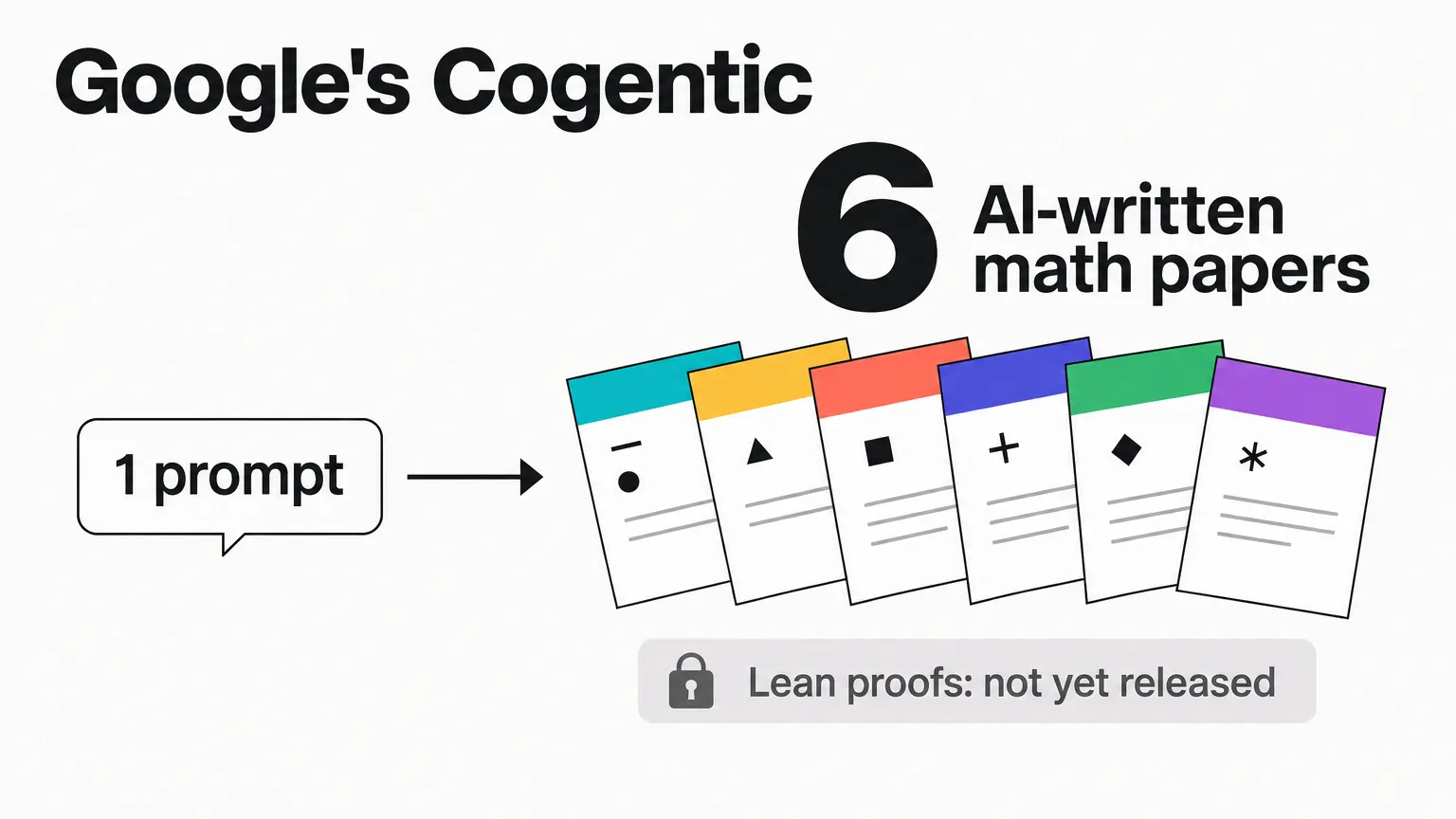
Google Research added six math research papers to its public GitHub repository on November 25, 2026, each written by Cogentic, an agent harness running on Gemini 4. The commit landed at 10:21 UTC with one line that frames the whole release: “These papers were generated by the Cogentic harness. Lean 4 formalizations of all six proofs will be released in a companion submission.”
Every paper’s README makes the same claim about people: “There was no human interaction other than the initial prompt for Cogentic to generate a full proof and formalization.” Google had posted no blog or X announcement when we checked at 14:00 UTC; the story spread through X posts such as @kimmonismus, at about 35,500 views, and @dummerspast39, at about 40,100.
On this page · 6 sectionsOpen
 Google Research added six math papers to its public GitHub repository on November 25, 2026, each written by its Cogentic agent harness on Gemini 4.
 Each paper’s README says there was no human interaction beyond the initial prompt to generate a full proof and formalization.
 The claims span factoring, discrete logarithms, Nash equilibria, the log-rank conjecture and Harary’s edge reconstruction conjecture.
 The headline: an unconditional factoring algorithm in the number field sieve’s L[1/3] class, against the rigorous L[1/2] bound of Lenstra and Pomerance from 1992.
 Lean 4 formalizations of all six proofs are promised in a companion submission and were not public when we read the repository.
 Google had posted no blog or X announcement when we checked; the folder says it is not an official Google product.
§ 01The six papers, claim by claim
| Paper | What it claims | Earlier bound it names | Pages |
|---|---|---|---|
| Integer factorization | Complete factorization of every N in expected time L[1/3, 105], with no unproven hypotheses | Rigorous L[1/2, 1] of Lenstra and Pomerance (1992) | 54 |
| Deterministic factoring | No randomness: a factor of any composite N in exp(3 (ln N)^(3/4)) bit operations; quadratic nonresidues in L[1/2] | Burgess (1957, 1963) for nonresidues | 59 |
| Discrete logarithm | Small-characteristic finite fields in (pn)^o(log n) time | Quasi-polynomial (pn)^Θ(log n) of Kleinjung and Wesolowski (2022) and Lido (2026) | 36 |
| Bimatrix Nash equilibria | Exact polynomial-time 1/5-approximate equilibrium | 1/3 plus delta | 41 |
| Log-rank conjecture | Communication complexity O(r^(1/2 - ε)) with ε = 5 × 10^-6 | O(√r log r) of Lovett (2016), O(√r) of Sudakov and Tomon (2023) | 37 |
| Edge reconstruction | Every simple graph with m ≥ 1000 n edges is edge-reconstructible | m > n log2 n of Müller (1977) | 47 |
The factoring paper carries the headline. It describes its result as “matching the asymptotic exponent of the heuristic General Number Field Sieve”, meaning it proves a running-time bound of the shape the best practical method was only believed to have. The constant is 105, so this is a statement about proof, not a faster way to break encryption.

§ 02What Cogentic is
Cogentic is described in arXiv 2609.40324, dated September 30, 2026, by Yang Cai, Vineet Gupta, Yanchen Jiang, Christopher Liaw, Aranyak Mehta, Grigoris Velegkas and Di Wang of Google Research and Google DeepMind. The abstract describes an orchestrator that spreads independent provers across proof directions, checks their output with adversarial verifiers and keeps confirmed steps in a verified ledger that later rounds build on.
That paper ran on Gemini 3.1 Pro or “an early version of Gemini 4 Argon”, and says of its earlier results: “Each result was independently verified by domain experts”. The folder now lists ten papers: one dated October 30, one November 18, two November 23 and the six of November 25.
§ 03What is checked, and what is not
- The Lean proofs are not public. All six READMEs say a complete Mathlib-only Lean 4 formalization “has also been completed and will be released in a companion submission”. Until it is, nobody outside Google can run it.
- No outside review yet. These are PDFs in a GitHub folder, not refereed papers, and the arXiv paper’s expert-verification line covers earlier results, not these six.
- Not an announcement. Each README ends: “This is not an official Google product.” We found no Google blog post and no post from Google’s research accounts on X.
- Open licence. The papers are CC-BY-4.0; the directory is Apache 2.0.
§ 04Where this sits
This is the third lab in a month to publish AI-written mathematics at scale. OpenAI’s math repository counts hundreds of manuscripts with Lean checks on part of them, and Anthropic published Claude’s VP ≠ VNP paper with a Lean proof. Google’s batch is the smallest of the three and, for now, the only one whose proofs are promised rather than posted.
§ 05Where CellCog stands
Our conflict, declared: CellCog sells AI employees that read and summarize research, and does not route to Gemini 4. We have not checked any of these proofs; this post reports what the papers claim and what is public.
§ 06Sources
- Google Research, cogentic_research_papers on GitHub, and the commit of November 25, 2026, 10:21 UTC, read through the GitHub API
- Each paper’s README and PDF abstract, read through the GitHub API
- Cai et al., Cogentic: Multi-Agent Orchestration for Automated Proof Discovery, arXiv, September 30, 2026
- Posts by @kimmonismus and @dummerspast39, read through the X API at 13:59 UTC
Q1Does this break RSA?
No. The factoring paper proves a running-time bound of the same shape as the best known heuristic method; it does not claim a faster practical attack.
Q2Were humans involved?
Per each README, only the initial prompt. The harness itself was built by seven researchers at Google Research and Google DeepMind.
Q3Are the proofs verified?
Google says complete Lean 4 formalizations exist and will be released in a companion submission. Until they are public, nobody outside can run them.
Q4How does this compare with OpenAI and Anthropic?
OpenAI’s math repository holds hundreds of AI-written manuscripts, and Anthropic published a Claude-written VP vs VNP paper with a Lean proof. Google’s batch is smaller and its Lean files are not out yet.
Q5Can I reuse the papers?
The papers are licensed CC-BY-4.0, per each folder’s README; the rest of the directory is Apache 2.0.