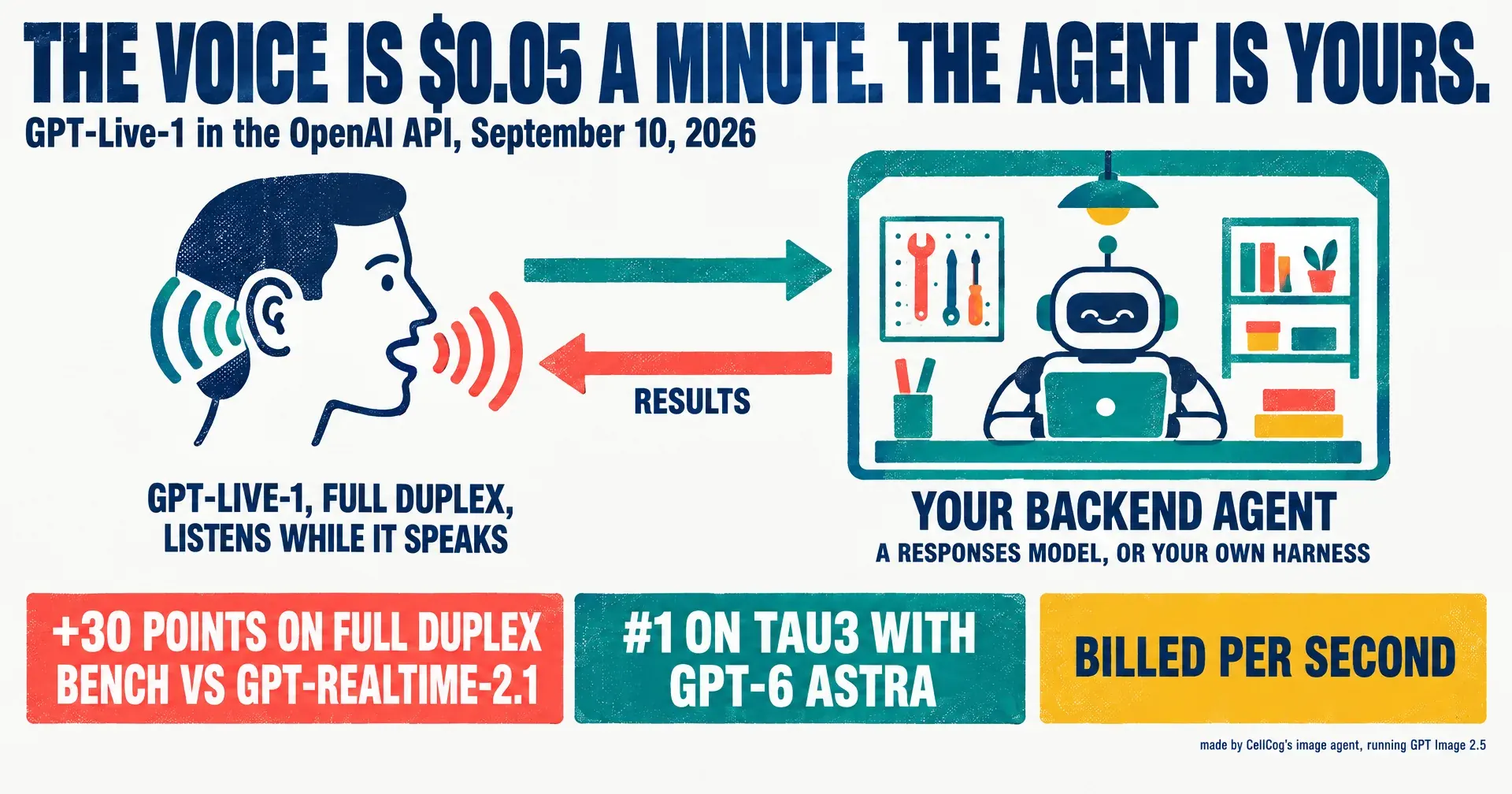
OpenAI released GPT-Live-1 in the API on September 10, 2026. The launch post’s own summary: it “brings ChatGPT’s natural, full-duplex conversations to the API, with more control over how voice agents speak and act.” The model listens and speaks at the same time, and hands anything that needs thinking to a backend you pick.
This page is the record: what shipped, what it costs, how the delegation works, the benchmarks OpenAI published, and what it does and does not replace. Every quotation is from OpenAI’s launch post, the model page or the GPT-Live guides, all read the day of release.
On this page · 10 sectionsOpen
- Update, October 16: voices from a description, and nine new voices
- Update, October 15: GPT-Live-1.1 in ChatGPT
- What shipped
- One model for the conversation, another for the thinking
- The numbers OpenAI published
- Pricing: a clock for the voice, tokens for the thinking
- What it does and does not replace
- Where the agent lives
- What we are watching for
- Sources
 OpenAI released GPT-Live-1 in the API on September 10, 2026. It is a full-duplex voice model, ‘capable of listening and speaking at the same time’, first shipped inside ChatGPT and now sold to developers at $0.05 per minute, billed per second.
 The architecture is the story. GPT-Live-1 only runs the conversation; it ‘can delegate reasoning and tool calls to a backend text model like GPT-6 Astra or a third-party model’, and OpenAI’s docs say plainly that ‘Developers choose the models, tools, and agent harness behind the conversation.’
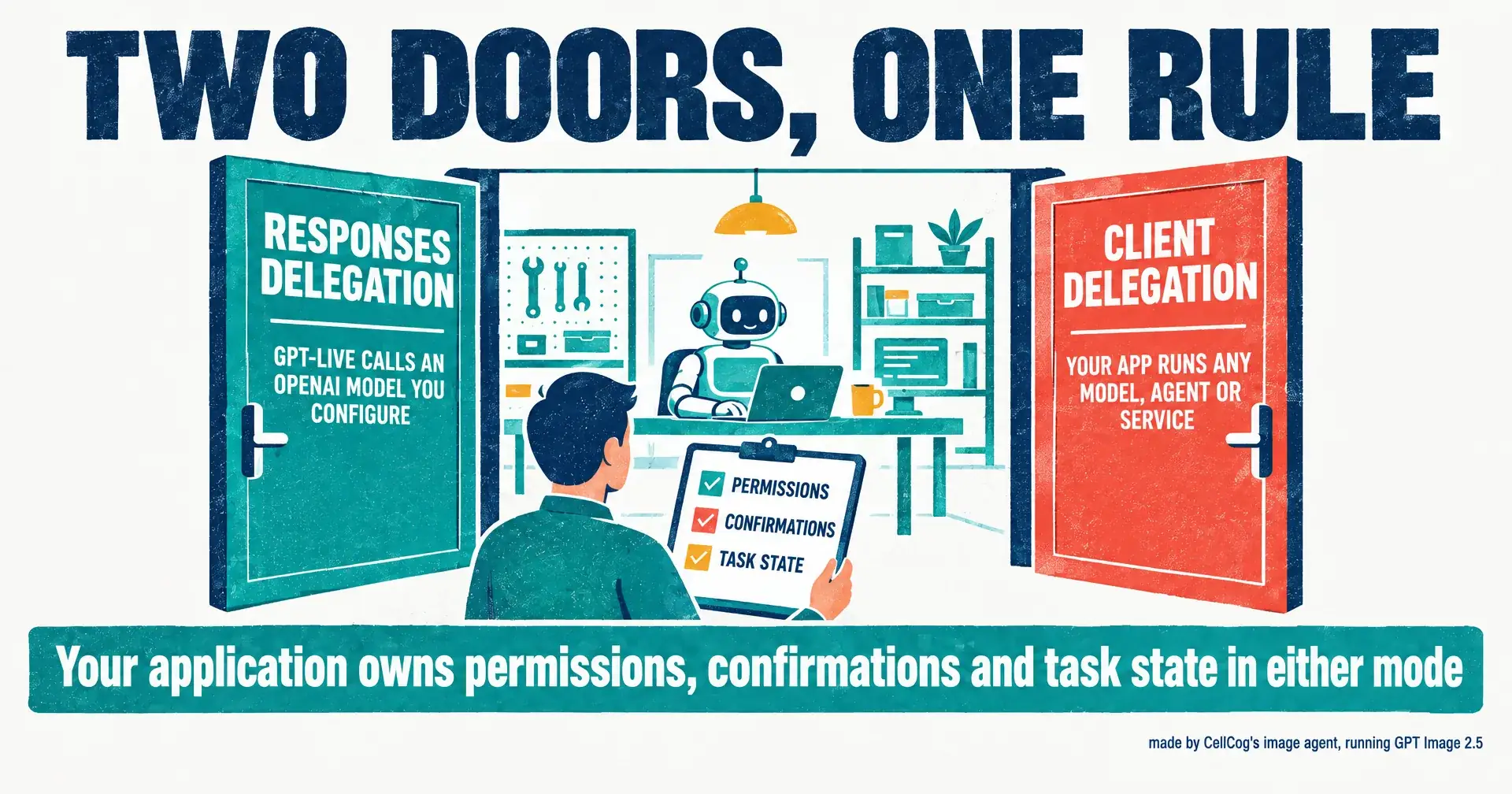
 Two delegation modes: Responses delegation, where GPT-Live calls an OpenAI model you configure, and client delegation, where your application runs any model, agent or service and returns results. In both, ‘Your application owns permissions, confirmations, private function execution, and durable task state.’
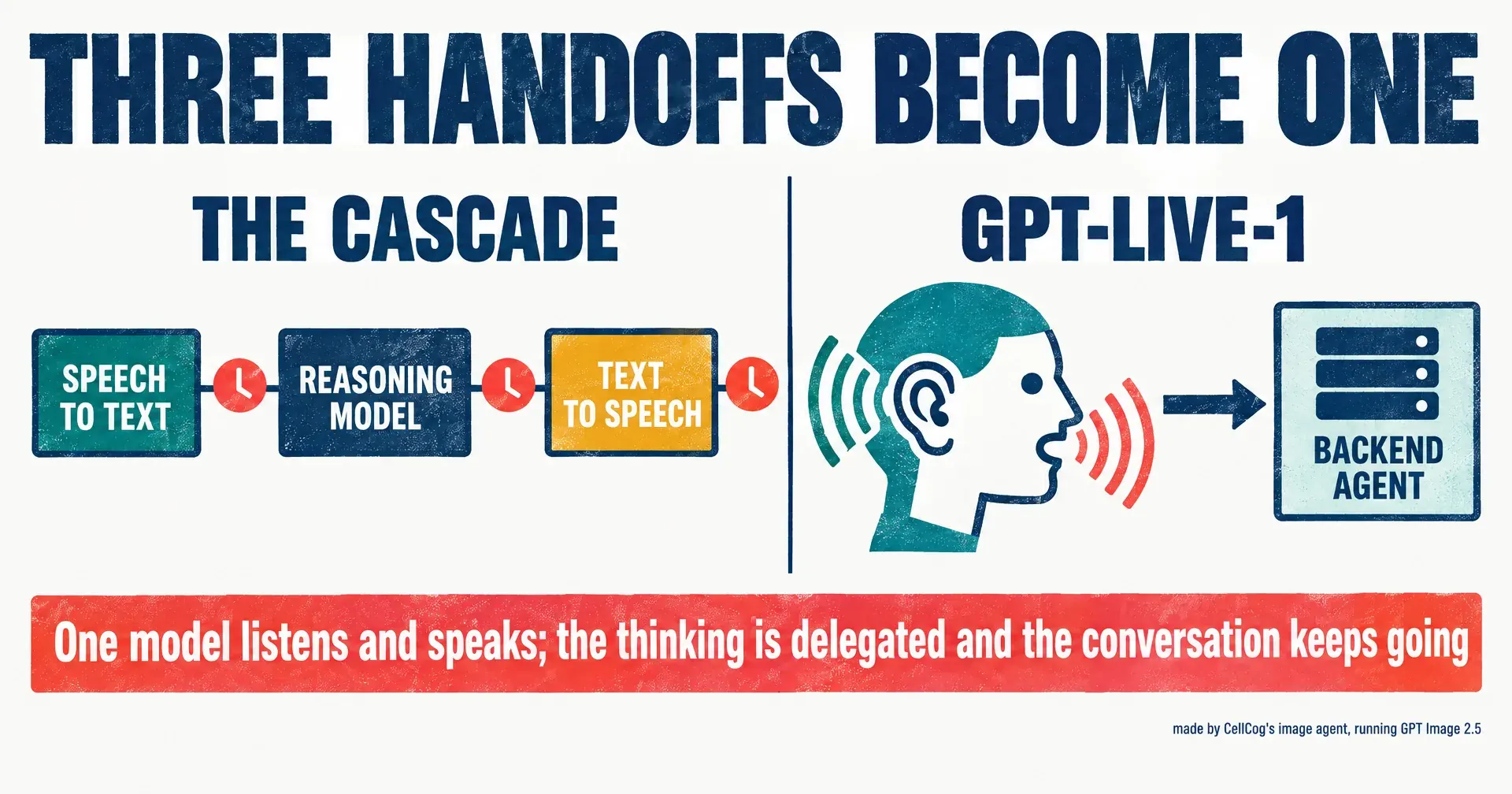
 It replaces the chain. ‘Traditional voice agents stitch together speech-to-text, a reasoning model, and text-to-speech.’ One customer’s CTO says the single model ‘simplified our code base by 80% and removed 23K lines of code’; Speak reports interruptions cut by almost 80 percent versus turn-based systems.
 Benchmarks, all OpenAI’s own: 30 percentage points better than GPT-Realtime-2.1 on Full Duplex Bench, and, paired with GPT-6 Astra at medium reasoning, first on Tau3, ‘which measures frontier voice-agent intelligence on end-to-end tasks’.
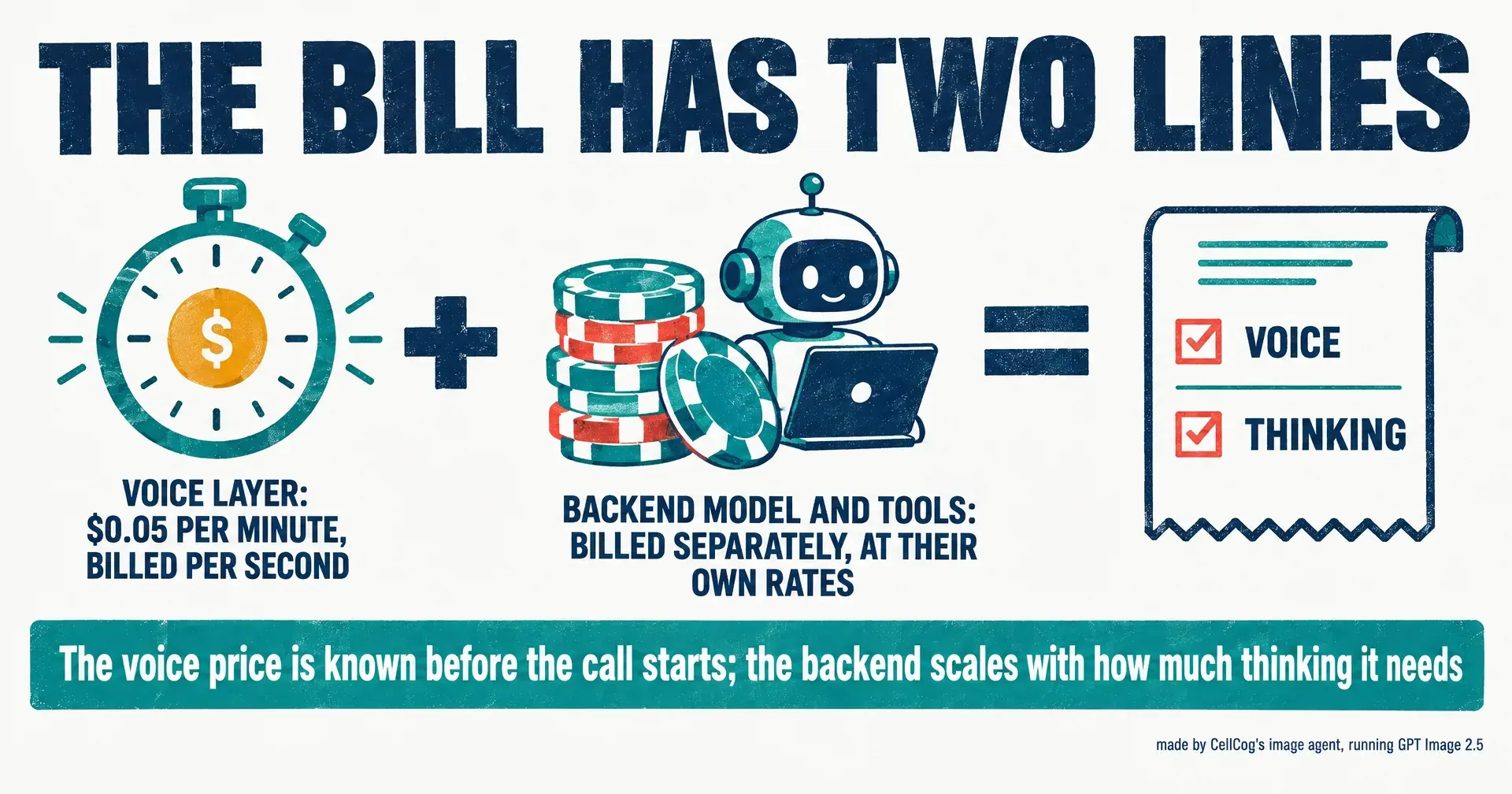
 Pricing changes shape, not just level: the voice layer is a per-second clock while the Realtime models are still sold per audio token, $32 per million in and $64 per million out for gpt-realtime-2.1. Backend model and tool usage is billed separately, at the backend model’s normal rates.
 It is not the Realtime replacement. OpenAI’s deprecations page still routes gpt-realtime to gpt-realtime-2.1 ahead of the January 20, 2027 shutdown, and GPT-Live-1 does not support the v1/realtime endpoint at all; it lives on v1/live/sessions. Twelve new voices ship with it.
§ 01Update, October 16: voices from a description, and nine new voices
OpenAI released prompt-to-voice to all API customers on October 16, 2026. The changelog puts it plainly: “Create a custom voice from a text description through the API or voice Playground, then reuse it in GPT-Live sessions.” You describe the voice in words, and the API saves it under an ID you reuse in any session.
The custom voices guide sets the terms. “You don’t need a reference recording or a consent recording for this workflow.” “Creating a prompt-generated voice is free,” while speech in that voice is billed as a normal GPT-Live session. “You can create up to 100 prompt-generated voices per organization.” Voices cloned from a real person’s recording still need a consent recording and remain limited to eligible customers.
The same day OpenAI added nine natural voices to the GPT-Live voice list, the first outside English and Portuguese:
| Voice | Language | Presentation |
|---|---|---|
| Nuri | German | Feminine |
| Juni | German | Feminine |
| Flitz | German | Masculine |
| Brise | French | Feminine |
| Sillage | French | Masculine |
| Nira | Hindi | Feminine |
| Harema | Japanese | Feminine |
| Shida | Japanese | Masculine |
| Noeul | Korean | Feminine |
For anyone building a voice agent, a custom voice now costs a sentence instead of a recording session, and a session’s voice is still fixed at startup: the guide says to start a new session to change it.
§ 02Update, October 15: GPT-Live-1.1 in ChatGPT
OpenAI rolled out GPT-Live-1.1 on October 15, 2026, alongside GPT-Live-1.1 Quip, which its release notes call “a mini version of the model.” The update brings more natural accents across languages, new voices in French, German, Hindi, Japanese, Korean and Mexican Spanish plus a new English voice, and a wider range of short phrases while Live searches, so fewer repeated “checking” lines. OpenAI’s X post at 18:19 UTC names Voice in ChatGPT, Codex and dots, and ends: “Rolling out today to all users. Coming soon to the API.”
So for developers nothing on this page has changed yet: the API model is still GPT-Live-1 at $0.05 a minute. OpenAI’s ChatGPT Voice help page says Live now runs on GPT-Live-1.1 or 1.1 Quip depending on plan. When 1.1 reaches the API, its model id, price and benchmarks get folded in here.
The same day, the API side did move. OpenAI’s API changelog for October 15 adds native Decisions in GPT-Live: “Your app can act while your user is speaking or react to what Live says.” Decisions is OpenAI’s API for picking from fixed choices, and its guide lists gpt-6-luna as the only supported model.
| Mode | What triggers it | OpenAI’s example |
|---|---|---|
| Native delegation | Live recognizes a request it should hand off and calls Decisions itself | “Make it warmer” raises the cabin from 70°F to 71°F |
| Transcript triggers | Input or output transcript deltas as people speak | A digital person smiles and nods while the user says “I got the job!” |
Until now, Live’s delegation went through your app, which then called a backend. The voice guide puts the change in one line: “Native delegation skips a round trip through your app.” For anyone building a voice agent, that moves simple, fixed-choice steps out of the backend and closer to the conversation, while open-ended work still goes to your own agent.
§ 03What shipped
| Item | Detail |
|---|---|
| Model id | gpt-live-1 |
| Endpoint | v1/live/sessions (Chat Completions, Responses and Realtime endpoints all listed as not supported) |
| Modalities | Audio and text in, audio and text out; image and video not supported |
| Features | Streaming, function calling; no structured outputs, no fine-tuning |
| Knowledge cutoff | July 31, 2025 |
| Price | $0.05 per minute of session, billed per second; backend model and tools billed separately |
| Voices | Twelve new: Quartz, Ripple, Vesper, Willow, Stone, Gleam, Meridian, Bossa, Tempo, Beacon, Delta, Cinder |
| Telephony | Full-duplex agents for phone calls, “from restaurant reservations to customer support” |
§ 04One model for the conversation, another for the thinking
OpenAI’s pitch begins with the architecture it is replacing. “Traditional voice agents stitch together speech-to-text, a reasoning model, and text-to-speech. Each handoff adds latency and creates more opportunities to lose timing, context, or the natural rhythm of a conversation.” GPT-Live-1 collapses the voice half into one model and keeps the thinking half separate: it “can delegate reasoning and tool calls to a backend text model like GPT-6 Astra or a third-party model”, and “This lets the conversation continue while work happens in the background.”
The getting-started guide puts the two parts in one sentence each. GPT-Live “listens, speaks, and decides when to ask the backend for help.” The backend “reasons, uses tools, and returns results for GPT-Live to communicate. Keep detailed instructions, business rules, and tool workflows here.” And on the line that matters for anyone deploying this in a business: “Your application owns permissions, confirmations, private function execution, and durable task state.”
| Responses delegation | Client delegation | |
|---|---|---|
| Who runs the backend | GPT-Live calls the OpenAI Responses model you configure | Your application runs any model, agent harness or service |
| Who prepares context | GPT-Live supplies conversation context | Your application chooses which history, memory and state each request receives |
| When OpenAI recommends it | A configured model and tool loop fits the task | You need to validate, redact or combine results, use another backend, or route between code and models |
| What stays with you either way | Permissions, confirmations, business records, task state | The same |
| Switching | Chosen at session creation; a new session to change | The same |
§ 05The numbers OpenAI published
All of these are OpenAI’s evaluations on OpenAI’s benchmarks; no independent run existed on launch day.
| Claim | Source line |
|---|---|
| Full Duplex Bench | “improves Full Duplex Bench performance by 30 percentage points over GPT-Realtime-2.1, with large gains in turn-taking latency and interactive behavior” |
| Tau3 | Paired with GPT-6 Astra at medium reasoning effort, “ranks #1 on Tau3, which measures frontier voice-agent intelligence on end-to-end tasks” |
| Speak | Learners got more time to think before the tutor answered, “cutting interruptions by almost 80% versus previous turn-based systems” |
| A healthcare customer | GPT-Live-1 “simplified our code base by 80% and removed 23K lines of code”, per its CTO |
| Yelp | Yelp Host and Hatch saw “meaningful improvements in call handling rates” and callers “speaking fuller, more natural sentences” |
§ 06Pricing: a clock for the voice, tokens for the thinking
The voice layer is $0.05 per minute, and the model page is specific: “Session duration is not rounded up to the next whole minute.” Ten minutes of conversation is $0.50 before the backend does anything. The backend is billed at its own rates: “Backend Responses calls use the normal pricing for the configured model and tools.” So the bill has two lines, and the second one is whatever agent you chose.
For contrast, OpenAI’s Realtime models, which put speech, reasoning and tool selection in one model, are still priced per audio token.
| Model | Audio input, per 1M tokens | Cached input | Audio output, per 1M tokens |
|---|---|---|---|
| gpt-realtime-2.1 | $32.00 | $0.40 | $64.00 |
| gpt-realtime-2.1-mini | $10.00 | $0.30 | $20.00 |
The two schemes do not convert cleanly, since a minute of speech is not a fixed number of audio tokens, and we will not pretend otherwise. What is true is that the GPT-Live-1 price is knowable before the call starts, and the backend cost scales with how much thinking the call needs.
§ 07What it does and does not replace
GPT-Live-1 is not listed as a Realtime replacement anywhere in OpenAI’s documentation. The deprecations page, updated July 20, 2026, retires gpt-realtime and gpt-4o-realtime on January 20, 2027 in favor of gpt-realtime-2.1. The getting-started guide draws the design line instead: “You choose the backend model or agent independently of the voice model; Realtime uses one model for speech, reasoning, and tool selection.” A separate transcription lineage is also moving: whisper-1, gpt-4o-transcribe and their siblings shut down February 26, 2027 in favor of gpt-live-transcribe or gpt-transcribe.
| Date | Event |
|---|---|
| July 20, 2026 | Deprecation notice for legacy audio, realtime and transcription models |
| September 10, 2026 | GPT-Live-1 generally available in the API |
| January 20, 2027 | gpt-realtime and gpt-4o-realtime shut down; gpt-realtime-2.1 is the replacement |
| February 26, 2027 | whisper-1 and the gpt-4o-transcribe family shut down; gpt-live-transcribe or gpt-transcribe replace them |
§ 08Where the agent lives
Our conflict, declared: we build CellCog, an AI employee platform. On launch day this paragraph said it had no real-time voice channel; since September 2026 its employees speak: you can talk to one from its chat, and it attends Google Meet and Zoom calls (updated September 16, 2026). Every CellCog tier runs on Claude Opus 5.5 (updated October 15, 2026), which is not a voice model; the voice is a separate layer in front of the employee, the same split this post describes.
What interests us is the split OpenAI just made official. A voice layer priced by the second, with “Developers choose the models, tools, and agent harness behind the conversation” written into the launch post, is OpenAI saying that the conversation and the worker are different things. The worker is where the permissions live, where the task state lives, where the memory of the last call lives, and where the business rules live; OpenAI’s own guide tells you to keep all of that in the backend. That backend is what an AI employee is: the part that remembers, holds the credentials, does the work, and asks before doing anything consequential. The voice on the phone is one more interface to it, next to chat, email and a task board.
§ 09What we are watching for
- Independent benchmarks. Every number above is OpenAI’s own; the first outside Full Duplex Bench or Tau3 run gets folded in here.
- The Agents API. OpenAI published “Introducing the Agents API” the same day; how it pairs with client delegation is its own record.
- Realtime’s future. Any deprecation-page change that names GPT-Live as a Realtime successor flips the “does not replace” line above.
- Decisions pricing and latency. The guides show no per-call price or latency figure for Decisions inside Live yet.
- GPT-Live-1.1 in the API. OpenAI says it is coming soon; we will add the model id, price and any new benchmarks the day it lands.
§ 10Sources
OpenAI, Build more natural voice experiences with GPT-Live-1 in the API, September 10, 2026 (every quotation above is from this post, the GPT-Live 1 model page, the getting started and delegation guides, or the pricing and deprecations pages, all read September 10, 2026). CellCog routing statements reflect our configuration on the same date.
October 15 additions: OpenAI’s API changelog, the Connect voice to Decisions guide and the Decisions guide, read October 16, 2026. - OpenAI, API changelog, October 16 entry, Custom voices guide and Live conversations voice options, read October 16, 2026.
Q1What can the backend be?
With Responses delegation, a supported OpenAI Responses model such as GPT-6 Astra or Luna; OpenAI’s example pairs Luna with high-volume tasks like scheduling and Astra with complex customer issues. With client delegation, anything your application runs: your own model, a third-party model, an agent harness or an external service. The launch post includes a code sample connecting GPT-Live-1 to Codex.
Q2What does the application still have to own?
Permissions, confirmations, private function execution and durable task state, in either mode. The docs also warn that ‘Interrupting speech does not automatically cancel backend work’, so the backend needs its own lifecycle.
Q3How does it connect?
WebRTC for browser apps, WebSockets for server-side audio, sideband connections for backend control, and telephony through partner paths; the launch post names phone calls from restaurant reservations to customer support as a target. Input and output are audio and text; image and video input are not supported, and the knowledge cutoff is July 31, 2025.
Q4Which voices are new?
Twelve: Quartz, Ripple, Vesper, Willow, Stone, Gleam, Meridian, Bossa, Tempo, Beacon, Delta and Cinder, across accents, dialects and languages. Custom voices require contacting sales.
Q5Does CellCog have a voice interface?
Yes, since September 2026. You can talk to an AI employee by voice from its chat, and it attends Google Meet and Zoom meetings as a speaking teammate. The voice is one more interface to the employee, next to chat, email, channels and its task board; the employee itself stays the half of this architecture OpenAI now describes as separate: the agent behind the conversation, with its own memory, permissions and task state. Anything that binds your company still comes from the employee’s judgment and your approvals, never from the voice on its own. The Live Conversations guide in our support docs has the details.