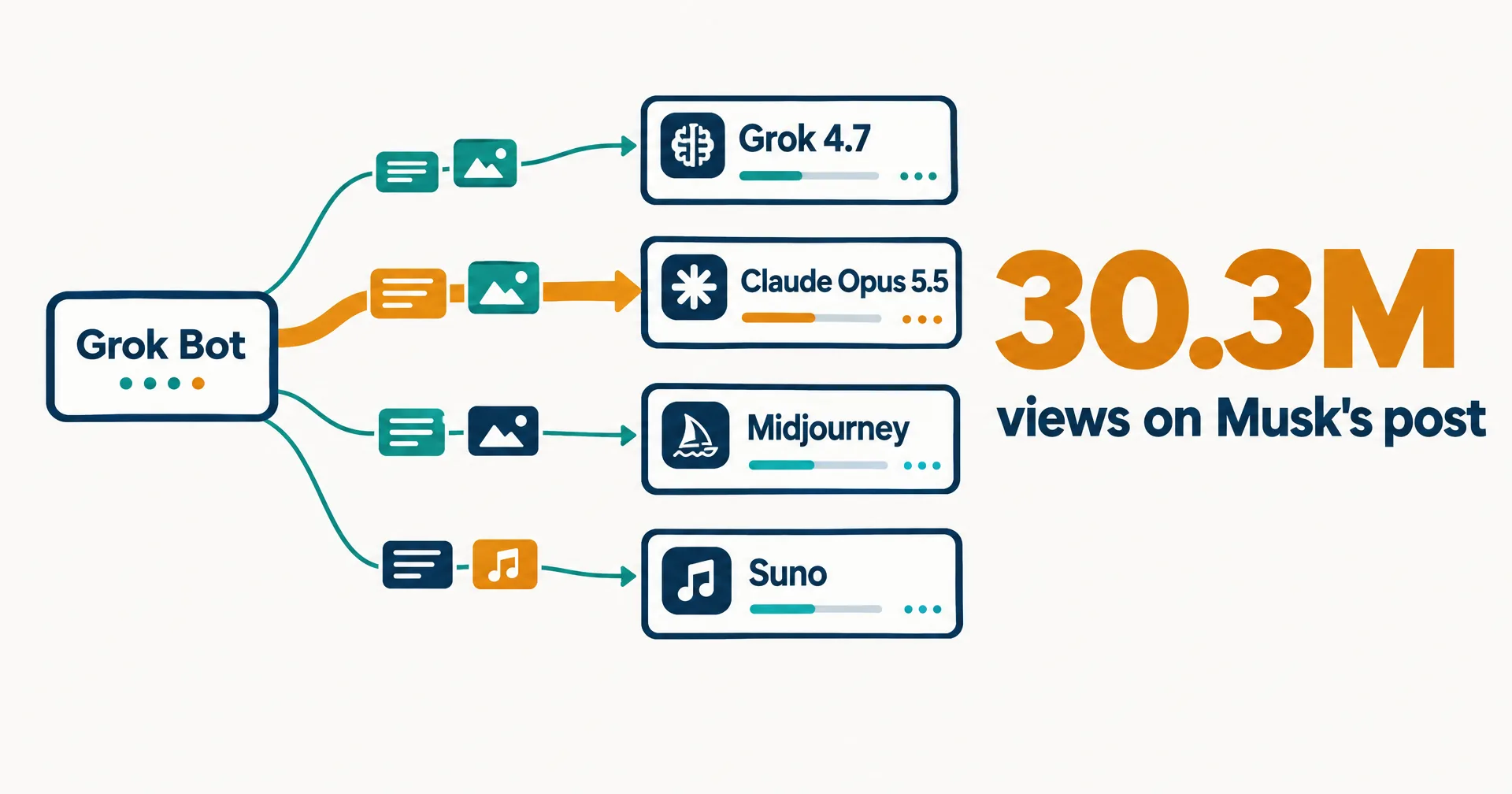
Grok Bot will no longer run only on xAI’s own Grok models. On October 7, 2026, Elon Musk posted that SpaceX “will use the best back end model for any given task” in Grok Bot, and he named Claude Opus 5.5, Midjourney and Suno. The post passed 30 million views within seven hours. This is a routing change, not a new setting. Grok Bot’s own security documentation already says the model is chosen for you. There is no model picker, and billing follows whichever model served the request. This page reads Musk’s post against SpaceXAI’s docs and the published list prices, as of October 7, 2026. A disclosure up front: CellCog builds AI employees, a product in Grok Bot’s category, and our own employees run on Claude Opus 5.5.
On this page · 8 sectionsOpen
 On October 7, 2026, Elon Musk posted that SpaceX will use the best back end model for each Grok Bot task, naming Claude Opus 5.5, Midjourney and Suno; the post passed 30 million views.
 Grok Bot’s docs already said model selection is managed for you: there is no customer-facing model picker and no fixed vendor set is guaranteed.
 Billing follows the serving model, and usage analytics show which model served each request, including failovers.
 At list API prices, Claude Opus 5.5 costs $4 in and $20 out per million tokens, against $2 and $6 for Grok 4.7 with short prompts.
 Enterprise teams can set a model allowlist, but SpaceXAI says enforcement is not guaranteed, and Claude-served tasks add Anthropic to the data path.
§ 01What Musk said
The full post, at 06:46 UTC (2:46 AM ET) on October 7: “Going forward, SpaceX will use the best back end model for any given task, including Claude Opus 5.5, MidJourney, Suno and other leading APIs.” It closes with one more line: “Whatever is most likely to give you the best outcome.”
That is the whole announcement. As of 13:30 UTC there was no SpaceXAI news post and no entry in the Grok Bot changelog, whose latest release was v0.66.0 on October 2 (Main Bot). The post does not say when the routing starts, which tasks go to which vendor, or whether plans change. Midjourney and Suno point at images and music, and Claude Opus 5.5 at reasoning and coding work. Grok 4.7, released September 21 and trained to understand the Grok Bot harness, is not mentioned.
§ 02What the Grok Bot docs already said
Nothing in the post contradicts the documentation. The docs describe a product built for exactly this. Here is each open question against what docs.x.ai says.
| Question | Musk on X, October 7 | Grok Bot docs |
|---|---|---|
| Who picks the model | SpaceX, per task | “Cursor manages model selection.” |
| Which vendors | Claude Opus 5.5, Midjourney, Suno, other leading APIs | “the serving mix can change over time with no fixed vendor set guaranteed” |
| Can you choose | Not addressed | “There is no customer-facing model picker” |
| Can you see which model ran | Not addressed | Usage analytics show the serving model per request, including failovers |
| What you pay | Not addressed | “billing follows the serving model” |
| Enterprise limits | Not addressed | “The team model allowlist is Enterprise only, and enforcement is not guaranteed.” |
Two of those rows matter more now that a second lab is named. The billing row means the model a task lands on can change what it costs. The allowlist row means even an Enterprise team that blocks a vendor has no guarantee the block holds. The security FAQ says onboarding asks admins to acknowledge that Grok Bot may not follow the list.
§ 03What it could cost
Grok Bot plans include weekly usage. Beyond that, per the FAQ, “eligible accounts can add on-demand usage billed from model and token cost.” So the list prices of the two models are the useful comparison.
| Model | Input | Output | Source |
|---|---|---|---|
| Grok 4.7 (prompts under 200k tokens) | $2 | $6 | xAI models |
| Grok 4.7 (prompts over 200k tokens) | $4 | $12 | xAI models |
| Claude Opus 5.5 | $4 | $20 | Anthropic pricing |
At list prices, a task served by Opus 5.5 costs twice as much on input and about 3.3 times as much on output as the same task on Grok 4.7 with a short prompt. Agents write a lot of output while they browse, plan and draft, so output is the line that moves the bill. Two caveats: xAI has not said whether weekly allowances change, and the on-demand rate Grok Bot charges for a Claude-served request is not published. We will update this page when either is.
§ 04Why SpaceXAI would do this
Musk’s last line is the stated reason: the best outcome per task. There is also a working relationship behind it. In May, SpaceXAI signed an agreement to give Anthropic access to its Colossus 1 supercomputer, with Anthropic saying the compute would add capacity for Claude subscribers. And Grok Bot already runs on Cursor accounts and Cursor-hosted computers, so a mixed-vendor serving layer is the existing plumbing, not a new build.
For buyers, the change says something about the category. An always-on agent is judged on whether the job gets done, and even the lab with its own frontier model is now routing work to a rival’s model to get there.
§ 05What it means if you run Grok Bot
- You still cannot choose. The routing is SpaceXAI’s call per task, with no picker.
- Check your usage analytics. They show which model served each request, and that is the only place you will see a switch.
- Review your data path. The security docs say: “If your contract limits which subprocessors can handle your data, contact your account team before rolling out Grok Bot.” A task served by Claude now sends your context to Anthropic as well.
- Watch the meter. If more of your work lands on Opus 5.5, the same week of tasks can use more of your allowance.
§ 06How CellCog handles models
CellCog’s AI employees run on Claude Opus 5.5 at every tier, since September 2026, and we name the model publicly. You pick the operating point: the mode (Agent, Agent Creative, or Agent Team) and the tier (Flash, Core or Max), which sets how much reasoning each task gets. When a better model ships, we move the tiers to it and say so the same day. We did that when Claude Fable 5.1 shipped on September 1, before Opus 5.5 replaced it. Each employee works on its own secure computer with its own file system, logins and the tools its owner assigns.
The trade is real both ways. Grok Bot’s per-task routing can pick an image or music model for media work without you asking. Our approach gives you one stated model and one place to see what it costs.
§ 07What we are watching
- A changelog entry. When the routing actually ships, and which tasks go to which vendor.
- Allowances and on-demand rates. Whether weekly usage or on-demand pricing changes for Claude-served work.
- A model picker. Whether SpaceXAI ever lets users or admins choose, given that the docs say there is none today.
- Grok 4.7’s role. Whether SpaceXAI’s own model stays the default for most Grok Bot work.
§ 08Sources
- Elon Musk on X, October 7, 2026, 06:46 UTC: x.com/elonmusk
- SpaceXAI, Grok Bot security (models and data): docs.x.ai
- SpaceXAI, Grok Bot security FAQ: docs.x.ai
- SpaceXAI, Grok Bot FAQ: docs.x.ai
- SpaceXAI, Grok Bot changelog: x.ai
- SpaceXAI, New Compute Partnership with Anthropic, May 6, 2026: x.ai
- Model prices: xAI models and Anthropic pricing
Q1Does Grok Bot use Claude now?
Elon Musk posted on October 7, 2026 that SpaceX will use the best back end model for each Grok Bot task, including Claude Opus 5.5. As of that day the Grok Bot changelog had no entry for the change, so the start date is not stated.
Q2Can I choose which model Grok Bot uses?
No. SpaceXAI’s security docs say Cursor manages model selection and there is no customer-facing model picker. Enterprise teams can set a model allowlist, but the docs say enforcement is not guaranteed.
Q3Will Grok Bot cost more if it uses Claude Opus 5.5?
It can. The docs say billing follows the serving model. At list API prices Opus 5.5 is $4 input and $20 output per million tokens, versus $2 and $6 for Grok 4.7 with prompts under 200k tokens. SpaceXAI has not said whether weekly allowances change.
Q4How do I see which model ran my Grok Bot task?
Grok Bot’s usage analytics show the model that served each request, including failovers, according to SpaceXAI’s security documentation.
Q5What model does CellCog use?
CellCog’s AI employees run on Claude Opus 5.5 at every tier since September 2026. The owner picks the mode and the tier, which sets how much reasoning each task gets, and the model is named publicly.