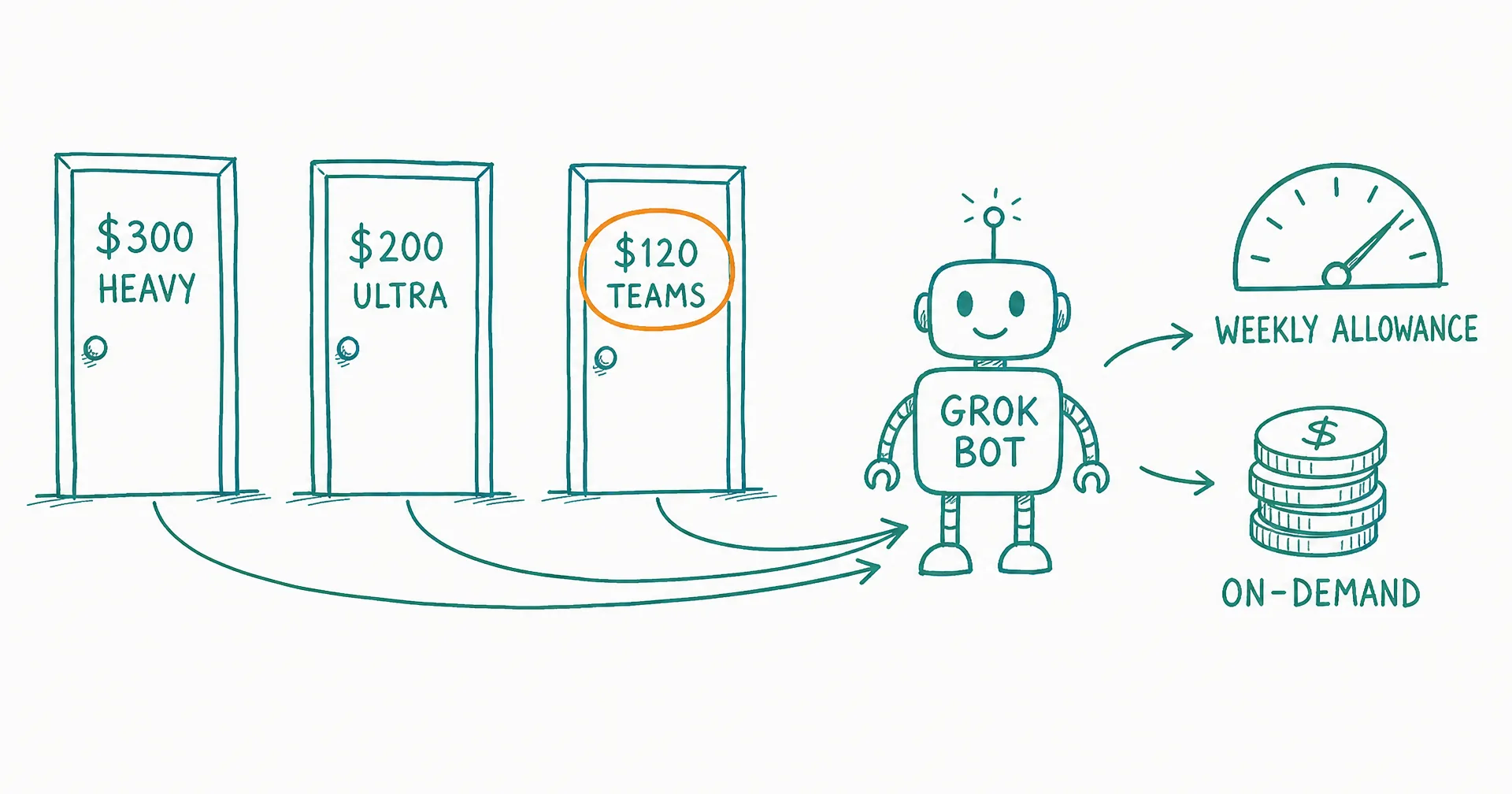
Grok Bot, SpaceXAI’s always-on AI teammates product, launched in early beta on August 11, 2026 with a pricing model that confused a lot of first-day readers: there is no Grok Bot plan. You cannot buy it directly at any price. Access is bundled into existing subscriptions, and sixteen days into the beta, the list of which subscriptions qualify has already changed twice.
This guide lays out the real numbers, first published August 14, 2026 and updated August 27 after SpaceXAI’s second plan expansion: the routes in, what the weekly allowance means, how on-demand billing works, what specific buyers actually end up paying, and how the total compares with other ways of running always-on AI workers.
On this page · 11 sectionsOpen
- The routes in (updated August 27)
- The quiet repricing, and why it matters
- The Ultra entitlement that ended mid-beta
- Allowances and on-demand billing
- What is the cheapest way to get Grok Bot?
- Three worked scenarios
- What you are actually buying
- How the cost compares, honestly
- The rollout gating that surprises teams
- What did the first two weeks show?
- The caveats a buyer should price in
- Grok Bot still has no standalone subscription as of August 26, 2026, but every SuperGrok, Cursor Pro, and Cursor Teams plan now includes it: eight routes, from base Cursor Pro ($20/mo) and base SuperGrok ($30/mo) up to SuperGrok Heavy (~$300/mo).
- The pricing has changed twice since launch: the August 21 expansion was announced only in an X post, while the August 26 expansion to all plans got a proper news post. Users on Cursor’s forum are asking for a pricing changelog.
- Each eligible plan includes a weekly Grok Bot usage allowance; heavier use is billed on demand from model and token costs, and early users report the allowance can go fast under heavy Bot work.
- The underlying models, Grok 4.6 and, since September 21, 2026, Grok 4.7, share one price: $2 per million input tokens and $6 per million output tokens below 200k prompt tokens, doubling above that, which is what on-demand usage is built from.
- The cheapest route is now base Cursor Pro at $20 a month for individuals, or Cursor Teams Standard at $40 per seat for teams; the individual floor has fallen from $200 at launch to $60 on August 21 to $20 on August 26.
- Enterprise access opened September 3, 2026 (activation in the admin dashboard, two free weeks for Grok and Cursor Enterprise customers), with pricing still unpublished; there is no Grok Bot-specific spend cap yet, and Privacy Mode (Legacy) blocks the product entirely.
- Always-on agent products all charge real money at real workloads: bundled subscriptions plus usage for Grok Bot, usage-based pricing (pay for the work, not the hire) for CellCog AI employees, infrastructure plus API costs for self-hosted OpenClaw.
§ 01The routes in (updated August 27)
| Route | Published price | Who it is |
|---|---|---|
| Cursor Pro | $20/mo | The cheapest individual route |
| SuperGrok (base) | $30/mo | SpaceXAI’s base consumer tier |
| Cursor Teams Standard | $40/seat/mo | Self-serve team seats |
| Cursor Pro+ | $60/mo | Mid individual Cursor tier |
| SuperGrok Plus | $100/mo | SpaceXAI’s mid consumer tier |
| Cursor Teams Premium | ~$120/seat/mo | Premium team seats |
| Cursor Ultra | $200/mo | Cursor’s top individual plan |
| SuperGrok Heavy | ~$300/mo | SpaceXAI’s top consumer subscription |
At launch there were three routes: SuperGrok Heavy, Cursor Ultra, and Cursor Teams Premium, which put the individual floor at $200 a month. On August 21 the list grew to six, with Cursor Pro+ at $60 as the new floor, plus a limited-usage free trial for users without any eligible plan (allowance size unpublished). On August 26, SpaceXAI expanded again to every SuperGrok, Cursor Pro, and Cursor Teams plan: eight routes, with base Cursor Pro at $20 and base SuperGrok at $30 now included, and per the announcement the Bot usage pool stays separate from your existing plan usage. We cover the August 26 expansion in detail in Grok Bot on Cursor Pro.
Two details matter beyond the sticker prices. First, sign-in still runs through a Cursor account even for SuperGrok subscribers, and team administration lives in the Cursor dashboard. Second, if you hold both a Cursor and a SuperGrok subscription, the FAQ says Grok Bot draws on whichever has more usage; the two allowances remain separate pools rather than adding together.
Enterprise access opened on September 3, 2026: organizations activate Grok Bot from the admin dashboard, Grok and Cursor Enterprise customers get two free weeks (and can invite people without an existing seat), and the release added access, network, and audit controls. Enterprise pricing remains unpublished; the page routes buyers to sales.
§ 02The quiet repricing, and why it matters
The expansion from three plans to six was announced on August 21, in a post on the Grok Bot X account rather than in the product’s own documentation trail; the further expansion to eight arrived August 26 as a proper news post. The live access page and FAQ carry the current list; and threads on Cursor’s own forum are asking for a pricing and entitlement changelog, because the terms changed after people had already subscribed.
For a buyer, that has two practical consequences. The good one: the individual floor fell from $200 to $60 to $20 within fifteen days, and a team can now cover every seat at $40 instead of $120. The awkward one: any pricing fact about Grok Bot, including the ones on this page, needs a date attached, because the vendor changes the terms without marking them. We re-verify this page against the live pricing page and FAQ; the “as of” dates in each section are literal.
§ 03The Ultra entitlement that ended mid-beta
There is a second pricing change buyers should know about, and it is sharper than the plan expansion. At launch, SuperGrok Heavy came with a documented companion benefit: a $0 Cursor Ultra subscription that stayed active while Heavy renewed. Cursor staff confirmed it on their forum on August 15, quoting the documentation: “The subscription remains active at no charge so long as the SuperGrok Heavy plan is active on renewal.” On August 21 at 18:51 UTC, Cursor staff announced the promotion had ended. Users who had already claimed Ultra keep it; new Heavy links now grant Grok Bot usage only. Cursor’s current documentation says it plainly: “Linking is a usage grant, not a Cursor plan.” A Heavy subscriber with no paid Cursor plan stays on Cursor Free.
The transition was rough on exactly the buyers you would expect. The help page describing the $0 Ultra stayed live past the cutoff, and people who bought Heavy while it was up reported linking successfully, receiving Grok Bot, and never receiving Ultra. Cursor Billing’s written response to one of them owned the stale page (“The help page was behind. That is on us”) but said it could neither provision Ultra nor refund the roughly $300 charge, because xAI billed it; that user’s xAI refund tickets sat unanswered as of August 23. No published cutoff timestamp, no retroactive provisioning, and no compensation program existed as of this update.
For a buyer, the lesson compounds the one above: date every Grok Bot pricing fact, screenshot the page you relied on at purchase, and treat any bundled benefit as valid only while it appears on the live page.
§ 04Allowances and on-demand billing
Every eligible subscription includes a weekly Grok Bot usage allowance. SpaceXAI does not publish the allowance size in units; what it publishes is the mechanism: when you exceed it, eligible accounts can add on-demand usage billed from model and token cost.
The token rates underneath are public. Grok 4.7, the frontier model released September 21, 2026, holds Grok 4.6’s exact price row on the API: $2 per million input tokens and $6 per million output tokens below 200,000 prompt tokens, doubling to $4 and $12 above that threshold. Always-on agents that browse, read files, and operate apps consume tokens continuously, which is why the weekly allowance exists and why heavy users should expect the on-demand meter to matter.
If you want a single planning number: the practical floor for an individual is now $20 a month (Cursor Pro), and the floor for a team is $40 per seat, both down sharply from launch.
§ 05What is the cheapest way to get Grok Bot?
Enough readers arrive at this page asking exactly that question, so here is the direct answer as of August 26, 2026, cheapest first.
- You already pay for any of the eight eligible plans. Your incremental cost is zero. Grok Bot arrives bundled, weekly allowance included.
- You are an individual with no eligible subscription. Cursor Pro at $20 a month is the floor. Base SuperGrok at $30 only makes sense if you also want SpaceXAI’s Grok chatbot for its own sake.
- You are on a Cursor team, or willing to be. Standard seats at $40 per user a month include Grok Bot, so a team no longer needs Premium seats for coverage.
There is still no free tier, no standalone plan, and no Bot-only product at any price. If the subscription gate itself is what sent you here, the honest move is a different product shape, which is what our Grok Bot alternatives comparison covers.
§ 06Three worked scenarios
Sticker prices hide the arithmetic that decides real purchases. Here is what three common buyers actually pay, using only the published prices above.
A solo buyer with no eligible subscription. Cursor Pro at $20 a month is the floor, which is $240 a year before any on-demand usage. Fifteen days earlier, the same buyer’s floor was $200 a month, or $2,400 a year. That 10x gap is the clearest single measure of how fast this pricing moves, in both the buyer’s favor and the planner’s frustration.
An existing Cursor or SuperGrok subscriber. Your incremental cost is zero. Grok Bot arrives as a bundled beta perk on a plan you already pay for, weekly allowance included. The only new line item is token-metered overage if your Bots outrun the allowance. This is the buyer the bundle economics genuinely reward.
A five-person team on Cursor. The seat-mix arithmetic this page walked through at launch is gone. Standard seats at $40 per user now include Grok Bot, so five Standard seats run $200 a month, $2,400 a year, with the weekly allowance on every seat. Under the launch rules, the same coverage required five Premium seats at $600 a month. Teams that upgraded to Premium in week one specifically for Bot access are the buyers with the strongest case for that missing changelog.
As for the overage arithmetic: at the published Grok 4.6 and 4.7 rates, a Bot that consumes 10 million input tokens and 2 million output tokens beyond its allowance in a month adds $32 of on-demand usage. Treat that as an illustration of the rate card, not a prediction. Always-on agents that browse and operate real interfaces vary enormously in token appetite, and the doubled rates above 200k prompt tokens penalize long-context work specifically.
§ 07What you are actually buying
It is worth being precise, because none of the eight routes is a Bot-only product. SuperGrok Plus and Heavy are consumer AI subscriptions whose headline is the Grok chatbot. The Cursor plans are primarily coding subscriptions. Grok Bot rides along with all of them.
That bundling cuts both ways. If you already pay for an eligible plan, Grok Bot is effectively a free beta perk, and that is a genuinely good deal. If you would be subscribing only for the Bots, you are paying for a bundle where much of the value sits in products you may not use, though at $20 the size of that objection shrank considerably.
§ 08How the cost compares, honestly
The always-on agent category prices three different ways as of August 2026, and comparing stickers without mechanisms misleads.
- Grok Bot: subscription gate (now $20 to $300 a month depending on the route) plus weekly allowance plus on-demand token billing. Best value when you already hold an eligible subscription.
- CellCog AI Employees: usage-based from the start. Plans begin at $8 a month with no card required to try it; you pay for the work of an AI employee, not the hire, and the cost depends purely on how much work you assign. The spend buys a standing worker with its own inbox, task board, schedule, and memory, in its own isolated workspace, with server-enforced control over which tools and credentials it can use. The full breakdown lives in our AI employee cost guide.
- Self-hosted frameworks (OpenClaw): the software is free, the running costs are not: typically $5 to 30 a month for a server, $20 to 60 or more in model API usage, and your own operations time.
The honest summary: serious always-on AI work costs real money everywhere. The differences that should drive the decision are the entry gate, the platform coverage, and the architecture, which we compare in depth in Grok Bot vs AI employees.
§ 09The rollout gating that surprises teams
Beyond the price list, three operational facts from Cursor’s team documentation catch buyers during rollout, and none of them appear on a pricing table.
- Privacy Mode (Legacy) blocks Grok Bot entirely. The product requires cloud data storage, so teams on the legacy privacy setting see a block message and a prompt to ask an admin; the setting changes in Team Settings. Standard privacy modes work.
- There is no Grok Bot-specific spend cap yet. Account-level on-demand controls still apply, and per-product spend is visible on the dashboard usage page, but an admin cannot cap Bot spending separately as of August 2026. An audit view of Bot actions is listed as coming.
- Administration is Cursor-native even for SpaceXAI subscribers. Sign-in runs through a Cursor account, and enabling or disabling Grok Bot for an organization happens in the admin dashboard.
For a team piloting the beta, the practical checklist is: confirm the privacy setting, count which seats actually need coverage now that Standard qualifies, and set account-level on-demand controls before the first Bot starts, since that is currently the only brake on usage spend.
§ 10What did the first two weeks show?
This post first ran on day three of the beta. Two weeks in, three patterns from public user reports are worth pricing in.
- The weekly allowance can go fast. One early tester on a Cursor plan reported consuming nearly the entire Grok Bot allocation in under two days of heavy use, while barely touching the plan’s ordinary AI allowance. Always-on agents that browse and operate real interfaces are token-hungry by nature; the allowance is not sized for standing workloads.
- Reliability had a rough patch. Users reported Grok Bot errors around August 19 and 20, and Cursor’s own community forum tracked one such incident. That is normal for an early beta; it matters if you are planning to depend on scheduled routines.
- The terms move without notice. The eligible-plan expansion documented above is the largest example, but users also report entitlement details shifting mid-subscription. As of August 22 there is still no Grok Bot-specific spend cap, and the audit view of Bot actions is still listed as coming.
None of this changes the pricing structure. All of it changes what the allowance and the on-demand meter are worth to a heavy user, which is the number this page exists to make legible.
§ 11The caveats a buyer should price in
Three non-price factors change the value math. Grok Bot is an early beta, with rough edges its own rollout notes acknowledge. It runs on macOS, Windows, iOS 18+ and, since September 2, 2026, Android, with Linux listed in Cursor’s docs by September 9: still no iPad. And all of a user’s Bots share one cloud computer, including logins and browser sessions, which SpaceXAI’s documentation says should not be treated as a security boundary. None of these appear on a pricing table, and all three belong in the decision. For the full picture of what the product is, start with our Grok Bot explainer.
Q1How much does Grok Bot cost per month?
There is no separate Grok Bot fee. As of August 26, 2026 the eligible plans are Cursor Pro at $20 a month, SuperGrok at $30, Cursor Teams Standard at $40 per seat, Cursor Pro+ at $60, SuperGrok Plus at $100, Cursor Teams Premium at about $120 per seat, Cursor Ultra at $200, and SuperGrok Heavy at about $300. Each includes a weekly usage allowance, and heavier use bills on demand from token costs.
Q2What happens when I exceed the weekly allowance?
Eligible accounts can add on-demand usage, billed from the underlying model and token costs. SpaceXAI publishes the same API rates for Grok 4.6 and Grok 4.7 (released September 21, 2026): $2 per million input tokens and $6 per million output tokens below 200k prompt tokens, and double that above, which is the raw material of on-demand pricing.
Q3Can I set a spend cap on Grok Bot usage?
Not yet. Cursor’s team documentation states there is no Grok Bot-specific spend cap as of August 2026: account-level on-demand controls still apply, and per-product spend appears on the dashboard usage page. An audit view of Bot actions is listed as coming.
Q4Is Grok Bot worth it compared to an AI employee platform?
They price different things. Grok Bot charges a subscription gate up front and meters usage weekly, which suits an individual already inside the Grok or Cursor ecosystem. An AI employee platform like CellCog is usage-based from the start: plans from $8 a month; you pay for the work, not the hire, and the cost depends purely on how much work you assign. At serious workloads the totals converge; the entry gates differ sharply.
Q5Can a team get Grok Bot without paying $120 per seat?
Yes, since late August. Cursor Teams Standard seats at $40 per user a month now include Grok Bot with the weekly allowance; Premium seats at about $120 add Cursor’s premium features rather than exclusive Bot access. At launch, Premium seats were the only covered ones, which is worth knowing when reading older guides.
Q6Does Grok Bot pricing include the Grok chatbot?
SuperGrok Plus and SuperGrok Heavy are SpaceXAI’s consumer subscriptions and include its Grok chatbot tiers. The Cursor plans are primarily coding subscriptions that bundle Grok Bot access. In every case you are buying a broader subscription that Grok Bot rides along with, not a Bot-only product.