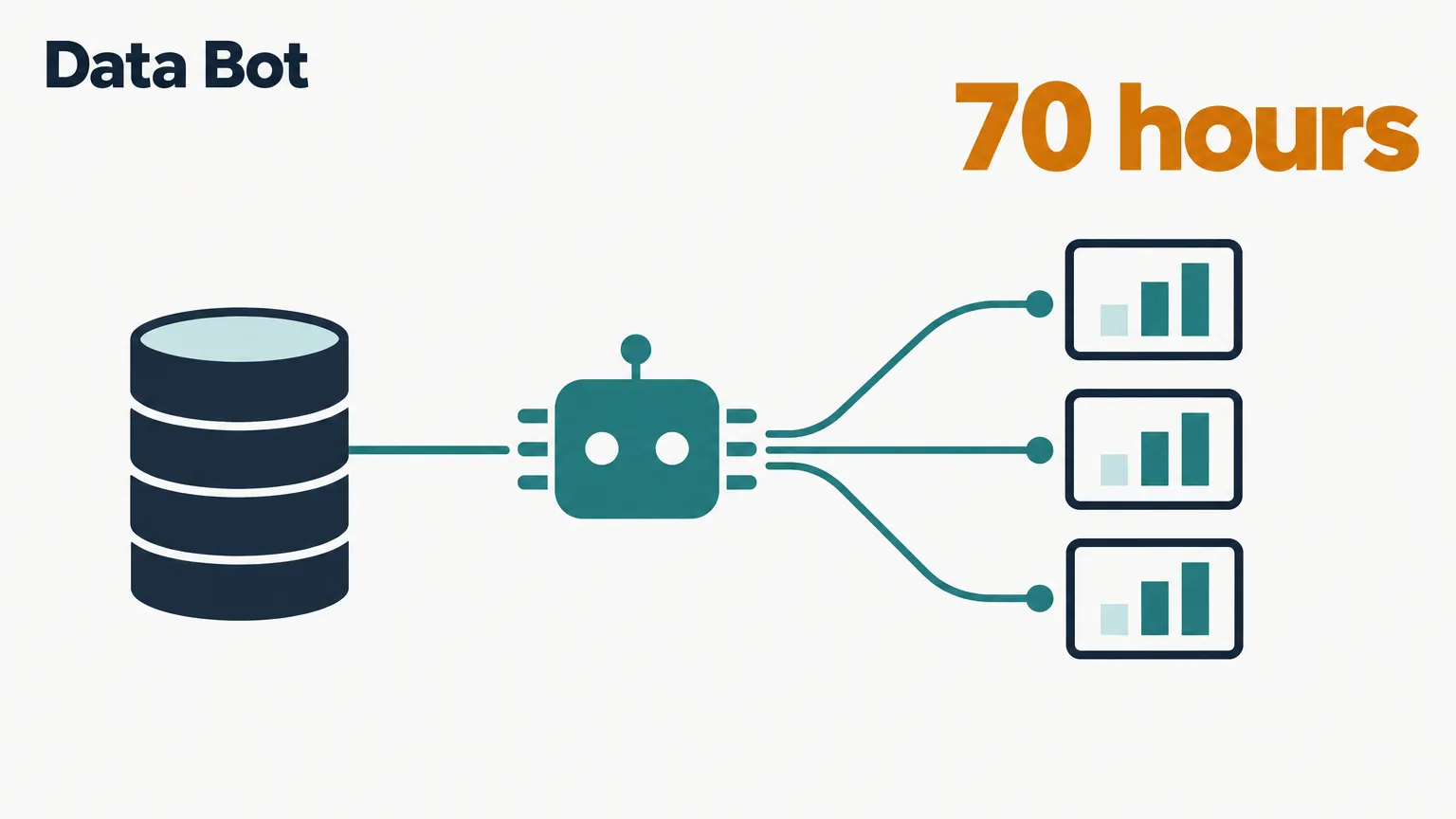
SpaceX Super Intelligence (SpaceXSI), the company behind Grok, published how its own data science team built Data Bot on November 2, 2026. The post’s summary: “Data Bot is a Shared Bot in Grok Bot that the data science team teaches, so every team can query the warehouse, run analyses, and get answers the way a data scientist would.”
The reason is a familiar one. The team writes that “our small team cannot answer every question that arises in a fast-growing company,” so the data team became a bottleneck. Its estimate of the result: “Last week alone, we estimate it handled about 70 hours of work that would otherwise have landed on the data science team.”
On this page · 7 sectionsOpen
 SpaceXSI published Data Bot on November 2, 2026, a Shared Bot in Grok Bot that its data science team teaches.
 Unlike a personal bot, it answers from a shared set of skills the data team maintains for everyone.
 Its shared memory grows from use, but managers approve or reject each proposed addition first.
 Product, marketing and revenue teams use it for questions, campaign readouts and weekly reports, including in Slack.
 SpaceXSI estimates it took on about 70 hours of the data team’s work in one week; the post gives no method or accuracy figure.
§ 01How a Shared Bot differs

The post draws the line itself: “Unlike personal bots, which depend on what their owners know to teach them, Data Bot draws on a shared set of skills that our data team maintains and improves for everyone.” The data team stops answering each question and instead maintains the skills the bot answers from.
Data Bot also keeps a shared memory, and that memory has a gate. It might learn who owns a pipeline, or that a past drop in a metric was a regional holiday. Before that becomes shared knowledge, the post says, “As the Team Bot’s managers, we can review these proposed additions to its memory and approve or reject them before Data Bot shares that knowledge with everyone who uses it.”
§ 02What the data team taught it
The skills fall into four areas, per the post.
| Area | What the skills cover |
|---|---|
| Metrics and analysis | Core metrics such as active users and revenue, their source tables and query logic, and how to break down a spike or drop |
| Experiments | A/B test setup, power analyses, exposure balance and sample bias, rollouts and readouts |
| Charts and dashboards | Chart conventions, team themes and style guides, and turning a chart into a Databricks or Hex dashboard |
| Data engineering | Writing and reviewing dbt models, pipeline alert conventions, and event logging for new features |
§ 03Who uses it, and for what
The post names uses across three teams, plus a fourth way in through Slack.
| Who | What they ask it for |
|---|---|
| A product manager | Questions about how people use the product, answered in minutes with a headline and a chart |
| Lifecycle marketing | What email recipients did after a Braze campaign, such as how many switched plans |
| Revenue growth | How events feed pipeline, weekly progress against targets, and charts for presentations |
| Any team in Slack | Scheduled weekly metric updates, plus follow-up questions in the channel |
The product manager in the post describes it as having “a data scientist in his pocket.” The marketing case is the clearest example of a gap it fills: the email tool’s own conversion metric could not say how many recipients changed plans, so Data Bot went to the warehouse.
The post is also plain about the limit: “We still handle complex analyses that require more judgment.” The data team keeps the hard calls and spends more of its time improving the bot’s skills.
§ 04What the post does not say
- How the 70 hours were counted. It is an estimate of work avoided in one week, with no method given.
- Accuracy. There is no error rate or review rate for Data Bot’s answers.
- Access. The post does not say which data each user can query through the bot, or how permissions are set.
- Availability. Data Bot is SpaceXSI’s internal build on Grok Bot’s Shared Bots, not a separate product; the post links to Grok Bot itself.
§ 05What this means if you want a data analyst you can share
Our position, declared: we build CellCog, and Grok Bot competes with our AI employees. Read our take with that in mind.
The useful part of the post is its design, and we agree with most of it. Expertise lives in skills a team keeps up to date, not in one person’s prompts. Memory grows from real use, but a person approves what becomes shared. And the bot reports into the channels where the team already works. That is close to how we think about AI employees: a standing worker that owns a role, keeps memory and works in team channels, with its owner approving what goes out.
Where the two differ is the unit. Data Bot is a bot a team teaches inside Grok Bot. On CellCog, an AI data analyst is an employee with its own secure computer, file system and browser identity, its own inbox and task board, and a person who owns its work. For pricing on the other side, see our Grok Bot pricing breakdown.
§ 06What we are watching
- Shared Bots for customers. Whether more companies publish Shared Bot builds like this one, with numbers.
- The 70 hours, measured. Whether SpaceXSI reports how it counts work avoided over more than one week.
- Memory controls. How the approve-or-reject step for shared memory works for teams outside SpaceXSI.
§ 07Sources
- SpaceXSI: Giving every team a data scientist with Grok Bot, by Sally Xu, November 2, 2026, read the same day.
- Tools named in the post: Databricks, Hex, dbt and Braze.
Q1Who built Data Bot?
SpaceXSI’s data science team, for internal use, on Grok Bot’s Shared Bots. The post is by Sally Xu, dated November 2, 2026.
Q2What can Data Bot do?
Query the data warehouse, investigate metric changes, analyze experiments, make charts and Databricks or Hex dashboards, and post scheduled updates in Slack.
Q3How does Data Bot learn?
From skills the data team writes and from a shared memory built through use; managers review each proposed memory addition before it is shared.
Q4Is Data Bot a product I can buy?
No. It is SpaceXSI’s own build on Grok Bot. Teams would build a similar Shared Bot themselves.
Q5What does the post not say?
How the 70 hours were counted, how accurate the answers are, and how data permissions work for people asking through the bot.