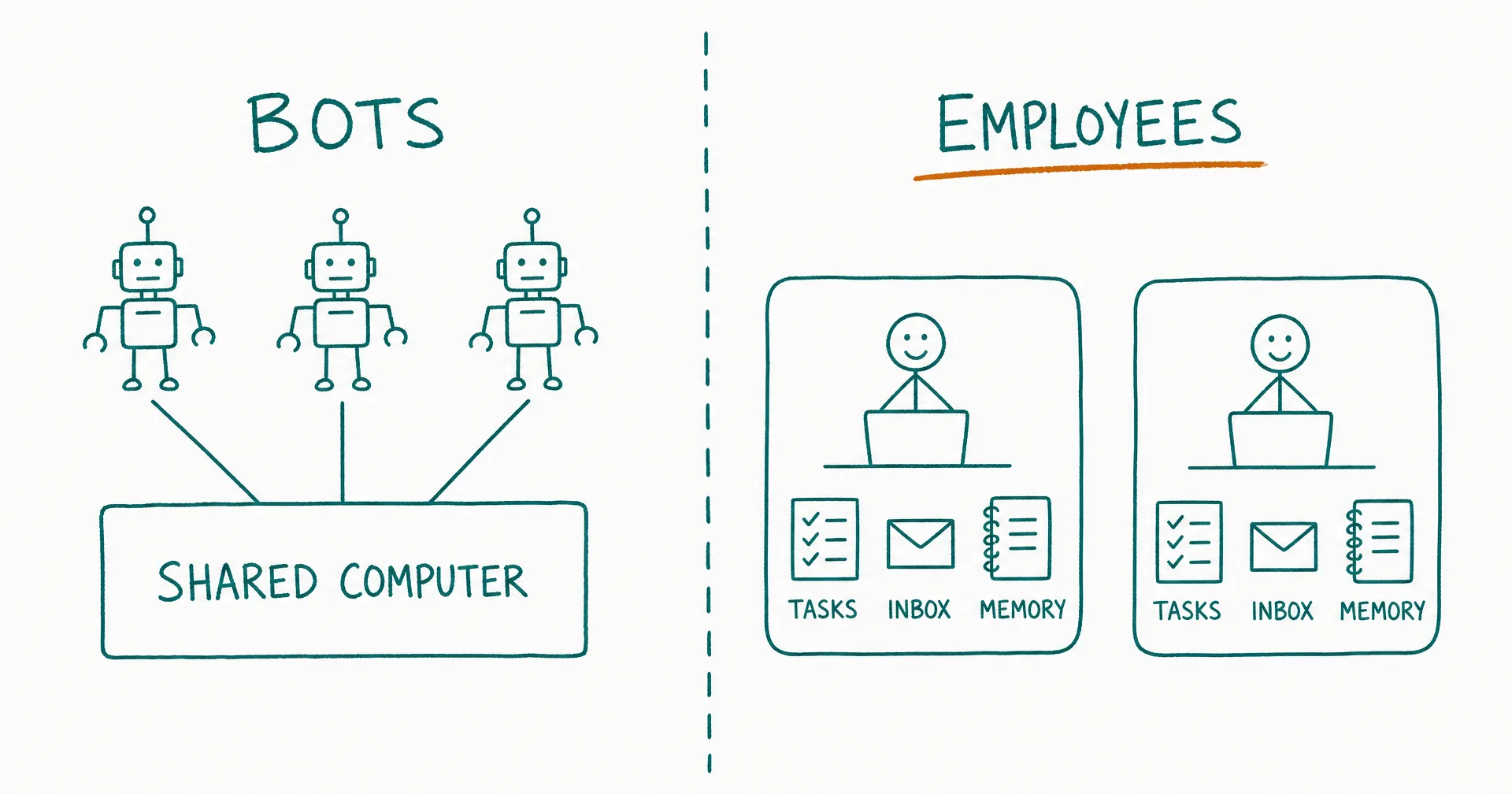
On August 11, 2026, SpaceXAI launched Grok Bot: always-on AI teammates that work on a persistent cloud computer, sign into your tools, and finish jobs end to end. If that sounds like an AI employee, that is the point. The largest AI lab building consumer agents just aimed directly at the standing-worker model.
This comparison takes both products seriously. Grok Bot is a genuinely strong v1, and pretending otherwise would make this page useless. The interesting question is not which one is “better” but where the architectures diverge, because the divergence decides which fits your situation.
The short version: Grok Bot gives one person a team of pooled agents on a shared computer. An AI employee gives a business a standing worker with a role, isolation, memory architecture, and an accountability trail. Everything below is the detail behind that sentence, sourced from SpaceXAI’s own launch post and documentation, first written August 14, 2026 and re-verified against the live docs on August 22.
On this page · 7 sectionsOpen
- Grok Bot (SpaceXAI, beta since August 11, 2026) and AI employee platforms are converging on the same idea: persistent, named AI workers you delegate real work to.
- Grok Bot’s architecture pools all of a user’s Bots on one shared cloud computer with shared logins; SpaceXAI’s docs say separate Bots should not be treated as a security boundary.
- An AI employee holds a standing role with per-worker isolation: its own workspace, inbox, task board, schedule, and approval thresholds.
- Memory is the sharpest contrast: Grok Bot’s docs advise re-checking sources rather than relying on Bot memory, while employee platforms treat structured memory and handovers as the core architecture.
- Grok Bot access is bundled into Cursor and SuperGrok subscriptions, from $20 a month after two late-August plan expansions; CellCog plans start at $8 a month; you pay for the work, not the hire, and the cost depends purely on how much work you assign.
- Pick Grok Bot for a personal team of always-on agents inside the Cursor and Grok ecosystem; pick an AI employee when a business role needs an accountable, continuous owner.
§ 01What Grok Bot is, in one paragraph
A Bot is a persistent, named agent you message like a colleague. All of your Bots share one cloud computer (a managed Linux VM with a browser, filesystem, and terminal), each on its own screen, so they can work in parallel and hand off to each other. They act through connectors and computer use, return for approvals on consequential actions, and can learn routines by watching you do a task once. Access is bundled into Cursor and SuperGrok subscriptions, from base Cursor Pro at $20 a month since August 26. The full breakdown is in our Grok Bot explainer.
§ 02The five-part employee test, applied
Our working definition of an AI employee uses five tests: a defined role, continuity across runs, initiative through triggers, agency in real tools, and accountability. Here is how each model scores.
| Test | Grok Bot | AI employee |
|---|---|---|
| Role | Named Bot with one primary job and a working style description | Standing role with scope, KPIs, and a task board the owner reviews |
| Continuity | Preferences, role context, and summaries; vendor advises re-checking sources | Structured memory and written handovers; work state carries run to run |
| Initiative | Routines re-run on a schedule or on demand | Schedules, routines, wake triggers, and recurring tasks |
| Agency | Shared cloud computer, connectors, computer use, approval cards | Own workspace and tools, permission tiers, approval thresholds |
| Accountability | Approval cards and chat threads | Task board, daily reports, dashboards, and its own email inbox |
Grok Bot scores well on agency and initiative, respectably on role, and weakest on continuity and accountability. That pattern is not an accident; it follows from two architectural choices.
The role column got its best evidence on September 4, 2026, when SpaceXAI published the system prompt of its own procurement Bot: the systems it may read, a named operator who makes all final decisions, and permission lines that separate what it may always do from what needs an explicit go and what it must never do. That is a job description, and it moves Grok Bot up the role test. What it does not add is the accountability structure: the operator reads findings in a thread, and the Bot’s standing report to a business is whatever the operator asks for. The two architectural choices below are the ones that still separate the models.
§ 03Memory: advisory vs architecture
SpaceXAI’s FAQ contains one of the most honest sentences in any agent product’s documentation: “For important decisions, ask the Bot to check the current source rather than relying on memory.” That is good advice, and it tells you memory is a convenience layer in this design, useful for preferences and style, not trusted for state.
The employee model inverts this. On CellCog, memory is the product’s spine: durable notes, per-role knowledge, and written handovers that let the next session pick up as the same worker. Employees do not reset; what they learn one day carries into the next, so they get better at your business every week. Continuity is what turns an agent into a colleague, and it has to be architecture, not recollection.
§ 04Isolation: one shared computer vs a workspace per worker
Grok Bot pools everything. Files, browser sessions, and app logins belong to the account, not to a Bot, and SpaceXAI states the consequence plainly: “Do not use separate Bots as a security boundary.” That design buys cheap handoffs between Bots, and it means every credential you place on the computer is reachable by every Bot you create. In security terms, the blast radius of any single Bot’s mistake is the entire credential pool.
An AI employee runs the other way: each worker gets its own isolated workspace, its own email identity, and its own permission and approval thresholds. You can give the bookkeeper access the marketer never sees, the least-privilege model a business would demand of human staff. For a single power user automating personal workflows, pooling is a fair trade. For a business handing real system access to multiple AI workers, per-worker isolation is usually the requirement that decides the evaluation.
§ 05Teams: parallel bots vs an organization
Grok Bot’s team story is real and clever: Bots message each other, share threads, and pass ownership, and SpaceXAI describes users running a chief-of-staff Bot over specialists. It is a team the way browser tabs are a team: parallel lanes for one person’s work.
The employee model extends this into an organization. CellCog employees form teams, onboard and manage each other: they delegate across task boards, report to managers, and hold reporting lines a human can read on an org chart. CellCog’s own Sales Lead started solo and now manages five outbound reps. Whether you need that depends entirely on whether you are automating your own workflows or staffing roles in a business. Both are legitimate; they are different products.
§ 06Cost and access, honestly
As of August 26, 2026, Grok Bot has no standalone price, but the entry has dropped twice: every SuperGrok, Cursor Pro, and Cursor Teams plan now includes it, from base Cursor Pro ($20 a month) and base SuperGrok ($30) through Cursor Teams Standard ($40 per seat) up to SuperGrok Heavy (about $300), each including a weekly usage allowance with on-demand token billing beyond it. The first expansion arrived without a dated announcement; the second got a proper news post. Enterprise access opened on September 3, 2026 with pricing still unpublished, and there is no Linux or iPad support (an Android app arrived on September 2, 2026).
CellCog is self-serve with no waitlist: plans start at $8 a month with no card required to try it. You pay for the work, not the hire, and from there the cost depends purely on how much work you assign. An employee’s output spans research, code, dashboards, spreadsheets, PDFs, video, and images, so the spend buys deliverables rather than a seat.
Neither product is the cheap option at serious usage. The real difference is the entry gate: Grok Bot asks for a subscription bundle before the first task, and its plan list already moved once, without a dated announcement, in the product’s first two weeks; an employee platform lets you start small and scale spend with the work.
Week two added a field note to the serious-usage half of that sentence: early users report the weekly Bot allowance can disappear in a couple of days of heavy use, and there is still no Bot-specific spend cap as of August 22, so the on-demand meter is the number a heavy user actually lives with. The numbers stay current in our Grok Bot pricing guide.
§ 07Which one fits you
Pick Grok Bot if you are one person with premium Grok or Cursor access who wants a team of always-on agents for your own workflows, you work on macOS, Windows, iOS, or Android, and you are comfortable with the shared-computer model. It is the strongest personal-agent product a major lab has shipped, and the demonstration-learned routines are genuinely useful.
Pick an AI employee if a business role needs a continuous, accountable owner: a worker with its own inbox, task board, schedule, and memory, isolated from its coworkers, that you can hire in minutes and review like a hire. That is the model CellCog has been building on Cellular Multi-Agents since October 2025. The AI employees hub shows the roles you can hire today.
The bigger story is the convergence itself. When the loudest lab in consumer AI ships persistent, named, role-shaped workers, the question stops being whether AI takes on standing work, and becomes which operating model you trust it with.
Q1Is Grok Bot an AI employee?
It is the closest thing a general AI lab has shipped. Bots are persistent, named, and role-shaped, with approvals and routines. It stops short of the full employee model: there is no task board, KPI ownership, or standing report, memory is advisory by the vendor’s own guidance, and all Bots share one computer rather than having isolated workspaces.
Q2Do Grok Bots have their own memory?
Partially. Each Bot keeps its own conversation, learned role, and summaries, while files, browser sessions, and logins are shared across all Bots on the account. SpaceXAI’s documentation recommends asking a Bot to check the current source for important decisions rather than relying on its memory.
Q3Can Grok Bots work as a team?
Yes, within one account: Bots can message each other, share context in threads, and pass ownership of tasks, and SpaceXAI describes a chief-of-staff pattern with one Bot managing specialists. Organizational structure across people and roles, such as teams, reporting lines, and manager reviews, is the layer employee platforms add.
Q4Is Grok Bot cheaper than an AI employee?
For light use inside an eligible subscription, often yes: access is bundled into plans from $20 a month (teams from $40 a seat) as of late August 2026 with weekly allowances, plus on-demand token billing beyond them. CellCog entry plans start at $8 a month; you pay for the work, not the hire, and the cost depends purely on how much work you assign. Comparable workloads land in a similar band; the difference is what the spend buys.
Q5Which is better for research-heavy work?
The closest public signal is DeepResearch Bench (July 2026, GPT-5.5 judge), where CellCog Max ranked #1 with a score of 55.78 and Grok Deeper Search, SpaceXAI’s research product, scored 41.22. Grok Bot itself is not benchmarked there, so treat this as a read on each stack’s research depth rather than a verdict on the Bot product.