humans& released Ampersand v0.1 on October 20, 2026: a model trained to sit inside a group of people and decide, message by message, whether to speak or stay quiet. The launch post calls it “the first model trained for people to achieve more together.” It is built on Z.ai’s open-weight GLM 5.3 and is available now through the humans& Agents API, with no waitlist.
The lab announced it on X at 22:37 UTC with its strongest claim: “In multi-month simulations, users collaborating with Ampersand accomplished more than with Fable”. Those simulations are humans&’s own, run on its own user model. This page reads the launch post, the model card and the pricing page directly.
On this page · 6 sectionsOpen
 humans& released Ampersand v0.1 on October 20, 2026, a model trained to work inside a group of people rather than answer one person.
 It is built on Z.ai’s open-weight GLM 5.3 (about 744B parameters, about 40B active) and sold through an API at $1.00 per million input tokens and $5.20 per million output tokens.
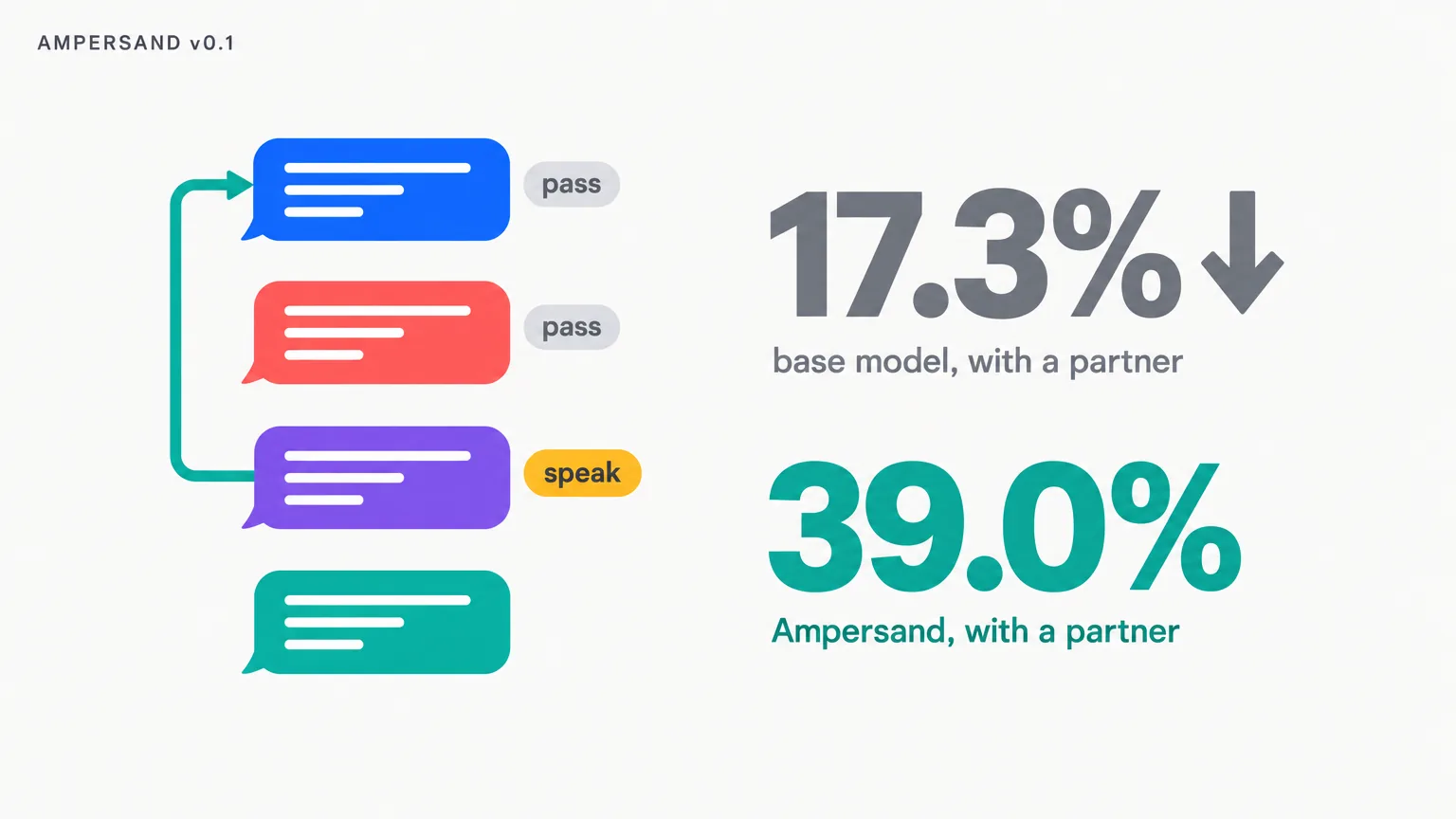
 On CooperBench, GLM 5.3 falls from 52.5% alone to 17.3% with a partner; Ampersand reaches 39.0% with a partner, about 2.25 times the base model.
 In humans&’s own test, Ampersand was the least likely of nine models to report that it thought it was being evaluated, at -6.5 points against real conversations.
 humans& published the weak spots too: cybersecurity knowledge rose from 80.6% to 89.0% on WMDP and prompt injection succeeds far more often than on frontier models.
§ 01What Ampersand does
Most chat models answer whoever spoke last. Ampersand gets two tools, send_message and pass, and after every message it calls one of them. In the launch post’s own replay, Sam says he is out Friday and Ampersand passes; Alex wishes him a good trip and it passes again. When Maya then proposes a Friday rehearsal with all three of them, Ampersand flags the clash with Sam’s trip, though nobody asked it anything.

humans& puts the skill plainly: “Success depends as much on timing and restraint as on what the model says or does.” The model card lists the intended uses as workplace and social groups (reasoning together, surfacing context, working through disagreements) and adds that “it does not replace their decisions.”
To train that, humans& built Persimmon, a user model that plays the people in its simulations and pushes back on unhelpful or flattering answers. Episodes can run for months of simulated time, and Ampersand is scored on progress toward each user’s goals minus the cost of interactions that went against their preferences.
§ 02The numbers humans& published
The model card calls these results tentative: “Tentative results; numbers may change as runs finish.” The CooperBench figures come from the launch post, where the card shows dashes.
| Evaluation | What it measures | Ampersand | GLM 5.3 |
|---|---|---|---|
| Collaboration Over Time | Value added in long social simulations | 12.94 | 9.89 |
| Collaborative Intelligence | Handling a teammate’s mistakes | 59.1% | 54.3% |
| CooperBench, alone | Interdependent code, working solo | not published | 52.5% |
| CooperBench, with a partner | Interdependent code, coordinating | 39.0% | 17.3% |
| CIMemories violation rate | Sharing facts it should not (lower is better) | 0.241 | 0.299 |
| SWE-bench Pro v2 (Hard-51) | Software engineering, resolved tasks | 82.4% | 84.3% |

Collaboration Over Time rises about 31% over the base model. On Collaborative Intelligence, the launch post breaks the gain into four parts: information sharing 65% to 89%, conflict handling 11% to 30%, emotional intelligence 25% to 40%, and keeping the team on track 72% to 83%.
The costs are in the same post. Ampersand brought users the most value of any model humans& evaluated, and also the highest interaction cost, mostly from coaching: “Ampersand sometimes offers guidance or encouragement when people simply want an answer or prefer to work things out themselves.” It also scores 1.9 points below GLM 5.3 on the hard SWE-bench subset.
§ 03Safety: what improved and what did not
| Evaluation | Metric | GLM 5.3 | Ampersand |
|---|---|---|---|
| WMDP bio | Accuracy | 87.9% | 87.2% |
| WMDP chem | Accuracy | 81.4% | 79.7% |
| WMDP cyber | Accuracy | 80.6% | 89.0% |
| LAB-Bench (public) | Accuracy | 53.6% | 53.5% |
| SecFid prompt injection | Follows the injected instruction (lower is safer) | 0.668 | 0.687 |
| FORTRESS (adversarial) | Attack risk score (lower is safer) | 21.4 | 13.8 |
| Internal sycophancy test | Conversations with sycophancy (lower is better) | 77.3% | 62.6% |
Two rows deserve attention. Hazardous cybersecurity knowledge rose 8.4 points, and prompt injection stayed close to the base model, “with a successful injection rate substantially higher than frontier models.” A model that reads every message in a group reads every injected message too, which is why the card says “Applications must enforce permissions and validate tool actions.”
§ 04Does it know when it is being tested?
humans& also measured evaluation awareness: how much more likely a model says it is in a test on humans&’s sycophancy evaluation than on 300 real human conversations, with Claude Opus 5.5 playing the user. A model that spots the test can look better than it behaves.
- Gemini 4 Argon: +49.1 points
- GPT-6.1 Sol: +41.1
- GPT-6 Astra: +37.6
- GPT-6 Luna: +19.0
- Muse Spark 1.3: +6.8
- Claude Opus 5.5: +0.4
- GLM 5.3: -5.2
- Ampersand: -6.5
- Gemini 3.8 Flash: -17.9
Swapping in Persimmon as the simulated user lowered the gap for Sol, Astra and Argon. In humans&’s Multi-User Turing Test, Persimmon’s conversations were rated human in 19.8% of comparisons against under 1% for every frontier model tested.
§ 05Price and access
Ampersand costs $1.00 per million input tokens, $0.20 per million cached input tokens and $5.20 per million output tokens, reasoning included. The Normal tier allows 30 API requests a minute and 16 concurrent executions; High allows 600 and 64 at the same prices. It is text only, with GLM 5.3’s 1,048,576-token context.
The API follows OpenAI’s Agents API, so developers point the official OpenAI SDK at humans&’s base URL, open one session per conversation and tag each message with its sender’s name.
§ 06What to watch
Every headline number rests on humans&’s own simulations and its own user model. The next things worth reading are independent runs on CooperBench and Collaborative Intelligence, and the product humans& says it built alongside the simulation and aims to release soon. The underlying question, when an agent in a team should speak and when it should stay out, is one every company running several AI agents together will have to answer.
Q1What is humans& Ampersand?
Ampersand v0.1 is a collaborator model from the lab humans&, released October 20, 2026. It is trained to help groups of people reach their individual and shared goals, choosing after each message whether to reply or stay silent.
Q2What model is Ampersand based on?
GLM 5.3 from Z.ai: a mixture-of-experts model with about 744B total and about 40B active parameters and a 1,048,576-token context. Ampersand takes text in and gives text out.
Q3How much does Ampersand cost?
$1.00 per million input tokens, $0.20 per million cached input tokens and $5.20 per million output tokens including reasoning. The Normal and High account tiers share these prices and differ only in rate limits.
Q4Is Ampersand safe to put in a group chat?
humans& reports lower attack risk on FORTRESS and less sycophancy than GLM 5.3, but prompt injection succeeds substantially more often than on frontier models, and its model card says applications must enforce permissions and validate tool actions.
Q5Does CellCog use Ampersand?
No. CellCog’s agents run on Claude Opus 5.5. We follow collaborator models because deciding when to speak is a problem every team of AI employees faces.