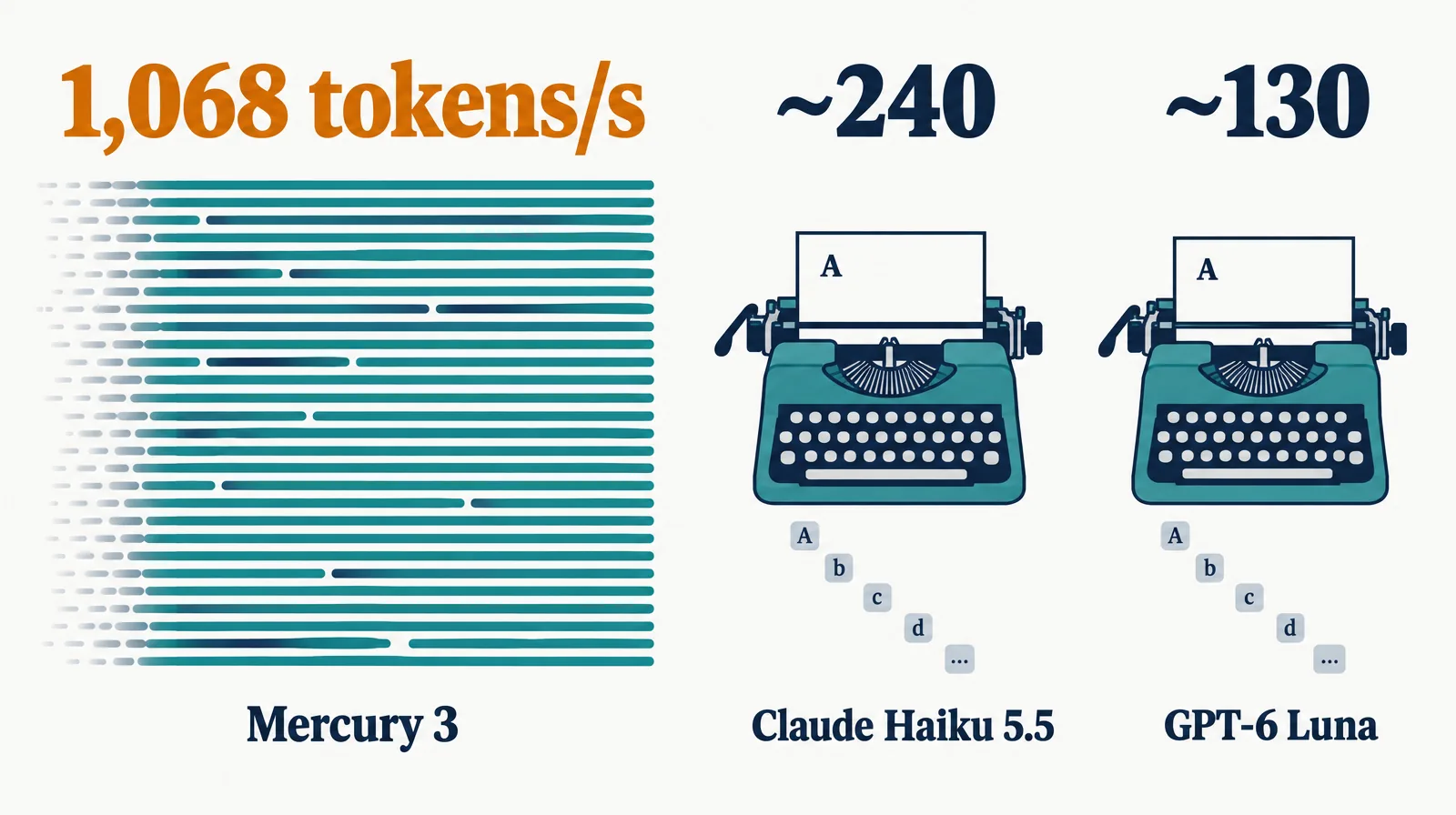
Inception released Mercury 3 on October 19, 2026, and its pitch is one number: 1,068 tokens per second. Mercury 3 is a diffusion language model. Instead of writing an answer one token after another, it refines the whole answer in parallel over a few passes, which is why Inception can put it at 4 to 8 times the speed of GPT-6 Luna and Claude Haiku 5.5 in its own benchmark table.
The bigger claim is about scale. “Mercury 3 demonstrates that text diffusion scales.” Inception says the model is more than 40x larger than Mercury 1 and that “The scaling laws that drove progress in autoregressive models hold for diffusion too.” It ships with a 1M-token context and a 50% launch discount, on the Inception API, OpenRouter, Baseten and Vercel.
On this page · 6 sectionsOpen
 Inception released Mercury 3 on October 19, 2026, a diffusion LLM that refines a whole answer in parallel instead of writing it one token at a time. Inception says it is more than 40x larger than Mercury 1.
 Inception measures it at 1,068 tokens per second on NVIDIA GPUs, against about 240 for Claude Haiku 5.5 and about 130 for GPT-6 Luna in its own table.
 Launch price is $0.10 input and $0.35 output per million tokens, 50% off. The list price is $0.20 and $0.70, which puts output above both rivals’ $0.50.
 On Inception’s 12 capability rows, Mercury 3 leads 8. GPT-6 Luna leads AA-Omniscience and AA-LCR; Claude Haiku 5.5 leads MRCR v2 and DeepSWE.
 Every benchmark number is Inception’s own run, in medium settings for all three models. It is available on Inception’s API, OpenRouter, Baseten and Vercel, with a 1M-token context.
§ 01Speed and price against its class

| Mercury 3 | GPT-6 Luna | Claude Haiku 5.5 | |
|---|---|---|---|
| Output speed (tokens/s, Inception’s measure) | 1,068 | ~130 | ~240 |
| Input, $ per 1M tokens | $0.10 launch ($0.20 list) | $0.10 | $0.10 |
| Output, $ per 1M tokens | $0.35 launch ($0.70 list) | $0.50 | $0.50 |
| Context | 1M | not in Inception’s table | 1M |
The price comparison depends on the date. At the launch discount, Mercury 3 matches both rivals on input and undercuts them on output. Inception lists the full price as $0.20 input and $0.70 output, and at that price output costs more than Claude Haiku 5.5 and GPT-6 Luna, both $0.50 per million output tokens on their own pricing pages. Inception does not say when the discount ends. One more wrinkle on long inputs: Anthropic charges $0.50 input and $2.50 output for Haiku 5.5 prompts over 100,000 tokens.
§ 02The benchmark table, row by row
| Benchmark | Mercury 3 | GPT-6 Luna | Claude Haiku 5.5 | Leader |
|---|---|---|---|---|
| GDPval (Elo) | 1,237.2 | 1,204.0 | 1,225.0 | Mercury 3 |
| t3-bench Banking | 30.24 | 23.00 | 13.06 | Mercury 3 |
| MultiChallenge | 60.35 | 51.49 | 52.48 | Mercury 3 |
| AA-Omniscience-Public (accuracy) | 46.44 | 46.94 | 37.22 | GPT-6 Luna |
| IFBench | 76.84 | 61.82 | 54.65 | Mercury 3 |
| GPQA Diamond | 89.23 | 86.36 | 84.51 | Mercury 3 |
| AA-LCR v1.1 | 77.67 | 78.30 | 74.70 | GPT-6 Luna |
| MRCR v2 | 75.50 | 62.72 | 78.40 | Claude Haiku 5.5 |
| SWE-Bench Atlas | 51.08 | 33.33 | 32.26 | Mercury 3 |
| DeepSWE v1 | 46.31 | 37.76 | 51.62 | Claude Haiku 5.5 |
| BrowseComp+ | 55.18 | 50.50 | 45.78 | Mercury 3 |
| DeepSearchQA | 71.33 | 60.00 | 65.22 | Mercury 3 |
Mercury 3 leads 8 of the 12 rows. The widest gaps are in instruction following (IFBench, 15 points over Luna) and agentic coding on SWE-Bench Atlas (about 18 points over both). The losses are informative too: Haiku 5.5 keeps the lead on DeepSWE, the longer coding test, and on MRCR v2, a long-context retrieval test, while Luna edges it on both AA measures. Speed did not cost Mercury 3 the general-knowledge rows; it did not win every hard one.
§ 03What early users report
Inception quotes four early-access partners. TinyFish ran it on 50 live Mind2Web web-navigation tasks: “Mercury 3 completed 50% of them, significantly more than GPT-6.1-Sol.” The post gives no number for GPT-6.1 Sol. Octen, building search for smart glasses, reports a median generation time of 0.9 seconds and 2.2 seconds end to end. RevisionDojo and Lorikeet describe drop-in swaps for tutoring and customer support. These are customer statements on Inception’s page, not independent runs.
Inception also names two siblings: Mercury Voice, tuned for time to first answer token in voice agents, and Mercury Decide, a classification model it says beats Jev on JevBench and LegalBench. We have not tested either claim.
§ 04Where CellCog stands
Every CellCog agent tier runs on Claude Opus 5.5, so Mercury 3 is news for us, not a routing change. The bar it sets is the useful part: for the fast, cheap tier that sits under voice agents and browser agents, speed now comes with competitive scores rather than instead of them.
§ 05What we are watching for
- Independent speed and quality runs, starting with Artificial Analysis.
- The end date of the 50% launch discount, which decides the price comparison.
- Whether GPT-6 Luna or Claude Haiku 5.5 respond on price or speed.
§ 06Sources
- Inception, Diffusion at Scale: Introducing Mercury 3, October 19, 2026. Read directly; benchmark table read from its image.
- OpenRouter, inception/mercury-3 listing: 1M context, $0.10 / $0.35 per million tokens, read October 20, 2026.
- Anthropic, Claude pricing, Haiku 5.5 rows, read October 20, 2026.
- OpenAI, API pricing, gpt-6-luna standard row, read October 20, 2026.
Q1What is a diffusion LLM?
A language model that starts from a rough draft of the whole answer and refines every position over a few passes, rather than predicting one token after another. Fewer sequential steps is where the speed comes from.
Q2Is Mercury 3 cheaper than Claude Haiku 5.5 and GPT-6 Luna?
At the launch discount, yes on output: $0.35 against $0.50 per million tokens, with the same $0.10 input. At the $0.70 list output price it costs more per output token than both.
Q3Where can I use Mercury 3?
On the Inception API Platform, OpenRouter (as inception/mercury-3), Baseten and Vercel. Inception says it is OpenAI API compatible and offers 100 million free tokens to try the API.
Q4How big is its context window?
1M tokens, up from 260K for Mercury 2.5, per Inception and OpenRouter’s listing.
Q5Are the benchmarks independent?
No. The table is Inception’s, with all three models in medium settings. The partner results it quotes, such as 50% on 50 live Mind2Web tasks, are early-access customer reports.
Q6Does CellCog run on Mercury 3?
No. Every CellCog agent tier runs on Claude Opus 5.5. We cover Mercury 3 as news.