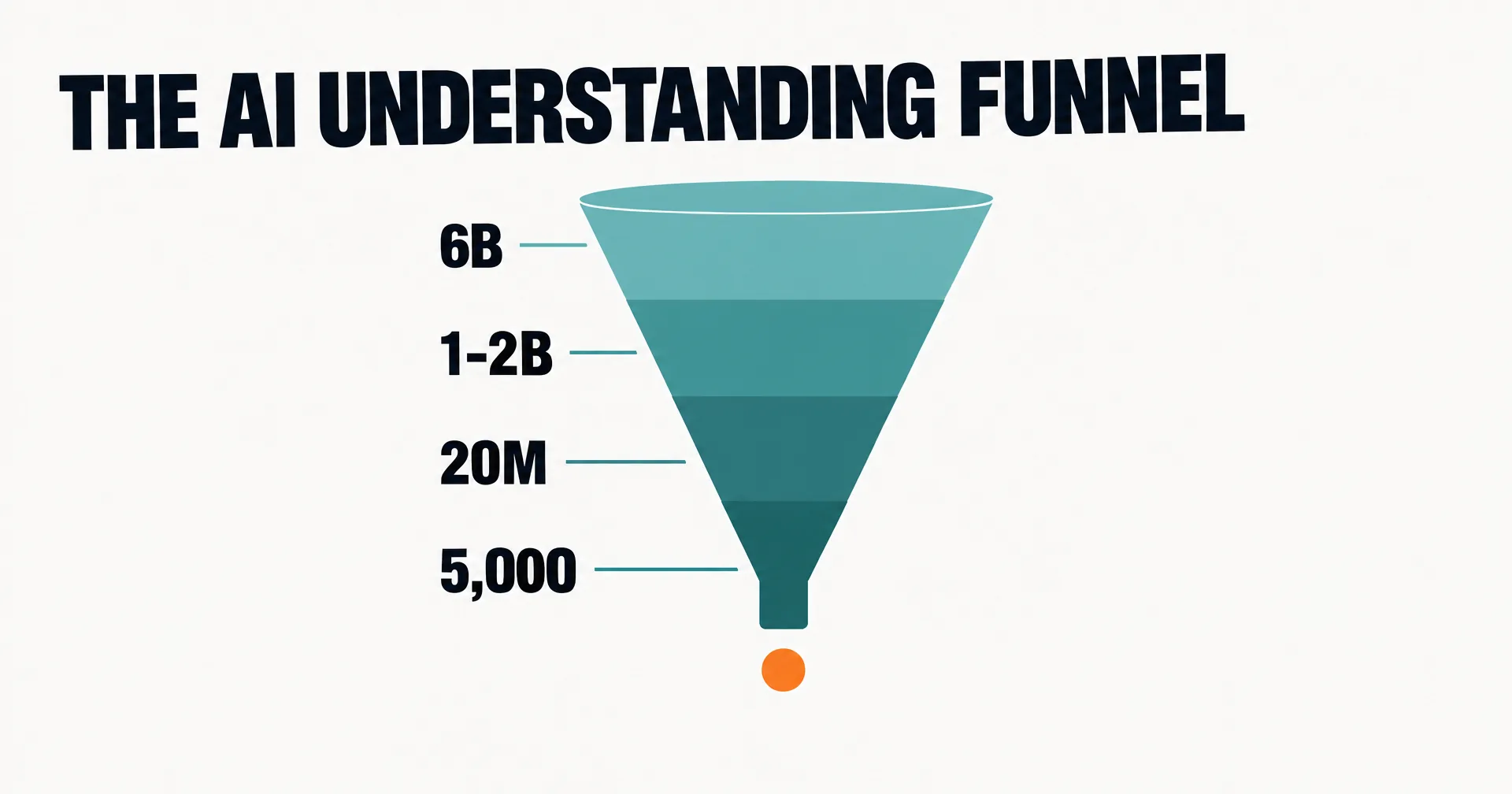
Andrej Karpathy says the gap in how people understand AI is no longer two camps talking past each other but a funnel: about 6 billion people who have barely touched a language model, 1 to 2 billion casual chatbot users, about 20 million professionals in math and code, and about 5,000 people inside the labs. He posted it on X at 19:12 UTC on October 11, 2026, re-sharing a post from April, and it had 777.1K views when we read it at 22:43 UTC. The first tier, in his words: “Napkin math somewhere around 6B people (~75% of the population) have barely come in contact with LLMs at all.”
The counts are napkin math by his own label, and the post gives no source for them. What it adds is the shape, and three reasons for it.
On this page · 10 sectionsOpen
 Andrej Karpathy posted on X at 19:12 UTC on October 11, 2026 that the gap in understanding of AI is now a sharp funnel, re-sharing an April post. It had 777.1K views at 22:43 UTC.
 His tiers: about 6 billion people barely in contact with language models, 1 to 2 billion casual free-tier users, about 20 million professionals in math and code, and about 5,000 people inside the labs.
 The casual tier treats AI like a better search or a writing aid, and he puts many professionals outside math and code there, executives included.
 The math-and-code tier sees projects that took weeks or months done by agents from a prompt; the lab tier sees swarms of agents working for weeks on large projects.
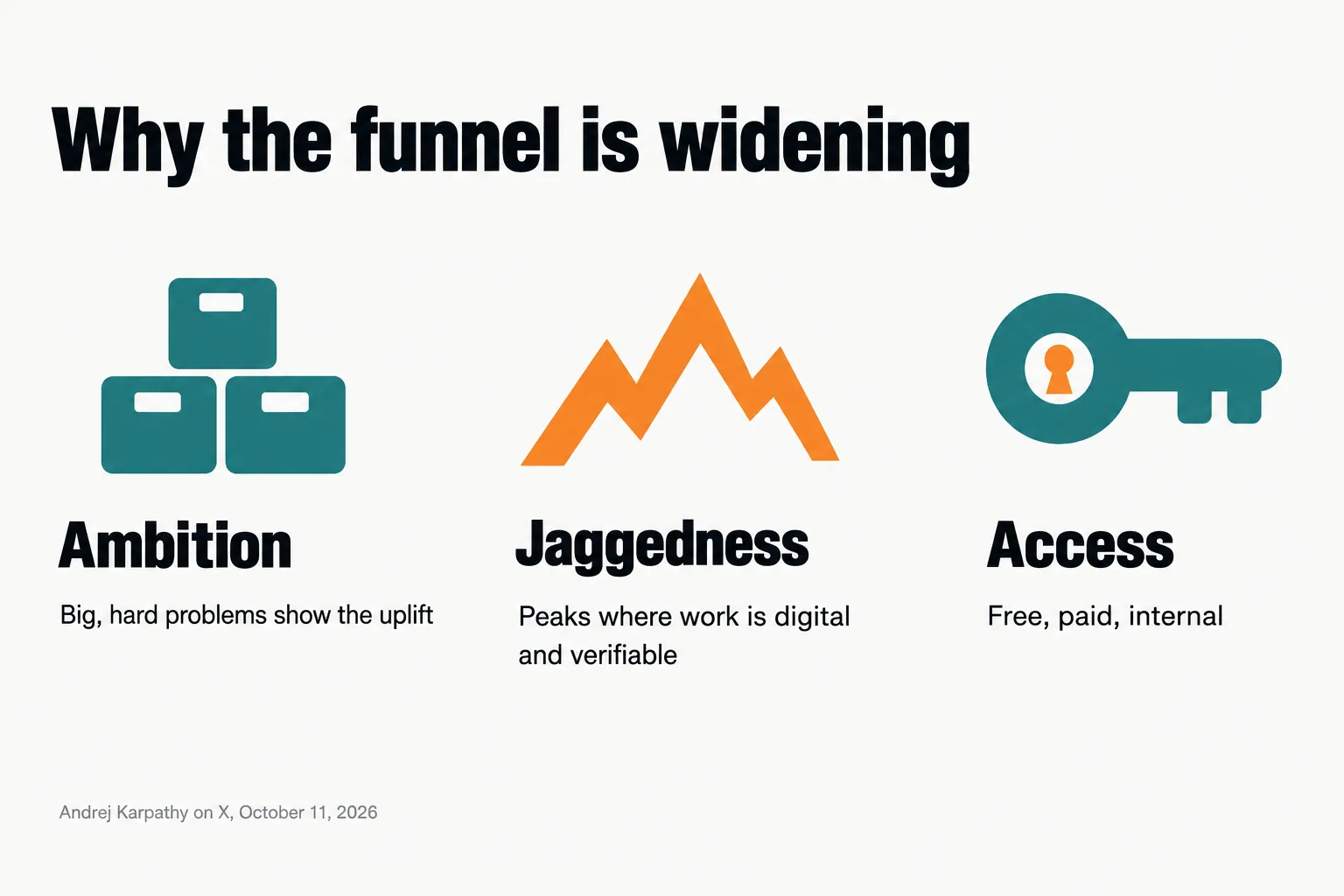
 His three reasons: impact needs big, difficult problems; capability peaks where work is digital, verifiable and valuable; and access runs free, paid, internal.
 The counts are napkin math with no source, the 5,000 are unnamed, and the post was edited after it went up. CellCog builds AI employees for roles outside code, so this funnel is our market.
§ 01The funnel, tier by tier
| Tier | People | Share of world | What they see |
|---|---|---|---|
| Barely in contact | About 6 billion | About 75% | Little or nothing |
| Casual free-tier users | 1 to 2 billion | About 20% | A chatbot used like a better search or a writing aid |
| Professionals in math and code | About 20 million | About 0.2% | Weeks or months of work done by agents from a prompt |
| Inside frontier labs | About 5,000 | About 0.00006% | Swarms of agents working for weeks on large projects |
The last two bars are too small to see at this scale, which is his point. The second tier is where most working people sit, executives included: “I have non-tech friends who (reasonably, imo) say they have not much use for it at all.” The third tier sees something else entirely, that “large, complex projects that used to take them weeks/months can now be completed by agents with a prompt”. Karpathy places himself there, writing that less than a year ago he still typed code by hand.
§ 02What changed since April
| April 9, 2026 | October 11, 2026 | |
|---|---|---|
| Framing | Two groups speaking past each other | A four-tier funnel |
| Groups | Free-tier users vs paying technical professionals | Untouched, casual, math-and-code professionals, lab insiders |
| Named products | OpenAI Codex, Claude Code, Advanced Voice Mode | None; agents and internal systems |
| Views when we read it | 5.1M (October 11, 22:22 UTC) | 777.1K (October 11, 22:43 UTC) |
In April the summary was “the people in these two groups are speaking past each other”. Six months later he adds a top tier that the public cannot see at all, and says the gap is widening rather than closing.
§ 03His three reasons for the funnel
- Ambition. Impact scales with the size and horizon of the problem: “You need a reservoir of big, difficult problems that you really care about.” A question with a one-paragraph answer barely tests the system.
- Jaggedness. “Capability peaks in domains that are digital, verifiable and economically valuable.” He ties this to reinforcement learning on verifiable rewards, which is why math and code moved first.
- Access. Free tier, paid tier, internal.
He closes on the strangeness of all three tiers existing at once: “And it is all happening at the same time.”
§ 04Testing the funnel against published numbers
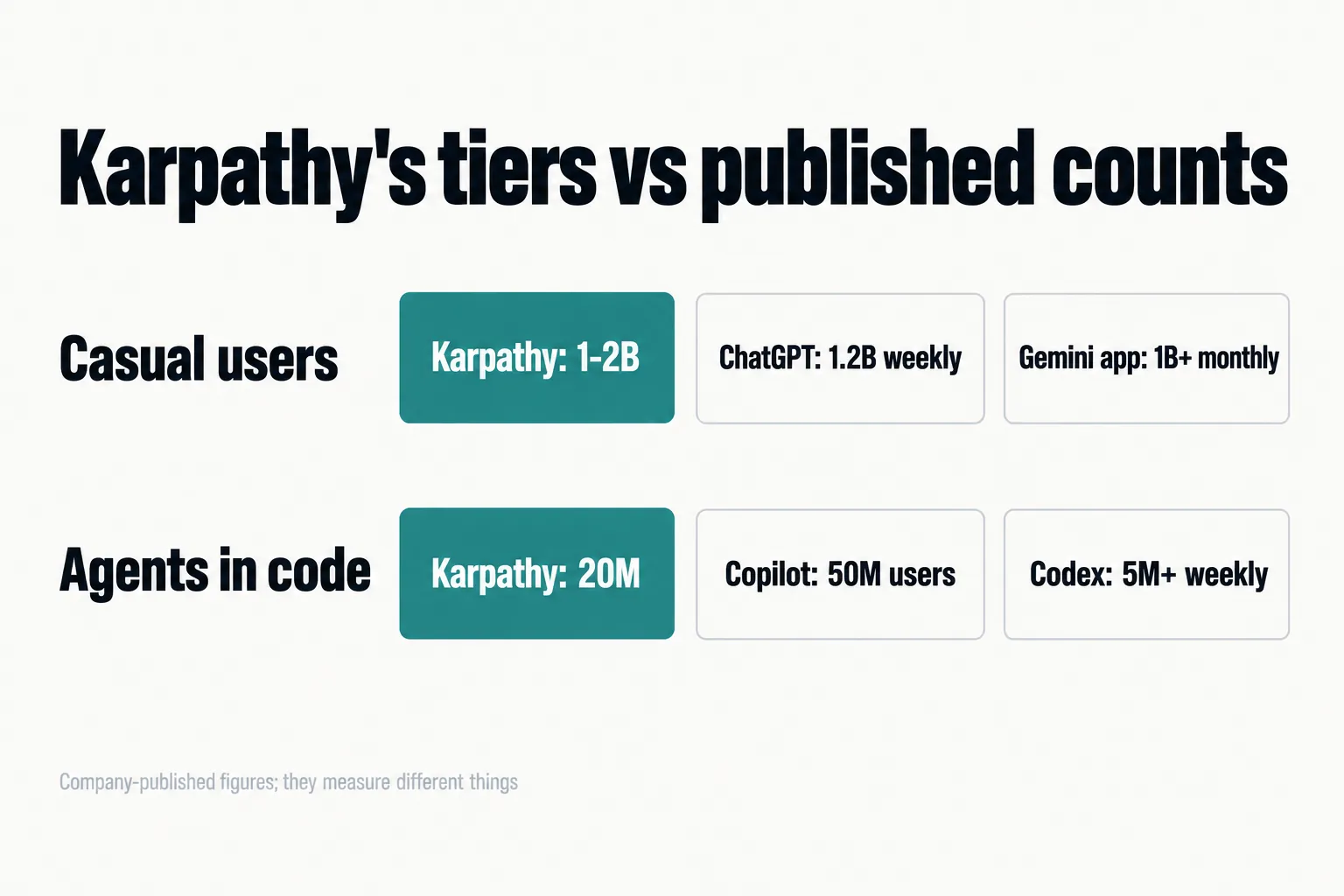
Karpathy cites no sources, but the companies behind the products in his middle tiers publish their own counts. They measure different things (weekly, monthly, all-time users), so none of them add up, and none is a survey of understanding.
| Figure | Number | Published by |
|---|---|---|
| ChatGPT weekly users | 1.2 billion, called “collective” | OpenAI, DevDay 2026 recap |
| ChatGPT weekly active users | More than 900 million | OpenAI |
| Gemini app monthly users | More than 1 billion | Google, August 11, 2026 |
| GitHub users | 225 million | Microsoft, fiscal 2026 fourth-quarter earnings |
| GitHub Copilot users | 50 million | Microsoft, same earnings call |
| Codex weekly users | More than 5 million | OpenAI |
His second tier holds up. OpenAI’s DevDay recap speaks of “our collective 1.2B weekly users”, Google says more than 1 billion people use the Gemini app every month, and the two audiences overlap, so 1 to 2 billion casual users is a fair range.
The third tier is harder to pin. Microsoft says “GitHub Copilot now has 50 million users”, more than twice his 20 million, but Copilot counts autocomplete, the tab-to-autocomplete habit Karpathy says he has left behind. The closest match to agents finishing whole projects is Codex: “More than 5 million people use Codex every week,” OpenAI writes, and more than 1 million of them use it outside software. Add Claude Code, for which Anthropic publishes no absolute count, and 20 million reads as a plausible order of magnitude, not a measured figure.
The top tier, about 5,000 people, has no published number to test against at all.
§ 05What the top tier has shown in public
Karpathy points to two public glimpses of the fourth tier, and both are already on our records. One is the OpenAI Hugging Face incident, which he says people are still reconstructing months later. The other is OpenAI’s 722 math manuscripts, three of which OpenAI withdrew on October 7 after a sign error. His line on both: “Meanwhile, human review and comprehension are starting to fall behind.”
§ 06What the post does not establish
- The counts. 6 billion, 1 to 2 billion, 20 million and 5,000 are his estimates; no survey or vendor figure is cited.
- Who the 5,000 are. He describes people “with access to frontier-grade systems internally” and names no lab.
- The final wording. X marks the post as edited after it went up.
§ 07Where CellCog sits
Our conflict, declared: we build CellCog, where businesses hire AI employees for roles outside code as well as in it, so this funnel is our market. Most of our customers start in his second tier. His first reason is the one we build around: a CellCog AI employee holds a standing role, such as marketing, support or research, so the larger, ongoing problems come with the job rather than one question at a time. Each one works on its own secure computer with its own files and browser, and every tier runs on Claude Opus 5.5. Whether that moves anyone from the second tier to the third is not something this post, or we, can show yet.
§ 08What we are watching
- Whether a lab answers the 5,000 figure, or publishes how many people use its internal systems.
- Any published usage data that tests the 20 million estimate for frontier tools in math and code.
- A follow-up from Karpathy; his April post drew one six months later.
§ 09Update log
- October 11, 2026: page opened, about 3.5 hours after the post.
§ 10Sources
- Andrej Karpathy on X, the funnel post, October 11, 2026, 19:12 UTC, read 22:43 UTC.
- OpenAI, DevDay 2026 recap, Codex announcement and Accelerating the next phase of AI, read October 11, 2026.
- Google, one billion Gemini app users, August 11, 2026.
- Microsoft, fiscal 2026 fourth-quarter earnings, read October 11, 2026.
- Andrej Karpathy on X, the April post, April 9, 2026, read October 11.
Q1What did Andrej Karpathy post on October 11, 2026?
A re-share of his April post on the AI understanding gap, now framed as a funnel of four tiers: about 6 billion people barely in contact with language models, 1 to 2 billion casual users, about 20 million professionals in math and code, and about 5,000 people with internal access at the labs.
Q2Where do the funnel numbers come from?
They are his own napkin math. The post cites no survey, vendor figure or study for any of the four counts.
Q3Who are the 5,000 people at the top?
People with access to frontier-grade systems internally, he writes. He names no lab and gives no basis for the figure.
Q4Why does he say math and code moved first?
Because capability peaks in domains that are digital, verifiable and economically valuable, which he ties to reinforcement learning on verifiable rewards.
Q5What does the funnel mean for businesses outside code?
Most sit in his second tier. His first reason says the uplift needs a reservoir of big, ongoing problems; a CellCog AI employee holds a standing role so those problems come with the job. We build CellCog, so read that answer as ours.