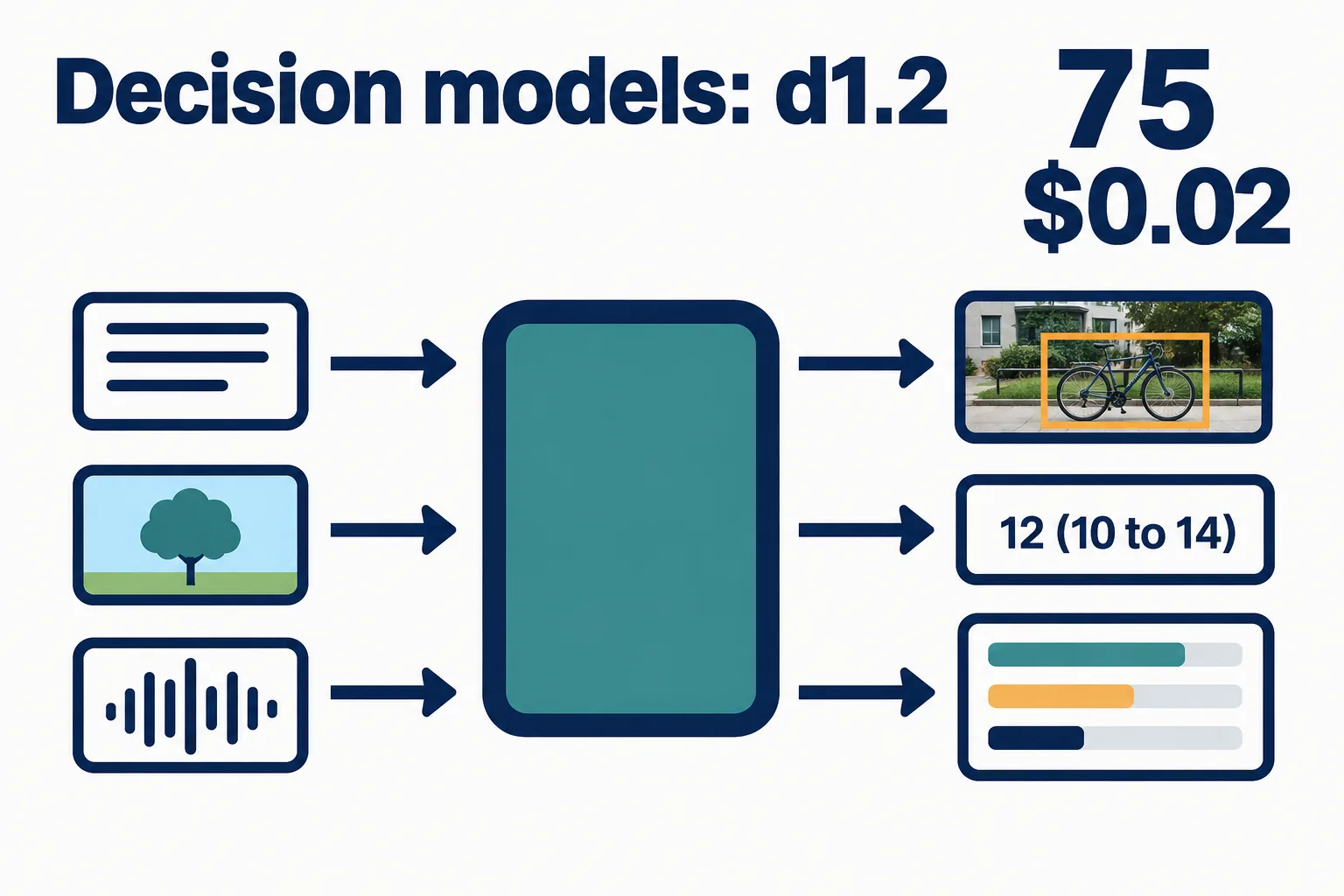
Liquid AI released d1.2 and d1.2-ultra on November 16, 2026. Both are decision models: you ask typed questions about an input and get back values with probabilities, not text. Both now take text, images and audio, add five answer types, and keep their old prices of $0.02 and $0.042 per million input tokens. Liquid AI’s launch post on X passed 8.3 million views within five hours. We read Liquid AI’s announcement and Artificial Analysis’s post on the scores.
On this page · 6 sectionsOpen
 Liquid AI released d1.2 and d1.2-ultra on November 16, 2026. They are decision models: they answer typed questions with values and probabilities, not prose.
 d1.2-ultra scores 75 on the Artificial Analysis Decision Index v2.1, first among decision models; d1.2 scores 69.
 Both bill input tokens only: $0.02 per million for d1.2 and $0.042 for d1.2-ultra, the same prices as the versions they replace.
 Five new answer types: read a value, find every passage of a kind, put boxes on a picture, estimate a number with a range, and pick every option that applies.
 Both now take audio. The thing you ask about can be a recording, and so can the question itself.
 Liquid AI reports a calibration error of 0.8 points for d1.2-ultra, against 2.7 for Jev 1.14 and 7.2 for GPT-6 Luna, on its own test of 22,505 questions.
§ 01The scores and the prices
Artificial Analysis runs the Decision Index, six benchmarks that score both the answer and the probability a model gives it. Per its post, d1.2-ultra scores 75, up 4 from d1-ultra, and d1.2 scores 69, up 3 from d1.1. d1.2-ultra also leads Artificial Analysis’s private AA-Paperclip benchmark at 76, 3 points ahead of Drex Max v1.1.
| Model | Decision Index v2.1 | Price per 1M input tokens | Cost per 1M index tasks |
|---|---|---|---|
| d1.2-ultra | 75 | $0.042 | $133 |
| d1.2 | 69 | $0.02 | $63 |
| d1-ultra (previous) | 71 | $0.042 | not stated |
| d1.1 (previous) | 66 | $0.02 | not stated |
For the price context: Jev and Microsoft-Decision-1 sit at $0.042, the same as d1.2-ultra, and Gemini Decision 1 at $0.10 per million input tokens.

§ 02Calibration, by Liquid AI’s own test
A decision model’s probabilities only help if they are honest. In Liquid AI’s words, “When it says 80%, it should be right about 80% of the time, which lets you set a threshold.” It reports calibration error, the gap between stated probability and how often the model is right, across 13 benchmarks and 22,505 questions answered by all five models.
| Model | Calibration error |
|---|---|
| d1.2-ultra | 0.8 |
| d1.2 | 1.2 |
| Jev 1.14 | 2.7 |
| Perplexity Decider v1.3 | 3.7 |
| GPT-6 Luna (Decisions API) | 7.2 |
These are Liquid AI’s numbers on a test it chose. No outside group has published a comparison on the same questions yet.
§ 03Five new answer types, and audio
- Read a value (text, number or date), with the characters it read it from, or “not found” when the input does not show it.
- Find every passage of a kind, such as each piece of personal data in a note, with its position.
- Locate things in a picture: one box, or a box for every instance plus the count.
- Estimate a number with a range, such as 12, between 10 and 14.
- Pick every option that applies, each with its own probability.
Both models also take audio, either as the thing being asked about (which language is spoken, whether a siren is in the background) or as the question itself. On Liquid AI’s internal test sets, built from held-out splits of public datasets, d1.2-ultra reads receipt values correctly 98% of the time and finds personal data at 94% precision and 93% recall; both models answer 95% to 97% of sound and language questions.
§ 04Availability and what is not known
The models are on the Liquid API today, called as d1.2 and d1.2-ultra; Liquid AI says OpenRouter and Vercel are coming. Images bill at the text rate, 1.5 tokens per 32x32-pixel patch. Liquid AI wrote that “we will open the weights at some point”, with no date.
Not known yet: any outside measurement of calibration on the same questions, speed figures, rate limits, and whether the new answer types score the same in languages other than English.
§ 05Our conflict, declared
CellCog uses TypeSafe’s Jev, one of the models in Liquid AI’s calibration table, in its own product. We have no relationship with Liquid AI.
§ 06Sources
- Liquid AI, d1.2: State-of-the-Art Omnimodal Decision Models, November 16, 2026
- Liquid AI announcement thread on X
- Artificial Analysis on d1.2-ultra and d1.2, X
- Artificial Analysis Decision Index
Q1What is a decision model?
A model that answers structured questions with a value and a probability instead of writing text. You set a threshold on the probability and route uncertain cases to a person.
Q2Where can I use d1.2?
On the Liquid API with a key from Liquid’s console, as d1.2 or d1.2-ultra. Liquid AI says OpenRouter and Vercel are coming soon.
Q3Are the d1.2 weights open?
Not yet. Liquid AI wrote on X that “we will open the weights at some point”, with no date.
Q4How are images billed?
At the text rate, 1.5 tokens per 32x32-pixel patch, so a 1024x1024 image costs 1,536 tokens, per Liquid AI’s post.
Q5Who measured the calibration numbers?
Liquid AI, on 13 benchmarks and 22,505 questions answered by all five models. The Decision Index score comes from Artificial Analysis.