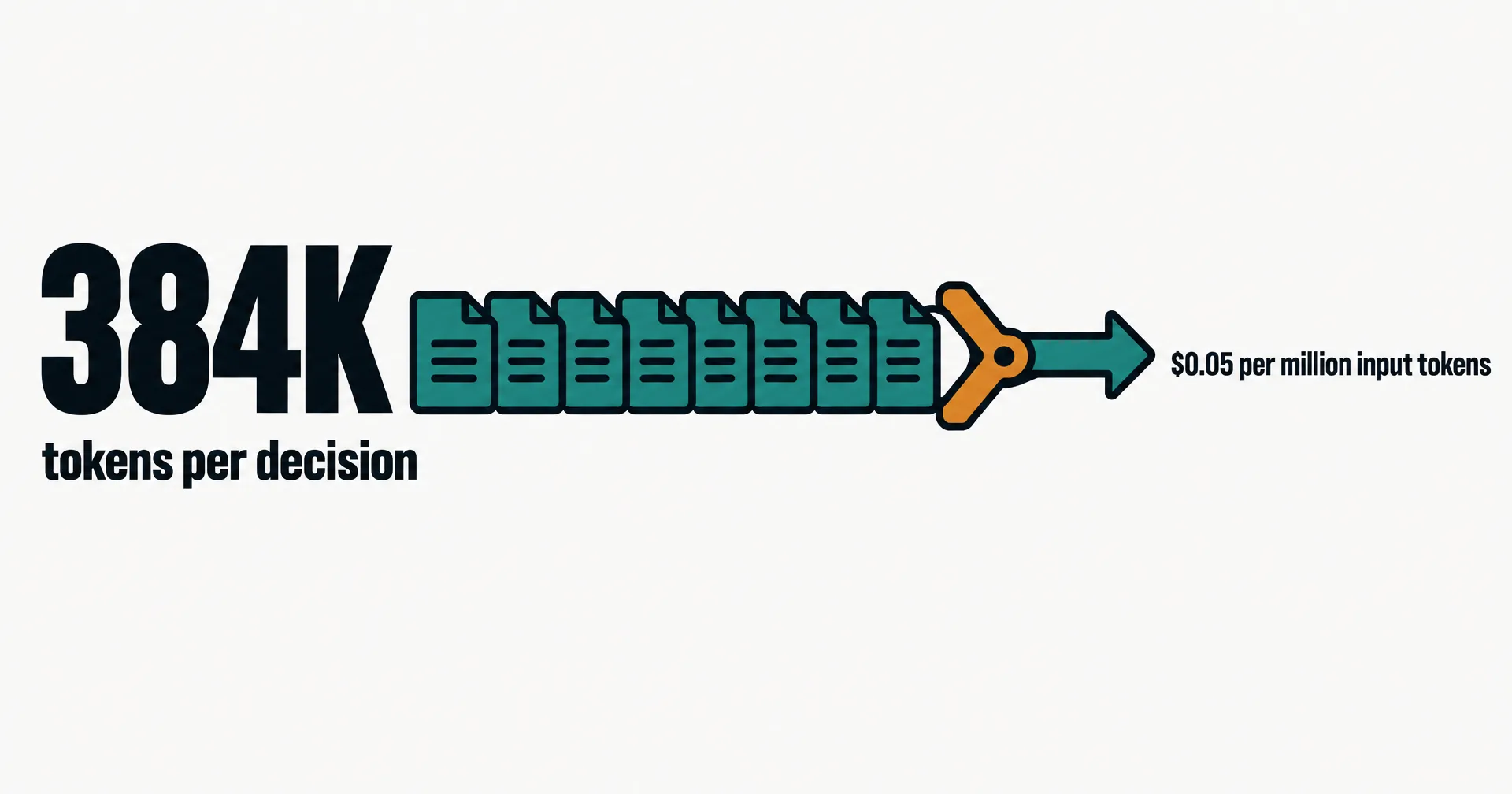
Subquadratic released SubQ Snap on October 12, 2026: a decision model that reads up to 384K tokens of text and images and returns a probability for each allowed answer, priced at $0.05 per million input tokens with output free. It is the sixth hosted decision model to ship in about three weeks, after Jev, Perplexity’s model and Cloudflare’s Clef, OpenAI’s Decisions API and Microsoft-Decision-1. Its pitch is context length, not price.
On this page · 7 sectionsOpen
 Subquadratic released SubQ Snap on October 12, 2026: a decision model that scores a fixed set of answers instead of writing text, for routing, tool picking and checks inside agent workflows.
 It reads up to 384K tokens of text and images in one call; the next-largest hosted decision models we track take 64K (Jev) or 32,768 (Microsoft-Decision-1).
 The price is $0.05 per million input tokens with output free, about 19% above Jev’s $0.042, plus 100M free tokens for the first 10,000 users.
 Subquadratic says requests up to 100K tokens come back in under a second.
 Against Jev, the only rival it benchmarks, Snap scores 61.7 to 57.9 on Decision Index 0.2.1 and 74.0 to 48.0 on its long-document test.
 Every number is Subquadratic’s own, the long-context tests are its own adaptations, and it does not compare against Microsoft, Perplexity or Cloudflare models.
§ 01What SubQ Snap is
A decision model answers bounded questions inside an agent loop: which file is relevant, which tool to call next, whether a test passed, whether to escalate. You send context, a question and the allowed answers; it returns a probability per answer instead of generating text. Subquadratic names four jobs for Snap: routing, tool picking, checking and stopping.
The difference is how much it reads. Subquadratic’s framing of the field: “today’s decision models stay at 32K tokens and decide without most of what they need to see.” Snap is built on Subquadratic Sparse Attention, the same architecture as its SubQ language models, which it says cuts attention cost from quadratic to linear in context length. In Subquadratic’s words, Snap “processes requests up to 100K tokens in under a second.”
- Context: up to 384K tokens, text and images in the same call.
- Price: $0.05 per million input tokens; output is free. The first 10,000 users get 100M free tokens (worth $5 at list price).
- Access: public preview through the Decisions API as
subq-snap-preview. “SubQ Snap is available in Public Preview on a first come, first served basis while capacity is limited.” - Waitlist: “Once capacity is reached, new users may be added to a waitlist.”
§ 02The numbers Subquadratic published
Every comparison in the launch post is against one model, TypeSafe’s Jev.
| Benchmark | What it tests | SubQ Snap | Jev |
|---|---|---|---|
| Decision Index 0.2.1 | 37 short decision tasks, all under ~34K tokens | 61.7 | 57.9 |
| Nimble Suite 13 | 13 public decision datasets, accuracy | 82.9% | 76.0% |
| Enterprise subset (16 Decision Index tasks) | Routing, security, legal, finance, code, tools | 67.5 | 61.6 |
| Decision LCR (72K to 115K tokens) | Reasoning across real multi-document sets | 74.0 | 48.0 (chunked) |
| Decision RULER at 32K | Finding facts hidden in long filler | 99.8 | 94.1 |
The biggest gaps in the enterprise subset are phishing detection (47.1 to 25.1), predicting code output (73.8 to 57.1) and RAG hallucination checks (64.8 to 51.3). Snap trails Jev on three of the 16: When2Call, which tests whether to call a tool, ask, answer or decline (67.0 to 74.6), API-Bank next-call prediction (86.4 to 88.0) and aspect-level review analysis (26.7 to 27.3). The When2Call loss is worth noting for agent builders, since deciding whether to act is one of the four jobs Snap is sold for.
§ 03Price and context against the rest of the field
| Model | Maker | Price per million input tokens | Context per request |
|---|---|---|---|
| Clef-flash | Cloudflare | $0.038 | Not checked |
| Decisions API | Perplexity | $0.04 | Under 262,144 tokens |
| Microsoft-Decision-1 | Microsoft | $0.042 | 32,768 tokens (OpenRouter listing) |
| Jev | TypeSafe | $0.042 | 64K tokens (32K for state) |
| SubQ Snap | Subquadratic | $0.05 | 384K tokens, text and images |
| Decisions API (gpt-6-luna) | OpenAI | $0.10 | Not checked |
| Clef | Cloudflare | $0.24 | 65,536 tokens |
Snap sits in the middle on price, about 19% above Jev and Microsoft. At $0.05 per million, a decision over the full 384K tokens costs about 1.9 cents and a 100K-token decision half a cent, which is what Subquadratic means by “cents per decision.” The trade it is selling: pay a little more per token, and stop chunking or summarizing the context before the model sees it.
§ 04What is not verified
- Every number is Subquadratic’s. No outside leaderboard has run Snap yet, and the Business Wire release repeats the launch post.
- One rival. Microsoft-Decision-1, Perplexity’s model and Cloudflare’s Clef all published their own scores before October 12; Snap’s post compares only against Jev.
- Its own long-context tests. Decision RULER and Decision LCR are Subquadratic’s multiple-choice adaptations of RULER and Artificial Analysis’s AA-LCR. The post says the LCR results cannot be compared with published AA-LCR scores, and the RULER scores run to 1M tokens, past the 384K the product accepts.
- “Stay at 32K” is a framing. Jev’s docs give 64K per request (32K for the state plus the longest question), and Perplexity’s request limit is under 262,144 tokens. Snap’s 384K is still the largest we have seen; the gap is smaller than the line suggests.
- Speed. “Under a second” for 100K tokens is Subquadratic’s measurement, with no hardware or percentile stated.
§ 05Where decision models fit for an AI employee
Our conflict, declared: every CellCog tier runs Claude Opus 5.5, we have not tested SubQ Snap, and we build AI employees that compete with agents some of these models are meant to steer.
An AI employee makes dozens of small calls a day before it does any real work: is this email for me, which file matters, did that step succeed, should I ask first. A decision model that can read the whole thread, the whole repo or the whole contract before answering is aimed at exactly those calls. The open question is the one Snap’s own table raises: on When2Call, the test closest to deciding whether to act at all, it lost to Jev.
§ 06What we are watching
- Independent runs. The first outside Decision Index or JevBench result that includes Snap.
- A head-to-head. Snap against Microsoft-Decision-1 and Perplexity’s model on the same tasks.
- General availability. When the waitlist lifts, and whether $0.05 holds after preview.
§ 07Sources
- Subquadratic, Introducing SubQ Snap: A Long-Context Decision Model for Enterprise Agents, October 12, 2026, read 19:05 UTC.
- Subquadratic, SubQ Snap product and pricing page, read 19:05 UTC October 12.
- Subquadratic, API quickstart, read 19:07 UTC October 12.
- TypeSafe, Jev models documentation, for Jev’s context limits.
- Cloudflare, Clef faster, cheaper, multimodal, October 9, 2026, for Clef-flash pricing.
- OpenAI, Decisions API guide, for gpt-6-luna pricing.
Q1Is SubQ Snap available now?
Yes, in public preview on a first come, first served basis. Subquadratic says new users may be put on a waitlist once capacity is reached.
Q2How do I call it?
Through Subquadratic’s Decisions API with the model name subq-snap-preview: you send a state, the questions and their allowed answers, and get a probability per answer.
Q3Is it cheaper than Jev?
No. Snap is $0.05 per million input tokens against Jev’s $0.042. Its pitch is context length and accuracy, not price.
Q4Has anyone tested it independently?
Not yet. Every benchmark in the launch post was run by Subquadratic, and the long-context tests are its own multiple-choice versions of RULER and AA-LCR.
Q5What does a full 384K-token decision cost?
About 1.9 cents at $0.05 per million input tokens, since output is free. A 100K-token decision is half a cent.
Q6Does CellCog use SubQ Snap?
No. Every CellCog tier runs on Claude Opus 5.5, and we have not tested SubQ Snap.