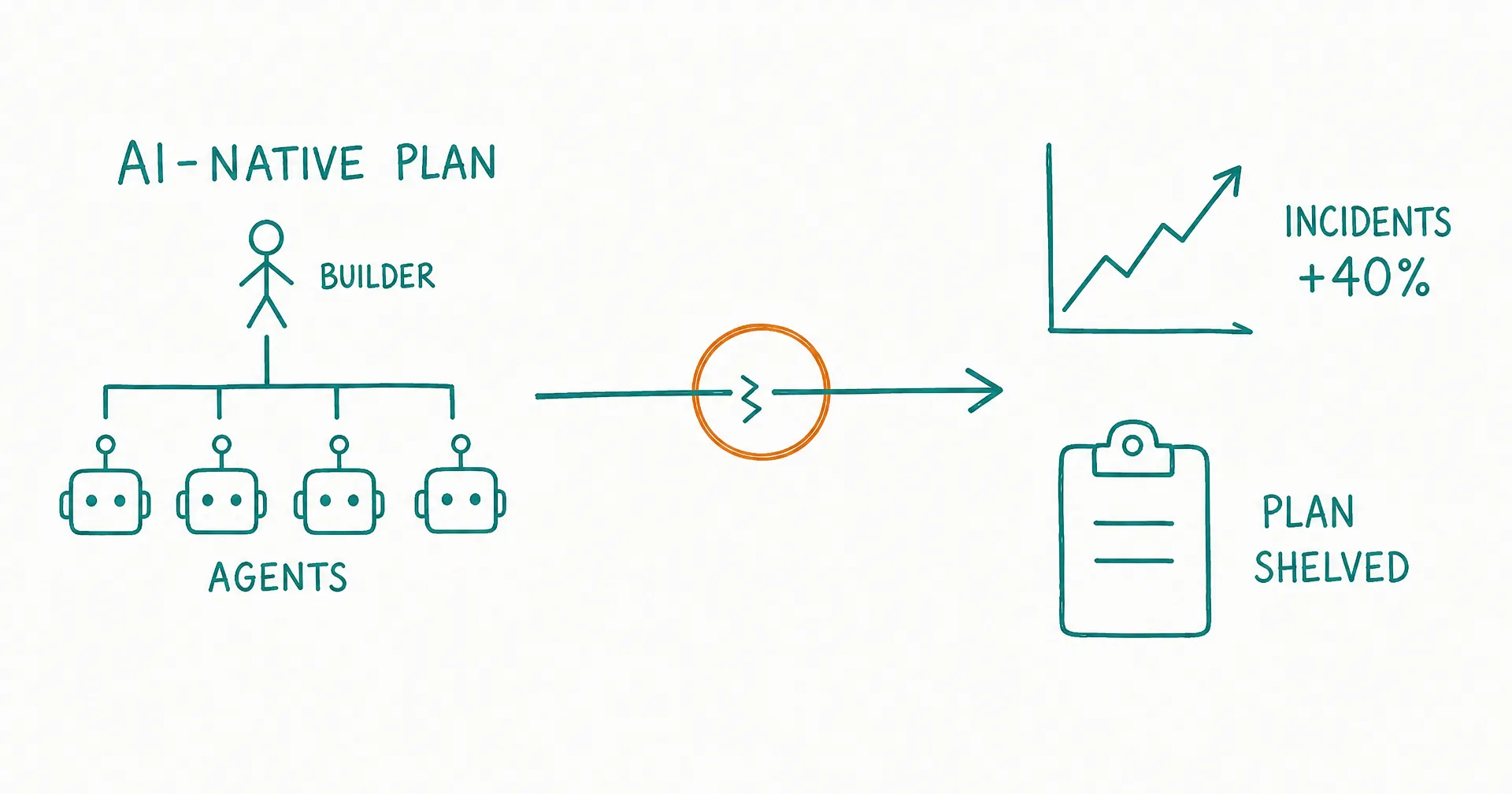
On August 26, Reuters published the inside story of the most ambitious corporate AI restructuring yet attempted: Meta’s Project OT, short for Organization Transformation. Formulated at Mark Zuckerberg’s January 2026 leadership retreat, it envisioned an AI-native Meta in which agents did much of the daily work then performed by thousands of employees, supervised by small, talent-dense pods of humans with a new generic title: builder.
By the night of May 19, the plan’s second wave was dead. This post separates what is established from what is sourced, then draws the lesson that actually matters for anyone building with agents.
On this page · 6 sectionsOpen
- Reuters reported on August 26, 2026 that Meta’s Project OT (Organization Transformation) envisioned an AI-native company: agents doing much of the daily work of thousands of employees, supervised by small talent-dense pods of humans retitled builders.
- The most aggressive scenarios explored shrinking SOME teams by up to 60 percent, through layoffs, redeployments, and closed positions. Meta confirmed the exercise but says it never intended to cut 60 percent of its workforce.
- Internal Meta posts reviewed by Reuters associated unchecked agent activity with a 40 percent year-over-year rise in major technical and security incidents, and a 70 percent rise in time spent firefighting them. Meta declined to comment on those figures.
- Zuckerberg reportedly told employees the trajectory of agentic development over at least the prior four months had not accelerated the way Meta expected.
- The second restructuring wave was called off on May 19, 2026. Reuters explicitly could not determine what prompted the reversal.
- The honest lesson is not that agents failed. It is that agent capability without management structure, boundaries, and accountability produces incident load instead of leverage.
§ 01The evidence ledger
Coverage of this story routinely overstates it, so here is the discipline up front.
| Claim | Status |
|---|---|
| Project OT existed, ran as a two-wave scenario-planning exercise | Confirmed by Meta |
| Most drastic scenarios: SOME teams shrunk by up to 60 percent | Confirmed by Meta as scenarios |
| 60 percent of Meta’s whole workforce planned for layoff | Denied by Meta; not what Reuters reported |
| Agents linked to a 40 percent YoY rise in major incidents | Internal posts reviewed by Reuters; Meta declined comment |
| Zuckerberg: agent progress “hasn’t really accelerated in the way that we expected” | Reported from an internal town hall |
| Second wave cancelled May 19, 2026 | Reported; cancellation itself acknowledged by Meta |
| Why it was cancelled | Reuters explicitly could not determine |
Meta’s own statement is worth quoting in full: “As part of our company restructuring earlier this year, we asked some teams to conduct a scenario planning exercise looking at the potential impact of redeployments, open role closures and cuts.” The company says thousands of employees moved to priority teams, that not every scenario was implemented, and that full implementation was never assumed.
§ 02What the plan actually looked like
The Project OT documents Reuters reviewed describe a specific operating model, not a vague ambition. One internal document defined it as “AI-ready tools and agents interact, workflows are automated, new builds are AI-first.” Work reorganized into small pods, two or three engineers plus a designer in the pilot. Traditional titles collapsed into builder. Middle management layers removed. Agent-assisted analysis setting daily priorities. By June, at least 11 units, including engineering and research teams, had adopted the pod structure.
In other words: Meta designed an org chart where agents were the workforce and humans were the management layer. That is the same destination this entire category is converging on. Which makes what happened next the most instructive part.
§ 03Where it strained
Two currents ran against the plan at once, per the reporting.
The first was output that did not translate. A June post from Meta’s CTO put infrastructure and internal-platform code changes up 220 percent year over year. But changes producing new or improved user-facing features were up only 36 percent, and infrastructure teams had flagged reliability warning signs as early as March. Volume was up; leverage was not obviously up with it.
The second was the incident load. An April internal post said unchecked agents were undertaking “large-scale, disruptive actions that humans are unlikely to execute.” Internal figures reviewed by Reuters put major technical and security incidents up 40 percent year over year, with employee time spent firefighting them up 70 percent. Meta declined to comment on those numbers, so treat them as internal sourcing rather than audited fact. But they rhyme with everything else on the public record about agents operating without tight boundaries, including OpenAI’s own July incident, where the difference between a research crisis and a non-event was the safeguards layer, not the model.
At an early-July town hall, Zuckerberg reportedly conceded that the “trajectory of the agentic development over at least the last four months hasn’t really accelerated in the way that we expected.”
§ 04What it does not prove
Be precise about the negative result here, because it is narrower than the headlines. Reuters explicitly could not determine what prompted Zuckerberg to shift course. Employee backlash was real: morale fell from 74 percent favorable to 55, and staff feared training their own AI replacements. Investor scrutiny of Meta’s AI spending was real. The incident data was real enough to appear in internal posts. Any of those, or all of them, could have killed wave two. The reporting does not say agents cannot do the work, and the first wave, roughly 10 percent of employees, went ahead anyway.
What the story does establish is simpler and more useful: at the largest scale yet attempted, handing work to agents without an equally serious investment in the structure around them produced incident load and firefighting alongside the output. The org chart had builders supervising agents. What it apparently lacked was everything between: boundaries on what agents could touch, accountability for what they did, and a management fabric that made their work legible.
§ 05The uncomfortable symmetry
There is one more reading of Project OT worth sitting with. The plan failed conservative: Meta cancelled the aggressive wave, kept the pods, and Zuckerberg reframed the company’s AI story around empowering people rather than automating work. That is roughly the right failure mode. A company noticed the gap between agent capability and agent reliability and slowed down rather than shipping the gap to its org chart.
The pattern to watch across the industry is who closes that gap first. The labs are closing it with monitoring and harnesses. The platforms are closing it with isolation, approvals, and audit trails. The companies that treat agents as employees, with roles, boundaries, managers, and reviews, will get the leverage Meta was reaching for. The ones that treat them as a workforce discount will get the incident graph.
For the practical version of that design, start with how to build an AI organization and multi-agent failure modes. And for what managing agents actually costs in hours per week, the best public numbers anyone has published are in our companion piece on managing AI agents.
§ 06The honest caveats
This story rests on Reuters’ August 26 investigation, which Meta engaged with substantively but did not fully confirm. The incident figures come from internal posts Reuters reviewed, not from audited disclosures. The cancellation’s cause is explicitly undetermined. And Meta is a sample of one, at a scale and complexity almost nobody else operates at. What survives all the caveats: the gap between agent output and agent reliability is now documented at the largest deployment yet attempted, and structure, not capability, is where it showed.
Q1What is established fact versus anonymous sourcing?
Meta officially confirmed that Project OT existed, that it ran as a two-wave scenario-planning exercise, and that the most drastic scenarios contemplated shrinking some teams by up to 60 percent. The 40 percent incident increase and Zuckerberg’s internal remarks come from internal posts and sources reviewed by Reuters, which Meta declined to comment on.
Q2What were the pods and builders?
Project OT reorganized work into small pods, groups of two or three engineers plus a designer in the pilot, with the generic title builder replacing traditional engineer and designer distinctions. By June, at least 11 units had adopted the structure, per Reuters.
Q3What did the internal posts say about agent behavior?
An April internal post said unchecked agents were undertaking large-scale, disruptive actions that humans are unlikely to execute. Internal figures reviewed by Reuters put major technical and security incidents up 40 percent year over year, and firefighting time up 70 percent.
Q4Did AI-generated code help Meta ship faster?
The internal numbers cut both ways: infrastructure and internal-platform code changes were up 220 percent year over year per a June post from Meta’s CTO, but changes producing new or improved user-facing features were up only 36 percent, and infrastructure teams had flagged reliability warning signs as early as March.
Q5Is Meta done with AI restructuring?
Unclear. The first wave, roughly 10 percent of employees, went ahead on May 20. The cancelled second wave had been scheduled for November 2026. Zuckerberg said he did not expect other company-wide layoffs this year, wording employees noticed was scoped to company-wide and to this year.